↓
 
  • Home
  • About the Author
  • Series
    • Carman Barnes: Five-Minute Movie Star
    • Crazy and Crazier
    • Films of Henry Hathaway
    • History of Cinerama: “Cinerama-Rama!”
    • Luck of the Irish: Darby O’Gill and the Little People
    • Marcel Delgado
    • Minority Opinion: The Magnificent Ambersons
    • Movie Souvenir Playing Cards
    • Shirley Temple Revisited: “Bright Eyes, 1928-2014”
    • The Bard of Burbank
    • The Fog of Lost London
    • The Museum That Never Was
    • William Wyler
  • Links and Resources
  • Jim’s Fiction
    • Glamour Boys
    • Items from the Scrapbook of Cosmo Brown
    • Sensible Christmas Wish, The
  • Contact

Jim Lane's Cinedrome

Classic Hollywood

Category Archives: Blog Entries

Post navigation

← Older posts
Newer posts →

Tony Curtis 1925-2010

Jim Lane's Cinedrome Posted on October 2, 2010 by Jim LaneJuly 16, 2016

When the news broke that Tony Curtis had died, suddenly everybody was talking about Some Like It Hot or Sweet Smell of Success. For my part, I got out my old laserdisc of Taras Bulba. I must have seen that movie three or four times within two weeks in 1962, at Sacramento’s old Esquire Theatre, but I hadn’t set eyes on it in decades, not even when I bought the laserdisc as a sentimental sop to my adolescence. It holds up rather better than I expected: a cast-of-thousands epic that didn’t skimp at a time when you really did have to hire thousands of extras, a pretty-good movie with one great sequence (the gathering of the Zaporoshti Cossacks, galloping across the Ukrainian steppes) and, as Leslie Halliwell aptly put it, “plenty of spectacular highlights.”

I suppose my resorting to Taras Bulba betrays a certain nostalgia for the big clunky pleasures of early-’60s Panavision — plus, of course, it hasn’t been that long since I saw Some Like It Hot or Sweet Smell of Success, or some of the other pictures that people point to when they reflect that the former Bernard Schwartz Could Really Act: The Defiant Ones, Spartacus, The Boston Strangler. Nevertheless, it seems to me that Taras Bulba, in its way, serves as an apt summary of Tony Curtis’s entire 130-picture run, from City Across the River to David and Fatima: a pretty-good career with plenty of spectacular highlights.

Students who come to Tony Curtis via film-class screenings of Some Like It Hot have a different perspective from those of us who were going to movies when Curtis was really hot. For them, his career dribbles down from Some Like It Hot; for us, it built up to it — or to The Defiant Ones (his sole Oscar nomination) or Sweet Smell (for that hardy handful who saw it at the time). My intro to Tony was George Pal’s colorfully ersatz biopic Houdini, a staple of Saturday kiddie matinees in my town during the ’50s; I must have seen it five times. Son of Ali Baba was another. I can’t say I ever heard him utter the immortal “Yondah lies the castle of my faddah” (did he really say that? Where? The Prince Who Was a Thief? The Black Shield of Falworth?), but that’s pretty much the Tony Curtis I first met.

It’s the Tony Curtis of this publicity still, which was printed in a short chapter near the end of Richard Griffth and Arthur Mayer’s 1956 coffee table tome The Movies. It was part of a two-page spread headed “Teen Faves,” featuring pictures of Curtis, Tab Hunter and Guy Madison and wondering which, if any, would turn out to be more than a flash in the pan.

For Curtis’s fans from those early days, this is the Tony we remember — athletic, exuberant, rambunctious. If we want to remind ourselves of what a good actor he could be, we’re as likely to think of The Great Impostor (as real-life poser Ferdinand Demara) or The Outsider (as the tragic Ira Hayes, participant-by-chance in the famous Iwo Jima flag-raising) as we are Sweet Smell of Success. And at comedy, we may say he never got the credit he deserved for Some Like It Hot, but we’re as likely to remember him for Operation Petticoat. That was the quintessential Tony: slick, even a bit shady, Bronx-street-hustler charming, fast-talking with that Noo Yawk honk, and immensely pleased with himself and what he could get away with. Which, by all accounts (including his own), is pretty much what Bernard Schwartz was like in real life.
.

Posted in Blog Entries

Films of Henry Hathaway: The Shepherd of the Hills

Jim Lane's Cinedrome Posted on September 29, 2010 by Jim LaneSeptember 2, 2016
 
In 1941 Paramount and Henry Hathaway followed up their success with The Trail of the Lonesome Pine with another Technicolor version of a bestselling rural romance. This one was taken from a novel by Harold Bell Wright, a writer who was, if anything, even more popular in his day than Lonesome Pine author John Fox Jr. I say “in his day,” but actually it was pretty much the same day; Fox’s most productive years were 1895-1910, Wright’s 1902-16 (although he continued to write and publish almost up to his death in 1944).
 
 Certainly, even as late as 1941 the name of Harold Bell Wright was one to conjure with; in this magazine ad for the picture, Wright’s name appears above the title, not once but twice. Even so, the credit “Harold Bell Wright’s The Shepherd of the Hills” has a sharp edge of irony — in point of fact, Grover Jones and Stuart Anthony’s screenplay has little to do with Wright’s novel (even less than Lonesome Pine had with Fox’s) beyond the title and some character names. (And by the way, here’s full disclosure: One of the names, in novel and movie, is Jim Lane, father of the movie’s heroine Samantha “Sammy” Lane; he’s played by Tom Fadden.) This departure from the text is enough to make Hathaway’s movie an outcast among Wright’s latter-day fans (and yes, he still has them), but in the movie’s defense it can be said that Wright’s plot is a pretty melodramatic can of worms, though it had been filmed fairly closely in 1928, and earlier in 1919 (that version, now lost, was presumably the most faithful of all, having been produced by Wright himself). Harold Bell Wright was still around in 1941, when the Hathaway picture was released, but what he thought of it — or for that matter, whether he even saw it — is not recorded. By that time, he might simply have washed his hands of Hollywood altogether — and thereby hangs a tale.


Harold Bell Wright was a 35-year-old minister in the Disciples of Christ Church in Redlands, Calif. when he resigned his ministry in 1907 after the success of The Shepherd of the Hills, his second novel. Thereafter, he devoted himself full-time to writing as a way of spreading the Gospel (of decency, of hard work, of caring for the downtrodden) by other means.


You can get the whole story at Gerry Chudleigh’s comprehensive Harold Bell Wright Web site, including this page specifically dedicated to movies from Wright’s stories and novels. The Reader’s Digest version, as brief as I can make it, is that Wright, dissatisfied with a 1916 picture based on his Eyes of the World, decided to film his books himself. To that end he formed the Harold Bell Wright Story-Picture Corporation with his publisher, Elsbery Reynolds. The company made only one picture, The Shepherd of the Hills in 1919, adapted and directed by Wright himself. Perhaps the picture was not well-received, perhaps the company was torn asunder by the falling-out between Wright and Reynolds when the writer decided to sign with a different publisher. Whatever the cause, by 1922 the two men were on the outs and the Harold Bell Wright Story-Picture Corporation was no more.

This is where Sol Lesser enters the picture. Lesser is remembered as a low-to-middle-budget independent producer who turned out such pictures as Our Town, Stage Door Canteen, and a long spate of Tarzan movies in the 1930s, ’40s and ’50s. In 1922, however, he was an eager young go-getter, an exhibitor looking to get into production after making a killing on a quickie exploitation flick about the passing of San Francisco’s Barbary Coast. He approached Wright for the movie rights to his books, but Wright’s first nine books were co-owned by Reynolds, and the two weren’t speaking; if Lesser would deal with Reynolds, Wright said, then they could talk. Lesser bought out Reynolds’s full interest for $174,500, then made a straight trade with Wright: publication rights, including Reynolds’s original printing plates, in return for the movie rights to all nine books.
 
Wright saw in time that he’d made a bit of a fool’s bargain. His books were hugely popular, but their very popularity had saturated the market; there simply wasn’t that much to be made from republishing them. The real money was in putting them on the screen, and he had traded that chance to Lesser. After the coming of sound, Wright tried to get the rights back — or at least get more money for them — with the creative argument that he had given Lesser only the rights to make silent movies, not talkies. Nice try, Harold, but that one didn’t hold up, and Lesser’s rights to the works “regardless of technical changes or additions in the film medium” were confirmed. And those rights were extensive; they were universal and in perpetuity, and they included the right to make any changes whatsoever in the story, title, or characters of a given work “to such an extent as the purchaser [Lesser] may deem expedient.” In effect, Lesser could make pretty much any picture he wanted and call it “Harold Bell Wright’s This and Such.” That’s what he did, for example, with Wright’s cowboy morality tale When a Man’s a Man, turning it into a rather paltry little B-western in 1935.
 

So Wright may well (and I wouldn’t blame him) have sighed and rolled his eyes at what was happening to his books in Hollywood, being powerless to alter it. Then again, his curiosity may have drawn him to check out what Paramount did in 1941 with his most popular novel; if so, perhaps he took comfort that, unlike that cheapskate Lesser, at least Paramount brought Technicolor, an “A” budget, and top-shelf talent to the table — beginning with Henry Hathaway and scenarist Grover Jones.

Hathaway and Jones had collaborated successfully before, having first worked together on 1929’s The Virginian, where Hathaway served as assistant to Victor Fleming. When Hathaway himself became a director, Jones worked with him on the scripts of The Lives of a Bengal Lancer, The Trail of the Lonesome Pine and Souls at Sea. Shepherd of the Hills would be their last picture together; on September 24, 1940, while Shepherd was in post-production, Grover Jones died of complications following surgery. He was 46.

The script for Shepherd is credited to Jones and Stuart Anthony, in that order. I don’t know how much the two collaborated; maybe they didn’t. Anthony may have been the writer brought in to add some connective scenes after Hathaway left the picture (more about that later). In any case, the script jettisons all the melodramatic curlicues of Harold Bell Wright’s plot and leaves only a few basics, expanding and elaborating on those.

The setting is a remote mountain valley (Wright was living in the Ozarks of southern Missouri when he began the book) where the sparse populace ekes out a hardscrabble life based on subsistence farming, small-scale sheep ranching, and running moonshine past impotent federal authorities. Everyone cowers under a pall of superstitious misery centered on an empty homestead called Moaning Meadow, where walks (so they say) the ghost of a woman whose man left her to die of a broken heart. Feeding off this festering unhappiness like a spider is the dead woman’s sister Mollie Matthews (Beulah Bondi); she has raised her nephew, Young Matt (John Wayne), on a diet of hate, telling him every day that the curse on all their heads can be lifted only when he finds and kills the unkown man who brought it on: his father. Matt is a gentle, tormented soul who doesn’t relish the thought of killing, but he sees no way out; not even his growing feelings for pretty Sammy Lane (Betty Field), who plainly adores him, can be allowed to sway him from the task Aunt Mollie has set for him.

Into all this walks kindly old Daniel Howitt (Harry Carey), a man of some (though mysterious) means with a hankering to settle down there. He befriends Sammy Lane and her father Jim, staying with them until he persuades the Matthewses to sell him Moaning Meadow. His effect on the whole valley is nearly miraculous: he heals the sick (treating Jim Lane’s wounds when he is shot by a federal agent), raises the dead (saving a little girl who nearly chokes to death while her grieving parents look helplessly on), and makes the blind to see again (sending an old woman to the city for an operation to restore her eyesight). As Howitt tends his flocks on Moaning Meadow, folks roundabout come to regard him, both literally and figuratively, as a good shepherd.

It isn’t long before Sammy figures out what has long since dawned on us: Daniel Howitt is Young Matt’s long-lost father, the man Matt has sworn to kill. What happens from there constitutes the last act of The Shepherd of the Hills.

Whether the credit goes to Grover Jones or Stuart Anthony (my own money’s on Jones), the script for Shepherd has passages that rise to a kind of mountain poetry, like something by James Whitcomb Riley or an Ozark Robert Burns. We hear it in the everyday speech, when a mother tells the village storekeeper about her sick daughter: “I put a dried tater chip and two crawdad legs in her bed. But she’s still got that seldom feelin’, complainin’ from head to heel.” And at more important moments, such as when Sammy first tells Mr. Howitt about Moaning Meadow: “That’s where the ha’nt comes from. Frogs as quiet as graverocks, and the lake comin’ from nowhere, and the trees don’t rustle, and the flowers grow big but they don’t have pretty smells.” Then, when Howitt disregards her advice and buys the meadow: “On account o’ ye disobeyin’ me ye bought a unhappy land. Moanin’ Meadow! Won’t nobody come an’ pay ye company there, nor warm by your fire with ye … Them that goes in there has daylight dreams they allus disremembers! An’ there’s pizen plants an’ pokeberries, an’ nightshades dancin’ with the bats!” The dialogue paints us a picture of an isolated people without schooling in the rules of grammar, but who have learned to make their language measure the deepest reaches of their simple hearts.

Casting Harry Carey and John Wayne as father and son was an inspiration, and it resonated for audiences in 1941 as much as it does for us today, if for a slightly different reason. Wayne was still sweeping along on the momentum of his A-picture breakthrough in Stagecoach after nearly a decade in Poverty Row horse operas. It’s a bit of a myth that John Ford and Stagecoach made a star out of an “unknown” John Wayne. He was already a star, albeit in the kind of movies that didn’t play Radio City or the Roxy, or win Oscars or make the New York Times 10-best list. But after Stagecoach Wayne was batting in a whole different league. He reported to the set of Shepherd directly after wrapping Seven Sinners with Marlene Dietrich over at Universal. The Duke Wayne of Santa Fe Stampede or King of the Pecos couldn’t have shot his way into a Dietrich picture; that’s what Stagecoach did for John Wayne. And in 1941 the Wayne persona was still malleable; studios were still experimenting with what kind of vehicles best suited this tall, handsome, earnest young man. The persona wouldn’t really become rigidly set until 1948, with Red River, when writer Borden Chase handed Wayne the script and said, “Here’s a part you can play for the next twenty years.” (Which Wayne pretty much did.) 

In 1941, naturally, audiences couldn’t be sure where John Wayne was going, but they all knew where Harry Carey had been. Born in the Bronx in 1878, Carey was a self-made westerner and by 1917, as “Cheyenne Harry,” he was a western star on a par with William S. Hart. By the late ’30s he had made well over 200 pictures and graduated to Respected Elder Character Actor, snagging an Oscar nomination in 1939’s Mr. Smith Goes to Washington. Even without knowing what the future had in store for Wayne, audiences could see that he and Carey were two of a kind, and Shepherd of the Hills — especially in a scene at a fishing hole where Young Matt finds a tentative rapport with the man he doesn’t yet know is the father he’s sworn to kill — has an unmistakeable passing-the-torch aura to it.
 
 
But the real revelation of The Shepherd of the Hills, its fervently beating heart, is the performance of Betty Field as Sammy Lane. Some writers have asserted that Henry Hathaway was strictly a man’s director, but they don’t know what they’re talking about. A simple look at what he drew from the normally decorative Dorothy Lamour in Spawn of the North and Johnny Apollo, from the ice queen Ann Harding in Peter Ibbetson, from Debbie Reynolds in How the West Was Won, or from Marilyn Monroe in Niagara (probably her best dramatic performance) is enough to put the lie to that. 
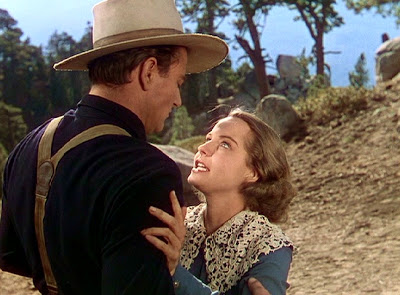
Frame18-Wayne-FieldThe best of the lot just may be Betty Field in Shepherd. Her Sammy is feisty and independent, uneducated and superstitious — muttering half-heard incantations, drawing symbols and spitting in the dirt before venturing into Moaning Meadow — but no fool. She knows her own world inside out, and when her moonshiner father stumbles home with a revenuer’s bullet in his side, she calmly goes about her business, slicing bacon and singing as if nothing had happened, until the suspicious lawmen have gone their way. When she meets Daniel Howitt, she’s wary at first, but she soon sees the good in the man and vouches for him to others; when he seeks to cash a check for the unheard-of sum of a hundred dollars, the storekeeper blanches, but says, “Sammy’s say-so is all right with me. I’ll look around.” Sammy senses the tender heart of Young Matt, too, and struggles to reach it, battering in futile frustration at the crust of hatred so carefully planted and tended by the malicious Aunt Mollie.
Hollywood never really knew what to do with this quirky, unique actress. She wasn’t really star material, never conventionally glamourous, and she didn’t always photograph well. Even when she did, she tended to be merely “attractive” in her youth, “handsome” in middle age. But you couldn’t ignore her on screen; whatever she had, she brought it to roles as different as the slatternly Mae in Of Mice and Men (1939), poisonous bad-news Kay in Blues in the Night (’41), and the tormented Cassie Tower in Kings Row (’42).
 
In Shepherd of the Hills she gave probably the best performance of her career, and for once she photographed like gangbusters. Her delicate, heart-shaped face, blue-water eyes and fair complexion never looked better than they did for the Technicolor cameras in the crisp mountain sunshine of Shepherd‘s Big Bear locations. (What a pity that this was her only Technicolor movie in her prime; she didn’t face Tech cameras again until 1955’s Picnic, when she was well out of her thirties and playing the kind of matronly roles that would occupy the rest of her life.) For perhaps the one and only time in her career, Betty Field is truly beautiful. Still not movie-star glamourous, no competition for Ava Gardner or Maureen O’Hara, but beautiful — in a way that perfectly suits the earthy, simple and pure-hearted character of Sammy Lane. The Shepherd of the Hills is Betty Field’s picture — lock, stock and barrel — and Netflix browsers who pop it into their queues expecting a “John Wayne movie” are going to be in for a very big surprise. I hope for their sakes that they’re open to it.
 
In a 1973 oral history interview with Polly Platt, Henry Hathaway told a frustrating tale of studio politics regarding Shepherd of the Hills. His first cut ran 120 minutes and was previewed in San Bernardino. The response, he said, was excellent: no walkouts, and nobody thought the picture was too long. At a second preview, with about ten minutes cut, a few people walked out and about five percent of the audience thought it was too long. A third preview confirmed the trend: the more they cut, the more people thought the movie was too long. Paramount refused to restore any of the cut scenes and just kept cutting; eventually they decided that new scenes needed to be shot to connect what was left. Hathaway said no, just put back some of what I’ve already shot. Instead, Paramount’s Y. Frank Freeman brought in another writer (Stuart Anthony?) and director Stuart Heisler to film the new scenes. Hathaway left the studio to work for Darryl Zanuck at 20th Century Fox; he didn’t return to Paramount until The Sons of Katie Elder in 1965.
 
Stuart Heisler was a textbook example of the reliable studio hack, and I think I can spot some of the scenes he directed after Freeman took Shepherd out of Hathaway’s hands. One is this studio-bound scene between Sammy and Young Matt, talking about things which I strongly suspect Hathaway showed us in some of those missing 22 minutes. Another is the picture’s hasty and too-pat final scene, where the writing has a let’s-wrap-things-up hurry to it, with little of Grover Jones’s ear for the artless poetry of rural speech — and the staging shows little of Hathaway’s instinct for where to put the camera.
 
But it’s no use crying now over 22 minutes of milk spilt 69 years ago. As it is, at 98 minutes, The Shepherd of the Hills gives us Harry Carey toward the end of his career and John Wayne and Betty Field near the beginning of theirs, all of them — and Henry Hathaway and Grover Jones, too — at their best.
Posted in Blog Entries, Henry Hathaway

C.B. Gets His Due

Jim Lane's Cinedrome Posted on September 26, 2010 by Jim LaneFebruary 24, 2021


Here’s another book review, but with a difference. While the subject of my last post, Florenz Ziegfeld, was only peripheral to the Hollywood story, this one is right smack dab in the middle of it. The book is Empire of Dreams: The Epic Life of Cecil B. DeMille by Scott Eyman.

I’m still reading Empire of Dreams, but I know gold when I find it. Besides, when you’re digging in the Scott Eyman mine, your odds of hitting paydirt are always good. Scott wrote The Speed of Sound, one of two indispensible books on the transition to talkies (the other is Richard Barrios’s A Song in the Dark). He also wrote Lion of Hollywood: The Life and Legend of Louis B. Mayer; Mayer was often (and often justly) detested in his time, but Eyman gives us a warts-and-all portrait to counter the warts-only bogeyman of legend, humanizing Mayer and giving the devil his due. And speaking of legends, there’s Print the Legend: The Life and Times of John Ford; Eyman himself “prints the legend” along with the truth, and shows how the one derived from the other. Add biographies of Mary Pickford and Ernst Lubitsch among his other books, and Scott Eyman has covered some of the most revered and reviled figures in movie history.

Cecil B. DeMille, in his day and since, was both. Personally, I’ve gone from one extreme to the other on DeMille, then most of the way back again. My uncle took me to The Greatest Show on Earth when I was four; God knows it’s no work of art, but it set the image of the circus for me forever; no real circus has ever lived up to it. Then there was The Ten Commandments (1956); for me, as for anyone else who first saw it at the age of nine or ten — I say this without fear of contradiction — DeMille’s movie was the Book of Exodus brought to life once and for all. Yes, the pillar of fire that holds back the Egyptian chariots and later carves the Commandments at Mt. Sinai is only ink-and-paint animation — any child could see that even in 1957. But it didn’t matter. Charlton Heston was Moses, Yul Brynner was Rameses II, and that sure as hell was the parting of the Red Sea. (And giving DeMille credit, he wasn’t any happier with that pillar of cartoon fire than I or my friends were. But money and time grew tight during post-production and he had to cut some corners. Then, once the movie was released, that was that as far as he was concerned; the age of a Steven Spielberg or a George Lucas tacking expensive afterthoughts onto a hit movie was still years in the future.)

The zenith (or nadir) of my contempt for DeMille’s brand of moviemaking was about 1971, in my college know-it-all, tear-down-the-titans phase. I remember writing that year that Ken Russell’s movies were no better than Cecil B. DeMille’s. “No better,” indeed; in fact, Russell’s movies — all of them — were a good sight worse. I like to think (now) that I knew it even then, but I was certainly too hip to say so. Then, fifteen years ago (more or less), I had mellowed toward the old boy; when The Ten Commandments played a revival date at a local theater, I wrote, “Cecil B. DeMille may have been a sanctimonious old humbug, but he sure knew how to put on a show.”

Well, I was getting warm — in more ways than one. In fact, as Scott Eyman proves beyond arguing, Cecil B. DeMille had a career absolutely unique in movies — or any other form of show business, for that matter. He was the first superstar movie director after D.W. Griffith, and he was still riding high thirty years later, as Griffith was fading away in boozy neglect at the Hollywood Knickerbocker Hotel. Thanks to his nine-year stint as host of The Lux Radio Theatre, DeMille was a nationwide household name at a time when few Americans knew or cared who directed the movies they saw every week.

When C.B. came to Hollywood in 1913, it was a sleepy wide spot in the rural road several miles from Los Angeles, surrounded by sagebrush, rattlesnakes, wolves, deer and jackrabbits. By the time he shuffled off his mortal coil in 1959, the town was home to Ciro’s, the Brown Derby, the Hollywood Bowl and Grauman’s Chinese Theatre — not to mention the very idea of “Hollywood” itself, which DeMille and his fellow pioneers had such a hand in creating.

They say one of the components of an epic story is that it portrays great changes in the land. By that measure, Eyman’s subtitle, The Epic Life of Cecil B. DeMille, is more than just a play on the kind of picture most associated with DeMille. It is an epic story, and DeMille’s was an epic life. Larger-than-life characters — that’s another ingredient of the epic, and DeMille was that, too: grandiloquent and intimidating to many, but he attracted a stock company of actors and a core of designers and technicians who stayed with him for decades, some for the rest of their lives, others for the rest of his.

DeMille came to movies as a struggling actor-playwright firmly grounded in the theater of the 19th century; his father’s partner, and Cecil’s own role model, was David Belasco. Cecil embraced the cutting-edge technology of early movies with eager arms, just as he would in time embrace talkies, Technicolor, the wide screen and stereophonic sound. But he never lost that Belasco worldview. One of the most interesting insights in Eyman’s book comes, oddly enough, from the costume designer Adrian, who worked two years for DeMille before settling into his throne at MGM: “He believed in his world … a world of antiquity from which he rarely emerged.” As Eyman himself puts it, “DeMille would remain his father’s son, a nineteenth-century man of the theater — his greatest strength, as well as his greatest limitation.”

Scott Eyman has a historian’s thoroughness, and for Empire of Dreams he had access to Cecil B. DeMille’s archives, which run to some 2,000 boxes now housed at Brigham Young University in Provo, Utah. Equally important, he has a critic’s perception and perspective. That combination makes all his books worth reading, and this one especially, because DeMille and his career really were unique. Eyman sheds light on all the facets of DeMille’s work: the innovative artist of the early silents, the monumental presence of the talkies, and — always — the showman. I’m loving it.
.

Posted in Blog Entries

Flo Chart

Jim Lane's Cinedrome Posted on September 18, 2010 by Jim LaneJuly 16, 2016
 

Florenz Ziegfeld Jr., who bestrode Broadway, in life and legend, for the entire 20th century, made a few forays into the movie business — especially in the last years of his life when, after a string of expensive flops on top of huge losses in the stock market crash of 1929, he tried to diversify his activities beyond Broadway and its lurking creditors. And that’s all the excuse I need to turn this post into a plug for Ethan Mordden’s Ziegfeld: The Man Who Invented Show Business.

Would you like even more of a Hollywood connection than that? Okay, how’s this: You see that beauty with the peacock feathers who adorns the front cover of Mordden’s book? There is, ahem, a more complete view on the back, reproduced at right. Mordden identifies her as The Ziegfeld Girl Who Never Was, photographed by Ziegfeld’s house photographer, Alfred Cheyney Johnston, with his customary mix of glamour, dignity and eros, even though her audition failed to get her into the rarefied ranks of the Ziegfeld Girls. Believe it or not, that’s the young Norma Shearer. No kidding. Now look again (if you haven’t already); try to match that gracefully arching back with the Norma you remember from The Women or Marie Antoinette. When her husband Irving Thalberg was overseeing The Great Ziegfeld at MGM in 1936, do you suppose Norma’s thoughts ever wandered to this photo session fifteen years or so earlier? Did she wonder what had become of the negatives and prints?

Ethan Mordden’s books are full of surprises like that, although he doesn’t usually splash them across the front cover. And the surprises usually aren’t pictorial, either; Mordden’s books are well but not lavishly illustrated.

Someone once said of the Civil War historian Bruce Catton that he wrote about the Army of the Potomac as if he had served with it — meaning his knowledge was that intimate and comprehensive, his style that relaxed and casual. That’s how it is with Ethan Mordden and his books about Broadway: he writes about these shows as if he saw them. Of course, for any show since the original The King and I in 1952, he probably did see it. But he writes with the same intimate authority about plays and musicals that came and went long before he was born in 1949, and that’s what makes his books so much fun. He’s written a seven-volume history of the Golden Age of the Broadway Musical that’s required reading for anyone even slightly interested in the subject: Make Believe (about the 1920s), Sing for Your Supper (’30s), Beautiful Mornin’ (’40s), Coming Up Roses (’50s), Open a New Window (’60s), One More Kiss (’70s), and finally (since he dates the end of the Golden Age to the death of Gower Champion in 1980) The Happiest Corpse I’ve Ever Seen (1980-2005). Toss in books like All That Glittered: The Golden Age of Drama on Broadway, 1919-1959 and the coffee-table tome Rodgers and Hammerstein, and Ethan Mordden becomes entirely indispensible. (Movies haven’t escaped his expertise, either; also indispensible is The Hollywood Musical, published back in 1981 — his seventh book.)

After all that, the very thought of a Mordden book about Florenz Ziegfeld is delicious — and the book fully delivers the feast that the thought promises. Mordden is a scholar, certainly, but he doesn’t write in a scholarly fashion; he’s offhand, chatty — even catty — and to read his account of Ziegfeld and his first wife, the belle epoque superstar Anna Held, motoring around New York in one of her beloved, newfangled automobiles is to feel like you’re there watching them pass. And he has a flair for the delightfully pithy: “Too often [in the 1900s], romantic shows dragged in jokes like a child pulling a yakking wooden duck.” “Ruby Keeler definitely had a lovable clunky something, but her performing skills per se were on the perfunctory side.” Or on the difference between the real Billie Burke, Ziegfeld’s second wife, and the Billie we know from movies like Dinner at Eight and The Wizard of Oz: “[T]hese films disguise the Billie who fell in love with Ziegfeld … Billie of the movies is a sharp comedienne playing a prattling human doily … Billie the Charles Frohman star was someone else entirely — younger, obviously, but keen, bold, and vivacious in a red-hair-and-blue-eyes coloring.” One of the ancillary pleasures of Ziegfeld is the long clear glimpse it gives us of the lady behind Glinda.

There have been many books about Florenz Ziegfeld, beginning just months after his death in 1932, and Mordden gives them full credit in a long “Sources and Further Reading” epilogue to his book (don’t skip it thinking there’s nothing more to learn). There’s much that’s unknowable, and always was, about this intensely private, even secretive, man. Mordden’s subtitle tells us his approach: The Man Who Invented Show Business. By deep research and sharp analysis he gives us what feels like a personal insight into Ziegfeld the staid conservative revolutionary, the first producer to have four smash hits running on Broadway simultaneously, earning him the cover of Time on May 14, 1928. You had to actually do something to get the cover of Time in those days. Do something and be somebody. This book gives us a real grasp of who he was, what he did, and what drove and enabled him to do it.

While I was reading Ziegfeld, I went to the post office on business. When I set the book down on the counter, the clerk glanced at it. “Ziegfeld. Is that the guy with the Follies?” Florenz Ziegfeld Jr. — and nearly everyone who knew him — had been dead a good forty years by the time this mailman was born. But he knew who Ziegfeld was — he even knew how to pronounce the name correctly. In Ziegfeld: The Man Who Invented Show Business, Ethan Mordden tells us why.

Posted in Blog Entries

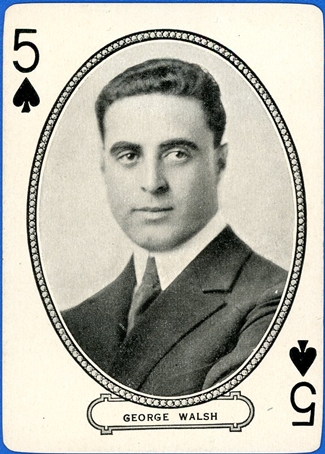
Movie Playing Cards: 5 of Spades – George Walsh

Jim Lane's Cinedrome Posted on September 11, 2010 by Jim LaneAugust 16, 2022
 
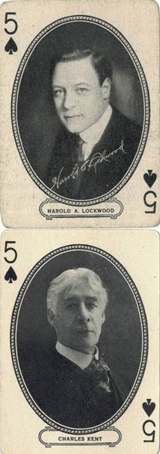
George Walsh’s chief claim to fame is the movie he didn’t make. He’s one of three actors known to have been the 5 of Spades in the Moriarty deck, and probably not the first. Of the other two, the first was probably Harold A. Lockwood. I say “probably” because Lockwood didn’t have long to join the deck, so he must have done it early; he died in the “Spanish” Flu pandemic of 1918, age 31. Before that he had appeared in 131 pictures since 1911, with three more released posthumously. In 23 of those pictures, all between 1915 and ’17, he was half of a romantic team with May Allison (5 of Diamonds in my deck, Queen of Hearts in others). The other 5 of Spades was Charles Kent, already 64 years old by the time the cards were introduced in 1916. Kent’s first known picture was in 1908 — Macbeth for Vitagraph (and he played old King Duncan in that). Unlike Lockwood, he would outlive the production of the cards, dying in 1923 at 70. My guess is that Lockwood was the first face on the 5 of Spades, Kent the second, followed by George Walsh, who didn’t make his first picture until the others had made 94 and 81, respectively.
 
This is as good a time as any to talk about those numbers of pictures I keep throwing around. Ninety-four and 81 pictures in less than ten years? Why, Dustin Hoffman and Jack Nicholson (to take two random, veteran examples) haven’t made 80 pictures apiece in their entire careers. Of course, we’re not talking about 90-to-100-minute features here, although such things weren’t unheard of even as early as 1915. By the late ‘teens, the average feature was about five reels ( 60 to 75 minutes, depending on the speed of hand-cranked projectors in those days). Before 1914, most pictures were probably two or three reels — roughly equivalent to a half-hour TV episode. That’s how Harold Lockwood and May Allison could make 23 pictures together in two years, but it’s still a pretty breakneck pace. Mutual, Vitagraph, Biograph, Edison and Famous Players-Lasky kept their actors and crews busy, grinding out material for the burgeoning number of movie houses, where a picture would seldom play more than two or three days.  
 

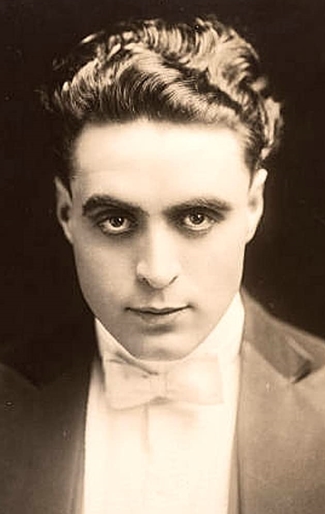
But back to our subject. Born in 1889, George Frederick Walsh followed his older brother Raoul (né Albert Edward) into pictures in the mid-1910s, having originally planned to be an attorney (he attended, however briefly, Fordham and Georgetown). He also attended New York’s High School of Commerce, where he graduated in 1911, and where he was a versatile athlete: baseball, track, cross country, swimming, rowing. This experience would stand him in good stead, at least in the Hollywood short run — certainly better than whatever he learned about commerce or pre-law.

I don’t know what drew George to pictures in the first place, but it’s easy to imagine him being lured by the stories his brother told. Raoul had backed into pictures after working as a cowboy; his horsemanship had landed him a stage job, riding a galloping horse on a treadmill for a touring company of The Clansman. From that he got the acting bug, forgetting all about cowpunching. He wound up in New York making westerns (mostly) for Pathe, then followed D.W. Griffith to California. He loved the freewheeling fun of making pictures in those days, and he surely must have painted an enticing picture for George — “With your looks and athletic ability, you’re a natural for this stuff.” Hal Erickson at AllMovie.com says that George joined Raoul at Reliance-Mutual in 1914, but according to the IMDB, George’s first picture was an indeterminate bit in The Birth of a Nation for D.W. Griffith. Or more likely a series of bits; Griffith was economical in his use of extras, and George may well have been one of those who saw himself on screen fighting on both sides of a battle. Raoul played John Wilkes Booth in Birth, but was already on his way to a director’s career (it would extend to 1964; Raoul Walsh remains a favorite director among critics and historians).

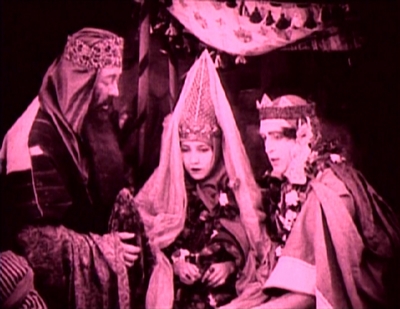
George did get his first breaks in Reliance-Mutual pictures directed by Raoul and others, moving up the cast list till he was top-billed, and first drawing the eye of Variety’s reviewer in Raoul’s Blue Blood and Red (1916): “The kid is clever…a fine, manly looking chap, full of athletic stunts…” By this time, both Raoul and George were working for William Fox, and soon George worked again for D.W. Griffith. Here he is as the Bridegroom of Cana in the Judean Story section of Intolerance, receiving the bad news that the wine supply has run out. With him are 17-year-old Bessie Love (still several years from her own stardom) as the Bride of Cana and William Brown as the father of the bride.

That same year, George married Seena Owen (née Signe Auen of Spokane, Wash.). They probably met on the set of Intolerance, where Seena played Princess Beloved in the Fall of Babylon story. The union, the only marriage for either of them, would end in divorce in 1924. (UPDATE 8/14/22: It turns out this was not in fact George Walsh’s only marriage, despite what the IMDb says. See the comment below from “Anonymous”, who married George’s eldest son Tom in 1982, but who only met George once and remembers few details. A second commenter, “Art”, who evidently knew Anonymous, provides another piece of the puzzle, and a visit to Find a Grave fills in the rest. The second Mrs. Walsh was born Winnifred Craven on July 1, 1911. She married George in 1942 when he was 53 and she was 21. Winnifred died February 2, 1966 at the age of 54; she and George are buried together in San Gabriel Cemetery, California.)
 
George Walsh’s career flourished as William Fox’s slightly younger answer to Douglas Fairbanks. By this I mean he was an “answer” to the early Fairbanks, before The Mark of Zorro, Robin Hood, The Thief of Bagdad, etc. landed him permanently in costume swashbucklers. Before Zorro, the typical Fairbanks hero was a boyish, high-spirited American naif, triumphing over adversity in effortless leaps and bounds, always with a beaming, irresistible smile. 
 
And so it was with George Walsh. His pictures from 1916 to 1920 are probably all irretrievably lost, but reviews in Variety document their pleasures, and Walsh’s appeal: The Mediator (’16), “Walsh proves himself as good a rough and tumble man as ever got into focus”; Melting Millions (’17), “his athletic ability stands him in good stead for this particular line of work”; Brave and Bold (’18), “Mr. Walsh does some athletics, jumping over everybody in his path, runs an auto or motorcycle, whichever is the handiest when needed, and climbs up the front of the Ft. Pitt hotel at Pittsburgh to keep an appointment with a French prince”; On the Jump (’18), “…the whole thing is built around Mr. Walsh, apparently with the idea of giving him opportunities to perform unusual stunts”; Luck and Pluck (’19), “Walsh is in his glory scaling walls, climbing trees, foiling cops, etc. There are a couple of corking fights where he handles anywhere from a dozen to twenty opponents at a time”; From Now On (’20), “What may be held up for approval is the hard work which George Walsh invests in it.” The image conjured up from these reviews is a series of lightweight adventures distinguished by George’s prowess; as brother Raoul, who directed From Now On, said years later, “Well, anything with him wouldn’t be too heavy.”
 
George’s career did get a little heavier as the 1920s dawned. In 1922 he played explorer Henry Morton Stanley in With Stanley in Africa; neither the film nor any reviews seem to have survived (though this French postcard image does), but it appears a more serious departure from his vehicles to date. So was Vanity Fair the next year, in which he played the dashing wastrel Rawdon Crawley; the picture, unfortunately, was not well received. It’s an open question how well Thackeray’s huge novel could be adapted into an 80-minute silent movie, but writer-director Hugo Ballin seems not to have risen to the occasion; Variety carped that most of the picture was frittered away on closeups of Ballin’s wife Mabel, who played Becky Sharp. In any case, Walsh didn’t make much of an impression. He had better luck with Rosita, playing the love interest for Mary Pickford under the direction of German émigré Ernst Lubitsch making his first American picture; Walsh basked in the reflected glory showered on Lubitsch and Pickford by the movie’s artistic and commercial success.
 
Then came what looked like the break of a lifetime: George Walsh was chosen by writer June Mathis to play the title role in Metro’s screen adaptation of Ben-Hur, to be shot on location in Rome. The role was coveted by every actor in movies except Jackie Coogan. The most popular choice, Rudolph Valentino, was out of play because of a contract dispute with Famous Players-Lasky; until they settled their differences, the studio wasn’t about to let him work for anyone else. Mathis ordered tests, dozens of them, and Walsh won out. In his recounting of the Ben-Hur production in The Parade’s Gone By, Kevin Brownlow tells us that there was little enthusiasm in Hollywood for the choice; George was a fine physical specimen, they all said, but not that strong an actor.
 
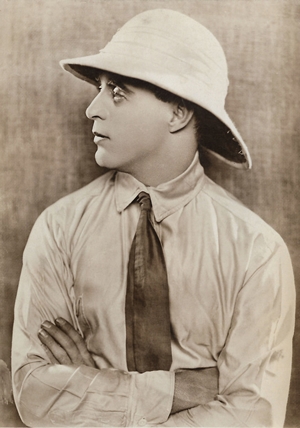
To Walsh, this surely seemed like the gravy train to glory, and he grabbed on with both hands. He gladly agreed to a salary cut when offered the role, and even swallowed his umbrage when, as the company sailed for Italy in the spring of 1924, he found himself relegated to second-class accommodations. Arriving in Rome, he worked out every day with his co-star Francis X. Bushman (playing the villain Messala) and posed for a few publicity stills like this one. Otherwise he was ignored.

Things didn’t go well for Ben-Hur in Italy. Sets weren’t ready, equipment wasn’t available, crews couldn’t speak English, supervisors couldn’t speak Italian. Matters began in a state of disorganization and degenerated into hopeless chaos. June Mathis, ostensibly the production supervisor as well as scriptwriter, was barred from the set by director Charles Brabin — not that there was much set to bar her from. While construction dawdled along, the company adjourned to Anzio to shoot the sea battle; Brabin sat around guzzling wine and regaling the crew with long-winded stories while underlings haggled with local bureaucrats, and hundreds of extras idled sweltering on the beach. When cameras finally rolled, everything went wrong.

Well, I needn’t go on; you can get the whole story from Brownlow. By autumn of 1924, the newly-formed MGM had inherited this mess, and the new bosses, L.B. Mayer and Irving Thalberg, took drastic action. Brabin was fired because his footage was awful. June Mathis was fired because she had been the supposed supervisor of this fiasco, and had insisted on shooting in Rome in the first place. And George Walsh was fired because Mathis had hired him — besides, MGM wanted to build up their rising star Ramon Novarro, and since Walsh hadn’t yet appeared on film it would cost only the price of a ticket home to get rid of him. Walsh and Bushman (who was one of the few survivors of the purge) read about the changes in the newspapers. The whole company — what was left of it — was ordered back to California at once, where Mayer and Thalberg could keep a close eye on things.

It was all a bitter pill for George. “You know, Frank,” he told Bushman, “I felt this was going to happen. But to leave me over here for so long, to let me die in pictures — and then to change me!” Because MGM, in damage-control mode, kept mum about the state of the production and the reasons for such sweeping changes, the impression was left that George simply couldn’t cut it — just as everyone had suspected.

Could he have cut it? Maybe, maybe not. June Mathis shrugged off her own dismissal, saying her chief regret was for Walsh: “I had complete faith in his ability to play Ben-Hur,” she told Photoplay. “I realize many other people did not believe in him, but the same thing occurred when I selected Rudolph Valentino for the role of Julio in The Four Horsemen. Valentino justified himself, and I am confident that Mr. Walsh would have done the same thing. Actually, he was given no opportunity to succeed or fail. He was withdrawn without a chance. Indeed, Mr. Novarro was in Rome for three days before Mr. Walsh was notified that he had been succeeded in the leading role.” Nevertheless, in Hollywood — then as now — image was everything. George slunk home a “failure”, even though he had not faced the cameras for so much as a frame of film.

He didn’t exactly “die in pictures”, but in an age where a star was expected to appear in a new picture several times a year — even every few weeks — George Walsh was off the screen from December 1923 to October ’25. He might as well have moved to Tibet and become a hermit. He had lost momentum, and he never really got it back. His vehicles continued as they had before, with titles like American Pluck, The Kick-Off, Striving for Fortune and His Rise to Fame, but the scripts were more formulaic than ever, the productions cheaper and more slapdash, the companies increasingly fly-by-night. The kid was looking less clever than he once had; more important, he was no longer a kid. His last starring vehicle was the inaptly named Inspiration (1928), which Variety termed “for second run houses in not too particular neighborhoods.”


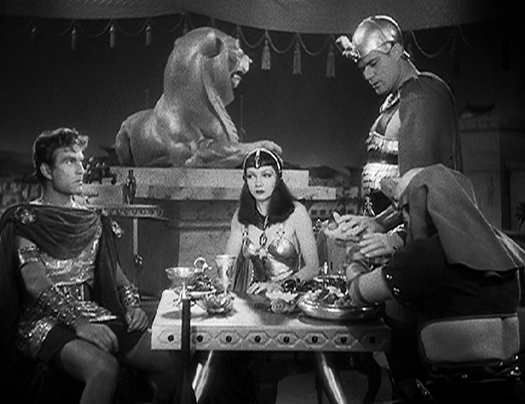
After the coming of sound Walsh made a few movies, but was never again top-billed. Supporting roles (often in brother Raoul’s pictures like Me and My Gal, The Bowery and Under Pressure) slid into bits — like this one in Cecil B. DeMille’s Cleopatra (1934), as a courier bringing Antony (Henry Wilcoxon) and Cleopatra (Claudette Colbert) the bad news that Octavian is on the march. After Raoul’s Klondike Annie and a couple of Poverty Row westerns in 1936, George decided to call it a day in pictures, and retired from the screen to work as a racehorse trainer for the Hollywood horsey set.

All in all, George Walsh didn’t have such a bad run; his pictures were breezy, undemanding fun in their day and he had a definite following. Getting canned from Ben-Hur was a blow, no doubt, but how much of his subsequent career slide was due to his two years out of circulation, and how much was simply because his day was done, is something I guess we’ll never know. Like any other star, he arrived, he blazed, and he waned, then (unlike some) lived to a ripe old age: George Walsh was 92 when he passed away in Pomona, Calif. in 1981.

Posted in Blog Entries, Movie Playing Cards

Movie Playing Cards: 9 of Diamonds – Mary Miles Minter

Jim Lane's Cinedrome Posted on September 5, 2010 by Jim LaneAugust 23, 2022


This one’s too dramatically juicy to ignore. Poor Mary Miles Minter — was there ever a Hollywood life more pathetic, or more completely ignored by posterity? She once seemed to be the heiress apparent to Mary Pickford, yet Pickford is still a household name nearly 80 years after her last movie, while Minter… I suppose it doesn’t help that only six of Minter’s 54 movies are said to survive. But Minter’s obscurity isn’t merely a function of poor film preservation. It was her off-screen life that doomed her to an addled oblivion and a lonely death at the age of 82 — and her off-screen life was something she never had a moment’s control over. Poor Mary Miles Minter. 
 
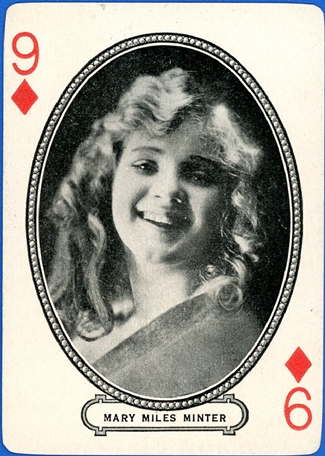
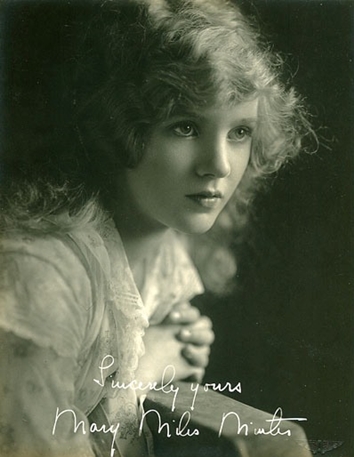
 As I said before, Minter is the only person to appear at the 9 of Diamonds in any extant version of the M.J. Moriarty deck of cards, so presumably the happily smiling lass we see on the card is Mary as she looked in 1916, when she was only 14 years old. She looks more mature in the undated photo at right, less inclined to adolescent baby fat, though surely no more than 18 or 19. More melancholy, too — or is it just historical hindsight that makes me want to see a sadder-but-wiser girl? 


Poses like that are easy to find of Minter — wide-eyed, pensive, gazing soulfully to one side or the other of the camera, as if listening intently for something. Or to someone. It was a popular attitude for virginal waifs in those days, but in Mary’s case it might have had another motive: to make her look older. People look younger when they smile. For an illustration by contrast, here’s a postcard of Mary (probably from late 1922 or early ’23, near the end of her career) in which her smile looks quite open and unforced. There’s a certain dressing-up-in-Mama’s-clothes quality about this picture, isn’t there?
 
That may not be too far from the truth. Minter’s mother was a real piece of work, a frustrated actress in the mold of stage mothers from time immemorial, who live out their own thwarted ambitions through their daughters — once they realize that that’s where the real talent in the family is.
 
Mary Miles Minter was born Juliet Reilly on April Fool’s Day 1902 in Shreveport, Louisiana, the younger of two daughters of J. Homer and Lily Pearl Miles Reilly. By 1907 Homer was out of the picture, sent packing by Lily Pearl, who went gallivanting off to New York to be an actress, adopting the name Charlotte Shelby. Nobody knows why she chose that name; Sidney D. Kirkpatrick, in his book A Cast of Killers (more about that later), relays the speculation that a politician named Shelby might have helped Lily Pearl get her first big break. For whatever reason.
 

Charlotte had left Juliet and her sister Margaret with their grandmother, but she soon sent for them to join her in New York, where little six-year-old Juliet caught the eye of Charles Frohman, producer of the play Charlotte was appearing in. Kirkpatrick says Frohman cast the tot in Cameo Kirby and A Fool There Was — but neither play was produced by Frohman, and Juliet Shelby doesn’t appear in either cast on the Internet Broadway Database. Well, whatever the exact names or titles involved, Charlotte realized in short order that little Juliet was the meal ticket.

Juliet Shelby made at least one picture under that name in 1912, for Universal in New York: The Nurse (now lost, of course). Not long after that she caught the baleful eye of the Gerry Society, watchdogs over the exploitation of child labor and the bane of any show business troupe with underage players. Charlotte handled the matter creatively; she rushed back to Louisiana and borrowed the birth certificate — and name — of her sister’s daughter, who had died in 1905 at the age of eight. And hey presto! — eleven-year-old Juliet Shelby became sixteen-year-old Mary Miles Minter, old enough to satisfy the Gerry Society but looking young enough (because she was) to play the sort of roles for which she was in demand. By the time she made a hit on Broadway in Edward Peple’s The Littlest Rebel, she was Mary for good.

This, in case you’re keeping track, makes the fourth name our girl had by the time she was eleven. Born Juliet Reilly, then Juliet Miles while she lived with her grandmother, then Juliet Shelby after joining her mother in New York, and finally Mary Miles Minter, a name and identity borrowed — stolen, really — from a dead cousin she never knew, yanking her once and for all out of any chance at a normal childhood. I leave the psychiatrists to speculate on what a history like that can do to a girl’s self-image.

By the time she returned to pictures in 1915, this time on the West Coast for a succession of studios, she was an established stage name (although in true Hollywood fashion, her biggest stage hit, The Littlest Rebel, was filmed with somebody else, one Mimi Yvonne). “Of Littlest Rebel fame” followed her everywhere she went. 

And so did Charlotte. Somebody made up a nursery rhyme: 
 
Mary was a little lamb.
Her heart was white as snow.
And everywhere that Mary went,
Her mother had to go.
 
Actress Florence Vidor, as quoted by Sidney Kirkpatrick, remembered: “She and her mother were at each other’s throats from the day I met them. They fought about everything. But her mother always won. Mary was like Charlotte’s cute little puppet. I don’t think she ever cared about acting too much, really, but Charlotte wanted her to be a star, so Mary did what she was told.” Journalist Adela Rogers St. Johns said that Charlotte’s only career was “managing” Mary’s — at a 30 percent commission. She hired lawyers to find loopholes in whatever contracts she signed for Mary so she could shop for better deals at other studios. 
 
And she kept Mary hopping: Six pictures at Metro in 1915 and ’16, then ten at Mutual in ’16 and ’17, one more at Metro, then back to Mutual for nine more through July 1918, when Mary was still only 16. Then to Pathe for seven pictures in one year, topped off by Charlotte’s coup de grace in 1919: a million-dollar-plus contract with Paramount just as America’s Sweetheart Pickford was bailing on her Paramount contract for a sweeter deal with First National and, later, her own United Artists.
 
Thirty-three pictures in 49 months; that’s a long resume for someone who “didn’t ever care about acting too much, really.” Maybe Mary’s heart wasn’t in the acting at that, but what else could she do? What else had she ever been allowed to do? She had to support the family in a style to which Charlotte was enjoying becoming accustomed. Charlotte and sister Margaret were actresses after a fashion, but the only parts they ever got were supporting roles in Mary’s pictures; talent was probably not a a major factor in their casting.
 
Besides, there’s evidence that the critics, at least, were beginning to view this Mary as something of a Pickford manque. Reviewing The Intrusion of Isabel in 1919, Variety said, “Miss Minter as the years advance still has much to learn now that she [is] becoming past the age of being a child wonder … She seems to be always bounding and jumping around, throwing her arms about someone.”  Later, on Anne of Green Gables, the paper said she “revealed nothing approaching the Pickford standard.”


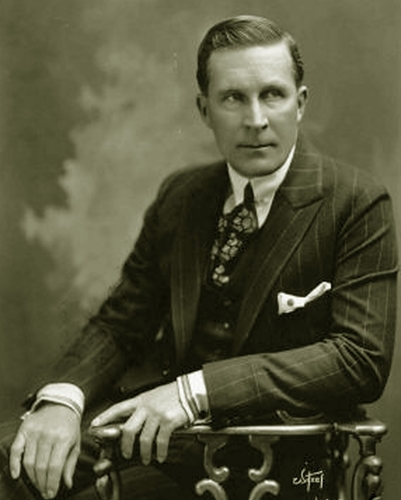
Green Gables was nevertheless a success, and credit for it accrued to the director, William Desmond Taylor (left). In all, Taylor directed Minter in four pictures, and seems to have had a good effect on her acting; of their next one, Judy of Rogues’ Harbor, Variety said, “Miss Minter shows improvement with each new production, and her work in the present feature is by far the best she has done yet.”
 

What effect further work with Taylor might have had we’ll never know, for after the release of Jenny Be Good in April 1920 they never worked together again. But there’s reason to believe — at least judging from Variety’s reviews — that he had a pivotal influence on her acting in those four pictures, all made in the year between her seventeenth and eighteenth birthdays. 


He may have had other effects on her as well, and that possibility came to light only after the evening of Wednesday, February 1, 1922. On that night, sometime after 7:45 p.m., in the living room of this bungalow at 404-B Alvarado Street in Los Angeles, somebody stood behind William Desmond Taylor and shot him dead with a .38-caliber Smith & Wesson revolver.

The murder came right smack in between Roscoe “Fatty” Arbuckle’s second and third trials, up in San Francisco, in the death of Virginia Rappe after a Labor Day party in Arbuckle’s suite at the St. Francis Hotel. And the press pounced on Taylor as they had on Arbuckle; here was more proof — as if any was needed — of the moral turpitude of Hollywood. Lurid stories circulated in the press as the investigation progressed. Most of them weren’t reflected in the official police files or those of a succession of Los Angeles district attorneys, but they were enough to ruin two careers.
 
Not all of those lurid stories were untrue. For one thing, it developed that William Desmond Taylor wasn’t his real name. He was born William Cunningham Deane-Tanner in 1872, not 1877 as was widely believed while he was alive. He had abandoned a wife and daughter in New York in 1908; his wife had divorced him in absentia, but she spotted him in one of his pictures as an actor, leading his daughter Daisy to seek to contact him. They had finally met in July 1921, and Tanner/Taylor promised to see her again; as things turned out, he never did. There was enough mystery in Taylor’s real life to feed plenty of rumors after his death.
 
The first career ruined by the Taylor scandal belonged to Mabel Normand. Already “tainted” in the public mind by her long on-screen association with Arbuckle, she had the incredibly bad luck to be the last person (besides the killer) to see Taylor alive. She had visited him that night, leaving a little after 7:30; Taylor walked her out to her car on Alvarado, then returned to his house for the last time. Rumors were repeated in the press: that she was a cocaine addict (true); that she was back at Taylor’s the morning his body was discovered, ransacking the place in search of compromising letters (false). She was closely questioned, investigated and exonerated. But it didn’t help; the rumors — and her drug problem — persisted, and fed each other in a spiraling decline. By the time she died in 1930, of tuberculosis no doubt aggravated by her addiction, she hadn’t worked in three years. She was only 37. As she lay dying, it’s said, she mused, “I wonder who killed poor Bill Taylor.”
 
The other ruined career, of course, was Mary Miles Minter’s, and looking at her face in this picture that she (or, more likely, Mama Charlotte) signed for the 1923 edition of Blue Book of the Screen, it’s impossible not to believe she knew the end was nigh. In the flurry of publicity after Taylor’s murder, all of her publicity was bad. Love letters surfaced, some in a kind of schoolgirl code, that she had written to Taylor — they look girlishly innocuous to modern eyes, but in 1922 they were scandalous, and not in keeping with the sugar-and-spice-and-everything-nice image Charlotte and her studios had so carefully cultivated. Stories flew, and grew in the telling. In Taylor’s bedroom dresser, it was said, they found a pair of pink panties, embroidered with “MMM”; in a later iteration, the panties became a sheer nightgown. Whatever. The garment, the story went on, was passed around police headquarters for a while, for laughs, before vanishing altogether. (That is, if it ever existed at all. Minter herself denied it in a phone conversation with historian Kevin Brownlow in the 1970s. She believed the panties/nightgown story was invented by journalist Adela Rogers St. John.)
 
Were Minter and Taylor — 15 and 45, respectively, when they met in 1917 — lovers? Only two people ever knew the answer to that one, and they both died without saying. Florence Vidor, for one, didn’t believe Minter was sexually active with Taylor or anyone else. When would she have the chance, with Charlotte never letting her out of her sight? Some friends of Taylor’s believed Minter was infatuated with the director, badgering him with pleas for his affection when he regarded her as no more than a dear little child; other acquaintances believed that, ahem, Taylor had no interest in women of any age — if you know what I mean. 
 
Whatever the case, the damage was done. Even before the murder, the Hollywood establishment had begun to suspect that Mary Miles Minter’s time had all but passed; afterward, studios and the public at large regarded her almost as a has-been who wouldn’t go away. Reviews of her last picture, The Trail of the Lonesome Pine (released on April 15, 1923) were downright cruel. The New York Times: “The chubby Mary Miles Minter, who apparently does not often take as much exercise as in this production…” Variety wasn’t as unchivalrous as all that, but reviewer “Fred” dismissed her as “colorless.” Ten days later, Paramount bought out her contract for $350,000 and released her. She had just turned 21. 
 
The murder of William Desmond Taylor was never officially solved, and it hung over Mary Miles Minter and her mother like a curse from beyond the grave. Eventually the two were driven to a public statement: the L.A. district attorney should put up or shut up; publish any evidence against them and charge them, or absolve them once and for all. The D.A.’s office replied that they had nothing, and absolved them. Over the years there’s been no shortage of theories. He was shot by a burglar. Or by Normand. Or one of her ex-lovers. Or a bootlegger to whom Taylor owed money. Or drug dealers, angered by his efforts to help Normand kick her habit and to have them driven out of town. Or a secretary who had disappeared after robbing Taylor and forging his signature to cash checks. Or, no kidding, the butler (one Henry Peavey) did it. 
 
In 1967, 73-year-old director King Vidor, who had been a contemporary and acquaintance of Taylor’s, launched a personal investigation for a screenplay he hoped to write and direct. Many Hollywood old-timers were still alive then, and nearly all of them had their own take on the mystery. His efforts took him far and wide, visiting friends and former colleagues — including Mary Miles Minter herself. She was now living quietly in Santa Monica and answering only to Mrs. Brandon O’Hildebrandt, the name of the man she married in 1957, after Charlotte Shelby finally died. Her husband had died in 1965, leaving little Juliet Reilly a final name to fold herself into.
 
Or perhaps there was one more. Vidor was appalled to find an obese, demented wreck of the beauty he had known, looking far older than her 65 years and clearly mentally unstable. She said she was writing a lot these days, poetry of her own. When Vidor glanced at the stack of poems she had, he noticed they were all signed “by Charlotte Shelby.” As they talked, Mary wafted her way through a disjointed, wandering monologue, often ignoring or only half-answering Vidor’s questions. At length, she mewled, “My mother killed everything I ever loved,” but the director couldn’t tell if she was being momentarily lucid or merely surrendering to the confusion of dim and distant imaginings.
 
Vidor never made that movie, or any other feature, though there was an unrelated documentary short in 1980. Solomon and Sheba in 1959 proved to be his final outing as a director. The fruits of his investigation were locked away in a strongbox in his garage, where they were discovered after Vidor’s death by his biographer Sidney D. Kirkpatrick. Kirkpatrick published the material in 1986, along with Vidor’s conclusions about the crime, as A Cast of Killers. Since then another book has examined the Taylor murder in depth; this was Tinseltown: Murder, Morphine and Madness at the Dawn of Hollywood by William J. Mann. Mann and Kirkpatrick — or rather, Mann and Vidor — reached quite different conclusions as to who killed William Desmond Taylor, and why, and I won’t reveal either one. Both books are good reads, and I wouldn’t care to spoil them. Besides, any would-be solution to the crime at this distance has to be based on circumstantial evidence, and circumstances can always change.
 
Juliet Reilly/Miles/Shelby/Mary Miles Minter/Mrs. Brandon O’Hildebrandt outlived King Vidor by nearly two years. Mentally fragile as she may have been, she was reasonably well-fixed thanks to real estate investments during the glory days. But her Santa Monica neighborhood grew perilous, and she was robbed more than once. During one robbery in 1981 she was bound, gagged, beaten and left for dead; she survived, and an ex-servant was charged with the crime. She died on August 4, 1984, age 82; any thoughts she had after that 1967 visit from King Vidor she most likely took with her. Mary Miles Minter has a star on the Hollywood Walk of Fame at 1724 Vine St., a little over five miles from the spot where William Desmond Taylor died. 
 
POSTSCRIPT: In preparing this post, I went looking for a copy of A Cast of Killers, my first one having slipped out of my hands some twenty years ago. I found a copy at a used-book store, and snapped it up. When I got it home, I learned to my surprise that I had bought an autographed copy. On the title page, above his signature, Sidney D. Kirkpatrick had cautioned a previous owner: “Don’t let this story haunt you. It’s only Hollywood.”
 
 
Posted in Blog Entries, Movie Playing Cards

“MOVIE” Souvenir Playing Cards

Jim Lane's Cinedrome Posted on August 27, 2010 by Jim LaneAugust 12, 2022

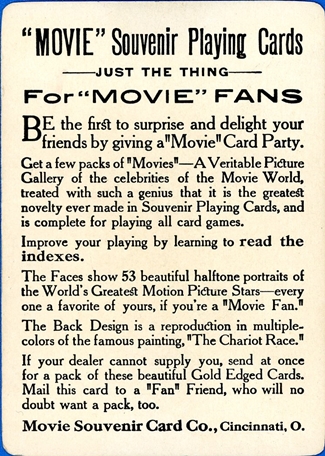
Try to imagine a time when a deck of cards with movie star pictures was a novelty. It’s not easy, is it? We can hardly even imagine a time when a movie star was such a novelty that the word “movie” itself was in quotes. But here it is, courtesy of one M.J. Moriarty and the Movie Souvenir Card Co. of Cincinnati, Ohio.

When I got this deck of cards as an opening-night gift from the director of a show I was in, about 50 years ago, I thought it was something really rare — all 54 cards (including the Joker and the descriptor card shown at right) complete and unblemished, with even the gilded edges of the cards reasonably intact after who knew how many years. Yes, a singular rarity, I thought. I know better now. These Moriarty movie cards are collectible, to be sure, but they don’t seem to be particularly rare. A deck cost fifty cents in 1916 — $13.59 in 2022 dollars. Collector-dealer Cliff Aliperti said in 2010 that one could sell for anywhere from $75 to $150, depending on condition; I don’t know what his estimate would be today, but as I write this in August 2022 there’s a deck for sale on eBay with a Buy It Now price of $229.99. On the other hand, over the last twenty years or so, I’ve seen more than one in dealers’ rooms and memorabilia fairs going for $40 or less.
 

The relative commonness of these decks at collector shows suggests to me that they were probably treated as collectibles from day one; people bought them to keep and look at the pictures, not to face the wear and tear of their Tuesday night whist clubs. (When was the last time you saw a 100-year-old deck of cards in perfect condition?)


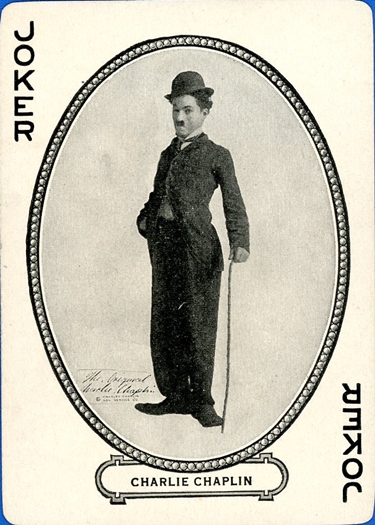
That may be about to change. It’s becoming common practice among dealers now to break up the decks and sell the cards one at a time. At this moment in 2022, there are 54 individual cards available on eBay at prices ranging from five to twelve dollars. At that rate, a deck that Cliff Aliperti once said was worth no more than $150 (and which I’ve seen much lower) can bring a dealer as much as $630 or more. (Some cards are worth more than others, like this Charlie Chaplin Joker; it brings a premium because it’s the one instance where the card and the personality are perfectly matched — and probably also because Chaplin is the one person in the deck whom pretty much everybody recognizes.) This deck-splitting makes good business sense, but it probably means that decks that survived the last hundred years in near-mint condition are going to have a tough time making it through the next ten.

These decks first appeared in 1916 — at least that’s the copyright date on the card backing. Stars came, went, and changed positions in the deck, and some people (here, for example, at Cliff Aliperti’s Immortal Ephemera) have made a study of comparing and contrasting the decks that can still be found. Certain evidence of the cards themselves suggests that that they stopped production in 1922 at the latest: Wallace Reid appears on the 4 of Spades, and Reid died in January 1923; that’s not conclusive, though, because two other actors (Nicholas Dunaew and Richard C. Travers) occupied that card at one time or another. More persuasive is the case of Mary Miles Minter, the only occupant (so far known) of the 9 of Diamonds. Minter’s career was wrecked in the backwash of the William Desmond Taylor murder in February 1922, when her indiscreet love letters to the late director (30 years her senior) shattered her virgin-pure screen image. But even if the cards were still in production in 1922 (probably unlikely), they stopped pretty early. Many of the stars most associated with the silent era — Rudolph Valentino, Clara Bow, Greta Garbo, John Gilbert, Colleen Moore, Harry Langdon, Ramon Novarro, Bebe Daniels, Bessie Love — hadn’t made their big splash yet and don’t appear in any version of the deck.


Others might be expected to show up but don’t. Conspicuous by their absence are the King and Queen of Hollywood (even before their marriage made it official), Douglas Fairbanks and Mary Pickford — although their colleague in United Artists, Chaplin, is Clown Prince of the deck. Dorothy Gish (5 of Clubs) appears, but not her sister Lillian, much the bigger star. And we have Mabel Normand (10 of Clubs) but not her teammate Roscoe Arbuckle, with whom she made dozens of popular Sennett comedies between 1912 and ’16. When these cards hit the market, Arbuckle’s legal troubles were still five years in the future, but he appears in no extant version of the deck, although “Fatty and Mabel” were as much a team as Laurel and Hardy would later be. 

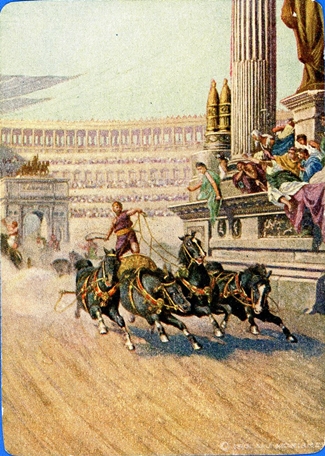
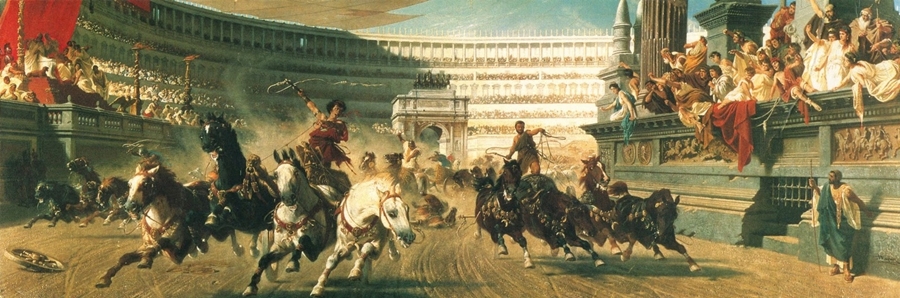
Now a word about the card backing — “the famous painting, ‘The Chariot Race'”, as the descriptor card says. The cards show only a detail; here’s a more complete look at the painting. It was indeed pretty famous during the last quarter of the nineteenth century, and was the work of Alexander von Wagner (1838-1919), a sort of Hungarian Norman Rockwell of the era. Von Wagner painted at least three versions of the painting, the first one in 1873 for the Vienna Exposition. A second version went on display at Philadelphia’s Centennial Exposition in 1876, and another — or perhaps the same one — at the 1893 Columbian Exposition in Chicago. The painting sparked a national craze, with etchings and lithograph prints for sale everywhere. Contrary to what some have said, it does not reproduce a scene from Ben-Hur, which wasn’t published until 1880; indeed, the painting and its pop-culture clones may have inspired Gen. Lew Wallace to include such a scene in his novel. In point of fact, the full title of the work is “Chariot Race in the Circus Maximus, Rome, in the Presence of the Emperor Domitian”, which would have been several decades after Judah Ben-Hur and Messala had their fateful showdown in Antioch’s Circus Maximus. Only one of von Wagner’s versions of the painting is known to survive; it hangs today in the Manchester Art Gallery in England. 

But back to those 53 faces — “every one a favorite of yours”, according to the deck’s promo. So many of those favorites are forgotten today — victims of fickle audiences even in their own lifetimes, then victimized again by the passage of time and Hollywood’s too-little-much-too-late attitude toward film preservation. I thought it would be a fun project to take these cards one at a time and review what we can know now of the lives and careers behind those “beautiful halftone portraits.” Chaplin hardly needs it, of course, but what about House Peters, Mildred Harris, Wanda Hawley, George Larkin? I’ll be shuffling the deck from time to time, cutting the cards and seeing what comes up. Maybe we can uncover some sense of why these cards were bought, and enjoyed, and even cherished and preserved so carefully for a hundred years and more.

*                         *                         *

King of Hearts – H.B. Warner


Here’s an easy one for starters. Every true film buff knows Henry Byron Charles Stewart Warner-Lickford, although they might have to look twice to recognize the H.B. Warner they remember in this dapper, Arrow-collared, surprisingly youthful gent-about-town. This portrait may date from Warner’s entry into movies, when he was 38; that would have made the picture a couple of years old when the deck was published, but that sort of thing is not unheard of among actors’ head shots.

So film buffs know the name, even if the face comes as a bit of a surprise — but what about those less devout moviegoers, who don’t make a practice of memorizing the name of every Thurston Hall or J. Edward Bromberg who marches across the screen? Well, I’m going to go out on a limb here: I think it just may be that H.B. Warner’s work has been seen by more people alive today than anyone else in the M.J. Moriarty deck. Yes, maybe even more than Charlie Chaplin.

Note I said “seen by”, not “familiar to”. So take another look. Try to add, oh, maybe 30 years to that face. Look especially at the eyes. Ring any bells? Well…


How about this? That’s right, H.B. Warner was old Mr. Gower, the druggist who slaps young George Bailey around the back room of his store in It’s a Wonderful Life, and who, in the world where George was never born, is the “rummy” who “spent twenty years in prison for poisonin’ a kid.” I’ll just bet that anyone who ever saw Warner’s performance in It’s a Wonderful Life has never forgotten it, even if they never took the trouble to find out the actor’s name.
 
By 1946, the year of Wonderful Life, Warner had become a steady member of Frank Capra’s informal stock company. This was the fifth of his six pictures for Capra, and those six are a major reason why I suggest H.B. Warner’s work has been seen by so many. He played the judge hearing Gary Cooper’s case in Mr. Deeds Goes to Town (1936) — “Not only are you not insane — you’re the sanest man who ever walked into this courtroom!” It’s a hallelujah moment, provided by writer Robert Riskin and delivered by H.B. Warner.


In 1937, Capra gave Warner the opportunity to deliver probably his best screen performance. The picture was Lost Horizon, from James Hilton’s utopian romance about a group of refugees from war-torn “civilization” who find themselves in the remote Himalayan paradise of  Shangri-La. Warner (here with Isabel Jewell, Edward Everett Horton, Ronald Colman and Thomas Mitchell) played Chang, their mysterious escort from the snowbound wreck of their plane to the Edenic Valley of the Blue Moon, and their host after they arrive. Endlessly cordial, welcoming and polite, he nevertheless is inscrutably vague about when and how they will ever be able to return to their homes. Warner got an Oscar nomination as best supporting actor, but he didn’t win; he lost out to Joseph Schildkraut as Alfred Dreyfus in Warner Bros.’ The Life of Emile Zola. That’s a worthy performance, but I’m not at all sure the Academy made the right call. H.B. Warner’s other pictures for Capra were You Can’t Take It with You (1938), Mr. Smith Goes to Washington  (1939, as the Senate majority leader) and Here Comes the Groom (1951).

But you don’t get your picture on a deck of cards for supporting and character roles in your twilight years, however memorable. What about his career earlier, when he appeared on the King of Hearts sometime between 1916 and 1920? Well, unfortunately, that’s something we’re going to bump up against over and over as we discuss this antique deck of cards — and for that matter, anything else about the silent era. The survival rate of movies made between 1890 and and 1920 is only a cut or two above snowball-in-hell level; for much of Warner’s career we have to piece together what information we can from secondary sources.

We know that he made his Broadway debut on November 24, 1902 at the age of 27 (billed as “Harry Warner”), in Audrey by Harriet Ford and E.F. Boddington. In 1910 he appeared in Alias Jimmy Valentine, one of the smash hits of the early 20th century stage, adapted from the O. Henry story “A Retrieved Reformation.” He must have made quite an impression in that, because in 1914, when he filmed another one of his stage successes, The Ghost Breaker, the laudatory review in Variety mentioned him as “he of ‘Jimmy Valentine’ fame.” The Ghost Breaker was his third picture in 1914, and was co-directed by Cecil B. DeMille. They would work together again, and would in fact make their last picture together — but more of that anon.

Warner was a veteran stage star by the time his movie career really got underway in the mid ‘teens, and he established himself (if we can believe his Variety reviews) as an appealing romantic lead in titles like The Raiders, Shell 43 and The Vagabond Prince (all 1916), Danger Trail (’17) and The Pagan God (’19). He continued to appear on Broadway until Silence in the winter of 1924-25 (which he also filmed in 1926); after that he was a Hollywood actor for good.

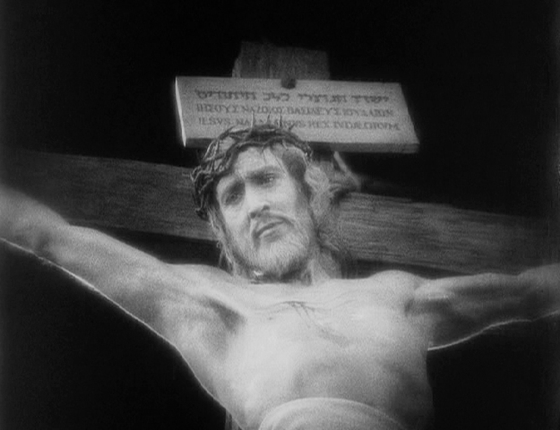
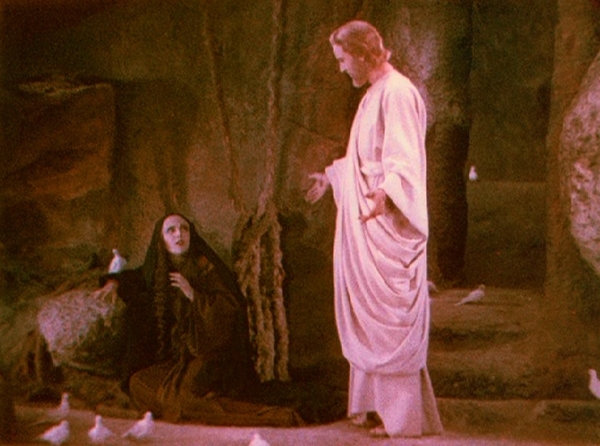
At least one of H.B. Warner’s silent movies has survived intact, and it’s a biggie: Cecil B. DeMille’s spectacularly reverent The King of Kings (1927), in which Warner played the title role. The movie was a triumph of prestige and box office for DeMille; in reviewing it, Variety’s legendary editor Sime Silverman was quite tongue-tied with awe; in 24 column inches, Silverman (normally so terse and pithy) fairly stumbles over himself groping for superlatives. The movie is a bit too earnestly pious for modern tastes, but its appeal for 1927 audiences is still understandable, and DeMille’s showmanship is at its smoothest. Most memorably, Warner’s performance, in an age when accusations of sacrilege were a very real concern, is excellent. Here’s a strikingly dramatic shot of him at the Crucifixion, seen from the viewpoint of Jesus’s mother Mary mourning at the foot of the Cross.


And here, just to give a flavor of the lavishness of DeMille’s picture, is a frame from one of King of Kings‘s two Technicolor sequences, showing the resurrrected Christ comforting Mary Magdalene (Jacqueline Logan) at the opening to the tomb on Easter morning. (On a curious side note: in King of Kings Judas Iscariot was played by none other than the self-same Joseph Schildkraut who ten years later would ace Warner out of that Oscar.)


With the coming of sound, H.B. Warner was well into his fifties, so character parts became his lot as they do for nearly all actors as they age. And it proved to be a fertile field for him; after King of Kings there were well over a hundred film appearances in the 29 years that remained to him — Lost Horizon and It’s a Wonderful Life were only two of them. Here’s one that movie buffs particularly cherish: Warner playing himself in 1950’s Sunset Blvd. (though unidentified until the closing credits), as one of the has-been “waxworks” playing bridge with Gloria Swanson’s mad Norma Desmond. Staring him down is, of course, Buster Keaton. (And on a cautionary note, here’s an example of what a decade of sodden alcoholism can do to you: Warner and Keaton look about the same age; actually, Keaton was twenty years younger, almost to the day.)


H.B. Warner’s final screen appearance was a poignant one. He was approaching 80 and living at the Motion Picture Country Home in Woodland Hills in 1955 when the call came from his old friend Cecil B. DeMille. DeMille was planning a massive spectacle expanding the Biblical section of his 1923 hit The Ten Commandments, and he had a part for H.B. if he felt up to it. The role was identified in the script as “Amminadab”, an aging Israelite setting out on the Exodus from Egypt, even though he knows he’ll never see the Promised Land — indeed, probably won’t live out the day. The actor carrying him in this shot, Donald Curtis, remembered that Warner weighed no more than a child, and carrying him wasn’t merely in the script, it was a necessity: “It was clear H.B. couldn’t walk — could barely breathe.” He had come to the set in an ambulance and lay on a stretcher, breathing through an oxygen mask, until the cameras were ready to roll. In the script, he had a rather complex speech adapted from Psalm 22, but he couldn’t manage it, so DeMille told him to say whatever he wanted, and Curtis and Nina Foch would work with it. H.B. Warner’s last words in his 137th movie, after 53 years as an actor, were: “I am poured out like water, my strength dried up into the dust of death.” 
 
Donald Curtis believed the old boy could only have weeks to live, but he was wrong. In fact, H.B. Warner lasted three more years; he died on December 21, 1958, 56 days after his 83rd birthday.
 
Posted in Blog Entries, Movie Playing Cards

Items from the Scrapbook of Cosmo Brown

Jim Lane's Cinedrome Posted on August 12, 2010 by Jim LaneJuly 29, 2016

(With Apologies to Betty Comden and Adolph Green)

I’m not at liberty to disclose how the following documents came into my possession. I think they pretty much speak for themselves.

Los Angeles Times, March 25, 1928


Los Angeles Times, March 28, 1928


Posted in Blog Entries

Rex the First

Jim Lane's Cinedrome Posted on August 7, 2010 by Jim LaneMarch 30, 2025


Hollywood had two Rex Ingrams. Maybe someday I’ll write about the fine African American actor who played De Lawd in The Green Pastures, Lucifer Jr. in Cabin in the Sky and the Genie in 1940’s The Thief of Bagdad. But today I’m writing about the other Rex Ingram, who was born Reginald Ingram Montgomery Hitchcock in Dublin, Ireland on January 15, 1893.

I’ve been wrestling with this post much too long, trying to get some feeling for what this man was like beyond what we can see in his movies: an artist’s sense of composition, a tasteful eye for the telling detail, a delicate touch with actors, and a sure hand with both intimacy and epic sweep.

There’s only one biography of him, Rex Ingram: Master of the Silent Cinema by the late Liam O’Leary, and unfortunately it’s not much help. I know it sounds presumptuous for an armchair historian like me to pass judgment on a man like O’Leary — actor, director, archivist, official with both the Irish Film Society and London’s National Film Archive. But the fact is, his biography of Ingram is long on facts and short on insight, and it raises more questions than it answers.

Did Ingram ever graduate from Yale, where he studied sculpture? Michael Powell, whom Ingram inspired to become a movie director himself, says Ingram was a Yale grad, but O’Leary’s book isn’t clear. If Ingram didn’t graduate, did he drop out to work in pictures for the Edison Company, or did he flunk out and turn to pictures when he needed a job? He was obviously intelligent even in his youth, but he wouldn’t be the smartest student who ever grew bored and careless in his studies. Either way, O’Leary doesn’t say; one moment Ingram is at Yale, the next at Edison.

We know Ingram loathed Louis B. Mayer (he was neither the first nor the last to do that), and seethed when Mayer became his boss (Ingram had been Metro’s star director before the merger with Goldwyn and Mayer that formed MGM). But why? Given the effect on Ingram’s career, and possibly on Hollywood itself, it would be useful to have more of an inkling why Ingram couldn’t work with Mayer while directors like Clarence Brown and Sidney Franklin could.

Did Ingram ever convert to Islam, or didn’t he? It’s reported in Wikipedia that he did, along with a claim that he co-directed the silent Ben-Hur (which he didn’t). O’Leary cites the periodic allegations, and Ingram’s demurrals, then finally concludes “there may have been something to it.” A definite maybe.
Most frustrating of all, what exactly was Ingram’s relationship with June Mathis? This remarkable woman was one of the earliest power figures as Hollywood entered the 1920s. A writer with ambitions to produce, she went on to do just that (or “supervise,” as the jargon of the day had it) and might have risen even higher if she hadn’t died suddenly of a heart attack in 1927, age 40 (or 38, or 35, depending on whom you believe as to when she was born). There were rumors at the time that Mathis and Ingram were romantically involved, and that he threw her over when he eloped with Alice Terry during shooting of The Prisoner of Zenda in 1921. If true, that could explain the alienation between them that festered after The Conquering Power that same year, causing Ingram later to miss out on his dream project, Ben-Hur, when production supervisor Mathis pointedly gave the director’s megaphone to somebody else.

But there’s an alternate explanation, too: that the two clashed over Ingram’s direction of Mathis’s protege Rudolph Valentino in Conquering Power, the follow-up to The Four Horsemen of the Apocalypse, the picture in which she and Ingram had launched Valentino to stardom. Mathis believed that Ingram was being high-handed with Valentino, while Ingram believed that he was directing the same way he always had, but that Valentino’s sudden fame had gone to his head and made him too big for his britches. Either story makes sense — the woman scorned or artistic differences — and it would be nice to know which is closer to the truth.
Ingram and Alice Terry at the time of their marriage in November 1921

Liam O’Leary became good friends with Alice Terry, Ingram’s widow, and she was still alive in 1980 when O’Leary’s biography of Ingram was published. I suppose it’s only natural that he might be too tactful to explore any rumors about Terry’s late husband and a woman dead more than fifty years, but you don’t dispel gossip by ignoring it. O’Leary does concede that Mathis may well have been in love with Ingram (as she clearly was with Valentino), but insists that Rex only had eyes for Alice; even Ingram’s first (apparently unhappy) marriage is dispensed with in two hasty paragraphs.

In any event, Mathis was there to give Ingram’s career a huge boost by choosing him to direct The Four Horsemen, her pet project at Metro, from the international bestseller by Vicente Blasco Ibañez. Ingram had been building a name for himself for some time, but that was the picture that catapulted him to Hollywood’s front rank.

Ingram began in movies in 1913 at the Edison Co. studio in the Bronx. He did a little bit of everything in those unregimented early days — advising on intertitles, set decoration, painting portraits of Edison’s prominent players, pitching in on scenario writing, and so forth. With his matinee-idol good looks (Erich von Stroheim said he looked like a Greek god), it was inevitable he’d end up on screen as well, but he was a self-conscious actor — and never much interested in that side of the camera anyway. After a few months at Edison he went to Vitagraph as an actor and writer for a year or so, then in June 1915 on to the Wm. Fox Film Corp. as a writer and assistant director. It was about this time that Rex Hitchcock dropped his last two names and became Rex Ingram for the rest of his life. After a year at Fox, he moved on to Carl Laemmle’s Universal, where he finally got his first opportunities to direct at the young age of 23 (like William Wyler nine years later). In 1917, When Uncle Carl moved his production operations to the new Universal City in Hollywood, Ingram went west as well.
 
 
In 1918, after America’s entry into World War I, Ingram enlisted in the Royal Canadian Flying Corps (he was still technically a British subject, his U.S. citizenship papers not having been finalized yet). But his service wasn’t long; he was honorably discharged after only ten weeks, possibly as a result of injuries incurred in a plane crash during training. In any case, in January 1919 he was back in Hollywood in very poor health, nearly broke, and out of a job. For months he was dependent on the kindness of friends; he was able to find some work as a set decorator at Lasky Studios, but it wasn’t easy to hold on even to that while he convalesced from whatever had washed him out of uniform.
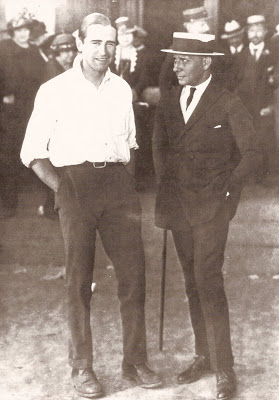
 

It probably didn’t help his morale to return to Universal seeking his old job back, only to be told that the vacancy had been filled, and by the Vienna-born Erich von Stroheim — the “enemy” Ingram had gone off to fight. Stroheim went out of his way to be cordial when he found Ingram lurking around the set (“What’s that sonofabitch doing? He’s got my job!”); Stroheim brought out a bottle of scotch and after ten or twelve drinks “we were very palsy-walsy.” The friendship took hold and endured for the rest of Ingram’s life; Stroheim once called Ingram “the world’s greatest director.”

In short order Ingram’s health and his job prospects improved. He managed after all to pick up a couple of directing jobs for Universal (including helming a screen test for a hopeful newcomer named Rudolph Valentino, who impressed Ingram as having possibilities), then in late 1919 landed a directing berth at $600 a week with theater magnate Marcus Loew, who had just acquired the Metro Pictures Corporation to supply product for his chain of cinemas.
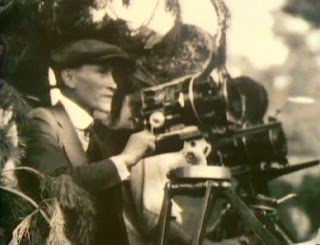
And this is where the Rex Ingram story really begins. His job at Metro brought him into contact with two people who had an incalculable impact on Ingram’s growing stature as an artist and as a maker of commercial hits. The first was John F. Seitz, the cameraman on Shore Acres, the first picture Ingram directed at Metro (though not the first released). Seitz was no inconsiderable artist himself; his career extended to 1960, and he just might be the greatest cinematographer of the sound era who never won an Academy Award (he was nominated seven times). He had begun his career as a lab assistant, so he knew how to manipulate not only lighting on the set, but the film itself in the developing process. Director Byron Haskin recalled, “Seitz was one of the true geniuses of filmmaking. Not just a photographer, he was tremendously imaginative, tremendously impressive to me as a young cameraman, and to most of the other boys in the business at the time.” Seitz and Ingram connected on a joined-at-the-hip level. They made a dozen pictures together in six years; Seitz understood Ingram’s pictorial sense because he shared it, and had the craftsmanship to interpret it in images that are subtly lit and strikingly textured even now, 75 and 80 years on.
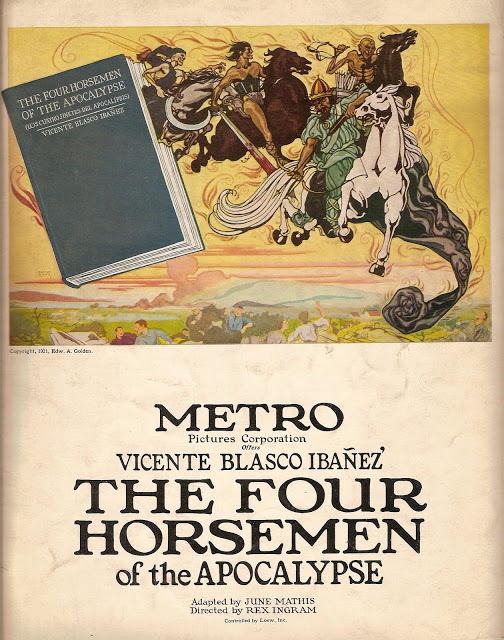
 

The other person, of course, was June Mathis. She had been impressed with Ingram’s work on his first two films at Metro and asked for him to direct The Four Horsemen of the Apocalypse, which she was shepherding to the screen after prodding Metro to acquire the rights. Spanish author Vicente Blasco Ibáñez’s novel had been a worldwide bestseller in 1918 and ’19, and rumor had it that Fox was willing to pay $75,000 for movie rights. Metro studio chief Richard Rowland, at Mathis’s urging, won the bid with a $20,000 advance against ten percent of the profits.

 
The Four Horsemen told the story of two branches of an Argentine family that diverge after the death of the patriarch around 1900. One daughter returns with her German husband to his fatherland, the other with her husband to his native France, and their sons end up on opposite sides in the Great War. Early scenes set in Argentina were filmed on the 250-acre Gilmore Ranch in what is now Los Angeles’s Fairfax District; elaborate action scenes set in a French village caught in the Battle of the Marne were shot in the hills behind Griffith Park, overlooking what are now Burbank, the Warner Bros. Studios and Forest Lawn. The visionary/symbolic scenes of the Four Horsemen themselves (Conquest, War, Pestilence and Death) were staged on Pico Boulevard, then little more than a country lane running from the seaside village of Santa Monica into downtown L.A. Shooting lasted from July to December 1920, at a cost of $1 million, 40 times the cost of the average Metro picture to date.
 
The result of Ingram, Mathis and Seitz’s efforts opened in New York on March 6, 1921, and was a sensation even greater than the novel that inspired it. The Four Horsemen of the Apocalypse was the first box-office blockbuster to come from the Hollywood studio system. Marcus Loew made enough profit off this one picture to reimburse him for the entire cost of purchasing the studio. Richard Rowland bought out Blasco Ibáñez’s interest in the movie for $170,000 (thereby saving Metro $40,000). June Mathis became the most powerful woman in Hollywood. And Rex Ingram, just turned 28, was hailed as the peer of D.W. Griffith and Cecil B. DeMille.
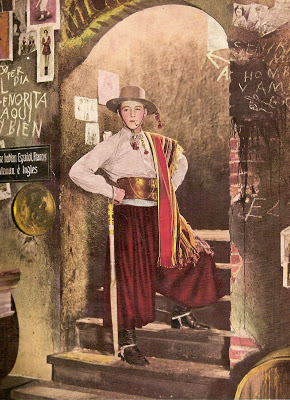
 
The biggest sensation of The Four Horsemen, as all the world knows by now, was 25-year-old Rudolph Valentino as Julio Desnoyers, the idle playboy whose belated patriotism to his father’s France leads to his death in the trenches of the Western Front. Mathis favored him for the role over a number of better-known actors, and Ingram — no doubt recalling that screen test at Universal — readily agreed. Valentino justified their faith in him, but as I said before (and assuming there was nothing more personal between Mathis and Ingram than their professional work together), he may have caused the rift that erupted between them. The Conquering Power was Ingram’s last collaboration with Mathis. The script for his next picture, Turn to the Right was taken over from Mathis by Mary O’Hara (later a novelist and author of My Friend Flicka). We don’t know why; had Mathis and Ingram already washed their hands of each other?
 
The Four Horsemen was Ingram’s biggest artistic and commercial success, but it wasn’t his only one. The Conquering Power could hardly miss, with Valentino starring. Turn to the Right was indifferently received (and led to rumors that Mathis had been the real genius behind Valentino), but The Prisoner of Zenda (1922) and Scaramouche (’23) — both with Ramon Novarro, a Latin Lover rising on Valentino’s coattails — cemented Ingram’s prestige. (Another picture, 1922’s Trifling Women, is now apparently lost.)
 
For his next picture, Ingram persuaded Metro to let him shoot on location: Tunisia for exteriors and a Paris studio for interiors. The Arab was intended to do for Novarro what The Sheik had done for Valentino (which, to a lesser extent, it did). Although Ingram did not stay away from Hollywood for good (he died there in 1950), he never worked there again. He moved his operations to the Victorine Studios in Nice, on the French Riviera, and his remaining five pictures were all made there. 
 
This is where we enter the realm of speculation, wondering why Rex Ingram, sitting on top of the world, preferred to work 6,000 miles away from his studio’s base of operations. “As we have seen,” Liam O’Leary writes, “Ingram had longed for the day he could get away from Hollywood, its coteries, gossip, and inevitable scramble for power, increasing bureaucracy and production controls.” With all due respect, by that point in O’Leary’s biography, we’ve seen nothing of the kind. So what did prompt Ingram to this quixotic drive to create a New Hollywood in the south of France? I think the straw that broke this Irish-American camel’s back was Ben-Hur. 
 
Lew Wallace’s book had been the best-selling novel of the 19th century, and a lavish stage production in 1900 had toured the U.S. for twenty years. It was only a matter of time before a movie would be made. In fact, strictly speaking, one already had been: a cheap and short quickie in 1907, produced by the Kalem Company without bothering to consult either the Wallace estate or Klaw and Erlanger, the stage producers. That sneaky piece of work had resulted in a landmark copyright lawsuit, and the rights were jealously guarded thereafter. Still, this was a plum property, and sooner or later someone was going to pick it. Ingram yearned to direct Ben-Hur, and had it written into his contract that if Metro finally landed the rights, he would get the job; if another studio did, he would be loaned out to do it. In the end, the Goldwyn Company got the rights, with June Mathis in charge of production and writing the script. After The Four Horsemen, Zenda and Scaramouche, Ingram was the obvious front-runner, but Mathis froze him out; she gave the assignment to Charles Brabin. 
 
By all accounts, Ingram went into a serious depression at missing out on what at the time promised to be one of the biggest pictures of all time; even casual acquaintances noticed a distinct change in his character. It was about that time that he went to North Africa to shoot The Arab, and while he was there another blow fell. His home studio Metro merged with the Goldwyn Company, and Louis B. Mayer came aboard to be head of production at the new conglomerate. 
 

We may not know exactly why Ingram despised L.B. Mayer — their paths don’t seem to have crossed in Hollywood — but we know he did. Ingram had left for Tunisia an employee of the Metro Pictures Corporation; now suddenly he was working for Metro-Goldwyn-Mayer. He had a new clause inserted into his contract: he would answer to Marcus Loew and Nicholas Schenck, not Mayer; his pictures would have the billing, “Metro-Goldwyn presents a Rex Ingram production.” He literally did not want Mayer’s name mentioned in the same breath with his own.

With the MGM merger, Loew’s Inc. had inherited Ben-Hur, shooting in Mussolini’s Italy at the same time Ingram was in Tunisia with The Arab. By mid-1924 the Ben-Hur production had degenerated into a shambling fiasco (for the juicy, fascinating details, see Kevin Brownlow’s The Parade’s Gone By). Mayer and Irving Thalberg assessed the situation, and were appalled. June Mathis, Charles Brabin and leading man George Walsh were all summarily fired. And at this point, evidently, Rex Ingram missed out on directing his dream picture once again. O’Leary reports that Mayer invited Ingram to take over the production, “but Ingram made so many conditions that Mayer refused to consider them.” What conditions? For that matter, if Ingram was so depressed when he lost out the first time, why were there any conditions? I suspect one condition might have been that “Metro-Goldwyn” business; Ingram wanted Ben-Hur, but not if it was to be a Metro-Goldwyn-Mayer picture. Also, Ingram may have wanted to shoot at Victorine, while Mayer may already have decided to bring this runaway disaster home to Hollywood where he could keep an eye on it; besides, an epic like this could never be done at Ingram’s quaint little boutique studio on the Mediterranean coast.

This double miss is one of the great what-ifs of Hollywood. As good as the 1925 Ben-Hur is — and it’s very good indeed, far superior to its more famous remake — it surely would have been even better in Ingram’s hands, even if he’d had to make it without his alter ego John Seitz.

For a few years in the 1920s Ingram operated in a manner Stanley Kubrick would later duplicate (albeit for a much longer time), staying within his own workspace far from studio higher-ups, keeping his own counsel and pursuing his own course, telling the home office when he had a movie ready for them. After The Arab he made three more pictures for MGM — or rather, Metro-Goldwyn — Mare Nostrum (1926), from another Blasco Ibañez novel set during the Great War; The Magician (also ’26), from a bizarre story by Somerset Maugham, with stylistic elements that clearly influenced James Whale’s later Frankenstein pictures at Universal; and The Garden of Allah in 1927. This last picture completed his contract with Metro, and when Ingram refused to return to Hollywood to work, MGM declined to renew.

Meanwhile, Ingram had somehow managed to lose control of his Nice studios. He sued his French lawyer, claiming that the attorney had fraudulently maneuvered ownership of the studio away from him (and alleging that the studio manager had swiped documents from Ingram’s office that would prove his charge). The case dragged on until 1936, and Ingram lost every step of the way. His opponent was a powerful and influential man in French law and politics; Ingram may have come to reflect that he hadn’t left chicanery and the “inevitable scramble for power” behind in California after all.

After that there were only two more pictures, The Three Passions (’29) and Baroud (’32). His only talkie, Baroud was planned in English, French, Spanish and Arabic versions, but only the English and French were ever shot. Released in America as Love in Morocco, it was curtly dismissed by Variety as “A dull story, badly handled and acted.”

That has a certain how-the-mighty-have-fallen ring, doesn’t it? Ingram didn’t see it that way at the time, he simply moved on from what he’d been doing. He welcomed talkies (“Silent pictures are finished and a good thing too”), but visual artist that he was, was never entirely comfortable with them — understandably, being an American working in France with polyglot actors and crews. He basked a while on the beaches of Nice, sojourned in North Africa, where his affinity for Arab culture gave rise to those rumors that he had embraced Islam. While in Egypt, O’Leary reports, he contracted an unnamed illness that left him with high blood pressure for the rest of his life (which no doubt brought on his early death at 57 of a cerebral hemorrhage).

In 1936 Ingram and Alice Terry settled again in Hollywood, where he lived in modest comfort, writing two novels and several short stories, sculpting, painting, traveling occasionally (Hawaii, Mexico, London, Egypt), and perusing a succession of scripts forwarded to him by his old pal Eddie Mannix at MGM, just in case there was that one he simply had to direct. (In 1942, when he heard Paramount was planning to make For Whom the Bell Tolls, he was interested, but nothing ever came of it; another what-if.) And so it was on July 21, 1950, that the Fourth Horseman of the Apocalypse came for Rex Ingram himself.
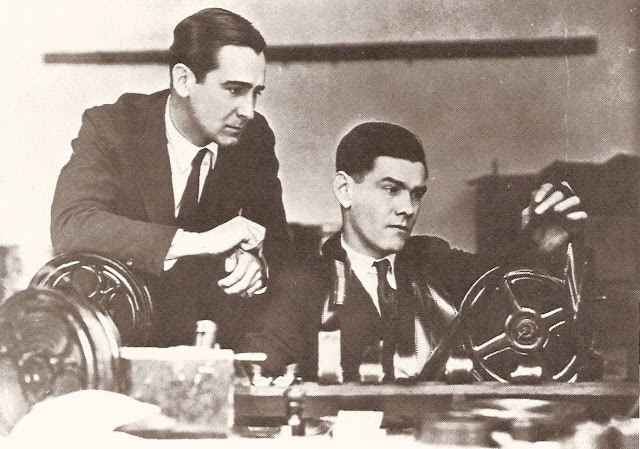
Rex Ingram’s output was impressive while it lasted — 27 pictures in just under 16 years. Unfortunately, few of his pictures are readily available to help us appraise his full career. Many (if not all) of his pre-1920 pictures are lost forever, and others are preserved only in archives and seldom shown. Fortunately — and it is good fortune indeed — the handful to be found on home video are among his best, and preserve the record of a great director at the pinnacle of his career.

The Four Horsemen of the Apocalypse, make no mistake, is every bit the masterpiece it was in 1921, and can be shown today to anyone without explanation or apology — anyone, that is, who doesn’t blindly and rigidly refuse to abide silent movies. There’s a reason this one made a star of Valentino (it’s probably still his best performance), but he’s far from the only reason to see it, and not even the best reason at that. Alice Terry (not yet Ingram’s wife) is radiant as Valentino’s married lover, and veteran Joseph Swickard as Valentino’s father gives one of the great performances of the silent era; it is in fact Swickard who carries more of the film than any single player. And over it all is Ingram’s amazing command of pacing, epic sweep, and depth of emotion, while underpinning it is June Mathis’s literate distillation of Blasco Ibañez’s sprawling novel.

Scaramouche (available here in a gorgeous transfer from the Warner Archive) has nearly the epic sweep of Four Horsemen, and John Seitz’s camerawork is little short of astonishing. Rafael Sabatini’s novel is faithfully and intelligently followed (unlike the 1952 remake, which made major changes), and the settings, costumes and faces of the characters have the realism of a trip in a time machine to Revolutionary France.

The Prisoner of Zenda, at least in the version I’ve been able to track down, does murky damage to Seitz’s photography, but Ingram’s subtlety, eye for detail and sense of pace survive, as does Lewis Stone’s performance in the lead (Ronald Colman obviously emulated him in the 1937 remake) and Ramon Novarro’s delightful turn as the likeable villain Rupert of Hentzau.

In the final analysis — and I admit, this is the rankest barstool psychology — I think Rex Ingram was an artist who fought against the constraints of the nascent studio system without realizing how much its support and resources helped him achieve what he was after. He worked best at the controls of a well-oiled machine with a complement of crack mechanics who understood how the machine worked and where Ingram wanted it to go. At its best, that machine and that crew gave shape to what Michael Powell called “Rex’s extravagant dreams”; when the crew started to fall away and Ingram tried to do more of the work alone or with substitutes, then came what Powell in the same sentence called his “thundering mistakes”.

Ingram had Irish charm, but arrogance as well, and he made enemies as easily as friends (though not as often). When he fell out with June Mathis, I’m sure it never occurred to him that it might backfire later on. And when she was mulling who would direct Ben-Hur, I suspect he thought something like, I’m the best choice for this job and she knows it. When Mathis chose Charles Brabin, he probably thought Mathis was being petty and vindictive and — maybe even — just like a woman. This created such a disgust in him — that she would wound him and the picture, simply out of spite — that it drove him out of Hollywood altogether, as far as he could go and still breathe the air.

In Nice he found a studio where, he thought, he needn’t wrangle with or truckle to anyone, smaller and more manageable than the factories that were coalescing in Hollywood, more like the heady, footloose atmosphere at Edison and Vitagraph where he started, but better equipped and up to date. But there was still wrangling to be done, and what he thought of as truckling we might now call networking. Off there in the Mediterranean, to the moguls back in Hollywood he was out of sight, out of mind. MGM indulged him because his movies were good, even excellent. And while there were no more blockbusters like Four Horsemen, there were no calamities either; his pictures made money, and even the least successful (The Magician) broke even. But when his time-out was up and Ingram still wouldn’t come home and play well with others, Metro-Goldwyn and Mayer sighed and cut him loose. Ingram, for his part, shrugged and got on with his life.

Of course, I could be wrong.

Finally, two quotes. First, Grant Whytock, editor on eleven of Ingram’s best pictures: “Rex worked harder than anyone I’ve ever seen. He used to run to the set.”

And one more from Byron Haskin: “Ingram’s work forecast the coming of finesse in movies. I would rank Ingram as number one director, number one in the business. He had traces of sophistication that were not seen in films, that’s all there was to it. Films were just a child-like, fairy-tale quality about most of them; they were made to entertain, and that’s that. But Ingram got into nuances and values of the story, of the characters that — I don’t really know any other director who reached that deeply.”
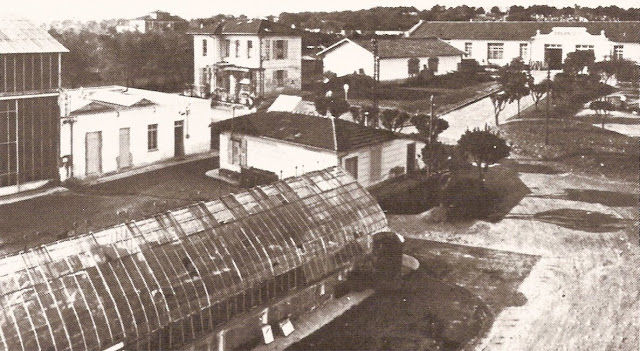
 

And here’s a parting look at the Victorine Studios as Ingram knew them in 1928. They still stand, though much changed, having weathered bankruptcies, fires, and World War II. Hitchcock’s To Catch a Thief was shot there, and Truffaut’s Day for Night, and even Mr. Bean’s Holiday. They are now run by Euro Media Television, the name changed to Studios Riviera. Ownership of the property will revert to the City of Nice in 2018, at which time the property may be cleared, subdivided and redeveloped. Some people say the ghost of Rex Ingram still walks there. They say he doesn’t want the place to close.
Posted in Blog Entries

The Bard of Burbank, Part 2

Jim Lane's Cinedrome Posted on July 28, 2010 by Jim LaneAugust 11, 2020

“Was Warner Bros.’ film the glorious climax of Shakespearean art,” asks Scott MacQueen in his commentary on the DVD of A Midsummer Night’s Dream, “or just another sign that the Day of the Locust was at hand?” It’s a good question, and I’ll address it in due course.

First, though, let’s take a look at the opening title that appears on the Midsummer screen. I wonder: Is this the only time the word “Brothers” was ever spelled out in a Warner Bros. picture? (They didn’t do it for Anthony Adverse, the studio’s big prestige spectacular of the following year.) Somehow it seems to lend an intimate touch, as if the title card were speaking for Harry, Albert and Jack Warner personally, not merely the corporate entity whose official name was “Warner Bros. Pictures.” At the same time, there’s an almost endearing air of self-conscious dignity about it. Deference too — notice that Max Reinhardt gets bigger billing than the brothers themselves.

Notice something else, the background. It’s an image that appears again early in the movie, as the scene shifts from Athens to the forest fairyland. There’s the moon exactly as it’s described by Hippolyta, Queen of the Amazons, “like to a silver bow/New-bent in heaven.” It’s the kind of touch that ruffled the feathers of some of the movie’s snootier critics (especially in Great Britain), a sign that (in their eyes) Shakespeare’s sublime poetry had been sullied by the over-literal hands of these impertinent, vulgar Yanks. A more charitable eye might have perceived that the artists and craftsmen behind the screen understood and honored that poetry, and were doing their best to render it faithfully in the visual medium that was their own area of expertise.

For the Hollywood Bowl production of A Midsummer Night’s Dream that so captivated Hal Wallis and thousands of other Angelenos, Reinhardt had moved away from the minimalist staging that he had been trending toward in Shakespeare’s forest revel (and which has more or less been followed ever since). In such a setting, a bare stage and simple green curtains would hardly do, so Reinhardt had transformed the play into a spectacular, awe-inspiring pageant. Or rather, transformed it back, for that was what the 19th century had seen in the play at least ever since 1843, when a German production in Potsdam first incorporated Felix Mendelssohn’s grandly romantic incidental music.

Scott MacQueen’s commentary on the DVD goes far to address the need for a full account of the making of A Midsummer Night’s Dream (though I still say it rates a book), but he offers only scattered details of the Bowl production which begot it. To my knowledge, no pictures from that staging are readily available, so I can’t address how the movie might have emulated or departed from it. There is, however, a certain semi-Wagnerian, almost Teutonic grandeur to the movie that is in keeping with what we know of Reinhardt’s style, and reviewers who saw his stage productions in L.A., New York and London recognized his touch on the screen. Whether direct credit for the final look of the movie goes to Prof. Reinhardt or to a combination of art director Anton Grot, set designer Harper Goff, costumer Max Ree, cinematographer Hal Mohr and editor Ralph Dawson (who won the movie’s other Oscar), it’s clear that the headline “A Max Reinhardt Production” was no empty boast.

The Hollywood Bowl had freed Reinhardt from the limitations of the ordinary proscenium stage. The movie screen freed him from the limitations of even that vast basin in the Hollywood Hills. As it happened, the camera ventured outside the sound stages only for this brief scene, where you can see the familiar hills of the Cahuenga Pass behind the studio’s backlot. But other freedoms came with the camera, and Reinhardt and co-director William Dieterle drew on the talents of Mohr and special effects team Byron Haskin, Fred Jackman and Hans Koenekamp to do things impossible on any stage.
 

Like this, for instance. Here the followers of fairy queen Titania gather for their nightly revels, prancing, dancing, swirling and flying to the sprightly strains of Mendelssohn’s Scherzo as scored by Erich Wolfgang Korngold. (Korngold was imported by Reinhardt from their native Austria to arrange Midsummer‘s music; he would stay in Burbank to do other work for Warner Bros. Then, on the heels of Hitler’s annexation of Austria, Korngold would settle in Hollywood permanently, composing some of the greatest film scores of all time.) In the droll words of The New Yorker’s John Mosher, “The Reinhardt fairies flit over the treetops on escalators of moonshine, mists rise from the meadows and take the shapes of weird creatures of the night…” Shakespeare himself (as we can infer from the text of his plays) had a keen appreciation for the power of theatrical effects; would he not have reveled in these scenes as much as Titania’s fairies do? I believe he would have, and that anyone who thinks otherwise is a snob beyond redemption.  

This first confrontation between the fairy king and queen — “Ill met by moonlight, proud Titania” — sets up the royal couple in terms of darkness and light. Victor Jory’s Oberon, in voice and appearance, is literally “king of shadows,” Anita Louise’s trilling Titania the physical embodiment of “moonlight revels” — indeed, she first materializes on screen as a moonbeam taking human shape. The two become a kind of supernatural yin and yang, and the visual juxtaposition of quarreling darkness and light emphasizes what Titania (in lines cut from the movie) calls “this…progeny of evils [that] comes/From our debate, from our dissension.” Was this what Shakespeare had in mind? I don’t know. But does it aptly express the spirit of the “debate and dissension” between the fairy monarchs that disrupts the life of the forest and spills over into the lives of the young lovers and Nick Bottom’s troupe of amateur players? It certainly does, and from Reinhardt and Dieterle down through the hierarchy of Warners’ designers and technicians, it bespeaks an acute understanding of Shakespeare’s play and an instinctive confidence in bringing it to life. 
 
Other facets of Reinhardt’s production drew fire, particularly the casting — some said miscasting — of some of the roles. In truth, it’s dizzying to consider some of the choices Reinhardt, fresh off the boat in New York, telegraphed to his son Gottfried, urging him to secure the following talents for stage productions in Hollywood, San Francisco and Berkeley: Oberon – John Barrymore; Titania – Greta Garbo; Puck – Fred Astaire; Hermia – Joan Crawford; Lysander – Gary Cooper; Helena – Myrna Loy; Demetrius – Clark Gable; Bottom/Pyramus – Charlie Chaplin; Flute/Thisbe – W.C. Fields; Theseus – Walter Huston.
 
Whew! Some of those choices are intriguing; most make us wonder what the maestro was thinking. But nearly all of them were obviously out of the question on sheer logistical grounds. That Reinhardt even contemplated such a stew was an early sign that his understanding of movieland reality was severely limited and would need careful guidance from old hands like Hal Wallis, Henry Blanke and (most particularly) William Dieterle.
 
In any event, when it came time to make the movie, most of the principal cast came from the deep bench of Warner Bros.’ contract players. Most widely reviled of these was Dick Powell as Lysander, both then and now — even Wikipedia makes a point of saying he was “horribly miscast.” But that’s unjust, really — if not to Powell, then certainly to whoever assigned him the role. In fact, he was ideally cast; there’s not that great a gulf between Lysander and Billy Lawlor in 42nd Street or Brad in Gold Diggers of 1933.
 
The problem wasn’t Powell’s casting, it was his performance; he’s terrible. 


He preens…


…minces…


…simpers…


…and pouts, in easily the worst performance of his career, and arguably one of the worst in Hollywood history. Powell was already chafing at his boy-tenor roles, sensing that the clock was ticking — on stage a male ingenue might keep it going until his grandkids were out of knee pants and pinafores, but in the movies it would never work, and at 30 Powell’s juvenile days were clearly numbered. Well then, playing Lysander in A Midsummer Night’s Dream was a heaven-sent opportunity for Powell to segue nimbly from squiring Ruby Keeler and Wini Shaw around Buzz Berkeley’s dance floors into the kind of roles where he could age with grace. But did he see it that way? He did not. Insisting he wasn’t “a Shakespearean actor,” he tried to dodge the role (some say “to his credit,” but I’d say it does him none; never mind “Shakespearean,” whatever that means; do you want to act or don’t you?). When the studio wouldn’t let him take a pass, he seems to have gone out of his way to prove how wrong they were. Obviously he didn’t think that one through; when the projector beam finally hit the screen in October 1935, it wasn’t Jack Warner or Hal Wallis up there with egg on his face. When Powell finally managed to carve out a new screen persona for himself in 1944’s Murder, My Sweet, I wonder: did he ever look back on the chance he had blown nine years earlier?

We can contrast Powell’s tantrum of a performance with another Midsummer actor who was miscast yet still managed to make it work: James Cagney. He’s the last actor you’d expect to play the lumpen dullard Nick Bottom, and he was apparently one of the last considered. Dieterle’s early notes mention Wallace Beery and W.C. Fields. Beery was a logical choice, if he could keep from dawdling through his lines and overdoing the neck-scratching mannerism he liked to use instead of acting — and if anyone on the set could have stood working with him (it certainly would have strained Anita Louise’s talent to the limit). Fields might have been fun, but the idea was a nonstarter — he was shooting David Copperfield over at MGM. Memos from Hal Wallis say what a “far-fetched” choice Cagney would be, and as late as the day before rehearsals started, contract player Guy Kibbee was slated for the role. But Reinhardt made an executive decision and Kibbee was out, Cagney in.

Fifty-two-year old Guy Kibbee would have been a comfortable choice for Bottom — a little old, maybe, but the right physical and character type — and he probably would have passed muster with the critics (except those in England who sniffed that there were just too damn many American accents in the cast). But Reinhardt was impressed with Cagney’s dynamism and the studio was comfortable with his box office clout (he did get top billing), so that was that. Cagney’s approach was straightforward — “The keynote,” he recalled decades later, “was the sonofabitch was a ham…he wanted to play all the parts…” He played Bottom as cocky and obnoxious rather than sluggish and obstinate; he made the character work for him, and made his performance work for Reinhardt and the movie. It’s not exactly the Bottom of Shakespeare, and in the movie it’s not entirely incongruous for Titania to fall for him, even crowned with a donkey’s head. But faced with the fait accompli of his casting, Cagney rolled up his sleeves and got to work. It was an attitude Dick Powell could have learned from, if he’d pulled in his lower lip long enough to take notice.


One facet of the movie that I’ve seen no comment on, but that keeps it living and breathing today, is its undercurrent of discreet eroticism. Nothing to put the bluenoses of the Hays Office out of joint, to be sure, but it’s there all the same. Here, for example, is the on-screen equivalent of that posed publicity shot of Titania and Bottom that I showed in Part 1. Not only is the pose more explicitly sexual, but so is the expression on Titania’s face. In the publicity still she stares blankly past Bottom’s snout, while here — in action, as it were — she gazes at him with a postcoital afterglow worthy of Scarlett O’Hara.

And here we are again with Hermia, as she contemplates eloping to beyond the forest with her true love Lysander. In 18-year-old Olivia de Havilland’s first screen performance, Hermia is proper and maidenly, but we see moments like this, flashes of the wanton under her decorous exterior. It makes the transition ring true later, as Puck’s mischievous love potion takes effect on Lysander, when Hermia becomes a snarling spitfire, seething with all the fury and sexual frustration of a woman scorned.

Notwithstanding the Neo-Victorian pageantry of the movie, there’s one way in which Reinhardt and Dieterle look not back to the past, but forward to later directors’ approach to A Midsummer Night’s Dream: they treat the quartet of young lovers not as the lyrical ideals they had become in the 19th century, but as foolish figures of fun, and the squabbling and bickering of this romantic quadrangle are some of the funniest scenes in the movie. Love’s unpredictable magic has turned them all into asses — a neat counterpoint to the story of Nick Bottom, where being changed into an ass unexpectedly turns him into a lover. Again, is that counterpoint explicitly to be found in Shakespeare? Perhaps not. But is it an astute comment on the intertwined stories of the Dream? Definitely. And it shows (again) an acute understanding of the material running all through the Warner lot in Burbank, not (as some critics then and now would have it) a blundering blindness to the beauty of what they were manhandling in their clumsy paws.

So returning to Scott MacQueen’s question — no, this was not the flowering of Shakespeare’s art, although it came closer to it than anyone could have expected. But “a sign that the Day of the Locust was at hand”? Hardly. For that, we need look no further than the 1930 Moby Dick, when Warner Bros. thoughtfully corrected the oversights of Herman Melville by providing Captain Ahab with a last name, a sweetheart, and a happy ending.

A Midsummer Night’s Dream may well be the most miraculous of those “miracle pictures” I wrote about before. Warner Bros. and Max Reinhardt undertook one of Shakespeare’s most beloved plays — not to “improve” or “correct” it, as Warners had tried with Moby Dick, but to fulfill it. Hal Wallis saw something at that amphitheater on Highland Avenue that struck him as worth putting on film, and whatever changes were wrought between the Bowl and Burbank, Wallis and his colleagues did their best to get it right. Let the salesmen worry about getting audiences into the theaters.


I conclude this tribute with a salute to three of the players from A Midsummer Night’s Dream, the three members of the Hollywood Bowl cast who Max Reinhardt absolutely insisted must be included in the movie. By a happy coincidence, they are also the last three survivors of the principal players. Top to bottom: Mickey Rooney as Puck, Olivia de Havilland as Hermia, and Nini Theilade as chief fairy-in-waiting to Queen Titania.


Rooney and de Havilland hardly need any introduction. De Havilland, not only for her double-Oscar career but for her landmark lawsuit that eventually broke the studios’ iron slaveholder’s grip on their performing artists, may have proven to be Max Reinhardt’s most momentous contribution to movie history.


Nini Theilade, however, is a less familiar name. Born in Indonesia to Danish parents, she was 19 when she danced for Reinhardt at the Bowl, and for Dieterle and choreographer Bronislava Nijinska on the Warner Bros. sound stages. When Midsummer went from its road show to general release, 16 minutes were trimmed; since her performance was almost entirely danced, she was left with only a brief moment of dialogue with Rooney’s Puck. It took the restoration of the complete movie in 1994 to let us again see Mlle. Theilade’s full work, and appreciate her ethereal beauty and exquisite grace. She turned 95 on June 15, while de Havilland was 94 on July 1 and Rooney will turn 90 September 23. Continued long life to them all, and thanks.


UPDATE 9/5/16: Mickey Rooney passed away April 6, 2014, age 93. But I’m pleased to report that as of this date Ms. de Havilland and Mlle. Theilade are still with us, having turned (respectively) 100 on July 1 and 101 on June 15 of this year.

UPDATE 4/15/18: Mlle. Nini Theilade left us on February 13, 2018, just past the halfway mark to her 103rd birthday. Olivia de Havilland, 101, is now the last survivor of Warner’s A Midsummer Night’s Dream — and, in all likelihood, of the Golden Age of Hollywood. 

UPDATE 8/11/20: And now, Olivia de Havilland is gone too, having passed away July 26, 2020, twenty-five days after her 104th birthday. May she, and the rest of the Midsummer cast, rest in peace, with the thanks of us all.

Posted in Bard Burbank, Blog Entries

Post navigation

← Older posts
Newer posts →
index sitemap advanced
search engine by freefind

Recent Posts

  • Twinkle, Twinkle, Little “Star” (Republished)

  • Sixty-Six Years’ Worth of Oscars

  • A Visit with Jody Baxter, Chick Mallison, Trooper Jeff Yorke et al.

  • Ave Atque Vale, Jody Baxter

Articles A – Z

You will find 222 posts in the category  on this blog.


Jump to , 4, A, B, C, D, E, F, G, H, I, J, L, M, N, O, P, R, S, T, U, W, Y

4

  • 40th Anniversary Tour: Jesus Christ Superstar

A

  • “A Genial Hack,” Part 1
  • “A Genial Hack,” Part 2: The Trail of the Lonesome Pine
  • “A Genial Hack,” Part 3: Peter Ibbetson
  • A “Christmas Wish” Returns
  • A Cinedrome “Christmas Tradition” Returns
  • A Cinedrome Pop Quiz
  • A Hitch in the Get-Along: State Secret
  • A Holiday Treat (I Hope!) for Cinedrome Readers
  • A Jigsaw Mystery
  • A Mystery Photo
  • A Time-Travel Studio Tour
  • A Treasure Trove of MGM Shorts, Part 1
  • A Treasure Trove of MGM Shorts, Part 2
  • A Visit with Jody Baxter, Chick Mallison, Trooper Jeff Yorke et al.
  • A Weekend With David O. Selznick
  • A-a-a-and We’re Back…!
  • Addio, Cinevent 42!
  • After a Brief Intermission…
  • America’s Canadian Sweetheart, 1921-2013
  • Andrew Sarris, 1928-2012
  • Auditioning for Immortality
  • Ave Atque Vale, Fairy Princess!
  • Ave Atque Vale, Jody Baxter

B

  • Bright Eyes, 1928-2014
  • Browsing the Cinevent Library, Part 1
  • Browsing the Cinevent Library, Part 2

C

  • C.B. Gets His Due
  • Camera Beauty
  • Cary-ing On
  • Catching Some Rays
  • Catting Around
  • CHAPTER I
  • CHAPTER II
  • Cinedrome Does Its Part
  • Cinedrome Wins 2012 CMBA Award
  • Cinedrome’s Annual Holiday Treat Returns
  • Cinerama-Rama!
  • Cinevent 2016 (Continued)
  • Cinevent 2016, Concluded
  • Cinevent 2016, Part 3
  • Cinevent 2016, Part 4
  • Cinevent 2017 – No. 49 and Counting, Part 1
  • Cinevent 2017 – No. 49 and Counting, Part 4
  • Cinevent 2017 — No. 49 and Counting, Part 2
  • Cinevent 2017 — No. 49 and Counting, Part 3
  • Cinevent 42
  • Cinevent 45
  • Cinevent 50 – Day 1
  • Cinevent 50 – Day 2
  • Cinevent 50 – Day 3 (Part 2)
  • Cinevent 50 – Prelude
  • Cinevent 50 — Day 3 (Part 1)
  • Cinevent 50 — Day 4
  • Cinevent 51 – Day 1, Part 1
  • Cinevent 51 – Prelude
  • Cinevent 51 — Day 1, Part 2
  • Cinevent 51 — Day 2
  • Cinevent 51 — Day 3
  • Cinevent 51 — Day 4
  • Cinevent Turns 50
  • Cinevent, Day 2
  • Cinevent, Day 3
  • Cinevent, Day 4
  • CMBA Blogathon: Come Next Spring (1956)
  • CMBA Blogathon: Kitty (1945)
  • Crazy and Crazier, Part 1
  • Crazy and Crazier, Part 2
  • Crazy and Crazier, Part 3
  • Crazy and Crazier, Part 4

D

  • “Don’t Stay Away Too Long…”

E

  • Elizabeth Taylor, 1932-2011

F

  • Films of Henry Hathaway: Brigham Young (1940)
  • Films of Henry Hathaway: Down to the Sea in Ships
  • Films of Henry Hathaway: Down to the Sea in Ships
  • Films of Henry Hathaway: Fourteen Hours (1951)
  • Films of Henry Hathaway: Prince Valiant
  • Films of Henry Hathaway: The Shepherd of the Hills
  • First Comes the Phone Call
  • Five-Minute Movie Star: Carman Barnes in Hollywood — Epilogue
  • Five-Minute Movie Star: Carman Barnes in Hollywood, Part 1
  • Five-Minute Movie Star: Carman Barnes in Hollywood, Part 2
  • Five-Minute Movie Star: Carman Barnes in Hollywood, Part 3
  • Flo Chart

G

  • “Glamour Boys” Begins…
  • “Glamour Boys” Continues…
  • Grand Opening!

H

  • “Here’s a Job for You, Marcel,” Part 1
  • “Here’s a Job for You, Marcel,” Part 2
  • “Here’s a Job for You, Marcel,” Part 3
  • Harlow in Hollywood

I

  • “Is Virginia Rappe Still Alive?”
  • Items from the Scrapbook of Cosmo Brown
  • Items from the Scrapbook of Cosmo Brown

J

  • Jigsaw Mystery — Solved?

L

  • Liebster Blog Award
  • Lost & Found: Alias Nick Beal
  • Lost & Found: Night Has a Thousand Eyes
  • Lost and Found: Miss Tatlock’s Millions (1948)
  • Luck of the Irish: Darby O’Gill and the Little People, Part 1
  • Luck of the Irish: Darby O’Gill and the Little People, Part 2
  • Luck of the Irish: Darby O’Gill and the Little People, Part 3
  • Luck of the Irish: Darby O’Gill and the Little People, Part 4

M

  • “MOVIE” Souvenir Playing Cards
  • Merry Christmas from Cinedrome!
  • MERRY CHRISTMAS from Cinedrome!
  • Mickey and Judy — Together at Last
  • Minority Opinion: The Magnificent Ambersons, Part 1
  • Minority Opinion: The Magnificent Ambersons, Part 2
  • Minority Opinion: The Magnificent Ambersons, Part 3
  • Minority Opinion: The Magnificent Ambersons, Part 4
  • Minority Opinion: The Magnificent Ambersons, Part 5
  • Minority Opinion: The Magnificent Ambersons, Part 6
  • Movie Playing Cards: 3 of Hearts – Geraldine Farrar
  • Movie Playing Cards: 5 of Spades – George Walsh
  • Movie Playing Cards: 9 of Diamonds – Mary Miles Minter
  • Moving Right Along…
  • Mr. Stewart Goes to War

N

  • Nuts and Bolts of the Rollercoaster

O

  • Our Mr. Webb

P

  • Picture Show 02 — Day 1
  • Picture Show 02 — Day 2
  • Picture Show 02 — Day 3
  • Picture Show 02 — Day 4
  • Picture Show 02, Day 00 — Prelude at the Wex
  • Picture Show 2022 – Day 2
  • Picture Show 2022 — Day 1
  • Picture Show 2022 — Day 3
  • Picture Show 2022 — Day 4
  • Picture Show 2022 — Prelude
  • Picture Show No. 3 — Day 1, Part 1
  • Picture Show No. 3 — Prelude
  • Picture Show No. 3 — Tying Off a Loose End
  • Please Stay Tuned

R

  • R.I.P. Ray Harryhausen, 1920-2013
  • Remembering the Night
  • Remembering the Night
  • Return of “Movie” Souvenir Playing Cards
  • Returning to Lost London
  • Returning to Lost London (Reprinted)
  • Rex the First
  • Rhapsody in Green and Orange – EPILOGUE
  • Rhapsody in Green and Orange, Part 1
  • Rhapsody in Green and Orange, Part 2
  • RIP Dean Stockwell, 1936-2021

S

  • Say, What Ever Happened to Carman Barnes?
  • Shirley Temple Revisited, Part 1
  • Shirley Temple Revisited, Part 10
  • Shirley Temple Revisited, Part 11
  • Shirley Temple Revisited, Part 12
  • Shirley Temple Revisited, Part 13
  • Shirley Temple Revisited, Part 14
  • Shirley Temple Revisited, Part 2
  • Shirley Temple Revisited, Part 3
  • Shirley Temple Revisited, Part 4
  • Shirley Temple Revisited, Part 5
  • Shirley Temple Revisited, Part 6
  • Shirley Temple Revisited, Part 7
  • Shirley Temple Revisited, Part 8
  • Shirley Temple Revisited, Part 9
  • Silent Weekends
  • Silents in Kansas 2011, Part 2
  • Sixty-Six Years’ Worth of Oscars
  • Songs in the Light, Part 1
  • Songs in the Light, Part 2
  • Songs in the Light, Part 3
  • Speak (Again) of the Devil
  • Speak of the Devil…

T

  • “The Best of Us,” Part 1
  • “The Best of Us,” Part 2
  • “The Best of Us”, Part 1
  • “The Best of Us”, Part 2
  • Ted Sierka’s Brush with Greatness
  • The 11-Oscar Mistake
  • The Annotated “Lydia the Tattooed Lady”
  • The Bard of Burbank, Part 1
  • The Bard of Burbank, Part 2
  • The Could-Have-Been-Greater Moment
  • The Duke of Hollywood
  • The Fog of Lost London, Part 1
  • The Fog of Lost London, Part 1
  • The Fog of Lost London, Part 2
  • The Fog of Lost London, Part 2
  • The Fog of Lost London, Part 3
  • The Fog of Lost London, Part 3
  • The Fog of Lost London, Part 4
  • The Fog of Lost London, Part 4
  • The Kansas Silent Film Festival 2011
  • The Last Cinevent, the First Picture Show — Day 1
  • The Last Cinevent, the First Picture Show — Day 2
  • The Last Cinevent, the First Picture Show — Day 3
  • The Last Cinevent, the First Picture Show — Day 4
  • The Man Who Saved Cinerama
  • The Mark of Kane
  • The Museum That Never Was, Part 1
  • The Museum That Never Was, Part 2
  • The Return of the King
  • The Rubaiyat of Eugene O’Neill
  • The Sensible Christmas Wish
  • The Shout Heard Round the World
  • The Stainless Steel Maiden, 1916-2020
  • The Stamm
  • Tony Curtis 1925-2010
  • Tragedy in Nevada, January 1942
  • Twinkle, Twinkle, Little ‘Star’
  • Twinkle, Twinkle, Little “Star” (Republished)

U

  • Ups and Downs of the Rollercoaster, Part 1
  • Ups and Downs of the Rollercoaster, Part 2
  • Ups and Downs of the Rollercoaster, Part 3
  • Ups and Downs of the Rollercoaster, Part 4
  • Ups and Downs of the Rollercoaster, Part 5
  • Ups and Downs of the Rollercoaster, Part 6

W

  • “Who Is the Tall Dark Stranger There…”
  • Wings, Again
  • Wyler and “Goldwynitis”
  • Wyler and “Goldwynitis” (reprinted)
  • Wyler Catches Fire: Hell’s Heroes
  • Wyler Catches Fire: Hell’s Heroes
  • Wyler’s Legacy
  • Wyler’s Legacy (reprinted)

Y

  • Yuletide 2018

Copyright Notice

All textual content Copyright © date of posting by Jim Lane. All rights reserved. Unauthorized use and/or duplication of this material without express written permission from this blog’s author is strictly prohibited. Excerpts and links may be used, provided that full and clear credit is given to Jim Lane and Jim Lane’s Cinedrome with appropriate and specific direction to the original content.

↑