
Ups and Downs of the Rollercoaster, Part 6
 There’s just no getting around the fact that Stanley Warner’s management of Cinerama was a disaster from the word go. To be fair, the limits imposed by the court gave SW little incentive to think beyond the short term: They could have no more than 24 Cinerama theaters, and they had to be out of Cinerama by the end of 1958 (SW did get a court-approved extension to that deadline). Still, with the purchase of International Latex, Stanley Warner behaved like a kid with a new toy. Cinerama became the old toy.
SW never operated more than 22 Cinerama theaters at one time, and they never produced enough pictures to keep even those busy (and nowhere near the court-imposed limit of 15 pictures). When they did produce a new Cinerama picture, all they could think to do was produce yet another travelogue, the only real change being where the picture traveled to. Even then, as we have seen, SW would delay release until they had wrung the current release dry; they insisted every picture had to premiere in New York, yet they wouldn’t open a second New York theater. Nor would they even consider beginning a new picture while they had one waiting in the wings; the idea of creating a backlog of pictures ready to go appears never to have been considered.
In 1957, when the foreign-rights agreement with Robin International expired, Stanley Warner ventured into that area themselves. They learned a lesson, though, from Nicolas Reisini’s practice of sub-licensing Cinerama to local exhibitors, who would pay to convert a theater, then lease rather than purchase the equipment from Cinerama Inc. Essentially, what Reisini had done, and what SW did now, was to sell Cinerama “franchises”. It was a policy that might have served Cinerama well from the outset — and indeed Reisini would employ it with some success after he took the driver’s seat — but it seems not to have occurred to anyone before Reisini came along.
Part of the problem all along was Cinerama’s Byzantine corporate structure, which hampered any attempt to strategize Cinerama for the long run. Instead of one central corporation, Cinerama was first three, then four, all severely under-capitalized and with complicated financial relations. A serious simplification of the arrangement was called for, but Stanley Warner never made any effort in that direction.
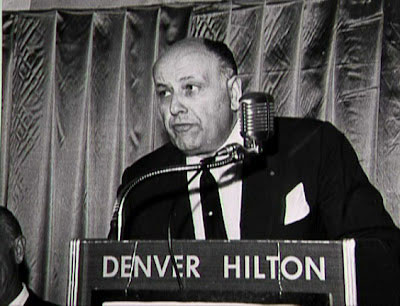 Reeves’s proven management skills might have turned Cinerama around even then if he had taken the reins in a firm hand, but evidently that was never his intention. With hindsight, it appears that Reeves was simply tired of dealing with Cinerama; his concerted efforts to streamline Cinerama’s corporate structure may have been just a way of getting it in good order — like a real-estate speculator fixing up and flipping a rundown house — so he could sell it and roll the capital into his own company, Reeves Soundcraft. In any event, Reeves had control of Cinerama for less than a year before he put it on the market — negotiating first with Walter Reade Jr. of Reade Theatres, then with Nicolas Reisini of Robin International. In the end Reisini bought Reeves out, becoming president and CEO of Cinerama Inc. (In his history of Cinerama, Thomas Erffmeyer mentions that in 1947 Reisini had purchased a California asbestos mine for $350,000 — which now, in 1959, he sold for $4 million. Dr. Erffmeyer doesn’t say if it was this windfall which enabled Reisini to buy Cinerama Inc., but it strikes me as a logical inference.)
Nicolas Reisini was, if nothing else, an energetic and ambitious entrepreneur and wheeler-dealer, and he hit the ground running. Even before assuming the presidency of Cinerama in May 1960, he accomplished something nobody before him had been able to do: He established a co-production agreement with a major studio. The studio was MGM (then flush with the critical and box-office success of Ben-Hur), and the agreement was announced on December 11, 1959: They would produce at least two and as many as six features; MGM production chief Sol C. Siegel would supervise them, with Cinerama having script, director and cast approval; Cinerama would distribute and exhibit the pictures in their theaters, and MGM would handle distribution of 35mm general release versions after the Cinerama roadshow engagements.
 A top priority for Reisini was to bring Cinerama to the widest possible audience — to increase its fan base, if you will. To that end he followed through on an idea Stanley Warner had flirted with in the mid-’50s but (typically) abandoned before doing much with it: portable Cinerama. A caravan of trucks criss-crossed France and other countries in Europe, visiting towns and villages like a 19th century travelling circus. The caravan would set up an enormous inflatable rubber tent — inflatable so it would be self-supporting with no internal columns or poles to block the view of the screen — that could seat up to 3,000 spectators on folding chairs. (Reisini had always been adept at thinking outside the box. In 1954, when Robin International undertook to open theaters overseas, he had tried to interest the United States Information Agency in mounting a travelling Cinerama theater on a retired aircraft carrier. USIA was game, and even President Eisenhower liked the idea, but Congress nipped it in the bud.)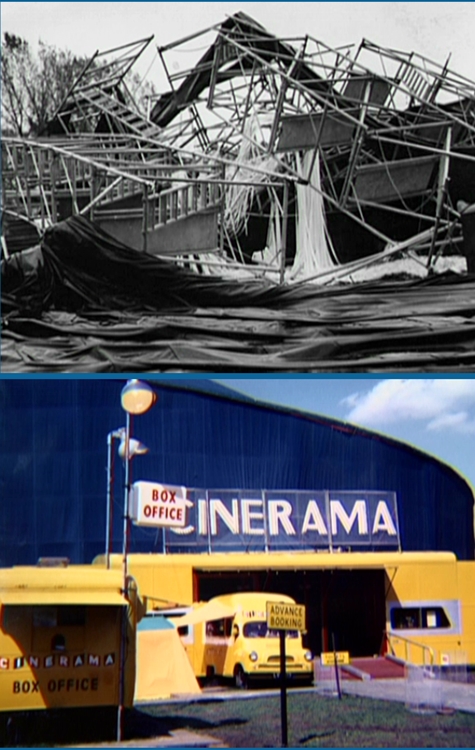
It wasn’t enough to save his job. Enter William Forman of Pacific Theatres. Several of his theaters had installed Cinerama equipment, and Forman jumped in with both feet in February ’63: for $15 million he bought up the note Prudential Insurance Co. held from their 1959 loan of $12 million, and with it he acquired a series of stock options, all of which he excercised, to the point where he replaced Nicolas Reisini as president and CEO in December ’63. Reisini remained as chairman of the board for the time being, but in September ’64, with Cinerama Inc. teetering on the edge of bankruptcy, he resigned even from that, effective immediately.

Welcome,Samantha! And please forgive the delay in responding to your request. I'm afraid I can't tell you much more about the traveling Cinerama tent than is already in my post. Most of my info came from David Strohmaier's excellent documentary Cinerama Adventure; you can learn more about the documentary at the link. Also, there's a "Contact Us" page where you can get in touch with Mr. Strohmaier directly for further information; I've always found him very prompt and helpful.
There's also more about Cinerama's history at the In70mm Web site; a little sloshing around may lead you to more details about that tent.
If Cedric Price's tent project for his Dutch client started in 1963, seems to me it could well have involved a decomissioned "Itinerama" tent. That was around the time Nicolas Reisini was trying to regroup and shore up Cinerama's finances (eventually getting nosed out by William Forman and Pacific Theatres), and he might easily have been happy to unload the tent on a respected architect who had a use for it. This, however, is purely speculation on my part; David Strohmaier or somebody at Pacific Theatres might perhaps shed some light on the question.
Good luck and good hunting, and thanks for stopping by!
HI – I am researching the work of a British architect called Cedric Price (1934-2003). He lists amongst his projects a design for a tent for a client in Holland (1963-71), and the photos in his archive show the more robust version of the tent with tilted roof. The textual records of the project are thin and inconclusive. Do you know who designed that tent? I wonder if Cedric got his hands on a decomissioned one and reused it for his own client's purposes? Any clues would be greatly appreciated!
Samantha Hardingham, London
Hi Jim!
Thanks again for another wonderful series. One advantage of your site is that you can tell a compelling story over many chapters. Unlike a magazine article, which has to condense all the highlights into one entry. Fans like me, who missed out on all these facets of the movies when they first happened, owe you a great debt. I can't wait to see what's next!
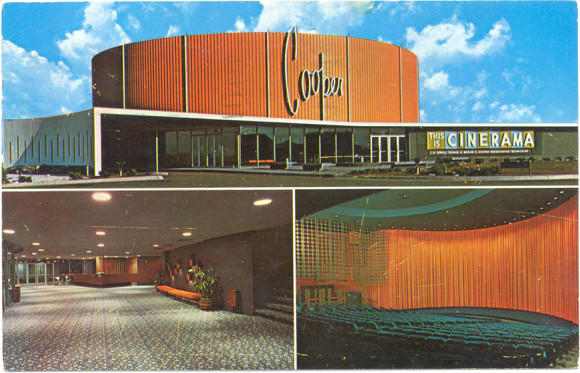
I love the photo montage of the Cooper "Super Cinerama" you've posted. It certainly illustrates the big vision of Cinerama.
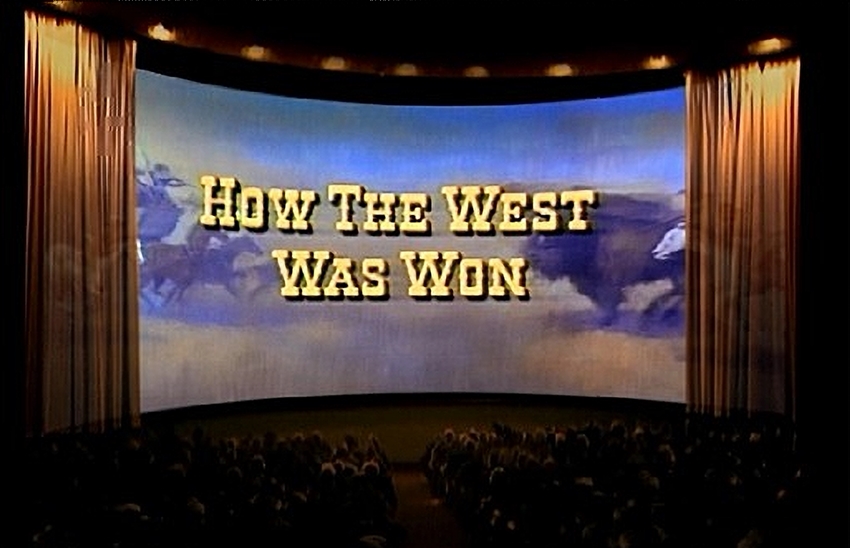
Can' t wait for the festival to start! During HTWWW, I'm going to watch carefully to see I can tell the different camera shots; thanks for pointing this out.
You must be doing this to eventually write a book if not then you should and I now want a thank you credit when the book does come out.