40th Anniversary Tour: Jesus Christ Superstar
Cinedrome celebrates the “Golden Age of Hollywood”, but like many ages, that one has no precise boundary date. As a general rule, I set the end of the Golden Age around 1964 — because that was the last year when the Oscar for best picture went to a movie (My Fair Lady) that was produced entirely within the walls of a major Hollywood studio (Warner Bros.). On the other hand, it’s a hard rule indeed that allows no exceptions, and I’m making an exception now. Here’s why:
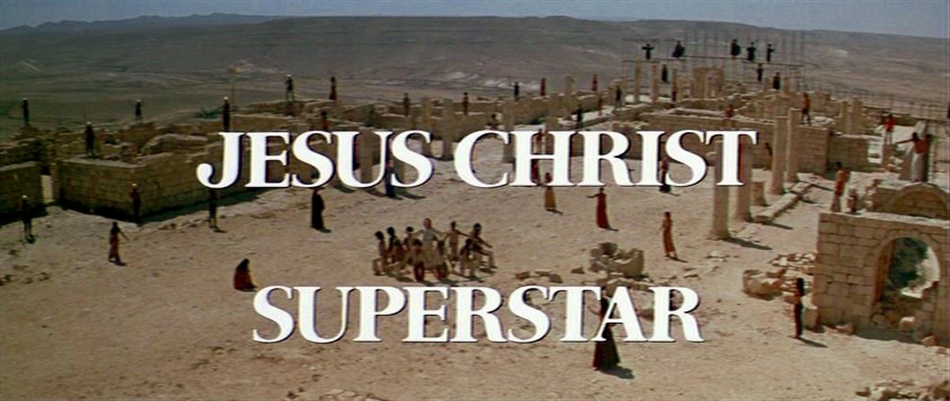
Wrong. As the picture unrolled on the screen before me I was bowled over time and again. At the fadeout I sat there stunned. My friend Paul, who had talked me into seeing it with him, turned to me and said tentatively, almost apologetically, “I thought it was pretty good, Jim.” I said, “I thought it was terrific, Paul.” This being the Era of Continuous Showings, we stayed and sat through the picture again. The next day I returned with other friends and saw it two more times.
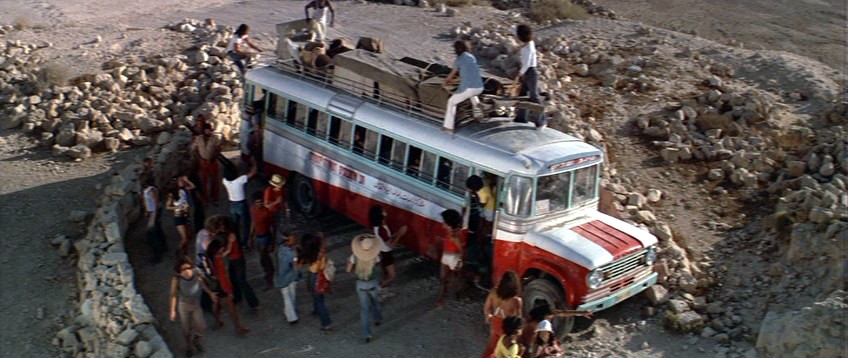
Bragg, the celebrated broadcaster, author and polymath who was made Baron Bragg of Wigton, County Cumbria in 1998, saw at once what Rice did not: that the cast-of-thousands Ben-Hur approach was not only prohibitively expensive but incompatible with the pop vernacular of Rice’s libretto for Superstar. Instead, Bragg and Jewison established the framework of the traveling band of players reconstructing the last seven days of the earthly life of Jesus in a tell-us-now-in-your-own-words manner, as if this modern Passion Play had been developed in improvisational workshops before being brought out to be performed in the open air. It is, in effect, an intimate Biblical spectacle in modern dress. In 1973, you could have left the theater after seeing the movie and, before you’d gone two blocks, seen a dozen people dressed exactly like the performers in Superstar — even the Roman soldiers in their purple tank tops and camouflage pants.
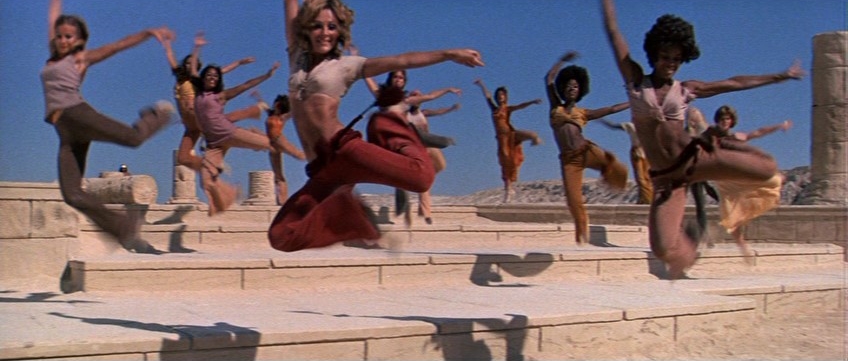 In his 2004 commentary on the DVD, Jewison credits production designer Richard Macdonald with the decision to shoot the picture on existing locations, making only minor modifications in the form of set dressing. Most of these locations — Avdat, King Herod’s Palace, the amphitheater at Beit She’an near Nazareth, where Jesus (Ted Neeley) is tried and condemned by Pontius Pilate (Barry Dennen) — were the ruined remains of Ancient Rome’s occupation of Palestine under the Caesars. Choosing to shoot in these places was a transformative decision, for it meant that Jesus Christ Superstar would show the early followers of Jesus, with the ecstatic joy of young people who have found something truly new and exciting, literally dancing among the bones of the Roman Empire. It’s a metaphor of breathtaking power, one that (naturally) no other production of JCS in any form has ever been able to attempt, let alone duplicate. It gives Jewison’s movie a level of meaning that JCS has never had before or since, one that complements and enhances Webber and Rice’s original text. (These dances, by the way, were performed in desert heat that rose as high as 115 degrees or more. The performers could dance for no more than 30 seconds before Jewison had to call cut and let everybody step to the sidelines to towel off and rehydrate. That the dances — this one is the Simon the Zealot number — play on screen as sustained, high-energy performances is a testament to all concerned: Jewison, choreographer Rob Iscove, editor Antony Gibbs, and most of all, the dancers themselves.)
Because Jesus Christ Superstar is a rock opera — or a “sung-through musical”, if you prefer — with no spoken dialogue, music is a constant on the soundtrack. Jewison makes it a constant in the image as well, fitting every camera movement, every cut, every dissolve, every zoom in or out to the rhythm of Andrew Lloyd Webber’s music. Both the performers and the camera are choreographed, using techniques he learned in early television, when he directed music-variety series like Your Hit Parade and the Andy Williams and Judy Garland shows. In Superstar he does things unavailable in live TV, too — slow motion, freeze-frames, etc. Always, everything to the music: a group of dancers will leap up and freeze midair, then we cut to another group similarly suspended, who come to life and complete the movement the first group began. Everything right on the driving beat; even something as simple as blowing out a candle matches the rhythm of the music.
All these techniques — moving and cutting to the music, playing with time and space — anticipated the music videos that would come along in the 1980s. As Ted Neeley put it in the DVD commentary, “This was the very first long-form music video ever done. MTV came as a result of this; after seeing these, MTV happened.”
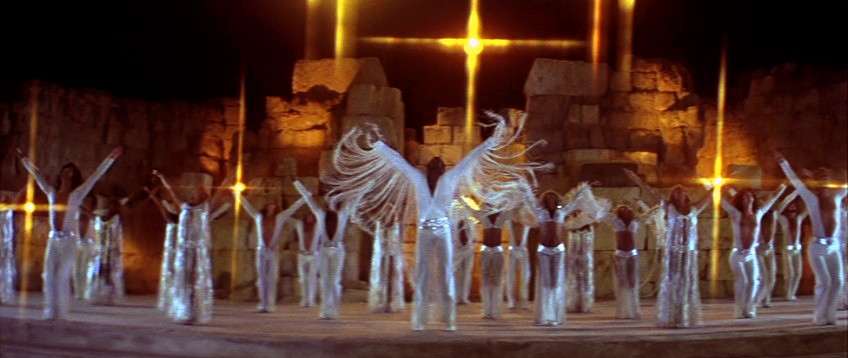 That’s a bit of an exaggeration, granted, but only a bit of one. The picture is a long-form video, with a visual freedom that spans decades of movie-musical syntax, past and (from 1973) future. Jewison’s vision ranges both forward to MTV and back to variety TV, even to the unfettered imagination of Busby Berkeley: this is supposedly an impromptu performance by a band of players piling out of a bus, but the movie draws us on until we’re seeing things this troupe could never have stuffed into those wicker baskets, and we move freely around, among and over the performers in a way no audience could ever do. Take, for example, this exultant rendition of the title song, where the shade of Judas Iscariot (Carl Anderson, center) addresses Jesus with his own doubts and questions. This frame comes at the beginning of a soaring crane shot, the camera rising to heaven as the ensemble sings “Jesus Christ / Jesus Christ / Who are you? What have you sacrificed?” The dancers glitter like silver angels, while Anderson’s costume recalls that of Sly Stone in his performance at Woodstock — a reference that was inescapable to audiences in 1973, every one of whom had certainly seen the hit 1970 documentary.


Then Judas Iscariot (Carl Anderson), the character who drew Rice and Webber to write Jesus Christ Superstar in the first place, in an attempt to understand and explicate his motives. Jesus may be the title role, but in a very real sense Judas is the lead. After the overture — which in the movie serves to introduce the cast, the characters, and the setting — Judas opens the proceedings with the first song, “Heaven on Their Minds”. If Jesus is uncertain what God expects of him, Judas feels no such uncertainty; he believes he knows what Jesus’s mission is, and he very much fears Jesus has betrayed it, letting dangerous celebrity go to his head: “…And all the good you’ve done / Will soon get swept away / You’ve begun to matter more / Than the things you say…” At the opera’s climax, after his remorseful suicide, Judas returns, dropping from the sky dressed in white (a forgiven angel?) to ask what it was all about: “Don’t you get me wrong… / Only want to know…” As the movie’s Judas, Carl Anderson gave the performance of his life — a life, alas, that proved all too short; he died of leukemia in 2004, age 58.

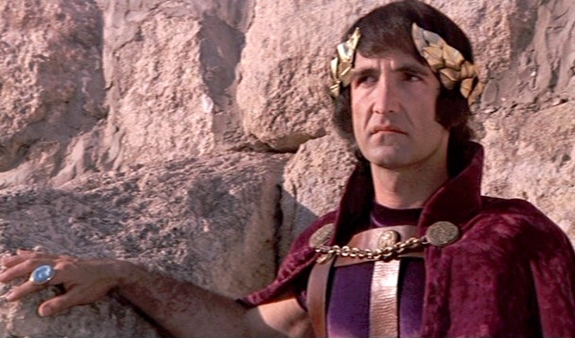
Jesus Christ Superstar took in $10.8 million at the box office, turning a more-than-respectable profit on Universal’s $3.6 million investment (both amounts were far more money in 1973 than they sound like now). It has by now acquired the aura — if not of a great movie musical, as I consider it — at least of a classic. In 1973, however, it weathered a torrent of critical scorn such as few movies have had to withstand. I remember particularly Paul D. Zimmerman’s screed in Newsweek: “…one of the true fiascos of modern cinema…Lord, forgive them. They knew not what they were doing.” There was a fiasco on display here, but it wasn’t the movie, it was Zimmerman’s dunderheaded review. I might have written it myself, if I had never bothered to, you know, actually see the movie. To be fair, Zimmerman was only echoing the near-unanimous sentiments of his critical fraternity. It was as if critics all over, embarrassed at the hyperbolic praise heaped on the album two years earlier, when it was compared to Bach and Handel, had decided in some secret meeting to take it out on Jewison’s movie. (Time Magazine no doubt regretted that they had already used the snark-line “I Was a Teenage Jesus” on 1961’s King of Kings.) Even when a review was positive — and Hollis Alpert’s in the Saturday Review was the only one I ever found — it carried a snide, patronizing air of I-can’t-believe-I’m-expected-to-take-this-thing-seriously. The critical reception was so savage that I sent a telegram to my uncle in Muncie, Indiana:
* * *

All these musings on Jesus Christ Superstar are prompted by an experience I had last Sunday, August 25. Ted Neeley came to Sacramento on the third stop (after Los Angeles and San Francisco) in a cross-country tour commemorating the picture’s 40th anniversary. He brought with him a pristine archival print from the Universal vault, and the audience that day heard Superstar‘s soundtrack as it was meant to be heard for the first time in years, maybe decades. (The audio mix on all the video transfers — laserdisc, DVD and Blu-ray — is incorrect, the vocals too “hot” and instrumentals too “cold”.) Mr. Neeley — actually, I feel comfortable calling him Ted — met with audience members in the lobby before the screening, addressed us from the stage and fielded questions as the show was about to begin, and held genial court once again in the lobby afterwards. He chatted warmly with my friend Don (that’s Don on the left) and me for a good ten or 15 minutes, especially when he learned we were both actors, and that Don himself had played Pontius Pilate in a local production of the show. Like the movie itself, Ted Neeley has aged gracefully and could easily pass for 20 years younger than he is. Our visit with him was friendly and comfortable, a perfect way to top off the day’s reunion with one of my favorite movies.

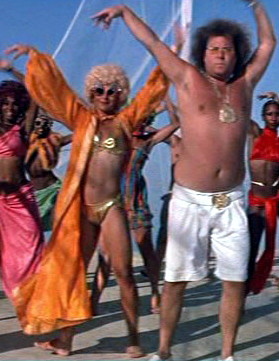
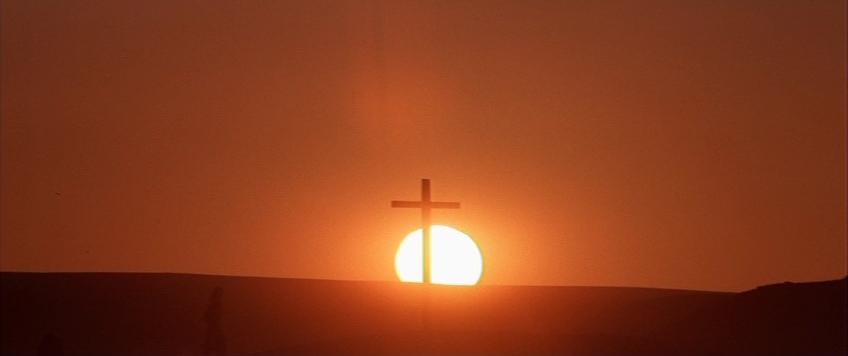 At this precise moment, something happened that nobody planned or even noticed. “We were shooting through a telephoto lens,” Ted Neeley remembered, “from a couple of miles away, looking into the setting sun. We didn’t even see it until later, when we were watching the dailies.” From out of nowhere, a figure appeared — it’s barely visible here at the bottom of the image, about one-quarter in from the left. On screen, the figure moves like a ghostly apparition from left to right across the dark part of the screen under the cross. It’s a shepherd leading his flock; we can just make out their woolly fleeces bobbing along at the bottom of the frame. A shepherd, leading his flock past an empty cross. And nobody knew who he was or how he got there. “Somebody Else,” says Ted Neeley, “was directing that day.”
I don't remember Vera but Baayork Lee was the sweetest person, I'm sure still is. Baayork helped me stay on with the production by coaching and directing me towards the right people. In the final month of filming, the big scenes with extras were completed, she knew (her husband was one of the assistant directors I believe) they needed a few "lepers". She sent me to the hotel bar where I "auditioned" as a leper across the crowded bar to her husband. "OK, you're a leper! Go to wardrome." Securing my participation for the last month of the filming.
Welcome, Wally — and many, many thanks for sharing on your blog those memories of working on Jesus Christ Superstar back in 1973! What a great behind-the-scenes look at one of my all-time favorites. (So tell me, did you get a crush on Vera Biloshisky too?)
In case any other readers come across these comments after you've added to your blog, they can access your JCS post directly HERE.
Thanks again for dropping by; hope you'll return often!
Enjoyed your post. I happened upon the filming of JCS traveling in Isreal in 1973 and got small parts enough to hang out with them for three months. It was incredible. I just wrote about it in my blog at:http://wallysalaskablog.blogspot.com/
I think you will enjoy it.
Wally
Thank you both, Kevin and Dorian; your visits and comments are always welcome here. Dorian, I do hope that sometime between your high school religion class and now you got a chance to see the whole picture!
Jim, your review of JESUS CHRIST SUPERSTAR was fascinating and lovingly drawn! In fact, I remember our high school religion class getting a reel of the film in The Bronx, and we were wowed (I'm sure the rock music didn't hurt :-)). Thanks for sharing this with us!
Great post, Jim. I have friends who are big fans of the movie version and I passed your site on to them. They loved your post and thought you captured the success of the film very well.
As for me, it's been decades since I've seen it. Time for another look see. I did see a revival at the Chicago Theater with Ted Neely and it was a terrific production.