
Cinerama-Rama!
I had hoped to be able to go into more depth with this post, but events have overtaken me, so I have to write it pretty much off the top of my head and get it up as soon as possible.
It’s been, oh, 25 or 30 years now since a teenage cousin of mine heard me mention Cinerama and asked me what it was. I was astonished, back then, that there was someone who didn’t know. Well, that cousin is now 46, with a Ph.D. and a position in the Microbiology Dept. at the Univeristy of California Irvine. How many have been born since then who also don’t know what Cinerama was?
In a nutshell, and for the benefit of those who don’t know, Cinerama was the first successful widescreen process. Hollywood had flirted with widescreen photography in the late 1920s and early ’30s, but it proved to be an innovation too far for an industry already grappling with the transition to sound and the Great Depression, and the experiment quickly petered out in failure.
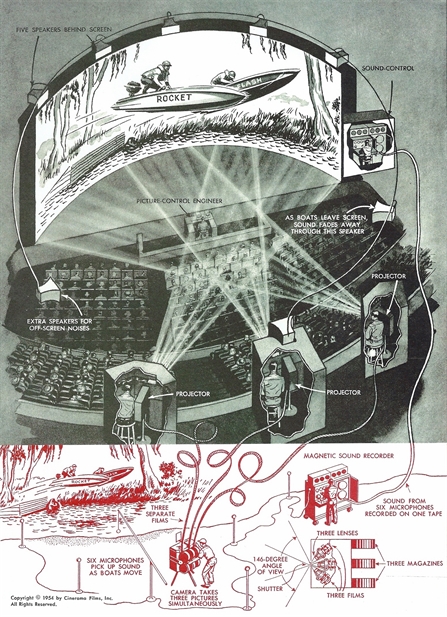 By the early ’50s things had changed — and besides, Cinerama was as different from those early pictures in Grandeur and Magnascope as FM radio was from AM. The screen wasn’t just wide, it was vast, curved 146 degrees to match almost the full range of human vision, using three synchronized projectors to display an image nearly five times the size of even the largest theater screen. And Cinerama had a multi-channel high-fidelity sound system for which a new term was coined: “stereophonic sound”.
Cinerama’s reign was brief, just a little over a decade, but it was the wonder of the age while it lasted. It was the brainchild of Fred Waller, an engineer, photographic researcher, special effects technician and director of short subjects at Paramount’s East Coast studio at Astoria, Long Island (he also invented water skis, believe it or not). Waller’s inspirational insight was the understanding that peripheral vision is what enables the eye to perceive depth, and he became obsessed with the idea of duplicating the entire range of human vision. Eventually, in 1939, he developed what he called Vitarama, an incredibly complicated system of 11 interlocking projectors in three rows of four, five and two, casting a single image on the inside of a hemispherical screen. In 1940, as it became increasingly clear that America would be entering World War II sooner or later, Waller contracted with the military to modify Vitarama (cutting the number of projectors from 11 to five) into the Waller Flexible Gunnery Trainer, an early version of a flight simulator (or video game) for training airplane gunners in aerial combat.
After the war, Waller continued to fine-tune the process, streamlining the projectors from five to three, replacing the hemispherical screen with a wide, curved rectangle, and partnering with sound technician Hazard Reeves to develop that multi-track sound system. But Waller was unable to interest anyone in what he now called Cinerama until it came to the attention of Lowell Thomas, the famous radio commentator, adventurer, lecturer and journalist who had first made his name covering T.E. Lawrence’s campaigns in Arabia during World War I (Thomas made Lawrence’s name, too). Thomas enlisted the services of producer Merian C. Cooper. Long story short, the result of Waller’s know-how and Thomas and Cooper’s enthusiasm and showmanship opened at New York’s Broadway Theatre on September 30, 1952. That first Cinerama production, which opened as simply Cinerama and eventually came to be known as This Is Cinerama, is (not to mince words) one of the most important and influential movies ever made — after all, today, it is a rare and cheap movie indeed that isn’t produced in wide screen and stereo.
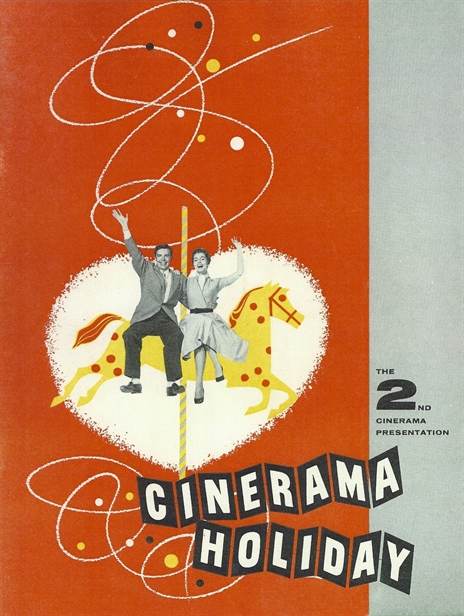
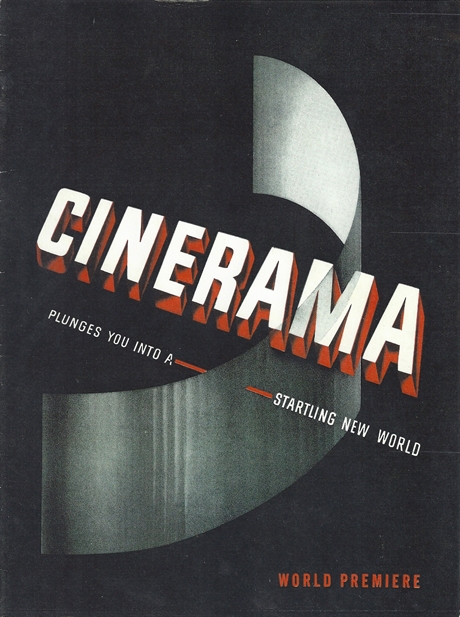 This coming September 30 will mark the 60th anniversary of Cinerama‘s premiere, and the occasion is not going unobserved. ArcLight Cinemas, which owns the Pacific Cinerama Dome in Hollywood (one of only three theaters in the world equipped to show true Cinerama) will be spending a week, from September 28 to October 4, presenting — to borrow the title of the second Cinerama production — a Cinerama Holiday. Every single Cinerama picture produced during the years Cinerama reigned as the Metropolitan Opera of movies will be on display, along with a couple of ringers — Cinerama’s Russian Adventure, an Americanized release of a picture produced by the Soviets in 1958 with pirated equipment and called Kinopanorama (then, typically of the time, the Russians accused us of stealing it from them); and Windjammer: The Voyage of the Christian Radich (1958), produced in a competing but compatible process called Cinemiracle — plus two movies that bore the Cinerama name even though they weren’t: It’s a Mad, Mad, Mad, Mad World (’64) and 2001: A Space Odyssey (’68).
Not all the screenings will be in “classic” Cinerama. Two of the early travelogues (This Is Cinerama and Search for Paradise [’57]) and the two “story” productions (The Wonderful World of the Brothers Grimm and How the West Was Won, both ’62) will be screened in their original three-strip (i.e., three-projector) form, albeit with digital sound reproduction to replace the original console that played Reeves’s seven-track magnetic sound strip. Mad, Mad World will be shown in Ultra Panavision, the 70mm process that supplanted (but could never replace) Cinerama after How the West Was Won. The others will all be digital presentations, most of them remastered from original negatives.
I’m not sure what to expect from those digital prints, but I’m willing take a chance. In any case, the trip down to Hollywood will be worth it to see This Is Cinerama and How the West Was Won again, and Search for Paradise and Brothers Grimm for the first time. If you can possibly make it to Hollywood, you’ll find it worth the trip too. Click here for details and to purchase tickets (at this writing, only the first screening of each title is available for purchase; later screenings will no doubt be along in time).
I’ll have more to say about Cinerama, but I want to get this post up as quickly as possible. Tickets have only been on sale since Thursday, and they’re already going fast.
To be continued…
The Shout Heard Round the World
It was Merian C. Cooper who came up with the perfect way to introduce Cinerama to audiences. To do it he took a cue from his alter ego Carl Denham in his most famous picture, King Kong, and the way Denham introduced the giant ape to New York.
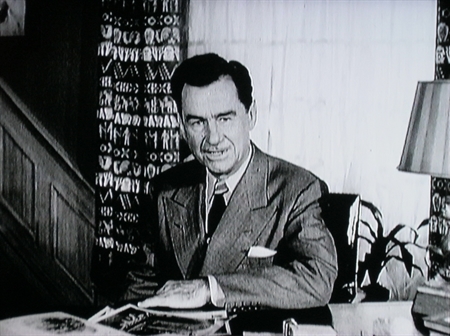 Spectators at that first showing on September 30, 1952 walked into an auditorium dominated by a huge curved wall of wine-red curtains. As the house lights dimmed, they heard the Morse Code dit-dit-ditting that was familiar to them all as the intro to Lowell Thomas’s daily radio program. The red curtains parted slightly, and there was the image of Thomas himself, in black and white, on a standard-size movie screen, welcoming them.
Thomas promised the audience “the latest development in the magic of light and sound.” Then for a full 13 minutes Thomas reviewed the history of moving pictures, from The Great Train Robbery down to 1952. Finally: “The pictures you are now going to see have no plot. They have no stars. This is not a stageplay, nor is it a feature picture, nor a travelogue, nor a symphonic concert, nor an opera. But it is a combination of all of them. In fact, it is the first public demonstration of an entirely new medium. Ladies and gentlemen…This…is Cinerama!”
The curtains rolled open — rolled and rolled and rolled — to the sound of a thundering fanfare that might have accompanied a triumphant army’s march into Ancient Rome, augmented by gasps and squeals from the flabbergasted audience. The screen dissolved from that ordinary little black-and-white image of Lowell Thomas…
…to THIS:
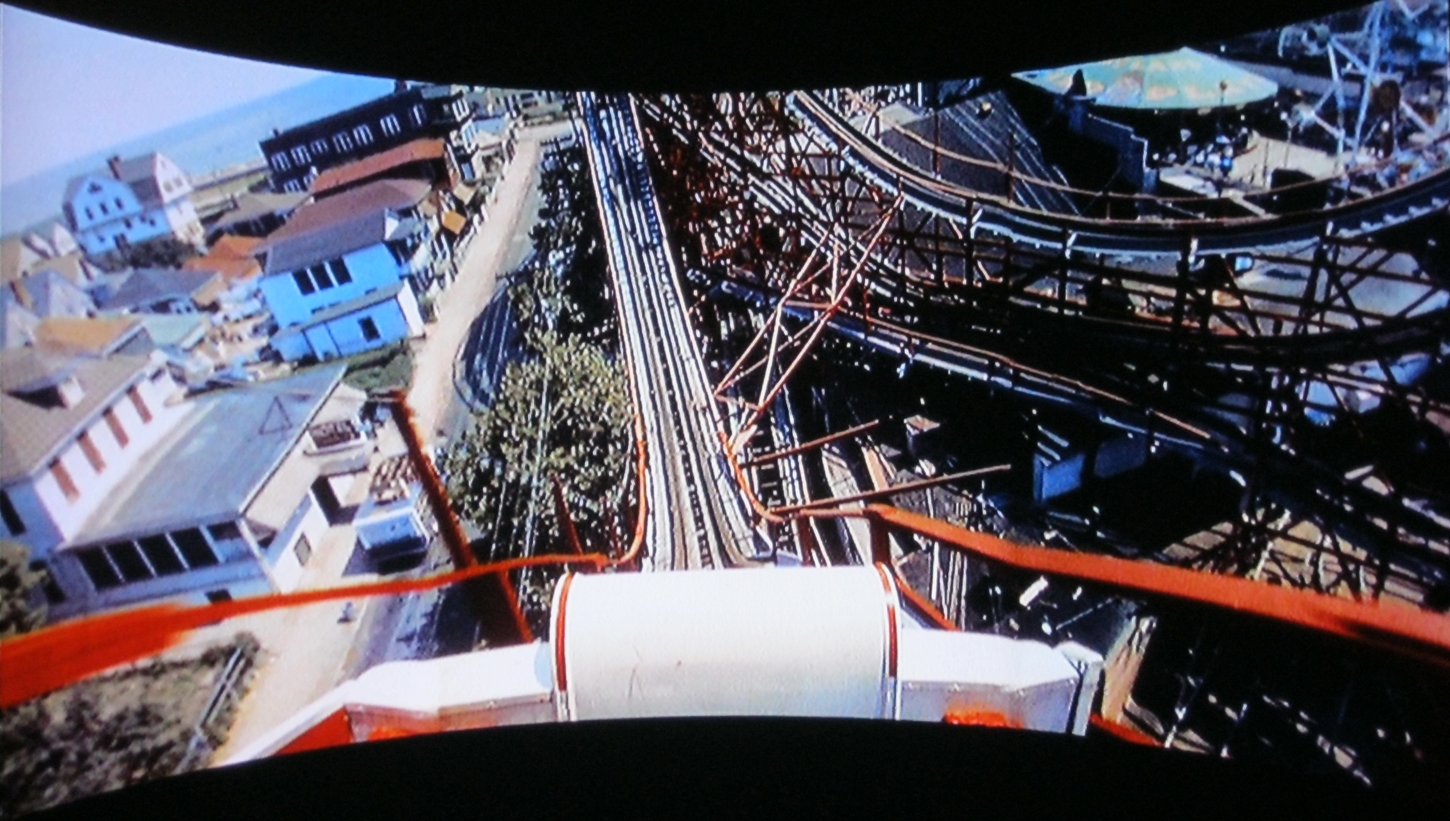
…and that Broadway Theatre audience was taken on an uninterrupted ride in the front seat of the Atom Smasher Rollercoaster at Rockaway, Long Island’s Playland amusement park. “No human being had ever sat in a theater and had this kind of visceral experience,” recalled production manager Jim Morrison. “It hit you right in the gut, right smack in the belly.” And historian Kevin Brownlow: “There was nothing to beat that moment… Suddenly the cinema seemed to open out…the back wall seemed to disappear and we were plunging on a rollercoaster. It was the most staggering moment one could possibly have.”
 My own father’s reaction was more succinct. My uncle took him, my mother and my grandparents to see This Is Cinerama when it opened at San Francisco’s Orpheum Theatre on Christmas Day 1953. As the curtains opened and the rollercoaster burst into view, my father reared back in his seat, his eyes bulging from their sockets, and bellowed at the top of his lungs: “Jeeee-zuss Christ!!” He may have been more vociferous than anyone else that day, but every single person in the Orpheum had exactly the same reaction. I know because when my own turn to see This Is Cinerama came 11 years later — even after a decade of CinemaScope, Todd-AO, Panavision, VistaVision, and all the other scopes and visions Cinerama had inspired — that Great Unveiling had lost none of its power. No two ways about it, this was — and remains — the greatest knockout punch in the history of motion pictures.
That first showing had been a mighty near-run thing. The entire feature had never once been run through the projectors — not until the first audience saw it on opening night. With three projectors running in interlocked unison, the standard practice of switching reels every 12 or 13 minutes was clearly out of the question. Special reels, nearly three feet in diameter, had to be built so that each half of the feature could be run without interruption, the only reel change coming during intermission. Two days before the premiere it was discovered that Act II was too long even for those; the film overran the reels by several hundred feet. With no time to make more reels, everybody cringed, rolled their eyes, took a deep breath and decided to hope for the best. They made it almost all the way home — but during the closing credits, the film finally slopped off the take-up reels and jammed the projectors.
Nevertheless, by that time the screening had created such a sensation that those lost last few seconds counted only as a tiny bump in the road to glory. “It was the biggest night I’ve ever seen in pictures,” Merian C. Cooper remembered. “People stayed on the sidewalk by the hundreds till four or five in the morning talking about it. And I knew we had revolutionized the picture business.”
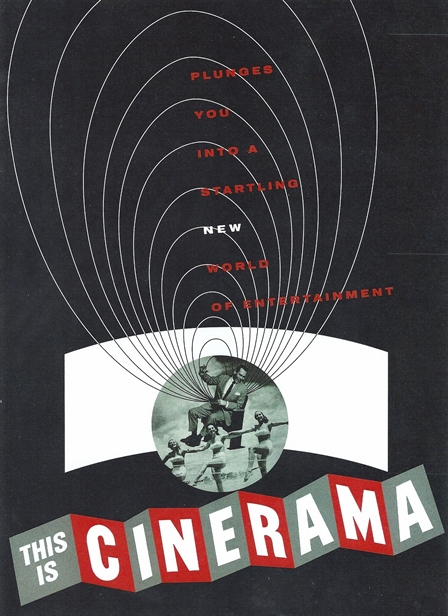
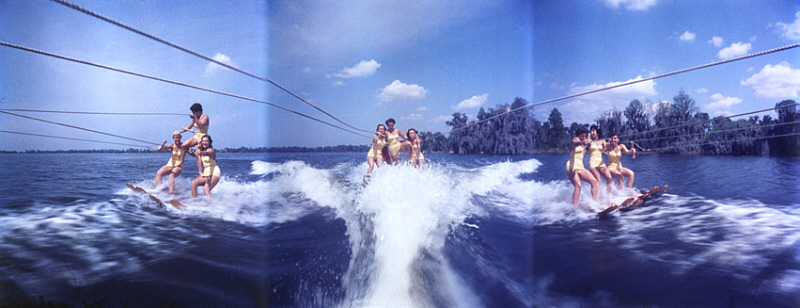
Actually, This Is Cinerama wasn’t really a movie at all; it was an early example of something there wouldn’t even be a term for until decades later: virtual reality. It filled your entire field of vision, 146 degrees left to right, 55 degrees top to bottom (each frame was half again as high as ordinary film, spanning six sprocket holes instead of the standard four). It projected at 26 frames per second instead of 24, lessening the flicker that is always perceived (if only subliminally) by the human eye, and brightening and sharpening the image perceptibly. The sounds didn’t sound recorded at all, and they came from wherever on the screen the images making them were located; musical passages seemed to come from an enormous, invisible orchestra and choir all around you. The postcard image above, an artist’s rendering of the Atom Smasher ride, and the photo on this souvenir program of a theater patron gazing with delight at the bathing beauties water-skiing all around him, are in fact accurate depictions of how audiences perceived the Cinerama experience.
Still, Cooper was right. He and Lowell Thomas and (especially) Fred Waller had revolutionized the picture business. All those Hollywood moguls who had trekked out to Waller’s workshop in Oyster Bay, Long Island, marveling at his demonstration reels but declining to buy into his process, now found themselves scrambling to come up with some variation on Cinerama for themselves. Darryl Zanuck’s 20th Century Fox was first out of the gate in September 1953 with The Robe in CinemaScope (“the poor man’s Cinerama”). Other processes followed, all of them more visually impressive than standard 35mm but none with the sense of audience envelopment Cinerama conveyed; Waller’s process remained the gold standard.
Cinerama entered the culture and the language. There were pop tunes about it (“Oh wide-screen mama/Don’t you Cinerama me…”). The very name Cinerama — a portmanteau word blending “cinema” and “panorama” — influenced American English in ways that haven’t entirely disappeared even now. Everything, it seemed, had its “rama”: laundromats called themselves Launderama; florists had Flowerama; fast-food joints became Burgerama; car dealers became Autorama or Motorama; Kelvinator came out with a Foodarama refrigerator; and, inevitably, burlesque stripper Mavis Rodgers billed herself as “the Sinerama Girl”.
Fred Waller and Hazard Reeves received special Academy Awards at the 1953 ceremony in March 1954, Waller “for designing and developing the multiple photographic and projection systems which culminated in Cinerama”, Reeves for developing “a process of applying stripes of magnetic oxide to motion picture film for sound recording and reproduction.” Two months later, almost to the day, while This Is Cinerama was still playing to sold-out houses at the Broadway Theatre, Fred Waller died of a heart attack at 67. It may seem tragic, to be taken away at the height of his fame after the vindication of his long struggle to bring Cinerama to the public. In fact, however, it was the act of a Merciful Providence. For Waller was spared the heartache of seeing what would become of his brainchild in only ten short years.
But more of that next time…
Ups and Downs of the Rollercoaster, Part 1
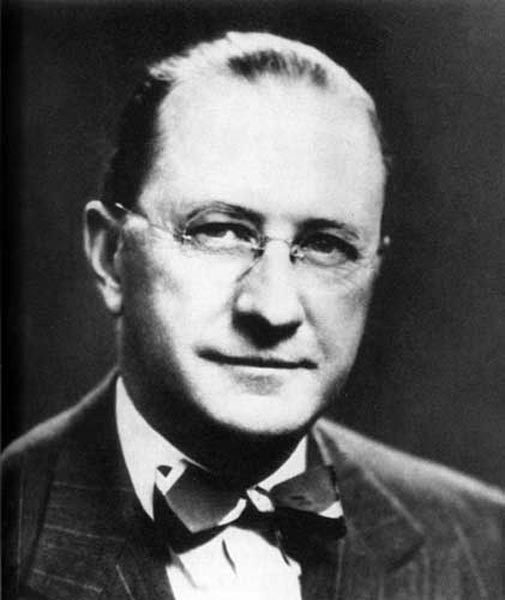 If there were such thing as a Dictionary of Stereotypical Characters, the entry for “eccentric inventor” would have a picture of Fred Waller. In the 1920s and ’30s, Waller’s day job was at Paramount’s East Coast studios in Astoria, Long Island, where he worked as a photographic jack of all trades. In one capacity or another he worked on, among other pictures, Male and Female (1921) for Cecil B. DeMille, and That Royle Girl (’25) and The Sorrows of Satan (’26) for D. W. Griffith. In the ’30s he produced and directed a series of innovative and visually striking jazz-flavored shorts featuring the likes of Cab Calloway, Duke Ellington and Fats Waller.
Meanwhile, on his own time, he tinkered and puttered. He invented a container for keeping food dry in humid climates, a remote-recording wind direction-and-velocity indicator, an adjustable sail batten for sailboats, and a still camera that could take a 360-degree panoramic picture. (Also, as I mentioned before, water skis, which he marketed as Dolphin Awkwa-Skees.) Through it all he continued his obsession with finding a way to photograph the full range of human vision, pursuing his idea that peripheral vision was as important to depth perception as binocular vision. He used to walk around his home wearing a baseball cap with toothpicks stuck in the brim, testing how far back he could place the toothpicks and still see them, mulling over the kind of screen he would need for what he had in mind.
 In 1938, architect Ralph Walker came to Waller with a unique photography challenge connected with an exhibit Walker was designing for the petroleum industry for the upcoming New York World’s Fair. Walker envisioned a spherical room with a battery of projectors casting a constant stream of moving pictures, an idea that dovetailed neatly with what Waller had been turning over in his own head. With Walker’s firm, Waller formed the Vitarama Corporation, and by early 1939 he had a working model of eleven 16mm projectors showing a patchwork image on a concave quarter-dome screen suspended over the heads of the audience.
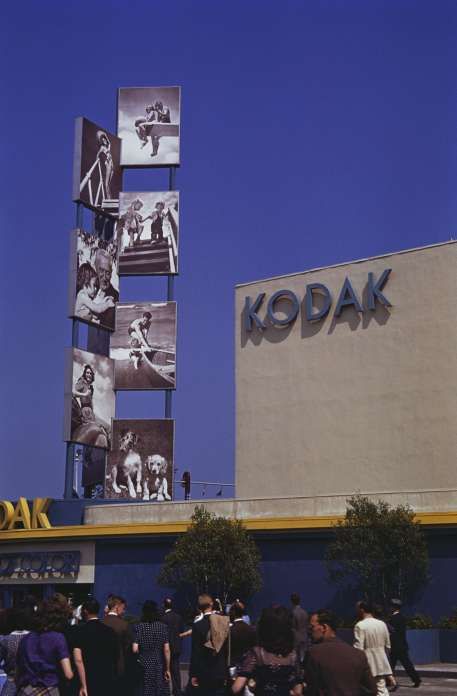
In the end Walker’s clients, the representatives of the petroleum industry, decided not to use Waller’s Vitarama, opting for something simpler, more conventional — and, not incidentally, cheaper to produce and exhibit. Waller adapted the Vitarama idea for another exhibit at the 1939 World’s Fair, a huge mosaic slide show of still images for the Eastman Kodak exhibit. More important, the idea of the concave screen had solved Waller’s dilemma over how to project his multi-part images to envelop an audience.
Waller and Walker obtained the backing of Laurance Rockefeller, scion of one of the world’s wealthiest families, to continue developing the Vitarama process, and an experimental lab was set up in the old Rockefeller carriage stables in Manhattan, where a number of invited guests saw demonstrations of the cumbersome process. The outbreak of World War II in Europe effectively back-burnered any plans to exhibit Vitarama theatrically, but one of those invited guests, a friend of Waller’s, was an admiral in the U.S. Navy specializing in ballistics, and he approached Waller with the idea of using Vitarama in training aerial gunners — looking forward to the time (which virtually everyone knew was coming) when the U.S. would be drawn into the war.
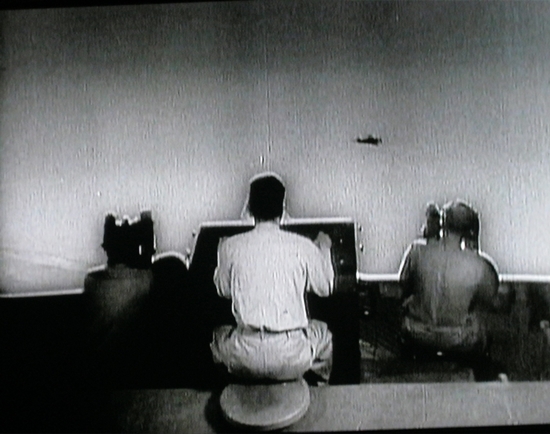 With a massive influx of military money (Waller later estimated it at over $5 million), the Waller Flexible Gunnery Trainer was born. It simplified the Vitarama design, using five 35mm projectors to display the same size image as the eleven 16mm ones, and it enabled Waller to work out the technical challenges involved in both the process itself and the manufacture of the equipment. Eventually 75 trainers, each occupying an area of some 27,000 cubic feet, were set up all over the U.S., in Hawaii, and in England, where over a million men were trained; the Air Force estimated that more than 250,000 casualties were averted thanks to this training.
After the war Waller returned to developing Vitarama for theatrical use. The Cinerama Corporation (it’s not clear exactly where the idea for the name came from) was formed in 1947, with the backing of Laurance Rockefeller, publisher Henry Luce of Time Inc., and other venture capitalists who were prominent in East Coast circles.
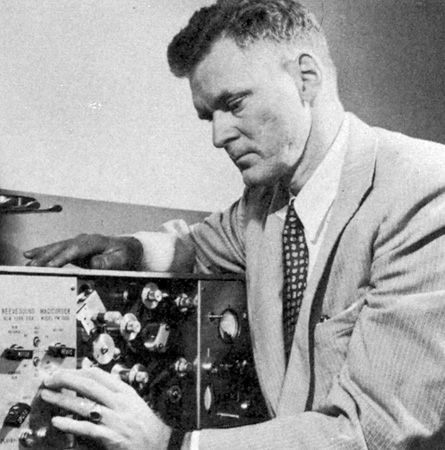 Also coming aboard at this time was Hazard E. “Buz” Reeves, one of the most brilliant and inventive men in the history of sound recording. Reeves had seen Vitarama as early as 1940, and was excited at the prospect of developing a sound system to go with it. Reeves and his company, Reeves Soundcraft, pioneered the use of magnetic recording for movies, a method more versatile than the standard practice of optical sound recording.
As Waller simplified the Vitarama/Cinerama process from five projectors to three, and from the quarter-dome screen to a wide curved rectangle (like the inner surface of a slightly flattened cylinder), Reeves developed a sound system to match: five huge loudspeakers behind the screen, each with its own discrete track, and a sixth track dispersed as needed to speakers placed at the rear and sides of the auditorium. (A seventh track, a composite of the other six, was intended only as an emergency backup and seldom used in practice.) Naturally, seven separate magnetic soundtracks required far more space than a standard optical soundtrack, so the sound was recorded on its own strip of 35mm film and run on a separate “projector” synchronized with the three image projectors just as they were synchronized with one another.
Standard 35mm sound film runs at a rate of 24 frames per second, 90 feet per minute. Cinerama ran at 26 frames per second, with each frame half-again as high, which worked out to 146.3 feet per minute. The soundtrack(s) ran at the same speed, or 29.25 inches per second, nearly twice the rate of broadcast-quality tape machines of the day. This allowed Reeves’s microphones to record a far wider dynamic range, 30 to 15,000 cycles per second (cps), as compared to the standard 125 to 7,000 cps of the day. Reeves and Waller could thus record and reproduce sound with a range and fidelity that, while commonplace enough to us in this digital age, were simply astounding to ears of the late 1940s.
Also in 1947, Waller moved his base of operations to an unused indoor tennis court on an estate in Oyster Bay, Long Island, where he and Reeves set up an experimental lab and the first Cinerama screening room. By the spring of 1949, they had the entire process — camera, projectors, screen, sound system, and demonstration reels — ready to show to further prospective investors. Through the rest of the year, they invited a parade of movie industry figures — theater executives, studio heads, producers, writers, technicians — out to Oyster Bay to see what they had.
The results and reactions were gratifying — up to a point. As Buz Reeves later remembered, there was “a terrifying inertia to their enthusiasm”. It was too cumbersome, too expensive, too complicated, too impractical, yadda yadda yadda. Everybody thanked Waller and Reeves for the show, but passed on the idea of doing anything with it (or about it) themselves.
In May 1950 a demonstration screening for the press attracted little attention and less publicity. Laurance Rockefeller and Henry Luce decided Cinerama was going nowhere, so they withdrew, selling their interest in the process to Reeves for a paltry $1,500. The Cinerama Corporation was dissolved (though Vitarama Corp. continued to hold all the relevant patents). But Waller and Reeves didn’t lose heart; Reeves was literally putting his money where his microphones were. And indeed, all was not lost; Cinerama’s twin angels were just around the corner.
To be continued…
(PLEASE NOTE: For much of the information in this and following posts, I am indebted to the work of Dr. Thomas E. Erffmeyer, who wrote a history of Cinerama as his Ph.D. dissertation in Radio, Television and Film at Northwestern University [June 1985].)
Ups and Downs of the Rollercoaster, Part 2
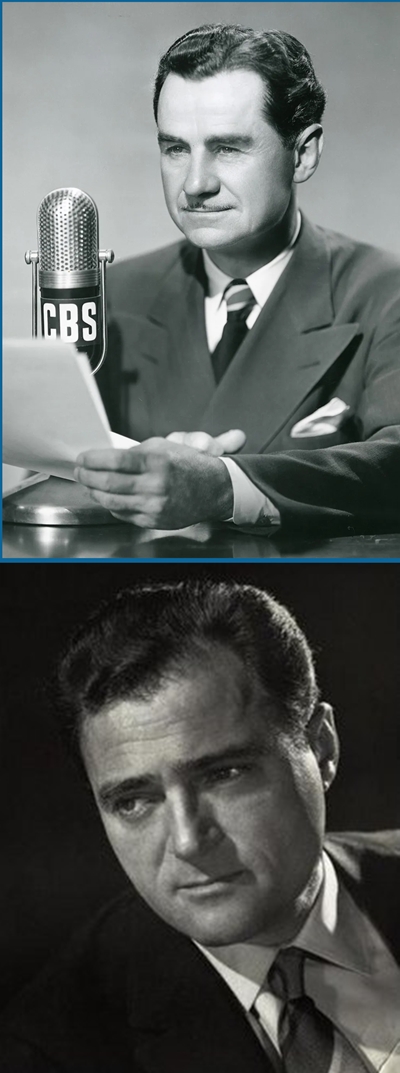 When Rockefeller and Luce bailed on Cinerama in July 1950, those other East Coast investors decided to take a pass as well, and Cinerama Corp. was dissolved in August. After buying out Rockefeller and Luce for a song, Hazard Reeves doubled down — he quite a bit more than doubled, in fact. In September he formed a new corporation, Cinerama Inc., in which Reeves Soundcraft was the principal stockholder, and set about tackling the challenges of moving Cinerama forward. The demonstration screenings at the converted tennis court continued. There were nibbles from independent producer Hal B. Wallis and a consortium of theater owners, but nothing came of them.
In the autumn of 1950 Cinerama got two big bites. Buz Reeves invited Lowell Thomas out to Oyster Bay to have a look; Thomas invited his business manager Frank M. Smith to come along, and Smith in turn invited another of his clients, theatrical producer Michael Todd.
It’s hard to explain Lowell Thomas to people who don’t remember him; even the Library of Congress was at a loss when it came time to classify his memoirs (they finally filed them under “biographies of subjects who don’t fit into any other category”). Born in 1892, he graduated from high school in 1910 and by 1912 (if we can believe Wikipedia) he had three bachelor’s degrees, plus an M.A. from the University of Denver. He worked as a reporter for the Chicago Journal, where he specialized in travel articles, which he expanded into lectures accompanied by motion pictures, thus pioneering (indeed, virtually inventing) the concept of travelogue movies. As a correspondent in the Middle East during World War I, he became world-famous for his coverage of the campaigns of T.E. Lawrence; subsequent lectures in New York and London spread the legend of Lawrence of Arabia. In 1930 he began 46 years of daily radio news broadcasts, first on NBC and later CBS, that made his resonant baritone one of the most familiar voices in America. His famous greeting (“Good evening, everybody.”) and sign-off (“So long until tomorrow.”) became the titles of his two volumes of autobiography. He wrote over 50 books in all, most of them chronicling his incessant world travels (the Society of American Travel Writers has an award named after him). When he became the voice of Fox Movietone News in the 1930s, it was he who lent stature to the newsreel, not the other way around. By 1950 he was one of the most respected men in American media.
Mike Todd (born Avrom Goldbogen in 1909) was also one of a kind, but a lot easier to classify. He was a flamboyant, dynamic showman cast in the mold of P.T. Barnum, mixing the high-rolling pretensions of a Florenz Ziegfeld or Billy Rose with the bumptious chutzpah of a Texas oil wildcatter. “A producer is a guy who puts on shows he likes,” he once said. “A showman is a guy who puts on shows he thinks the public likes. I like to think I’m a showman.” Among the shows with which he sought to please the public were Cole Porter’s Something for the Boys with Ethel Merman; The Hot Mikado, Gilbert and Sullivan in swingtime with an African American cast headed by Bill “Bojangles” Robinson, which opened on Broadway then transferred to the 1939 New York World’s Fair; The G.I. Hamlet with Maurice Evans; and Michael Todd’s Peep Show, a burlesque revue starring stripper Lilly “The Cat Girl” Christine — which, to Todd’s delight, was threatened with closure by censors in Philadelphia. Todd was adept at sweet-talking talent into his shows and even more adept at getting other men to foot the bill. He swung from fortune to bankruptcy and back with the regularity of a pendulum in a planetarium. As his son Mike Jr. remembered, when Todd saw Waller’s demonstration of Cinerama, he turned to an underling and gushed, “This is the greatest thing since penicillin! We’ve gotta get control of it!” (In fact, he never did — but I’ll get to that in its time.)
Lowell Thomas and Michael Todd had little in common beyond an instinct for showmanship and a flair for self-promotion, but they shared an avid enthusiasm for what they saw out in Oyster Bay. They also shared a business manager, Frank Smith, and that was enough for Smith to set up Thomas-Todd Productions Inc., licensed by Cinerama Inc. to produce and exhibit Cinerama movies. Thomas and Smith put up most of the money; Todd got stock in the corporation but, not surprisingly, didn’t put up any of his own money — his main contribution was to be his talent as a showman. In a parallel development, Cinerama Inc. had its initial public offering on the New York Stock Exchange in January 1951.
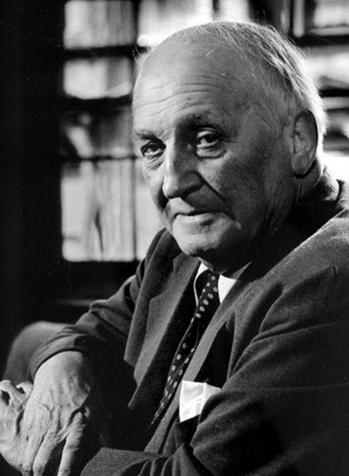 Also in early 1951 Thomas-Todd, or so the story goes, approached documentary master Robert Flaherty to direct the first Cinerama picture. Flaherty reportedly agreed, but he died in July ’51 as shooting was about to begin, leaving behind no notes or records to indicate what, if anything, he intended to do with Fred Waller’s process. This put Thomas and Todd back at square one.
Anyhow, that’s how the story goes. Thomas Erffmeyer, in his history of Cinerama, says that “after weeks of indecision,” Thomas and Todd decided to take a crew to Europe and film a variety of festivals and tourist events going on there that summer. But that doesn’t entirely make sense. Thomas, Todd and a crew of 11 set sail on July 25, only two days after Flaherty died. So either they threw the expedition together with dizzying swiftness, or they had been planning it all along, regardless of what Flaherty wanted to do. (On the other hand, it’s possible that Flaherty was never involved in the project at all.)
In Europe Todd and his son Mike Jr. filmed a number of sights and events: a gondola cruise through the canals of Venice, a bullfight in Madrid, the gathering of the clans of Scotland in Edinburgh, a performance by the Vienna Boys Choir in the gardens of Schönbrunn Palace. In a major coup, Todd Sr. even talked his way into the La Scala Opera in Milan, where no movie cameras had ever been allowed, to shoot a full-dress performance of the Act I finale to Verdi’s Aida. Back in the States, they filmed a flyover of Niagara Falls and did a Technicolor re-shoot of Waller’s black-and-white rollercoaster demonstration reel.
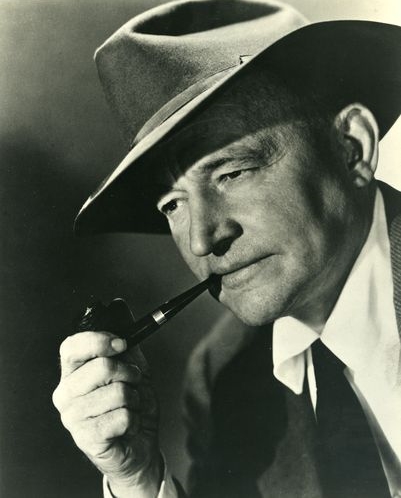 When all this footage was edited together in late 1951, it became clear that there wasn’t enough to make a full feature picture, so Thomas invited his friend Merian C. Cooper to come aboard. Even today, Cooper’s most famous production remains the original King Kong, but he has other ornaments on his résumé too: he was an early investor in the Technicolor process, and he partnered with John Ford on several of the director’s classic films: Fort Apache (1948), She Wore a Yellow Ribbon (’49), Wagon Master and Rio Grande (both ’50), with The Quiet Man (’52) and The Searchers (’56) still to come. Cooper had known Fred Waller in the early days at Paramount, and with that instinct for innovative ideas that made him an early passenger on the Technicolor bandwagon, he’d been following the industry buzz about Waller’s experiments out on Long Island. Cooper biographer Mark Cotta Vaz even suggests that Cooper may have approached Thomas before Thomas approached him: “He was convinced the picture business was in a rut and needed a good shaking up — and Cinerama was just the ticket.”
 In any case, there was an ulterior motive in enlisting Cooper: Mike Todd’s presence was becoming increasingly problematic. His domineering bull-in-a-china-shop style was beginning to grate on people. More important, perhaps, Todd’s presence spooked Wall Street. Thomas-Todd Productions wasn’t publicly held, but Cinerama Inc. was, and Todd’s well-known profligacy with other people’s money made investors wary. Then again, there were some ominous attempts by creditors from Todd’s numerous bankruptcies to recoup their losses from one of the Cinerama companies. There seemed nothing for it but to squeeze Todd out. By March 1952 it was announced he’d be taking a “leave” from Thomas-Todd Productions and Cinerama, and in August Thomas-Todd was dissolved, replaced by Cinerama Productions Corporation, with Lowell Thomas as chairman of the board.
Mike Todd’s 14 months on the scene left their mark, however, and not just for his storming the gates at La Scala; nearly the entire first half of what would become This Is Cinerama was supervised either by him or by Mike Jr. In the few years left to him (he died in a plane crash in March 1958), Todd would have his own story about his departure from Cinerama, a sort of you-can’t-quit-me-I’m-fired version. He said his associates at Thomas-Todd and Cinerama Inc. were too conservative and wary of taking chances: “We can’t stay on that roller-coaster and in the canals of Venice forever. Somebody has to say ‘I love you’ some day.” He also thought he could do better than Cinerama’s three-frame picture, and he wasted little time enlisting the services of the American Optical Company to develop the 70mm Todd-AO process, the only one of Cinerama’s many progeny that ever really challenged its supremacy.
But that was still in the unseeable future. Now, with Todd safely out of the way, Thomas and Cooper secured an additional $600,000 to complete their picture. To counteract the largely static footage in all those European sections, Cooper had the Cinerama camera in fairly constant motion for the two long sequences that would make up the second half. First was a colorful aquacade at Florida’s Cypress Gardens (coincidentally, much of the show consisted of athletic young men and nubile bathing beauties cavorting on Fred Waller’s other invention, water skis).
For the grand finale, Cooper hired stunt flyer Paul Mantz to pilot a modified B-25 bomber across the country for a bird’s-eye view of the natural and man-made wonders of America, set to the tune of the Mormon Tabernacle Choir singing “America the Beautiful”. Cooper also took on the task of determining what would go into the feature, and in what order — where others wanted to save the rollercoaster for the climax of the picture, Cooper insisted on hitting ’em hard right out of the gate. Preparations for the premiere proceeded feverishly right up to the last minute — Mantz’s “amber waves of grain” shots weren’t ready for the projectors until just twelve hours before showtime.
And, as we’ve seen, the result was a triumph beyond the dreams of everyone involved. New York Times critic Bosley Crowther, in an unprecedented front-page review, called it “an historic event in the history of motion pictures.” Cinerama, as it was called before This Is was added to the title, became overnight the hottest ticket on Broadway. Everyone in the picture business recognized it at once as a game-changer — much more so, in fact, than they had The Jazz Singer in 1927.
The question on everyone’s lips in the weeks that followed was the same one that Fred Waller, Lowell Thomas, Buz Reeves and their investors were asking themselves: What’s next for Cinerama?
To be continued…
Ups and Downs of the Rollercoaster, Part 3
 Lowell Thomas decided right off the bat — and Merian Cooper, when he came aboard, concurred — that the star of the first Cinerama picture would be Cinerama itself. “If Charlie Chaplin had offered to do Hamlet for us,” Thomas remembered, “I’d have turned him down. I didn’t want people judging Chaplin or rediscovering Shakespeare…The advent of something as new and important as Cinerama was a major event in the history of entertainment and I was determined to let nothing upstage it.” In other words, This Is Cinerama wasn’t a movie, it was a demonstration, just like Waller and Reeves’s screenings at their tennis court command post in Oyster Bay. The difference this time was that the presentation was more organized and formal, with tuxedo-clad personnel escorting the audience to their seats — and it was in Technicolor. (Mostly, anyhow; when opening night loomed and the feature was still a little short, Thomas and Cooper decided to splice in Waller’s black-and-white clip of the Long Island Choral Society singing Handel’s Hallelujah Chorus — it made a good demo of the sound system, with an invisible choir marching down the aisles of the theater before coming into view on the screen.) So in a sense, Cinerama was exactly where it was before the opening — only now the whole world was watching.
 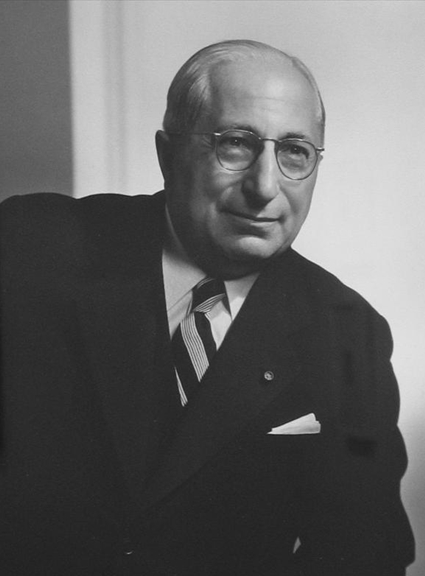 The first new development, barely three weeks after the premiere, was the appointment of Louis B. Mayer as chairman of the board of Cinerama Productions Corp. (with Lowell Thomas stepping down to vice-chairman). There was a certain irony in this; Mayer was one of the movie industry figures who trooped out to Long Island for those demonstrations, only to take a pass on investing. Back then, Mayer had been probably the most powerful man in Hollywood, but this was now. In the interim there had been that ugly power struggle at MGM between Mayer and Dore Schary, ending in a humiliating palace coup that sent Mayer packing in July 1951. By October ’52, Mayer was restless in forced retirement, and Cinerama looked like his passport back into the business. For Cinerama it was a windfall in both money (Mayer’s personal investment reportedly amounted to over $1 million) and prestige: Mayer’s status as a pioneer and longtime chief of the Tiffany of Hollywood studios gave an aura of solidity to Cinerama, and his reputation for showbiz acumen was expected to reassure and attract investors. He brought along some possible material, too: Mayer personally held the screen rights to several properties. One of them, Blossom Time, a moldy Viennese operetta of the sort Mayer had once so lovingly dusted off for Nelson Eddy and Jeanette MacDonald, would never do. But others might work very nicely, like the Lerner and Loewe musical Paint Your Wagon and the Biblical epic Joseph and His Brethren.
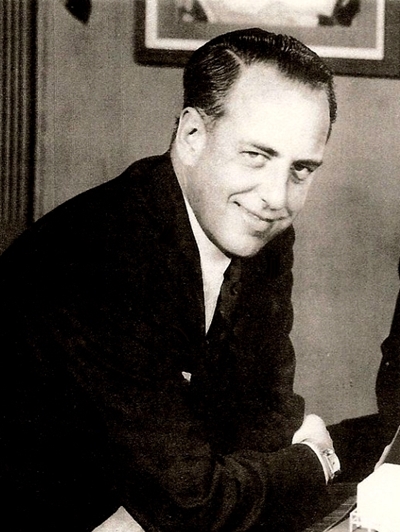 There was a flurry of announcements in trade papers. Dudley Roberts, president of Cinerama Productions, said Cinerama would open theaters in 100 cities, to be supplied with six to eight full-length features a year. Merian Cooper, now head of production, promised that Cinerama would either buy or build its own studio in Hollywood. (Might Cooper have had his eye on RKO? The studio was then in the process of being run into the ground by Howard Hughes, and ripe for the picking. If so, it didn’t happen; when RKO finally sold it went first to General Tire and Rubber Co., then to Lucille Ball and Desi Arnaz, who renamed it Desilu.)
 The first dramatic Cinerama picture, Cooper said, would begin shooting within two months with himself producing and directing, followed within a year by a second feature, probably directed by Cooper’s Argosy Films partner John Ford. (As it happened, Ford didn’t work in Cinerama until almost ten years later, and he wasn’t happy with it or well suited, contributing the shortest and weakest episode of How the West Was Won.)
An array of productions were considered, and some even announced. Paint Your Wagon. Tolstoy’s War and Peace. A remake of King Kong. Lawrence of Arabia (this would have been a much different picture from the one we eventually got; Lowell Thomas didn’t much care for David Lean’s 1962 take on his old friend). Paul Mantz climbed back in the cockpit of his converted B-25 and shot another 200,000 feet, at a cost of $500,000, without anybody knowing when or how it would be used.
Some of Mantz’s footage eventually wound up in Seven Wonders of the World (’56). But as for all those other ambitious plans, none of them ever came to pass.
Part of the reason was L.B. Mayer himself. Biographer Scott Eyman speculates that Mayer’s enthusiasm for Cinerama was never that great in the first place; he may have been clinging to the forlorn hope that his exile from MGM was only temporary, intending Cinerama as a base from which to stage a return to Culver City. Whatever his intentions, the battle with Dore Schary had left him, in Lowell Thomas’s words, “aging, tired [and] unable to make up his mind about anything.” (Eyman memorably quotes writer Gavin Lambert, who covered Mayer at the time, in almost the same words: “He was an aging, tired man in a dark suit, who looked like a businessman but was actually an exiled emperor.”) Mayer eventually left Cinerama, though sources vary on exactly when. Eyman dates Mayer’s departure to November 1954; Thomas Erffmeyer’s history implies (and an article in the Winter 1992 issue of The Perfect Vision says outright) that it may have been as early as May ’53. In any event, Cinerama Productions Corp. produced nothing under Mayer’s chairmanship, and frittered away much of its early momentum.
Another major factor was the Byzantine corporate structure under which Cinerama operated. It was in fact three separate but complexly interrelated entities:
Vitarama Corporation. This was the original corporation set up by Fred Waller and Ralph Walker in 1938, when Waller designed that petroleum industry exhibit for the 1939 World’s Fair (which was never used, and which morphed into the Waller Flexible Gunnery Trainer). A private corporation owned by Waller (43 percent), Walker (14 percent) and Laurance Rockefeller (43 percent, an interest Rockefeller retained when he sold his interest in Cinerama to Buz Reeves in 1950), Vitarama owned all the basic Cinerama patents and received a percentage of the box office take.
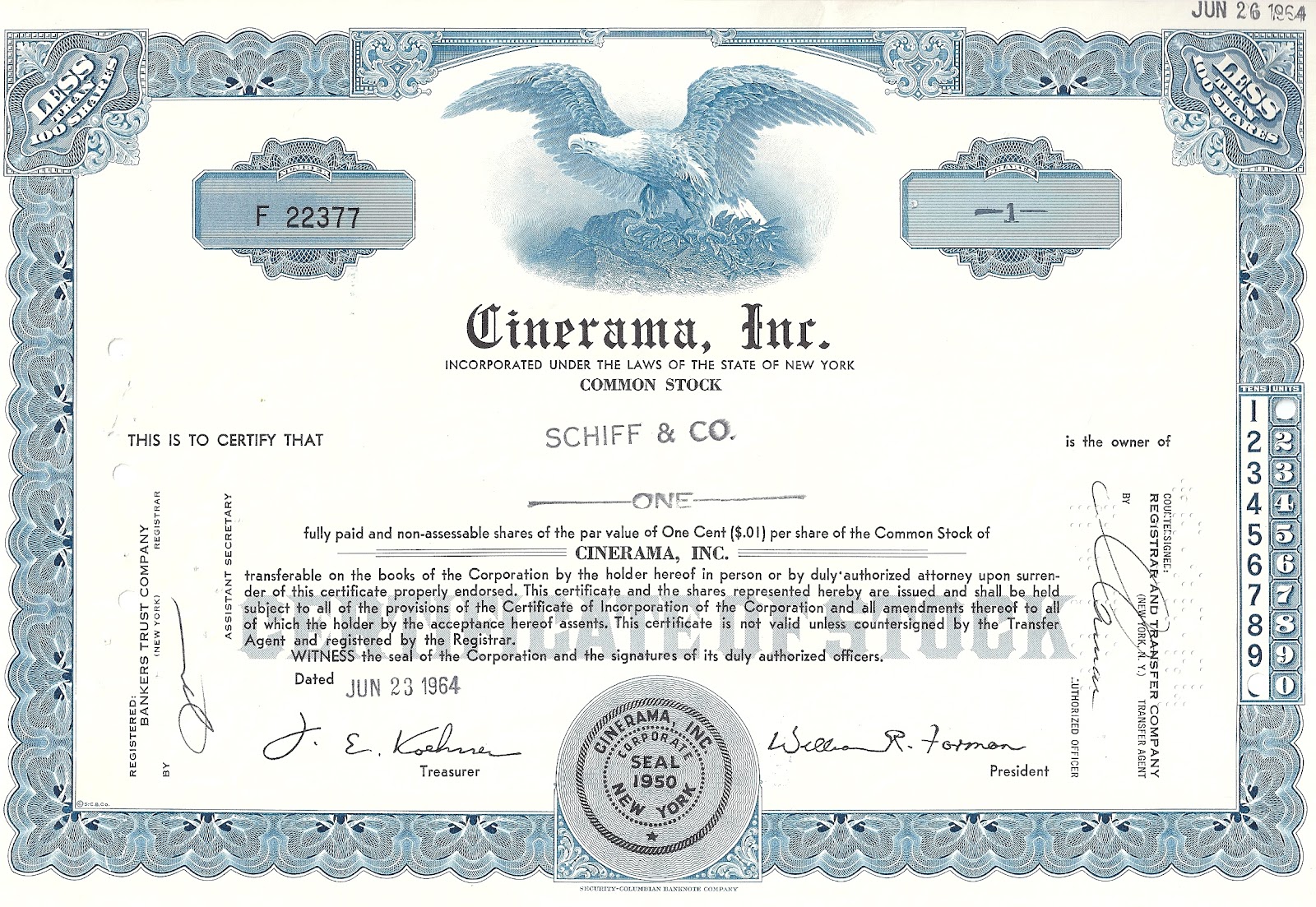
Cinerama Inc. This corporation, created in the wake of the dissolution of Cinerama Corp. in August 1950, manufactured the equipment for Cinerama — cameras, projectors, screens, sound systems, etc. This was the only publicly-traded of the three Cinerama corporations, but only about 16 percent of stock was available to the general public. The controlling stockholder was Buz Reeves, through his personal stock and stock belonging to Reeves Soundcraft. Cinerama Inc. received an initial 25 percent share of theatrical profits from the process, to decline over (presumably prosperous) time to a flat 10 percent. Cinerama Inc. also held the production and exhibition rights to the process, which it sub-licensed to…
Cinerama Productions Corporation. Privately owned like Vitarama Corp., this was the successor corporation created when Mike Todd was squeezed out of Thomas-Todd Productions. Lowell Thomas was originally chairman of the board; president was Dudley M. Roberts, a Wall Street broker who joined the crew — and brought along a cadre of other investors willing to buy in — once the loose cannon Todd was out of the picture. This was the corporation that enlisted, and later regretted, Louis B. Mayer.
The financial arrangements among these corporations were a real can of worms: Cinerama Productions Corp. paid profit royalties to Cinerama Inc., which paid a percentage of those to Vitarama Corp., which licensed the manufacture and use of its equipment to Cinerama Inc., which sub-licensed production and exhibition to Cinerama Productions, which bought the equipment for its theaters from Cinerama Inc.
In the flurry of excitement after the premiere of This Is Cinerama, the price of Cinerama Inc. stock had soared from $4.00 to $8.00 a share. But when investors, who thought they were buying into “Cinerama”, realized they were buying stock in the manufacturing company while most profits would go to the production company, the price fell back to $5.25. Some brokerage houses cautioned against Cinerama Inc. as a “speculation”, and stock-sale income dropped off accordingly.
Besides which, Cinerama was a high-overhead operation — requiring, for example, 12 to 16 projectionists, plus a technician to channel the six soundtracks into the appropriate surround speakers, and a “theater engineer” manning a master-board overseeing the synchronization of the whole operation. While the box-office take was huge, profits were minimal, and it was the profits that trickled over to Cinerama Inc. and Vitarama Corp. Moreover, it was profits from which Cinerama Productions Corp. needed to buy the equipment to convert additional theaters to the process.
All these factors contributed to cash-flow problems for the three Cinerama companies, and it made Cinerama Productions, which was both taking in and spending most of the cash, ripe for a takeover. And that’s just what happened in the spring of 1953, even as two new Cinerama theaters held triumphant openings in Detroit (the Music Hall on March 23) and Los Angeles (the Warner, April 29). I’ll get into that takeover next time.
Two other players entered the game about this time, and they put some new wrinkles on the playing surface. One was 3-D, which actually came along (with the surprise hit Bwana Devil) before This Is Cinerama opened; in the sudden interest in movies-with-a-difference, 3-D began to look like a cheaper alternative to Cinerama, and a number of studios grasped at it. As things turned out, 3-D fizzled within the year and wouldn’t make a real comeback for another half-century.
The other player, though, dealt a serious blow to Cinerama’s plans for development and expansion. It was something the Cinerama boys (especially Waller, with his background in photography) might have seen coming, but they didn’t:

Ups and Downs of the Rollercoaster, Part 4
 Remember all those movie-industry honchos trekking out to Oyster Bay to see Cinerama? One of them was Joseph M. Schenck, chairman of the board of 20th Century Fox. Like everybody else, Schenck passed on Cinerama, but as he did so he added ruefully: “I’ll be buying this process someday, and it will cost me ten times as much.”
Fox president Spyros Skouras spared Schenck the embarrassment of that. Skouras had gone out to Oyster Bay too, and been impressed, but he allowed Fox’s research department to talk him out of buying into Cinerama. Now, as This Is Cinerama‘s sensational debut woke Hollywood from its slumber, Skouras turned to his research department, saying in effect: You blew this one, boys; you’d better make it good.
They did. Digging back, they came up with a process a French professor named Henri Chretien had tried unsuccessfully to peddle in Hollywood back in the ’20s. He called it Anamorphoscope, and it involved using what Chretien called a “hypergonar” lens on the camera to squash a wide angle of view onto standard 35mm film, then a compensating lens on the projector to stretch it back out again. The good news was that Chretien’s patent had expired in 1951 and Anamorphoscope was now in the public domain; the bad news was that Chretien had the only set of lenses. Long story short, Skouras tracked Prof. Chretien to his home in Nice, reached an agreement for the use of his lenses (which were later refined and reproduced by Bausch & Lomb back in the States), and in February 1953 Skouras announced the process under a new name, CinemaScope (whoever came up with that replacement for “Anamorphoscope” surely earned his pay for the week!).
The first CinemaScope picture was to be Fox’s Biblical epic The Robe (pre-production was already underway, but was suspended to retool for the new process), and henceforth every 20th Century Fox picture would be shot in CinemaScope. Skouras and studio chief Darryl F. Zanuck encouraged other studios to sign on with their “new” process. MGM and Walt Disney took the bait at once; other studios hung back, exploring their own wide screen options.
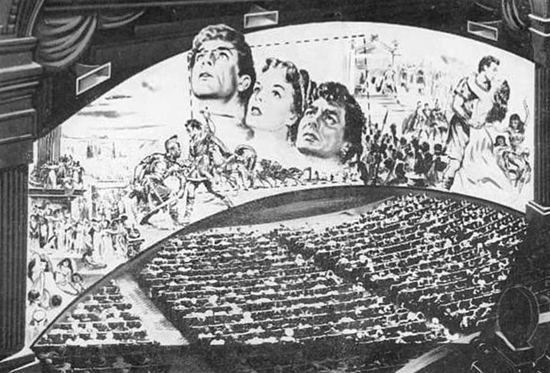 Early ads for CinemaScope, like the one I’ve reproduced here, emphasized a resemblance to both Cinerama and 3-D (“It’s the miracle you see without glasses!”) that didn’t really exist. While CinemaScope did originally call for a curved screen, most theaters didn’t bother with that. Even in The Robe‘s first-run engagements, the curve was much shallower than in this ad, and nowhere near as deep as Cinerama’s. (A good thing, too: you have to feel sorry for that poor sucker on the left end of the seventh row — what kind of view could he have had?) Anybody who compared Cinerama and CinemaScope side-by-side (so to speak) could see there was no real comparison. But in truth, most moviegoers couldn’t do that. Among Hollywood professionals, CinemaScope didn’t have to be as good as Cinerama, as long as they could sell it that way to the millions who hadn’t yet seen the real McCoy. Besides, it was still a huge change from movies-as-usual, and something folks couldn’t get on those newfangled 17-inch black and white TV screens in their living rooms.
And it was relatively cheap. While the Cinerama people did their best to lowball the estimated cost of converting a theater, the truth was it could run as high as $200,000. Moreover, hundreds of seats could be lost either to make room for the three projection booths or because of unacceptable viewing angles, thus limiting potential revenue. Conversely, CinemaScope (Fox promised) could be installed with no loss of seats, and for the mere cost of a set of lenses, a new screen, and a three-channel magnetic sound system — a sizeable investment, yes, but nothing like the fortune needed for Cinerama. (This is a good time to remind you that we’re talking about Eisenhower dollars here; to get a sense of 2022 equivalents, you should multiply by about 11.25 — $2,250,000.)

Fox mounted an aggressive and well-organized campaign to promote CinemaScope (Skouras was battling a hostile takeover, so ‘Scope had to succeed), and in the end it would effectively sink Cinerama Productions Corp.’s hopes of partnering with one of the major studios. Even as early as March and April ’53, when Fox began holding nationwide demonstrations of CinemaScope for industry and press, Cinerama was feeling the pinch. Not only were leads on new investment drying up, but some contractually committed investors were backing out, citing a “changed circumstances” escape clause in their contracts. Cinerama still had only three venues in the world (a fourth, the Palace in Chicago, wouldn’t open until July due to a protracted haggle with the local projectionists’ union). Cinerama Productions Corp. had to find funding to supplement their high-overhead box-office take if they were going to open more theaters and maintain a foothold in the market they had created, to say nothing of producing follow-up features to This Is Cinerama.
They considered their options. A public stock offering was one, but sales of Cinerama Inc. stock had already been less than expected. Another possibility was to seek financial participation from a theater circuit rather than a studio, and they decided on that. A logical choice for such an arrangement was the Stanley Warner Corporation, since Cinerama had already been dealing with them: the newly Cineramified Warner Theatre in Los Angeles was theirs, and This Is Cinerama was slated to move from the Broadway Theatre to New York’s Warner in June 1953 (the Shubert brothers wanted their house back).
 Before we go on, a clarification: “Stanley Warner” wasn’t a person. How the name came about (as simple as I can make it) was this: Stanley Warner’s president was S.H. Fabian, who had gotten into the theater business in his father’s small circuit of houses in New Jersey in the 1920s. In 1926 Fabian Theatres merged with another chain, Stanley Company of America. Two years later that circuit was acquired by Warner Bros. for the exhibition of their pictures, and Fabian partnered with one Samuel Rosen to rebuild his own chain in New York State, Fabian Enterprises. In the early 1950s, when federal antitrust action compelled the studios to divest themselves of their theater chains, Fabian went to Harry, Albert and Jack Warner to (essentially) buy his old theaters back. The corporation he formed for this might have been called Fabian Rosen, or Warner Fabian, but instead it was Stanley Warner.
As the corporate heir (as it were) to Warner Bros. Theatres, Stanley Warner became a party to the federal suit’s consent decree, and needed approval from federal court (and by extension the U.S. Dept. of Justice) for any venture into movie production, distribution or exhibition. That included any agreement with Cinerama Productions Corp., so it added yet another layer of negotiation. A tentative agreement for Stanley Warner to take over Cinerama theater operations was announced in May 1953, but there were a multitude of details to work out. Cinerama Productions’ licensing agreement with Cinerama Inc. ran only through 1956, so Stanley Warner wanted a two-year extension of that to help recoup their investment. They also wanted control of production and distribution as well as exhibition, to ensure a steady flow of pictures for the theaters. Meanwhile, Cinerama Productions was behind in payments to Cinerama Inc. for equipment, so Cinerama Inc. wanted at least something towards that before any talk about extending the license. And the Dept. of Justice had their own demands before they’d recommend court approval.
It took three months of intense dickering to sort this all out, with the clock ticking — if court approval wasn’t received by August 15, the whole deal was off. They finally made it with four days to spare, and the deal was this: For a little over $2.5 million, Stanley Warner essentially bought control of Cinerama Productions Corp. through 1958, adding yet another layer to the corporate tangle with its wholly-owned subsidiary Stanley Warner Cinerama. They would produce at least five Cinerama pictures but (the feds insisted) no more than 15. For each feature they could also produce a conventional 35mm version, but (again, per the feds) could not exhibit the 35mm versions in any of the Cinerama theaters. And — yet again, here was the hand of the U.S. Dept. of Justice — Stanley Warner could open no more than 24 Cinerama theaters in the United States. (So much for Dudley Roberts’s dream of a hundred theaters getting six to eight pictures a year.)
A month later, on September 16, 1953, The Robe premiered to respectful reviews and boffo box office. 20th Century Fox had three more CinemaScope pictures ready to go, MGM had one, and dozens more were in various states of production at one studio or another. Spyros Skouras’s gamble had paid off in a big way.
After that, things started getting complicated.
Ups and Downs of the Rollercoaster, Part 5
 In his 1977 memoir So Long Until Tomorrow, the 85-year-old Lowell Thomas — with nearly a quarter-century of frustrated hindsight — remembered the Stanley Warner deal thus:
“Our original group of founders had dwindled — Fred Waller, the gentle, bespectacled genius who started it all, had died before he even knew of his triumph; Mike Todd was busily hustling and working with American Optical on the process to be called Todd A-O … Arrayed against [Frank Smith], Merian Cooper and me were men of wealth who had gone into Cinerama solely for the investment possibilities, and at this critical juncture, either unwilling to go looking for the additional cash or simply ready to take their already large profits, they opted to sell out.
“The buyer was the Stanley-Warner company, and from a purely practical viewpoint, maybe the decision was not all wrong. In making it we all made a lot of money. But the bells began tolling for Cinerama then and there. Stanley-Warner was a brassiere manufacturing corporation, plus owners of a major theater chain. But they were not film producers … They didn’t really know what Cinerama was all about.”
Thomas’s memory wasn’t flawless. “Stanley Warner” wasn’t hyphenated, and “Todd-AO” was. Fred Waller lived long enough to know his triumph and collect an Oscar for it; he died in May 1954, nine months after the Stanley Warner deal was approved by the court. And Stanley Warner wasn’t “a brassiere manufacturing company”. Not yet. They didn’t purchase the International Latex Corporation (maker of, among other things, the Playtex Living Bra) until April 1954, a year after buying their six-year control of Cinerama Productions Corp. (This expansion from theater operation to ladies’ undies and baby pants was an early example of the kind of diversification that ultimately led to the entertainment conglomerates of today.)
But Thomas’s basic point was well taken. The folks at Stanley Warner, it’s true, were not film producers. And despite S.H. Fabian’s advocacy of alternate entertainment technologies — he was an early proponent of drive-in theaters, 3-D, and closed-circuit theatrical television — he really didn’t know what Cinerama was all about. Even if nobody heard it at the time, the bells were definitely tolling.
Thomas can be forgiven a certain amount of bitterness. By May 1954, Stanley Warner had managed to open only seven new Cinerama theaters and had yet to complete a follow-up feature to This Is Cinerama; yet they had managed to scrape up $15 million ($166.18 million in 2022) to buy International Latex. Moreover, in the next four years SW would lavish far more care and resources on International Latex, where profit margins were high and they were not under the thumb of the U.S. Justice Dept. Small wonder that, decades later, Thomas remembered SW being already in the brassiere business when Cinerama came along.
Stanley Warner was contractually obligated to produce a picture within the first year, and their original plan was the same as Cinerama’s before them: to involve one of the major studios in making Cinerama pictures. In early August, even before the court approved the buyout, talks were held with Columbia, Paramount and Warner Bros. All came to nothing, including a proposed picture about the Lewis and Clark expedition to star Gregory Peck and Clark Gable as the great explorers (excellent casting, that).
With the success of The Robe, studios began stampeding to CinemaScope in preference to the more expensive Cinerama, and any chance of a deal in that direction evaporated. SW negotiated with Merian Cooper, who was thinking of molding Paul Mantz’s 200,000 feet of aerial footage into a picture to be called Seven Wonders of the World, but talks broke down when they couldn’t agree on a completion schedule.
So Stanley Warner turned to producer Louis de Rochemont, who had experience in both documentary (We Are the Marines, the March of Time newsreel shorts) and fiction filmmaking (The House on 92nd Street, Boomerang!). De Rochemont had an idea that combined the two: follow one pair of American newlyweds as they honeymooned in Europe, and another European pair as they honeymooned across America. The Thrill of Your Life began shooting in December 1953 with John and Betty Marsh of Kansas City, Mo. and Fred and Beatrice Troller of Zurich, Switzerland touring the Cineramic stops on their respective honeymoon tours. Production wrapped in June ’54 and, with the title changed to Cinerama Holiday, the picture was ready for release by the August deadline.
But Stanley Warner held off on releasing Holiday. By this time there were 11 Cinerama theaters in operation, and This Is Cinerama was still playing to sold-out houses everywhere — even in New York, where it was nearly two years old. Why cut a thriving box office short when there was still a lot of money to be made?
And here’s where Cinerama’s can of corporate worms came home to roost — if you’ll forgive a mixed metaphor. At one end of the corporate arrangement was Vitarama and Cinerama Inc.; at the other end was Cinerama Productions — now a mere holding company for Stanley Warner Cinerama, but with its own stockholders. And in between was Stanley Warner.
 Cinerama Inc. made most of its money from the equipping of Cinerama theaters — the sale or lease of equipment and supplying of replacement parts — and was annoyed that Stanley Warner wasn’t opening theaters at a quicker pace. The remaining investors in Cinerama Productions were annoyed that SW wasn’t opening more theaters and producing a steadier stream of pictures to show in them. And Stanley Warner, who had to put up all the money for both the theaters and the pictures but had to share almost half of any profits (when operating costs alone could eat up as much as 90 percent of gross ticket sales), was beginning to wonder if investing in the process had been such a good idea in the first place. The cracks among the partners in Cinerama were beginning to show, and were the subject of chatter in the trade press.
The general public, however, saw none of this. All they knew, if they hadn’t seen This Is Cinerama yet, was that Cinerama was the miraculous more-than-a-movie that everybody was talking about. If they had seen it, all they knew was that the theater was jam-packed, at top-dollar prices; if they saw it more than once, showing that their own enthusiasm hadn’t dimmed, they saw that nobody else’s had either. And when Cinerama Holiday finally opened in February 1955, the box office didn’t fall off a dime. Movie houses in towns or neighborhoods may bring in picture after picture in CinemaScope, but to the public Cinerama was the gold standard. More than a movie, indeed — it was a tourist attraction.
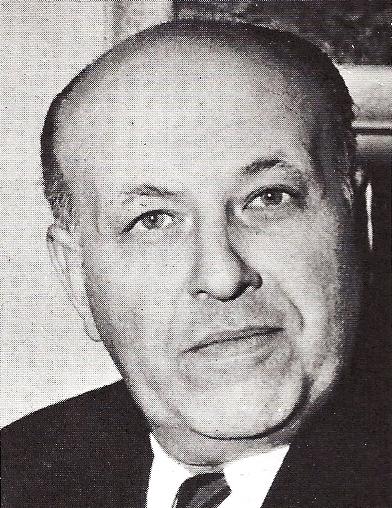 There had been talk of plans to expand Cinerama into foreign countries almost from the first opening in September 1952, but nothing had ever come of that idea. In the spring of 1954, Stanley Warner sought to farm out the foreign exhibition rights — find somebody who would foot the bill for overseas expansion and pay SW for the privilege. After three months of negotiations, S.H. Fabian hammered out a deal with Nicolas Reisini, president of Robin International.
Neither Robin International nor the Greek-born Reisini had any experience in the movie business. Robin International was reportedly an import/export company, although exactly what it imported and exported wasn’t clear. Nothing shady, mind you, it’s just that Reisini seems to have had his fingers in a bewildering number of pies — none of them having anything to do with the movie industry.
But there was another factor. According to his son Andrew (interviewed for David Strohmaier’s 2002 documentary Cinerama Adventure), Nicolas Reisini as a young man had seen the Paris premiere of Abel Gance’s Napoleon in 1927 and been spellbound — especially by Gance’s three-screen “Polyvision” triptych that climaxed the picture. When Reisini saw This Is Cinerama in New York in late ’52 or early ’53, it revived that youthful excitement and seemed to be the fulfillment of Gance’s earlier vision. Son Andrew says Reisini decided on the spot that he wanted to get in on Cinerama one way or another, and when Stanley Warner went looking for someone to buy foreign rights, Reisini was ready.
Reisini’s deal, announced in July 1954, licensed him to establish Cinerama theaters in any five cities (later amended to six) outside the western hemisphere. He ponied up a deposit of $500,000, to be refunded $100,000 at a time for each new theater as it opened. Robin International was responsible for all the expenses of converting and operating the theaters. And with this agreement, yet another corporation was added to the cluster of those already in place, each straining for its share of the trickle of profits that remained after Cinerama’s sky-high operating costs.
As things turned out, the first foreign showing of Cinerama — outside North America, that is; theaters in Toronto, Montreal and later Vancouver were considered “domestic” — wasn’t a permanent installation. It was in September ’54 at an international trade show in Damascus, Syria. This Is Cinerama was a huge success there, and again later that year at another fair in Bangkok, Thailand — where it was such a hit that it was held over an additional two weeks after the fair closed. (It was the Soviet Union’s fury at being upstaged in Damascus that led them to pirate their own three-screen process, which they called Kinopanorama. They couldn’t even come up with an original name for it.)
Robin International’s first “permanent” theater was the Casino in London, opening October 1, 1954. Reisini reduced his own expenses by sub-licensing to local exhibitor companies in each country, letting them shoulder the cost of converting and equipping the theater (more corporations, more straining for ever-thinning profits). That’s how it went when theaters opened in Japan (Tokyo and Osaka, January ’55), Italy (Milan, April ’55; and Rome, in May) and France (Paris, May ’55).
 Meanwhile, back home, Stanley Warner and Louis de Rochemont had fallen out over money — and SW’s reluctance to invest in perfecting the Cinerama process. De Rochemont stalked off to produce Windjammer: The Voyage of the Christian Radich in CineMiracle (a competing process just different enough to avoid infringing Cinerama’s patents). SW had enticed Lowell Thomas back to produce Seven Wonders of the World (revived after the departure of Merian Cooper). Shooting wrapped in June ’55, but as with This Is Cinerama before it, Cinerama Holiday was drawing so strongly that SW was in no hurry to release Seven Wonders (it finally opened in April 1956).
Buz Reeves at Cinerama Inc. finally lost patience with Stanley Warner’s dilatory production schedule. He charged SW with breach of contract and announced that Cinerama Inc. would produce its own picture, a documentary about the peaceful uses of atomic energy to be called The Eighth Day. But Reeves didn’t really have any leverage; any production would still be dependent on SW for theaters to show it in. The Eighth Day staggered along for over three years at a cost of $439,688 before being written off. (The Cinerama camera reportedly filmed the last above-ground nuclear test during this period, but the footage has mysteriously disappeared. Wouldn’t that be a sight to see!)
In the interim, Stanley Warner had produced two more travelogues, another one with Lowell Thomas (Search for Paradise, about India and the Himalayas), September ’57; and South Seas Adventure with producer Carl Dudley, narrated by Orson Welles, July ’58.
And with that the Stanley Warner era at Cinerama came to a close, after four pictures in five years. (For the record, in that same time 20th Century Fox and the other Hollywood studios had produced 291 pictures in CinemaScope.) When the dust from the transition settled, the new big cheese at Cinerama Inc. was none other than our starry-eyed friend Nicolas Reisini. He was an adroit wheeler-dealer who loved Cinerama and had a genuine vision for the process, and he would accomplish things that nobody before him had been able to do. But he would also fall victim to Cinerama’s chronic cash-flow problems, and in the end he presided over the process’s march into oblivion.
I’ll get into that next time, then I’ll add a brief coda about the mechanics of Cinerama, and efforts to perfect Fred Waller’s revolutionary invention.
To be concluded…
Ups and Downs of the Rollercoaster, Part 6
 There’s just no getting around the fact that Stanley Warner’s management of Cinerama was a disaster from the word go. To be fair, the limits imposed by the court gave SW little incentive to think beyond the short term: They could have no more than 24 Cinerama theaters, and they had to be out of Cinerama by the end of 1958 (SW did get a court-approved extension to that deadline). Still, with the purchase of International Latex, Stanley Warner behaved like a kid with a new toy. Cinerama became the old toy.
SW never operated more than 22 Cinerama theaters at one time, and they never produced enough pictures to keep even those busy (and nowhere near the court-imposed limit of 15 pictures). When they did produce a new Cinerama picture, all they could think to do was produce yet another travelogue, the only real change being where the picture traveled to. Even then, as we have seen, SW would delay release until they had wrung the current release dry; they insisted every picture had to premiere in New York, yet they wouldn’t open a second New York theater. Nor would they even consider beginning a new picture while they had one waiting in the wings; the idea of creating a backlog of pictures ready to go appears never to have been considered.
In 1957, when the foreign-rights agreement with Robin International expired, Stanley Warner ventured into that area themselves. They learned a lesson, though, from Nicolas Reisini’s practice of sub-licensing Cinerama to local exhibitors, who would pay to convert a theater, then lease rather than purchase the equipment from Cinerama Inc. Essentially, what Reisini had done, and what SW did now, was to sell Cinerama “franchises”. It was a policy that might have served Cinerama well from the outset — and indeed Reisini would employ it with some success after he took the driver’s seat — but it seems not to have occurred to anyone before Reisini came along.
In the end, Stanley Warner’s program of opening new Cinerama theaters was no more vigorous or aggressive than their production of Cinerama pictures. By the time SW’s management was drawing to a close, most of the theaters they’d opened had failed and been closed; only six remained in the U.S., with another 13 in other countries.
Part of the problem all along was Cinerama’s Byzantine corporate structure, which hampered any attempt to strategize Cinerama for the long run. Instead of one central corporation, Cinerama was first three, then four, all severely under-capitalized and with complicated financial relations. A serious simplification of the arrangement was called for, but Stanley Warner never made any effort in that direction.
Hazard Reeves, on the other hand, did, and he started as early as 1955. In that year, through Cinerama Inc., he absorbed the Vitarama Corp. by buying out the heirs of the late Fred Waller. It was about that time, too, that he initiated his futile breach-of-contract action against Stanley Warner, which may have been simply a negotiating ploy to prod SW into more decisive action. (If that was the intention, it didn’t work.)
As the clock ran out on Stanley Warner Cinerama, Reeves stepped up his efforts to consolidate things. I won’t go into all the arcane details, but the process entailed enlisting the participation of the Wall Street brokerage firm of Kidder, Peabody and Co. There was a flurry of stock sales, purchases and swaps as Buz Reeves gradually consolidated his control, and with his proven management expertise he was able in May 1959 to float a huge $12 million expansion loan from the Prudential Life Insurance Co., three-to-four million of which was used to buy out Stanley Warner once and for all. When the dust finally settled, Vitarama Corp. and Cinerama Productions Corp. were no more, absorbed into Cinerama Inc. And Hazard E. Reeves was in complete control of every facet of the process — something that had not been the case since Fred Waller formed Vitarama 21 years before.
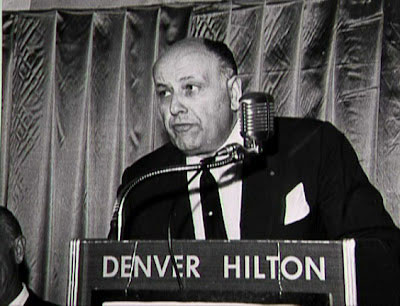 Reeves’s proven management skills might have turned Cinerama around even then if he had taken the reins in a firm hand, but evidently that was never his intention. With hindsight, it appears that Reeves was simply tired of dealing with Cinerama; his concerted efforts to streamline Cinerama’s corporate structure may have been just a way of getting it in good order — like a real-estate speculator fixing up and flipping a rundown house — so he could sell it and roll the capital into his own company, Reeves Soundcraft. In any event, Reeves had control of Cinerama for less than a year before he put it on the market — negotiating first with Walter Reade Jr. of Reade Theatres, then with Nicolas Reisini of Robin International. In the end Reisini bought Reeves out, becoming president and CEO of Cinerama Inc. (In his history of Cinerama, Thomas Erffmeyer mentions that in 1947 Reisini had purchased a California asbestos mine for $350,000 — which now, in 1959, he sold for $4 million. Dr. Erffmeyer doesn’t say if it was this windfall which enabled Reisini to buy Cinerama Inc., but it strikes me as a logical inference.)
Nicolas Reisini was, if nothing else, an energetic and ambitious entrepreneur and wheeler-dealer, and he hit the ground running. Even before assuming the presidency of Cinerama in May 1960, he accomplished something nobody before him had been able to do: He established a co-production agreement with a major studio. The studio was MGM (then flush with the critical and box-office success of Ben-Hur), and the agreement was announced on December 11, 1959: They would produce at least two and as many as six features; MGM production chief Sol C. Siegel would supervise them, with Cinerama having script, director and cast approval; Cinerama would distribute and exhibit the pictures in their theaters, and MGM would handle distribution of 35mm general release versions after the Cinerama roadshow engagements.
 A top priority for Reisini was to bring Cinerama to the widest possible audience — to increase its fan base, if you will. To that end he followed through on an idea Stanley Warner had flirted with in the mid-’50s but (typically) abandoned before doing much with it: portable Cinerama. A caravan of trucks criss-crossed France and other countries in Europe, visiting towns and villages like a 19th century travelling circus. The caravan would set up an enormous inflatable rubber tent — inflatable so it would be self-supporting with no internal columns or poles to block the view of the screen — that could seat up to 3,000 spectators on folding chairs. (Reisini had always been adept at thinking outside the box. In 1954, when Robin International undertook to open theaters overseas, he had tried to interest the United States Information Agency in mounting a travelling Cinerama theater on a retired aircraft carrier. USIA was game, and even President Eisenhower liked the idea, but Congress nipped it in the bud.)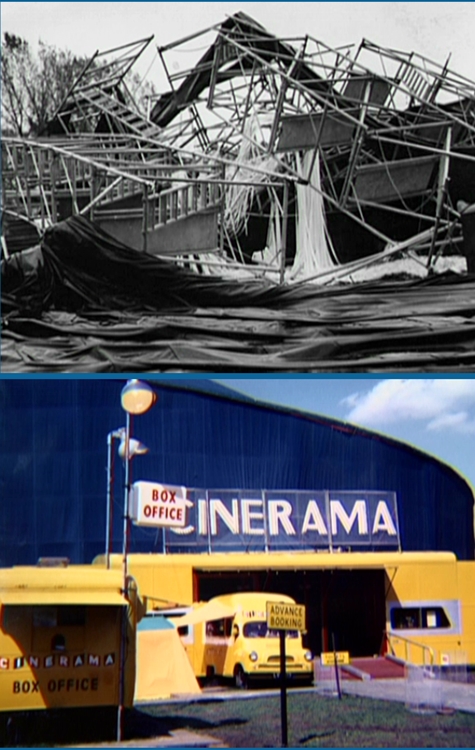
Reisini’s touring “Cinerama Europe” was well-received everywhere it went; anyone who wasn’t working or in school would flock to the field where Cinerama was setting up to watch the battery of huge fans, each the size of a Volkswagen, blowing up the big blue tent. Local dignitaries turned out to walk the red carpet at every screening. Even Abel Gance showed up one night to see this successor to “Polyvision” from his 1927 Napoleon.
The tent had an Achilles’ heel, though, and it was the anchoring system, which was inadequate to a building of its size. One night in France a terrible storm struck. It huffed and it puffed and it blew the house down; the collapsing screen wiped out the first ten rows of seats. A genuine catastrophe was averted only because nobody was in the tent at the time.
Undaunted, Reisini had the tent design revamped, strengthened and improved. This new version went on to tour England, Scotland and Wales as “Itinerama”.
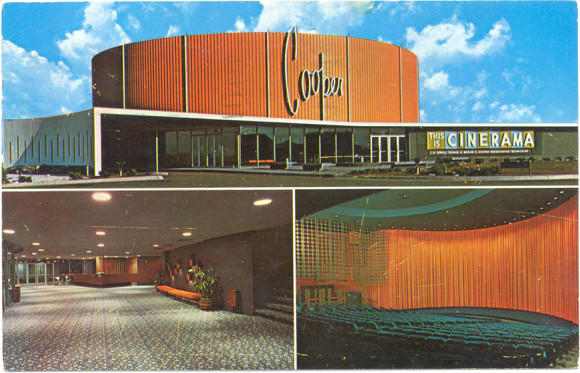
At the same time, Reisini set out to expand the paltry stable of standing Cinerama theaters that Stanley Warner had left behind. Within nine months, by selling franchises to local exhibitors, Reisini had nearly doubled that number by opening 17 new theaters. Among them, opening in March 1961, was the first theater built expressly to show Cinerama, the Cooper “Super-Cinerama” outside Denver, Colo. By 1964, Reisini’s expansion efforts had been perhaps his most striking success: 70 theaters in the U.S. and 116 overseas — nine times as many theaters as Stanley Warner had been able to open on their own.
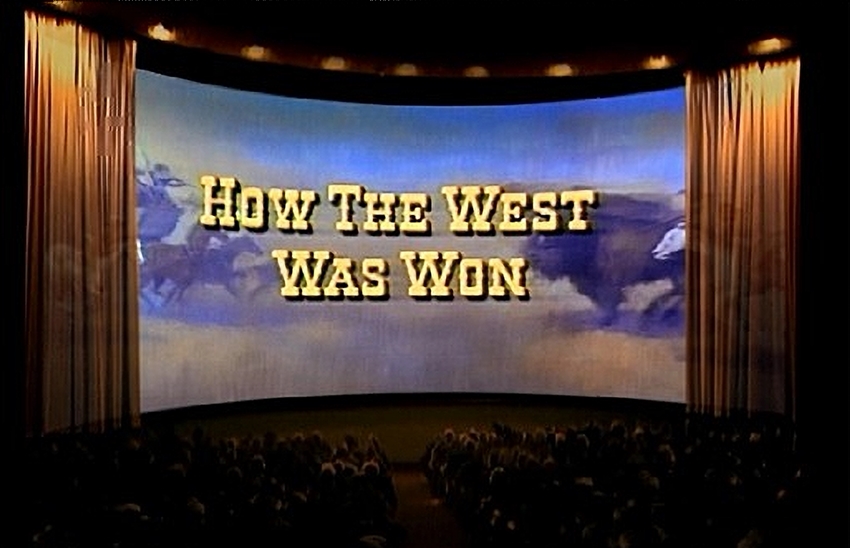
Now let’s review. By the end of 1962, Nicolas Reisini had inked a co-production deal with a major Hollywood studio; he was well on his way to establishing over 180 Cinerama theaters worldwide; and — another thing nobody else had been able to do — he had come out with two Cinerama movies in the same year.
The Wonderful World of the Brothers Grimm — the second picture to go into production but the first one released — opened in August 1962. It got novelty points as the first “story” Cinerama picture, but reviews were not great, and neither was the box office. How the West Was Won, however, was another story. It premiered at London’s Casino in December ’62 (the U.S. premiere was at L.A.’s Warner Theatre in February ’63) and was an immediate smash hit. It got rave reviews from all but the snootiest critics and played to sold-out houses for over a year.
We can only speculate how the Cinerama saga would have shaken out if Nicolas Reisini — or someone else with his energy and ingenuity — had taken the process in hand back in 1953. Things might have been very different. On the other hand, Cinerama might have died in its cradle; the process’s astronomical operating costs might have undone Nicolas Reisini in the mid-’50s — because they were what undid him now.
How the West Was Won — which went on to snag eight Oscar nominations, including best picture, and to win three (original screenplay, editing, sound) — was universally acknowledged in 1963 as the best movie ever made in Cinerama. And it’s still the best — because it was the last. While the movie cleaned up at the box office, the problem was the same old bugaboo: as much as 80-90 percent of the take went to the overhead expenses of running the theaters. Reisini had wagered $13.5 milllion on Brothers Grimm and HTWWW (Cinerama’s share of the production costs), and when all was said and done, the profits didn’t begin to cover his bet.
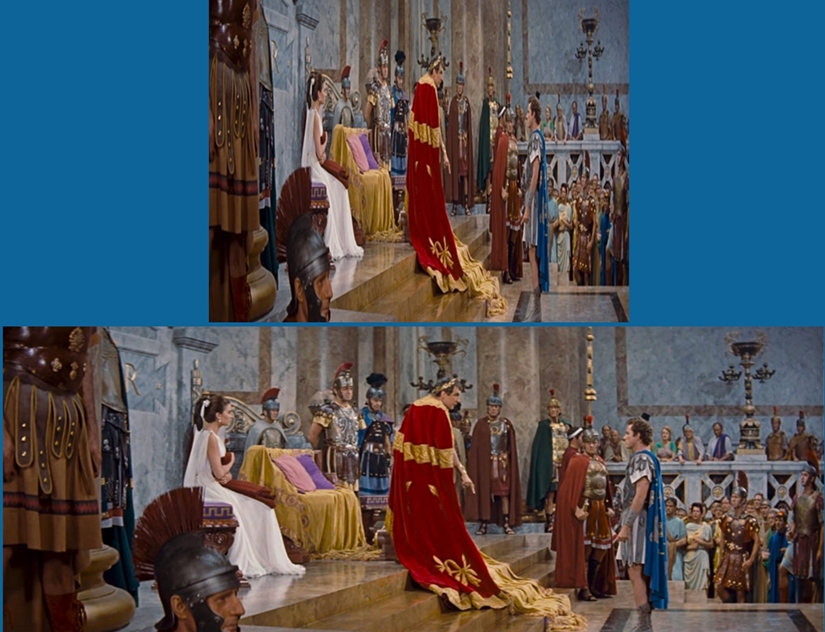
Not all of HTWWW had been shot with the three-lens Cinerama camera. There were some stock shots inserted from MGM’s Raintree County (1957), which had been shot in MGM Camera 65 (actually a variety of Panavision), and John Wayne’s The Alamo (’60), which had been in Todd-AO. In both cases, the original one-frame negative had been split optically into thirds to run through the three Cinerama projectors. Also, a number of risky shots — Karl Malden and Carroll Baker battling the river rapids on their raft, for example, or Eli Wallach clinging to the undercarriage of a runaway train — were done using back-projections, which couldn’t be shot in true Cinerama; instead, they were shot in UltraPanavision (which combined 70mm film stock with a slight anamorphic squeeze) and, again, split optically. This was the penultimate nail in the coffin of three-frame Cinerama. Look [the word went], we used Panavision in all these shots in HTWWW and nobody noticed the difference. (That wasn’t true, by the way; there was a sharp degradation of photographic quality. It’s just that the scenes were so exciting nobody minded.) Still, with cash-flow problems hammering at the door, Reisini saw no choice but to trim overhead by abandoning three-screen exhibition. He ordered a stop to all research into perfecting Cinerama (I’ll get into that next time) and announced that henceforth all “Cinerama” pictures would be shot in UltraPanavision.
It wasn’t enough to save his job. Enter William Forman of Pacific Theatres. Several of his theaters had installed Cinerama equipment, and Forman jumped in with both feet in February ’63: for $15 million he bought up the note Prudential Insurance Co. held from their 1959 loan of $12 million, and with it he acquired a series of stock options, all of which he excercised, to the point where he replaced Nicolas Reisini as president and CEO in December ’63. Reisini remained as chairman of the board for the time being, but in September ’64, with Cinerama Inc. teetering on the edge of bankruptcy, he resigned even from that, effective immediately.

William Forman was now in charge, and Pacific Theatres retains control of Cinerama to this day. Forman ratified Reisini’s abandonment of the three-screen Cinerama process, and from that point on Cinerama became a releasing rather than a producing corporation. There has never been another feature produced in Cinerama; pictures bearing the name — It’s a Mad, Mad, Mad, Mad World; Khartoum; Grand Prix; 2001: A Space Odyssey; Ice Station Zebra; etc. — were actually in UltraPanavision, using the familiar accordion-fold logo to evoke the magic of Fred Waller’s process that was no more, to an audience that had heard of but never seen the real thing.
Next time: The technology of Cinerama…
Nuts and Bolts of the Rollercoaster

At This Is Cinerama‘s premiere on September 30, 1952, historian Greg Kimble tells us, Lowell Thomas and Merian Cooper were as nervous as expectant fathers. But not Fred Waller; he sat quietly confident, and as the cheers and bravos echoed at the end, he allowed himself only the slightest of smiles. “I knew 16 years ago,” he said, “it would be like this.”
Even so, Waller never considered that night’s showing to be Cinerama in its final form; this was, in a sense, only the “third generation” version. Just as he had refined Vitarama’s 11 cameras and projectors down to five, and those five down to Cinerama’s three, he fully expected that the process would continue to evolve, and that he would be there to see it was done.
Truth be told, there was room for improvement, and Waller knew it.
 Some of Cinerama’s technical problems can be discerned in this frame (frames, actually) from Search for Paradise — although to be fair, by the time this picture was shot most of them had been considerably alleviated. Most often complained about were those dividing lines between the three panels. The panels overlapped by a degree or two, which meant that the overlap area would inevitably get the light from two projectors. To minimize this over-exposure, the sides of each projector’s film gate were supplied with little devices called (spellings vary) “gigolos”. These were serrated, comb-like assemblies mounted on cams that moved them up and down, once for each frame (i.e., 26 times per second) as the film passed through the gate. This was intended to cut down on the excess light hitting the overlap, and to blur the sharp division from one panel to the next. As a matter of fact, this worked reasonably well.
Actually, when people remarked on Cinerama’s join lines, they were reacting not so much to the lines themselves, but to other technical peculiarities that tended to draw attention to them. The resolution isn’t very high on this illustration of a shot from This Is Cinerama (photographed live in the theater), but it shows some of what I’m talking about. There were often variations in color and intensity from one panel to the next (particularly noticeable in the sky here). Several factors could contribute to this: minute differences in the emulsion on the three negatives, or in the processing and printing, or in the intensity of light from the carbon-arc projectors. The carbons burned away during operation, like fireworks sparklers but more slowly, requiring constant adjustment and frequent replacement (that’s a major factor in why carbon arc projectors and searchlights became obsolete). Cinerama’s carbons multiplied the problem by three, and all three had to be closely monitored during each show to keep the light output as uniform as possible. Also contributing to this was the three lenses of the Cinerama camera, each of which was “faster” (admitting more light) at the center than at the edges. Another occasional peculiarity that can’t be shown by a still illustration was a perceptible “jiggle” between the frames, caused again by minute variations — this time in the film perforations, the sprockets in the separate camera and projector movements, or a combination thereof.
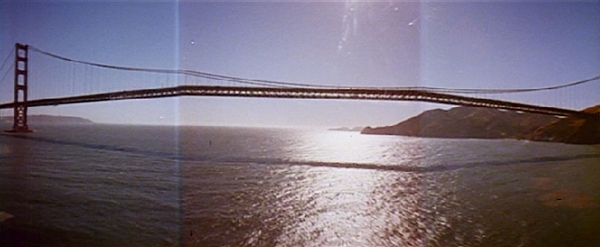 Most noticeable of all was the parallax effect caused by the fact that the Cinerama camera was really three cameras, each with its own vanishing point. (“parallax [pár-a-laks] n. 1 the apparent difference in the position or direction of an object caused when the observer’s position is changed.”) Imagine yourself looking out at a vista: First you look straight ahead; then you take a step to your right and turn your head left; then two steps left and turn your head right. You’re looking at the same view each time, but from three ever-so-slightly different places. That’s parallax. Take this frame on the right, from the last scene of How the West Was Won, flying under the Golden Gate Bridge. The join lines and the difference in color textures from one panel to the next are glaringly obvious, but even more pronounced are the “elbows” in the bridge; everyone knows that the Golden Gate travels in a perfectly straght line between San Francisco on the left and Marin County on the right.
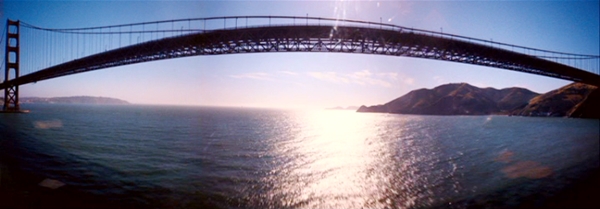
Here’s a similar frame, on the left, from the same scene as it appears in a later DVD issue. The digital clean-up crew has been busy: Join lines have been digitally erased, the color has been made uniform, and the “elbows” have been smoothed out. But the digital wizards couldn’t do anything about how the three lenses saw the bridge. That’s how it was with the Cinerama camera. The parallax wasn’t always obvious — especially when you were careening up and down rollercoaster tracks or swooping over Niagara Falls or through Zion Canyon in Utah — but when it was, it was impossible to ignore.
These were the things, as Cinerama opened in September ’52, that Fred Waller expected eventually to fine-tune. Early in 1953, as 20th Century Fox was beginning to beat the drum for CinemaScope, Cinerama announced plans for a single-booth, single-projector system. But that may simply have been a blue-sky announcement intended to take some of the wind out of CinemaScope’s sails. In any event, nothing ever came of it, at least not until It’s a Mad, Mad, Mad, Mad World ten years later — which, despite sporting the name, wasn’t Cinerama at all.
Also, by spring ’53, the Stanley Warner deal was in the works, and was finalized in August. Stanley Warner’s penny-wise-and-pound-foolish attitude toward Cinerama in general extended into the area of technical research, and Cinerama Inc., the manufacturing wing of the operation, was forced to eke out what technical improvements it could under the circumstances. New camera and projector assemblies were developed for the second feature, Cinerama Holiday, which had much greater registration accuracy than the industry standard, thus reducing considerably the jumping and jiggling of the three images. These new cameras also had improved focal ratios on the three lenses — from f/4.5 to f/2.8 — making them more sensitive to light.
As for the problem of slight variations in color, that was dependent on printing standards, which in most laboratories, as Hazard Reeves admitted, “have never been tight. If necessary,” he went on, “we’ll do our own printing.” But once again he ran up against the cheapskates at Stanley Warner. Not until 1958 did they agree to allot $200,000 for research into improved printing standards, and it wasn’t enough; Cinerama’s special in-house printers never materialized.

On May 18, 1954 Fred Waller died, and Cinerama lost its creator and conceptual genius. For all practical purposes, Cinerama remained, for the next (and last) nine years of its existence, what it was when Waller left it; the continuing evolution he envisioned would never happen — because there were no more Fred Wallers to drive it.
Waller left behind one final concept, designed to address the parallax problem inherent in Cinerama’s three-lens camera. This was a radically modified camera using a single lens that would duplicate the entire 146-degree field of vision of the three-lens camera, but on a single strip of film running horizontally through the camera 16 sprocket-holes at a time — the rough equivalent of a 102mm frame. This would eliminate the three-lens parallax, producing an image with a single vanishing point. That 102mm image could be divided in printing into three strips for projection (still necessary to cover Cinerama’s deeply curved screen) — and, as a bonus, could also be printed single-frame in any other format for conventional projection. The lens had been developed and a prototype camera was under construction in 1960 when the order came to abandon any further development.
In 1962, under Nicolas Reisini, Cinerama Inc. acquired the Photo Instruments Division of Benson-Lehner Corp. in Los Angeles, renaming it the Cinerama Camera Corp. Reisini might (and maybe should) have dedicated the new corporation to resolving the technical problems in Cinerama, perhaps even reviving that 102mm camera. But he didn’t. Instead, Cinerama Camera Corp. attempted to move into consumer products: a still camera that took 360-degree panoramic pictures, a wide-angle home movie projector, even (and I’ll bet you never knew this) a home videotape recorder. All of these ideas lost money in research and development (the videotape recorder was 20 years ahead of its time), and by 1964 Reisini had been ousted from Cinerama. The untapped potential of that single-lens, 102mm, 146-degree camera — Fred Waller’s last brainchild — is one of the great what-ifs of motion picture technology.
The Man Who Saved Cinerama
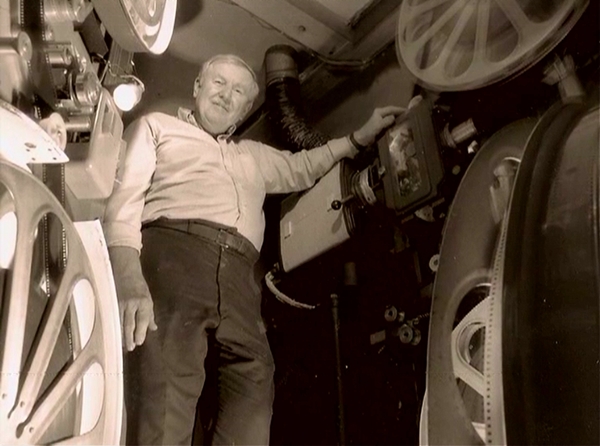 Let us now praise John Harvey.
Somewhere in my scattered stacks of pre-digital photographs, I have a picture I took of John Harvey posing proudly beside one of his Cinerama projectors. I’ve been ransacking the house for over three months now, all the time I’ve been preparing and posting this series on Cinerama, and I absolutely cannot find the damned thing, or any of the other pictures I took on my visit to John’s home town of Dayton, Ohio in 1996. So I’ve given up and decided to make do with this image from the supplemental materials on the This Is Cinerama Blu-ray. I’ll keep looking, because it’s important: I knew from the start that this whole series was going to culminate in a grateful tribute to John. Besides, those pictures aren’t just important to me. They’re historic.
Not to mince words or beat around the bush, John Harvey is the man who — virtually single-handedly — preserved Cinerama for posterity. His service to movie history can scarcely be overstated.
This is not in any way to minimize or overlook the efforts of others who have often worked above-and-beyond to ensure the survival of Fred Waller’s marvel. Just a few examples: The International Cinerama Society was instrumental in seeing that Cinerama was installed at the National Media Museum (formerly the National Museum of Photography, Film and Television) in Bradford, UK. John Sittig, who recently retired as Director of Projection and Sound for ArcLight Cinemas, performed a similar service for the installation of Cinerama at ArcLight’s Cinerama Dome in Hollywood (he also capped his career by putting together last month’s 60th Anniversary Cinerama Festival at the Dome). David Strohmaier’s 2002 documentary Cinerama Adventure was — besides being one of the best movie-themed documentaries ever made — a major step in retrieving the forgotten process from the memory hole of the 1950s and ’60s (Strohmaier also wrote, directed and edited the 30-minute short In the Picture [2012], the first picture in Cinerama since How the West Was Won).
And Australian collector John Mitchell has done much at his end of the globe — it was his prints of Search for Paradise and The Wonderful World of the Brothers Grimm that screened at the festival in Hollywood. But before any of them except John Mitchell Down Under — back when the ICS was still scouring the world for parts to put in that museum in Bradford, when David Strohmaier was just beginning to wonder what ever happened to Cinerama — John Harvey had been hosting screenings of This Is Cinerama and How the West Was Won for years. In his living room.
 Harvey’s interest in the movie projectionist’s craft began at an early age in Dayton. At the age of 10 he’d tag along when his older brother went to work at the local drive-in theater, and he began to wonder about the kind of machine it would take to project movies onto that massive outdoor screen. The projectionist noticed him peering in the windows night after night, invited him in to have a look around, and became his mentor, eventually sponsoring him into the projectionists’ union when John turned 17.
Meanwhile, when John was 16, his father (a loyal fan of Lowell Thomas) had taken the family to see This Is Cinerama when it opened at Cincinnati’s Capitol Theatre in 1954. For a boy with a budding interest in movie projection, here was movie projection on steroids; in time he would travel the 54 miles to Cincinnati to see all the Cinerama features at the Capitol. And when Dayton’s Dabel Theatre converted to Cinerama in 1963, John — now a union projectionist — worked backup to the Dabel’s crew, seeing How the West Was Won for 38 straight weeks and getting hands-on experience running a Cinerama setup.
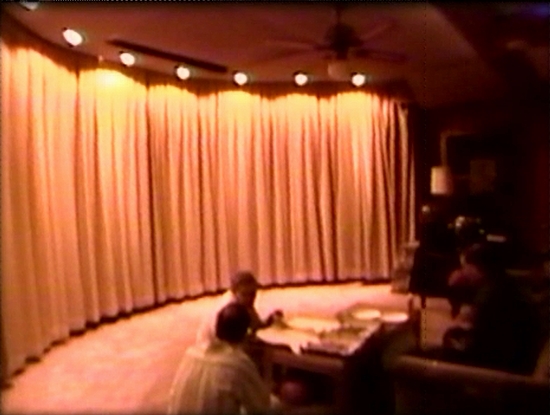 When three-strip Cinerama was abandoned after HTWWW, Harvey missed it. He saw clearly the difference with the “new” Cinerama movies like It’s a Mad, Mad, Mad, Mad World and The Greatest Story Ever Told (really only UltraPanavision — a big picture on a curved screen, but the viewer was no more “in” the picture than if he were standing in front of a billboard by the side of the road).
Harvey’s home cinema began as a a sort of laboratory where he experimented with ways of keeping a single wide-screen frame in focus on a deeply curved screen. He enlarged his living room three-fold by knocking out the walls of two unused bedrooms and raising the ceiling, installed a 35mm projector, and began tinkering with lenses, mirrors, beam-splitters and screen surfaces. Eventually — and I’m speculating here, but it may have been when he finally realized that classic Cinerama was never coming back — he decided to convert his home theater to Cinerama. “One day,” he remembered, “I finally took the initiative: ‘I’m gonna build my own projectors; I’m gonna run that film.’ Because it hadn’t been seen for years.”
And he did. It took him years of patient accumulation and painstaking work, but he eventually installed three full-size Cinerama projectors — sometimes having parts made from scratch when he couldn’t find them — and a Cinerama sound console the size of an armoire (the set-up even encroached on his kitchen). He tracked down snippets of film all over the world, splicing them together as they came into his hands (the sheer magnitude of that chore is mind-boggling). In time he had complete prints of This Is Cinerama, Cinerama Holiday and How the West Was Won. That’s at the very least; I seem to remember reading somewhere that he acquired, bit by bit, all seven features, but I can’t document that now. At any rate, he also amassed an impressive array of Fred Waller’s original test footage from the 1940s, and even a print of a Renault car commercial made to play with How the West Was Won in France. In addition, he had a museum’s worth of Cinerama memorabilia: posters, programs, lobby cards, stills — he even served guests popcorn in baskets lined with Cinerama napkins. Throughout the 1980s, to put it bluntly, John Harvey’s suburban Ohio home was one of only two functioning Cinerama theaters in the world; the other was in Australian John Mitchell’s backyard, 9,400 miles away. (It was about this time that I read of John and his happy obsession; I daydreamed about meeting him and wangling an invitation for a screening or two. If I had only known: I probably had only to look him up in Dayton directory assistance and drop him a line. In the end it didn’t come to that — but I’m getting ahead of my story.)
 In the early 1980s a mutual friend invited Larry Smith to a screening at John’s home and introduced the two men. Smith remembered seeing Cinerama at the Dabel at the age of six, and his experience that night was a reunion with one of his most vivid childhood memories. He told Harvey that if there was any way he (Larry) could help bring this to a wider audience, he wanted to do it. In 1986, Smith became the manager of the New Neon Movies, a cozy little 300-seat art cinema nestled in one corner of a huge parking garage in downtown Dayton, and began a ten-year campaign to persuade Harvey to install his Cinerama equipment at the New Neon. (This picture, by the way, is a rather misleading likeness of Larry. It’s from a 1997 interview taken while Kenneth Branagh’s Hamlet was playing at the New Neon, and Larry had bleached his hair and grown the moustache and soul-patch to emphasize his slight resemblance to Branagh as the Melancholy Dane.)
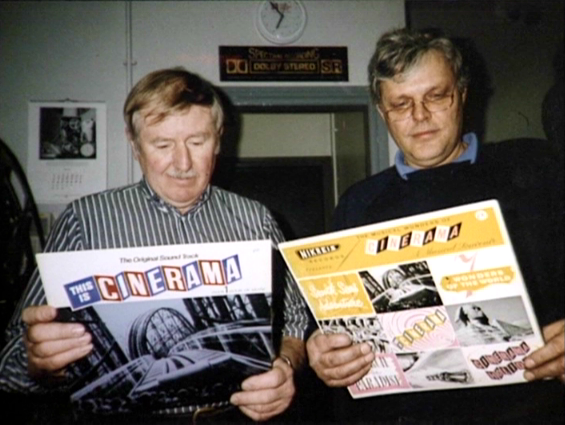 In John’s search for film and equipment, he had made the acquaintance of Willem Bouwmeester of the Netherlands. Like Harvey, Bouwmeester discovered Cinerama as a teenager and never lost his enthusiasm for the process. He grew up to work for IMAX in Europe and become a founding member of the International Cinerama Society, and from the Continent he had helped Harvey in his search. In 1993, when the ICS installed Cinerama at the Bradford museum, they sought and received advice and assistance from John Harvey. So now John’s house was no longer the lone outpost in a Cinerama-bereft world. But the only true Cinerama theater was in England; Cinerama remained a prophet without honor in the country of its origin (where it had once proved to be an honor without profit).
 As 1995 became 1996, the landlord of the New Neon Movies announced plans to split the already-modest theater down the middle and turn it into a two-screen venue. Larry Smith at last persuaded John it was now or never, and they hatched a plan that was brilliant simplicity itself: Before the remodel, the New Neon would install John Harvey’s screen, projectors and sound equipment. The theater would continue showing its standard art-house fare every evening, but on weekends there would be full-Cinerama matinees of This Is Cinerama (on Saturdays) and How the West Was Won (Sundays). The landlord was doubtful the scheme would pay for itself, but he agreed to let Smith solicit a letter-writing campaign; if he could get 1,000 writers to pledge to come to Dayton for Cinerama, then they could talk.
Ads went out in movie-buff publications all over the country, things like Classic Images and Films of the Golden Age, soliciting interest. By the deadline Smith had received 1,200 expressions of interest and pledges to attend; the next day another 200 arrived. “Can you say ‘no’ to fourteen hundred people at once?” Smith asked. And so the project got a green light — but only for an eight-week run.
Smith, Harvey and the New Neon staff had thirty days and almost no budget to retrofit the theater for Cinerama — something that had often taken months and as much as 200,000 1950s dollars to do when Cinerama was new. They did it with long hours and volunteer workers (“We can’t pay you,” Smith said, “but we can give you all the popcorn you can eat.”), ripping out 80 of the 300 seats to make way for the screen and auxiliary projection booth spanning the full back of the auditorium. As opening night drew near the story of their project made the Associated Press wire, drawing interest from all over the continent: Texas, Florida, Canada, New Orleans, Washington DC. “It just didn’t stop,” Smith remembered. “We had so many interviews that first week, we wondered if we’d ever get around to showing the movies.”
This Is Cinerama premiered a second time in America — and for the first time in over 30 years — at the New Neon on Thursday, August 29, 1996. The date was chosen to take advantage of the long Labor Day Weekend, but Harvey and Smith were in store for an eerie surprise. The guest of honor that night was Marianna Munn Thomas, widow of Lowell, and they learned from her that they had, without knowing it, brought This Is Cinerama back to America on the fifteenth anniversary of Lowell Thomas’s death.
Now that’s what I call some kinda Karma.
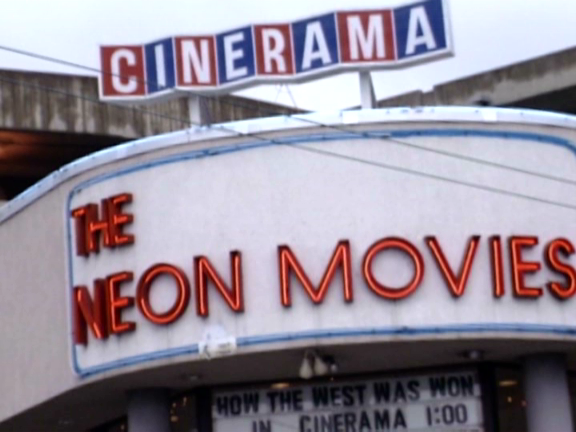 I’ll never forget how I learned about the project. That summer of ’96, when my girlfriend LuAnn and I returned from vacation in Illinois and Indiana, we were picked up at the Sacramento airport by my uncle, himself on vacation from his home in Muncie, Indiana — the same uncle who had taken my parents and grandparents to see This Is Cinerama in San Francisco in 1953. As I sat down in the car, he dropped an issue of Classic Images in my lap, open to an ad announcing the eight-week return of This Is Cinerama and How the West Was Won. I stared, gobsmacked, for a few seconds, and once I realized it wasn’t some kind of trick, I turned to my uncle and said, “Let’s go.”
In October ’96, midway through the (supposedly) limited run, that’s what we did. I flew to my uncle’s home in Muncie, and from there we drove the 84 miles to Dayton. That’s when I met John Harvey and Larry Smith, and when I took all those pictures that I can’t find now.* And that’s when I had an experience I never expected to have again: seeing This Is Cinerama and How the West Was Won in honest-to-goodness Cinerama, the way Fred Waller and Lowell Thomas and Merian C. Cooper and Hazard Reeves and Henry Hathaway and everybody else intended them to be seen.
Improvements in projection technology — and John Harvey’s almost supernatural rapport with his own equipment — made it possible for him now to do alone what had once taken an entire team of projectionists, and both movies came off without a hitch. John’s print of How the West Was Won was simply flawless: richly brilliant colors without a scratch, splice or line from the first frame to the last. I saw HTWWW four times in Cinerama in 1963 and ’64, and I’ve seen it four more times since the revival of the Cinerama Dome in Hollywood, but I never saw it looking better — or even as good — as it did that Sunday in Dayton.
This Is Cinerama was more variable, having clearly been assembled from more disparate sources. There were a number of splices, a few scratches, and a second or two here and there (no more than 10 or 15 seconds overall) when a section of one of the three panels couldn’t be found and had to be filled in with black slugs. (There were even a few seconds, in the canals of Venice if memory serves, imprinted with Danish subtitles — this footage no doubt obtained through the efforts of Willem Bouwmeester.) Even so, it was the real article, no doubt about it; for 23 years I had carried the unhappy memory of the picture’s misbegotten 70mm reissue in 1973 — which should have been called This Isn’t Cinerama — and this erased it completely.
Chatting with Larry Smith in the lobby, it was clear that, no matter what the ads said about “for 8 weeks only”, he intended to keep Cinerama playing at the New Neon until the landlord dragged the projectors, the sound console and the screen out the front door and threw them into the street. And that’s pretty much what happened.
People came — no exaggeration — from all over the world; the original eight weeks got extension after extension. After a year, the New Neon’s Cinerama matinees were still selling out seven and eight weeks in advance, and the shows continued. On at least one occasion Smith and Harvey screened John’s print of the second feature, Cinerama Holiday (rather badly faded Eastman color, but complete) and the guests of honor were the Marshes (now divorced) and the Trollers, the couples who had starred in it back in 1954. Ultimately, the New Neon’s Cinerama engagement lasted nearly four years of weekends and special occasions, finally drawing to a close in April 2000.
Eventually, the landlord followed through on his original plan, and the New Neon is now a two-screen cinema incapable of showing Cinerama. Larry Smith has moved on; he now lives in Culpeper, Virginia, where he works in the film preservation unit of the Library of Congress, specializing in the salvage and preservation of nitrate film.
John Harvey suffered a series of health issues in the early 2000s, and was forced to sell off his Cinerama equipment, prints and memorabilia to pay his medical bills. He finally lost his battle with those issues on May 3, 2018, at the age of 81. But the seeds of his quest and crusade to preserve Cinerama have borne priceless fruit. His and Larry Smith’s phenomenal success in Dayton from 1996 to 2000 sparked renewed interest in Fred Waller’s lifework. Now, in addition to the National Media Museum in Bradford, there are the ArcLight Cinerama Dome in Hollywood and the Cinerama in Seattle; both had been slated for demolition before public enthusiasm for Cinerama saved them from the wrecking ball, and both were fitted for Cinerama with John’s advice and assistance. Those two theaters owe their new lease on life — and the one in Bradford owes its very existence — in no small measure to the dedication, enthusiasm and practical know-how of John Harvey.
___________________
*Those pictures may yet turn up; stranger things have happened. If they do, I’ll add them here.
* * *
UPDATE 8/4/13: As always seems to happen, the photographs I took on my trip to Dayton in October 1996 turned up when I least expected to run across them. Here are a couple of good examples.
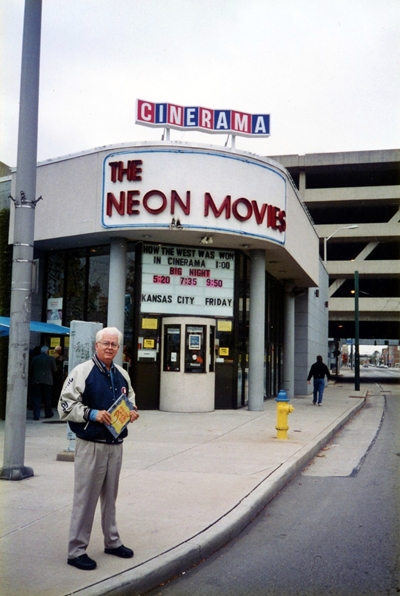
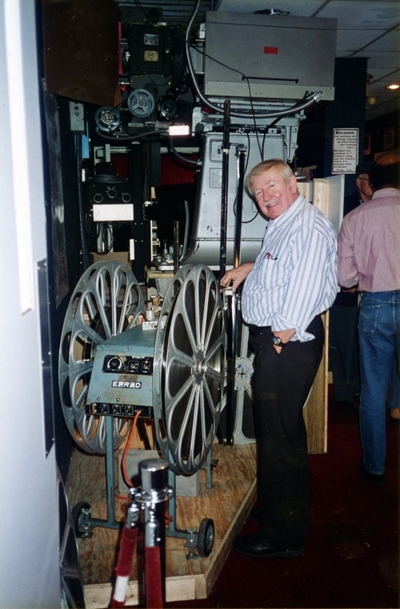
First, a shot of my uncle standing in front of the New Neon Movies as we arrived for the Sunday matinee showing of How the West Was Won. He’s holding one of my souvenir programs for the picture.
Just so there’s no confusion about the marquee over the box office: The New Neon ran This Is Cinerama on Saturday and How the West Was Won on Sunday afternoons. The rest of the week, and Saturday and Sunday evening, was devoted to current art-house fare. The marquee shows that the (regular) feature is Big Night, the 1996 hit starring Stanley Tucci and Tony Shalhoub as brothers operating a failing Italian restaurant. Opening on the coming Friday will be Robert Altman’s jazz-flavored Kansas City.
And here, finally, is the picture I originally wanted to open this post. This was taken the day before, in the “auxiliary” projection booth set up at the rear of the New Neon’s auditorium. It’s after the showing of This Is Cinerama, and John is carefully monitoring the rewinding of the second half of the feature.