Shirley Temple Revisited, Part 2
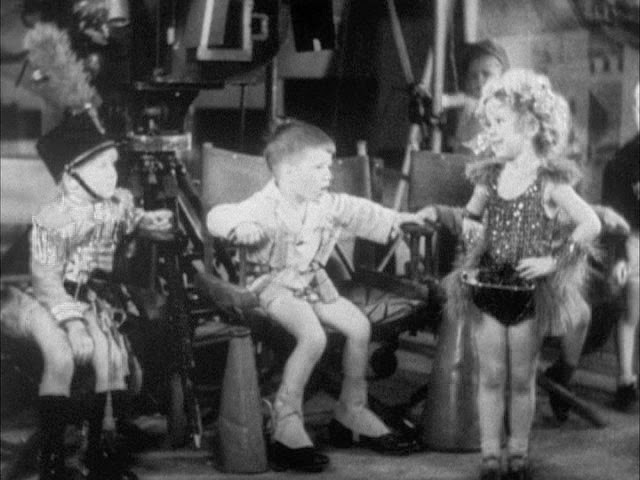
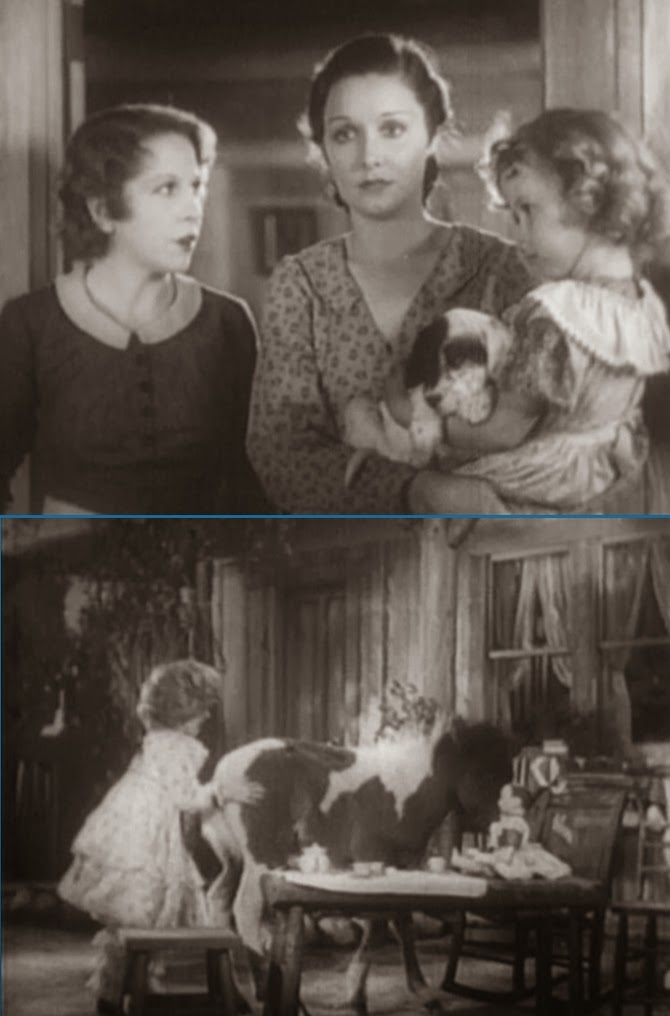
Even at the age of five, Shirley already knew two things: (1) animals can’t be counted on to follow the script, and you have to be ready to deal with what they actually do; and (2) no matter what happens, only the director gets to call “Cut!” (By the way, the pony’s kick did not remain in the picture; it would have detracted too much from the “murder” of the doll, the dramatic point of the scene.)
Shirley’s new contract with Fox was exclusive, but in the immediate aftermath of shooting “Baby, Take a Bow” for Stand Up and Cheer! all the studio found for her to do was a less-than-worthless bit in a Janet Gaynor/Charles Farrell romance called Change of Heart. Eight seconds on screen — with her back to the camera, yet! — and not a syllable of dialogue; it was worse than the bits Jack Hays used to send her on. Mother Gertrude set out to drum up some work — if some other studio wanted her daughter, surely a loan could be worked out — and she had just the picture in mind, over at Paramount. It was one for which Shirley had already auditioned and been dismissed out of hand. (“They took one look, watched me dance, and rejected me without a smile.”)
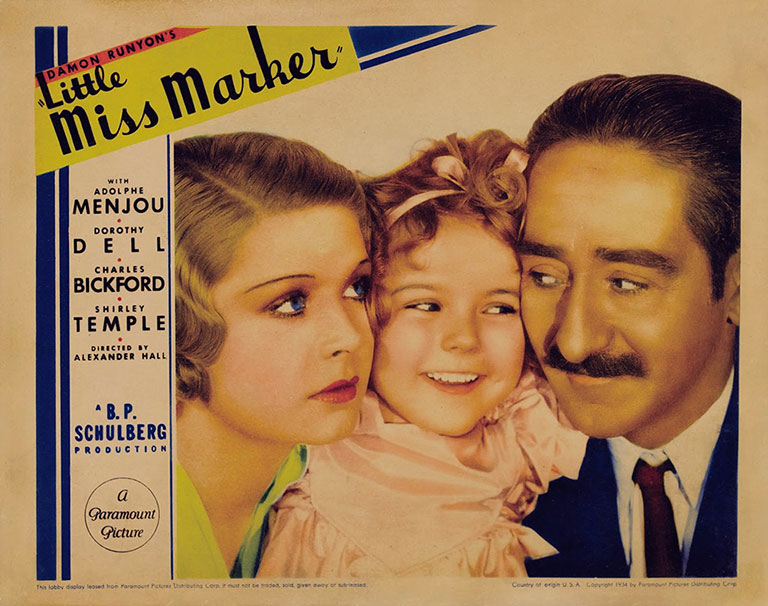
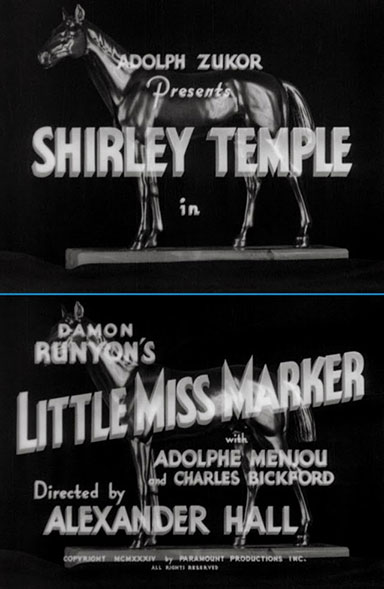
Little Miss Marker
(released June 1, 1934)
 Somehow, this time Gertrude was able to wangle an interview with the movie’s director, Alexander Hall. In Child Star Shirley doesn’t know how Mother did it; I wouldn’t be surprised if word of Shirley’s song-and-dance with James Dunn was already circulating on the Hollywood grapevine. In any event, Shirley auditioned for Hall personally.
“No, kid! Stop! We’re finished.” It was as simple as that; Shirley had the part. Paramount offered Fox $1,000 a week for Shirley’s services (a huge profit over the $175 in her Fox contract), and on March 1, 1934 Shirley reported for her first costume fittings for Little Miss Marker.
William R. Lipman, Sam Hellman and Gladys Lehman’s script was adapted from a story by Damon Runyon about a sourpuss bookie named Sorrowful who grudgingly accepts a bettor’s small daughter as a sort of “hostage” for a two-dollar bet on a horse race. The father promises to get the money and be right back, but he never comes back. Sorrowful finds himself saddled with the little girl, whose sunny sweetness gradually thaws his heart, brightens his outlook and loosens his airtight purse strings. Everyone notices the change the tot makes in Sorrowful, and they warm to little “Marky” themselves.
Damon Runyon died in 1946, but his name has stayed current in American culture thanks to the Broadway musical Guys and Dolls (its title taken from one of his story anthologies, its plot from two of his tales). But Guys and Dolls has also skewed the popular image of his stories and what it means to be “Runyonesque”. The musical is set in a rollicking fantasy land of cute underworld denizens — grifters, mugs, oafs and dames, colorful and essentially harmless. In Runyon’s stories there is humor, to be sure, but it’s not rollicking; it’s more often sardonic, even mordant, and the atmosphere of the stories, despite the picturesque speech, is hardly fantasy. The world of Runyon’s nameless narrator is gritty and down to earth, lit by bare bulbs in cheap hotel rooms and the gaudy glare of street neon; we can almost smell the cheap cigars and stale perfume. Things may work out — for the time being — for the characters, but it’s usually thanks to ironic accidents, not a benign universe. There’s often an undercurrent of menace beneath the whimsy, and bad things do happen.
And so it is in “Little Miss Marker”. One snowy night Marky wakes to find her nursemaid asleep and Sorrowful gone. Running outside barefoot in her nightgown, she tracks him to the Hot Box nightclub and runs into his arms just as a killer named Milk Ear Willie is about to settle an old grudge by plugging Sorrowful. Willie changes his mind, so Marky has saved Sorrowful’s life — but at the cost of her own. She contracts pneumonia and dies in hospital, despite the efforts of Sorrowful and his associates (even Milk Ear Willie chips in, kidnapping a famous child specialist to attend Marky’s bedside). Minutes after Marky’s death her father turns up, having suffered from amnesia since the day he left his little girl with the bookmaker. He has read about Marky in the newspapers and has finally come to take her home. “I suppose I owe you something?” he asks Sorrowful. Yes, says the bookie, you owe me two bucks. “I will trouble you to send it to me at once, so I can wipe you off my books.” He is once again the old Sorrowful, with the same “sad, mean-looking kisser” he had before — “and furthermore,” says the narrator, “it is never again anything else.”
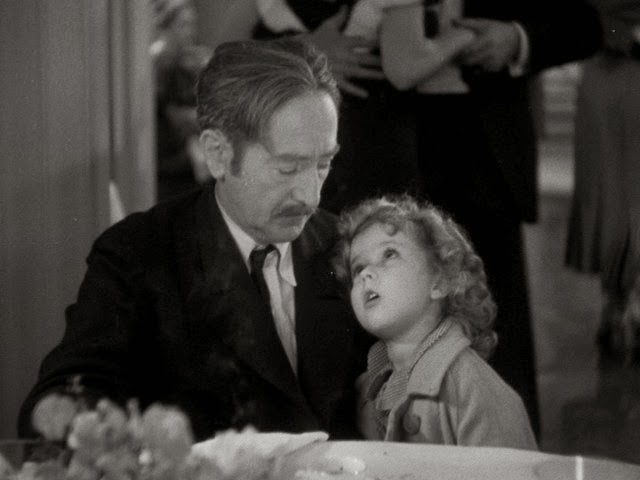
The movie keeps Runyon’s hospital climax — Marky is there with life-threatening injuries from falling from a horse, not pneumonia — but softens the ending: Marky lives, and Sorrowful’s reformation is allowed to stick. (The writers also gave Sorrowful a surname, Jones, which is not in the story but has stayed with him through two remakes.) Otherwise, it’s faithful to the spirit of Runyon’s story — basically a drama with small comic flourishes — with a suitable mix of seediness and vulgar glamour. Surely, Runyon was pleased.
Little Miss Marker contains one of the most unusual movie pairings of the 1930s: Shirley Temple and Adolphe Menjou. The usually dapper, immaculately tailored Menjou (he was voted Best Dressed Man in America nine times) was, at first glance, an odd choice not only to team with a child but to portray the rumpled, unkempt Sorrowful Jones. But it works; Shirley’s Marky brings out the debonair sport in Menjou’s Sorrowful, the one we knew was there all the time, by inspiring him to move to a more suitable apartment and upgrade his wardrobe. (Curiously enough, Menjou would play a similarly disheveled grump, and have a similar rapport with kids, in his last picture, Disney’s Pollyanna in 1960 — this time with two child stars, Hayley Mills and Kevin Corcoran.)
Shirley says in Child Star that Menjou once offered to play hide-and-seek with her, but otherwise tended to keep his distance (“off-camera he treated me with the reticence adults commonly reserve for children”). But when the camera’s rolling the two have a remarkable chemistry. It’s there when Marky and Sorrowful first meet, as she stands beside her father on the divider railing in Sorrowful’s shabby office. Sorrowful orders Marky “down offa there”, but she teases him: “Look, Daddy, he’s running away! Is he afraid?…You’re afraid of my daddy! Or you’re afraid of me. You’re afraid of something…” There follows a remarkable moment when Sorrowful picks Marky up, supposedly to get her off the railing, but holds her for a short while, her hands resting on his shoulders, while their eyes meet. Then he sets her down and growls to his henchman Regret (Lynn Overman), “Take his marker…A little doll like that’s worth twenty bucks. Any way you look at it.” (“Yeah,” Regret grumbles, “she oughta melt down for that much.”)
The chemistry is there, too, in a charming scene where Sorrowful and Marky talk about God, and he grudgingly agrees to teach her to say her prayers: “All right, get outta bed. I’ll show you how to pray. Sort of. But don’t you tell anybody, see?” The topper to the scene is the look on Sorrowful’s face when he hears why she wanted to learn: “And please, God, buy Sir Sorry a new suit of clothes.” In the very next scene, Sorrowful the sartorial butterfly has hatched out of his rumpled cocoon. (“Sir Sorry the Sad Knight” is the name Marky gives Sorrowful; she names all his cronies according to the stories she’s heard about King Arthur.)
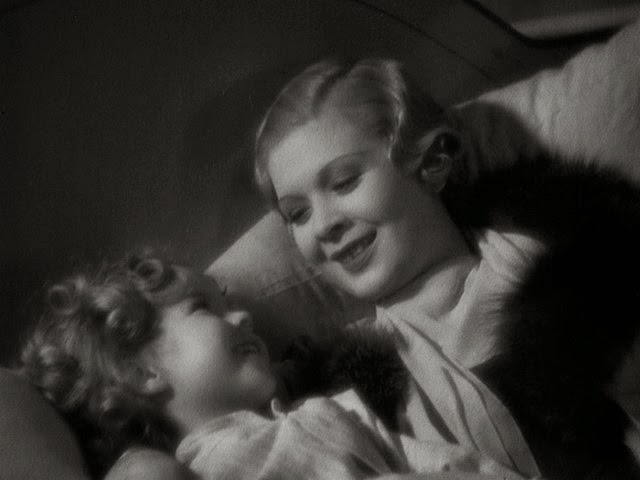
 Little Miss Marker fleshed out and in many ways improved Runyon’s original story. The amnesiac-father angle was always a bit of a credulity stretch; in the movie he becomes a suicide — driven off the end of his rope when the bet he placed with Sorrowful turns out a loser. This heightens Sorrowful’s sense of obligation to Marky: the race was rigged and he knew it when he took the man’s bet. It also links Marky to that losing horse, the ironically named Dream Prince. When Big Steve, Dream Prince’s owner, is suspended over suspicions about that fixed race, Steve and Sorrowful set Marky up as Dream Prince’s dummy owner so the horse can continue to run. Marky’s affection for “the Charger” (another one of her fanciful King Arthur names) draws her, Sorrowful and Bangles closer together, and leads to a crisis when Big Steve gets wind of shenanigans behind his back.
Jean: I'm with you; I cherished a lifelong affection for Shirley while going decades without seeing most of her movies. Re-seeing them has been a real voyage of rediscovery, which I'm sharing in this series. I think your mother would be pleased with what I'll have to say about Shirley and Bill Robinson when I get to them.
CW: I share your incredulity at Shirley's early rejection for Little Miss Marker, but we shouldn't be too hard on those who turned her down that first time; they'd probably seen 200 little girls that day. I think the real unsung hero of Shirley's career must be songwriter Jay Gorney, who saw Shirley in that Educational comedy short playing Junior Coghlan's kid sister, then recognized her outside the theater and asked to speak to her mother. Talk about your golden hunches…
I find it incredible that Shirley was originally rejected for "Marky". The movie works on so many levels for its dialogue, its heart and its outstanding cast. "Little Miss Marker" is always the first movie that comes to mind when I hear the name, Shirley Temple. Oh, how we would have loved the chance to enjoy more from Dorothy Dell.
I'm loving this!! It's been a while since I've watched any Temple films so I'd kind of forgotten how much I loved them. My mom, who you will remember was a dancer and dance teacher, used to wax rhapsodic about Shirley's talent- especially how well she navigated those stairs with Bill Robinson – and many of the tap steps I learned and have used over the years were ones that Shirley performed. Can't wait for the next installment.