A-a-a-and We’re Back…!
It’s been way too long — over a year-and-a-half — since I posted anything new here at Cinedrome. I want to apologize for that. I won’t overstate the concerns and conditions that led me to suspend blogging. Nor will I exaggerate the number of posts I began and never got around to finishing. But there have been some of both.
Be that as it may, I’ve had my necessary vacation and I feel rested, refreshed, and ready to soldier on. So with that, I file the following report on the 48th Annual Cinevent Classic Film Convention in Columbus, Ohio.
This was Cinevent’s second year in its new home, Columbus’s Renaissance Downtown Hotel. The convention’s previous, longtime venue, which had changed hands and names several times over the decades, closed suddenly — and permanently — in February 2015, only three months before that year’s Cinevent. Which, with an undertaking of this scale, qualifies as “at the last minute”. The Cinevent Committee had to scramble madly to find another venue, and by the grace of a merciful Providence the Renaissance was available. Better yet, the new place proved to be a step above the old one. Did I say a step? Actually, the new place is about three flights above the old one: superior accommodations, a better screening room with more comfortable chairs, a bigger dealers’ room, everything centrally located on one floor — and the hotel itself centrally located in a much better neighborhood, one block from the Ohio State House, with plenty of good restaurants nearby.
The Renaissance is now, as I said, Cinevent’s new home — but it wasn’t available for Memorial Day Weekend this year, so the get-together was delayed a week to June 2 – 5. Next year (the contract has already been signed) they’ll be going back to Memorial Day.
Cinevent 2016, Day 1
The first day featured a screening of King Vidor’s classic slice of life The Crowd (1928), one of the greatest pictures of the silent era — and probably one of the top 40 or 50 of all time. The Crowd is readily available on video and pops up regularly on Turner Classic Movies. Much harder to find — incredibly rare, as a matter of fact — was a program of all-but-lost comedy shorts from Fox Film Corp. For me, the highlights of the first day were Melody Cruise, a 1933 comedy starring Charlie Ruggles and Phil Harris (in his movie debut, 30-plus years before voicing Baloo the Bear in Walt Disney’s The Jungle Book); and The House of Rothschild (1934), from Darryl F. Zanuck’s fledgling 20th Century Pictures.
And by an astonishing coincidence, those happen to be the two pictures at this year’s Cinevent for which I supplied the program notes. And here they are:

Melody Cruise (1933) With a title like Melody Cruise and a leading man like Phil Harris, you can be forgiven if you expect this picture to be one uninterrupted songfest. Well, it’s not exactly, so you’ll be wise to dial those expectations back a bit so you can join in the fun. It’s not really a musical — a “comedy with songs” would be a better term. But director Mark Sandrich — who was finally, after six years directing shorts for various studios, beginning to graduate once and for all to features — assembles the picture with an intuitive sense of musical rhythm that would come to full bloom in his partnership with Fred Astaire and Ginger Rogers.
Melody Cruise concerns a trip by sea from New York through the Panama Canal to Los Angeles undertaken by two men, both well-to-do and each with an eye for the ladies: Pete Wells (Charlie Ruggles), a married man best described as a “male flirt”; and Alan Chandler (Phil Harris), a confirmed bachelor who loves to romance the fair sex but is (in the words of one of the movie’s semi-songs) “not the marrying kind.” In order to avoid any possibility of being waylaid into matrimony, Alan dispatches a letter to Pete’s wife in California “to be opened only in the event of my marriage” and detailing all of Pete’s marital indiscretions while husband and wife were on separate coasts; this, Alan figures, will give Pete a vested interest in scotching any shipboard romances that his bachelor pal may fall into.
Ah, but the best-laid plans…No sooner does the ship leave the pier than Alan meets winsome Laurie Marlowe (Helen Mack), and this bachelor suddenly finds himself feeling much less confirmed. Throw in an old flame of Alan’s who is also aboard (Greta Nissen), and a couple of randy party girls from Pete’s bon voyage celebration who linger in his stateroom after the vessel sails (June Brewster, Shirley Chambers), and the ingredients of an old-fashioned farce of misunderstandings and mistaken identity are in place, and the voyage promises to be a busy one for all concered.
The plot of this RKO pre-Code may be tissue-thin, but the execution gives it a gloss of frivolous fun. We can detect the influence of the previous year’s Love Me Tonight (from over at Paramount) right off the bat, as passengers in a shipping office negotiate for their respective cruises in a sort of recitative of rhyming dialogue, while the underlying music suggests a melody for their words that would become a song if anyone wanted to sing (the songs are credited to Val Burton and Will Jason). It happens again later as the ship sets sail, with the activities of the crew carefully choreographed to Max Steiner’s music, and later still as the ladies aboard (look sharp and you’ll catch a glimpse of 16-year-old Betty Grable) gossip about Alan Chandler in “He’s Not the Marrying Kind”. And in the picture’s one full-fledged song, sung by Phil Harris to Helen Mack as their ship waits its turn at the moonlit Panama Canal, both the title (“Isn’t It a Night for Love?”) and the staging are redolent of “Isn’t It Romantic?” from Love Me Tonight.
Making his screen debut here (if you don’t count an uncredited background bit as a nightclub drummer in 1929’s Why Be Good? with Colleen Moore), Phil Harris is younger, sleeker and smoother than the big loveable galoot we all remember from Jack Benny’s radio program and movies like The Wild Blue Yonder (1948) and The High and the Mighty (1954). Later on in 1933, he and director Sandrich would collaborate on the short So This Is Harris!, which would go on to win an Oscar for best comedy short subject.
Melody Cruise got an indulgent recpetion from the critics. Variety’s “Rush” found it “just a well-rehearsed trifle, padded out unmercifully with incidentals, atmosphere and other embroideries”, but allowed that “photography and technical production are better than first class, becoming notable for excellence at many points” — an apparent nod to the many whimsical screen-wipes Sandrich and conematographer Bert Glennon use to transition from scene ot scene. Likewise Mordaunt Hall in the New York Times, who called it “an adroit mixture of nonsense and music which makes for an excellent Summer show…It is, however, not the singing or the clowning that makes this a smart piece of work, but the imaginative direction of Mark Sandrich, who is alert in seizing any opportunity for cinematic stunts. From the viewpoint of direction this production is quite an achievement, for there are moments when it has a foreign aspect and there is some extraordinarily clever photography.”
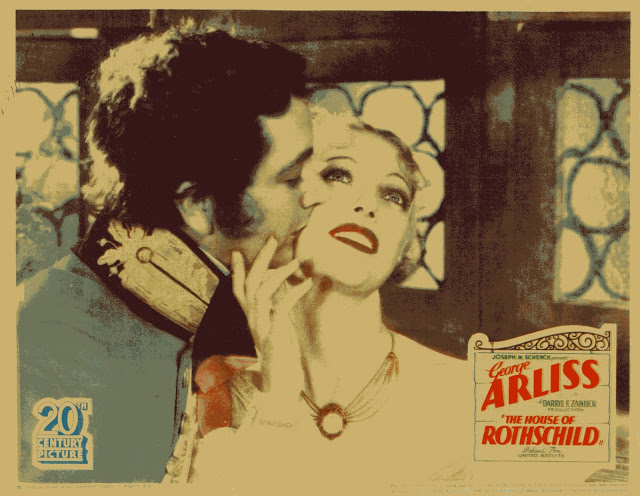 The House of Rothschild (1934) At the beginning of 1933, Darryl F. Zanuck was head of production at Warner Bros., the man behind The Jazz Singer, Little Caesar, The Public Enemy, 42nd Street, and other seminal pictures of Warners’ pre-Code era. On April 15, Zanuck abruptly resigned. As might be expected — especially with Warner Bros. — it was due to a dispute over money. For once, though, it wasn’t Zanuck’s money that was being disputed. Zanuck had reluctantly agreed to be the bearer of the bad news when the brothers imposed temporary studio-wide pay cuts in the wake of FDR’s bank holiday in March ’33. When studio chief Jack Warner decided to extend the cuts beyond the agreed-upon end date, Zanuck felt that he (Warner) had broken his (Zanuck’s) word to the employees. Harsh words flew, and Zanuck took a walk.

Welcome back to the Blogosphere! Good to see you again.
And thanks for your thoughts on these films. I haven't seen any of them, but I think there's some good watching ahead!