↓
 
  • Home
  • About the Author
  • Series
    • Carman Barnes: Five-Minute Movie Star
    • Crazy and Crazier
    • Films of Henry Hathaway
    • History of Cinerama: “Cinerama-Rama!”
    • Luck of the Irish: Darby O’Gill and the Little People
    • Marcel Delgado
    • Minority Opinion: The Magnificent Ambersons
    • Movie Souvenir Playing Cards
    • Shirley Temple Revisited: “Bright Eyes, 1928-2014”
    • The Bard of Burbank
    • The Fog of Lost London
    • The Museum That Never Was
    • William Wyler
  • Links and Resources
  • Jim’s Fiction
    • Glamour Boys
    • Items from the Scrapbook of Cosmo Brown
    • Sensible Christmas Wish, The
  • Contact

Jim Lane's Cinedrome

Classic Hollywood

Category Archives: Blog Entries

Post navigation

← Older posts
Newer posts →

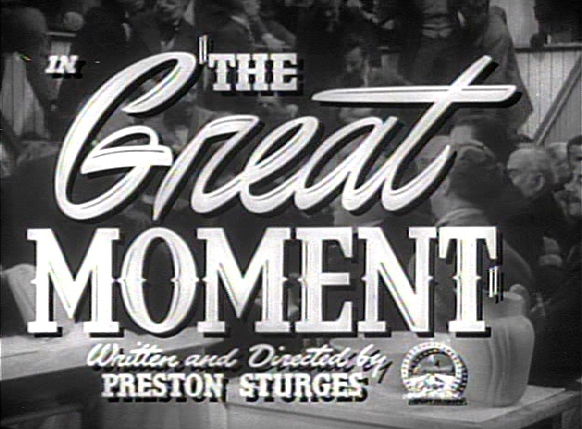
The Could-Have-Been-Greater Moment

Jim Lane's Cinedrome Posted on February 5, 2011 by Jim LaneJanuary 8, 2024
The Great Moment is the movie Preston Sturges’ admirers don’t like to talk about — the crackpot uncle at the family feast who makes everyone squirm in their seats, politely trying to ignore him and casting about for opportunities to change the subject (“Hey, how ’bout that Palm Beach Story?”).
 
I’ve always kind of liked The Great Moment myself. I think it comes of having seen it on TV at an early age — must be fifty years ago now, maybe more — before I even knew who Preston Sturges was, and I could get wrapped up in the story without comparing it to the rest of the man’s output. Harry Carey’s exultant “Gentlemen, this is no humbug!” really stayed with me; so did the final scene between Joel McCrea and the young girl on her way into surgery. It would be years, decades before I even refreshed my memory on the title of the picture, much less learned who made it, and when I did I was taken aback. The Great McGinty, The Miracle of Morgan’s Creek — that Preston Sturges???
 
It’s common for critics and historians to regard The Great Moment as the beginning of Sturges’ precipitous decline after his amazing track record at Paramount in the early 1940s, when it seemed he couldn’t put a foot wrong. In this view, The Great Moment is when the master begins to lose control of his craft — or at least when it begins to show. After this stumble it’s an unseemly plummet downhill, like a slapstick scene in one of his own movies: Sturges’ pictures become fewer, farther between, and weaker, until he ends his days in the Algonquin Hotel, unemployable, finally keeling over of a heart attack in the midst of writing his autobiography. It fits the legend of the meteoric genius flashing across the Hollywood firmament, then quickly and predictably burning out. It makes a comfortably dramatic story arc.

The facts are messier and less clear-cut. For one thing, Unfaithfully Yours (1948) may have flopped at the box office, but Sturges’ craft was as strong as ever, and the picture can stand now beside The Lady Eve and Sullivan’s Travels without blushing. But that’s a subject for another post; more to our present point, let’s not read too much into The Great Moment‘s eventual release date — September 9, 1944, on the heels of the giddy peaks of The Miracle of Morgan’s Creek and Hail the Conquering Hero. That skews the chronology. In fact, Sturges began writing The Great Moment (under his own title, Triumph over Pain) in 1939, even before he became a director of his own scripts. And he shot it from April to June 1942, between The Palm Beach Story and The Miracle of Morgan’s Creek. In other words, he started work on the picture while he was still on the rise, and shot and edited it (to his own satisfaction, if not Paramount’s) while he was at his absolute peak.

Actually, it gets even messier than that. I think I’d better back way up and start at the beginning.
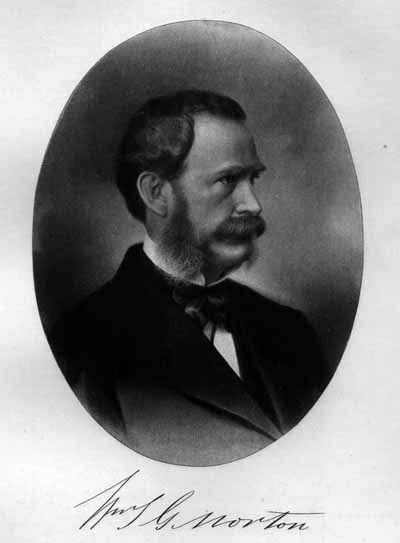
The Great Moment is one of two Sturges scripts to deal with a historical personage (the other was Diamond Jim [1935]). The subject here is William Thomas Green Morton (1819-68), a Boston dentist who in 1846 stumbled upon the use of ether as an anesthetic for the extraction of teeth. At first he had great success with his painless dentistry, disguising his simple discovery with the patent name Letheon. When he offered the use of Letheon in more serious surgery, he was forced to disclose its ingredients — or rather, sole ingredient. Almost immediately he was besieged with accusations that he had pirated the work of others, specifically fellow dentist Horace Wells and physician Charles T. Jackson, both of whom were personally acquainted with Morton, and Dr. Crawford W. Long of Georgia, who was not. Morton embarked upon an ill-advised lawsuit against the U.S. military for infringement of his Letheon patent, which only resulted in bad publicity for him; his patent was ultimately ruled invalid, and by 1850 the use of ether in surgery was virtually universal.
 
Morton spent the rest of his life in a futile effort to gain some kind of financial reward for his discovery, interrupted by honorable Civil War service as a volunteer surgeon with the Army of the Potomac. His efforts were forever frustrated by the grandiose claims of Jackson (who had a penchant for such things; he also claimed to have invented the telegraph), and by the fact that Wells committed suicide in 1848 — there were rumors (false) that Morton had driven him to it. Finally, in 1868, on his way to Washington to pursue yet another claim, Morton collapsed and died in New York City, three weeks short of his forty-ninth birthday. How much credit Morton really deserves for the discovery of anesthesia, and whether he ever deserved any money for it, remains a matter of controversy to this day.
 
Morton’s life was the subject of a book by French author Rene Fulop-Miller, which appeared in translation in the U.S. under the title Triumph over Pain in 1938. Paramount Pictures bought the screen rights to Fulop-Miller’s book before publication; Warners’ The Story of Louis Pasteur was hot just then, and was the beginning of a vogue for scientist biopics that would stretch well into the ’40s.
 
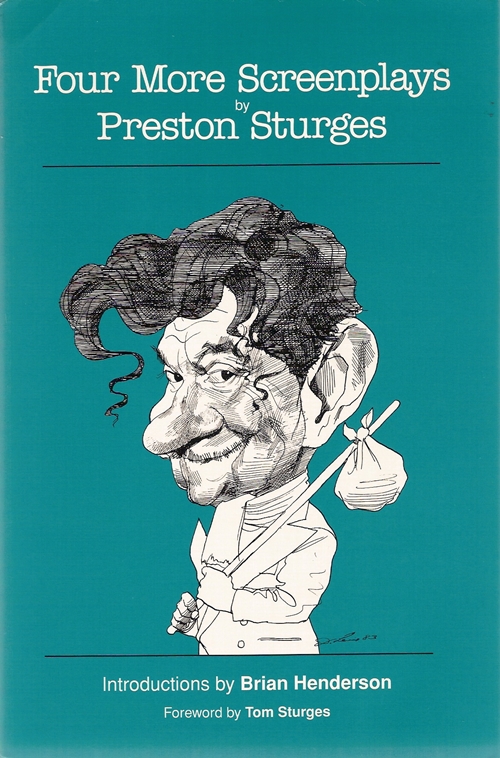
What happened to Triumph over Pain once it passed through the Paramount gate is a little foggy, which could often be the case when a property bought on spec bounced around a studio full of producers and writers trying to wrestle it into a screen treatment and, eventually, a script. In his detailed introduction in Four More Screenplays by Preston Sturges, Brian Henderson (citing Sturges biographer James Curtis) says there was first an extended treatment (perhaps even a script) by Samuel Hoffenstein. Over at Turner Classic Movies, on the other hand, their notes on The Great Moment cite the Paramount Collection at the Motion Picture Academy Library in stating that the original 1939 script was written by Sturges, Irwin Shaw, W.L. “Les” River, Charles Brackett and Waldo Twitchell; the notes don’t say whether any of them worked in collaboration or simply took turns at the script as it moved from one writer to the next. Another Web site, giving no source for its information, further asserts that Ernst Laemmle (one of “Uncle” Carl Laemmle’s extended family, in fact his literal nephew) also had a hand in things somewhere. (UPDATE 1/7/24): That site, however, no longer exists; the text has gone the way of its unspecified sources.) In any case, all the sources agree that the original (possibly vague) idea was for Triumph over Pain to serve as a vehicle for Gary Cooper as Morton, to be directed by Henry Hathaway.
 
Making matters even more confusing, Hathaway himself had a distinctly different recollection in 1973, in an oral history interview with Polly Platt. According to him, Sturges had written Morton’s story as a comedy, whereas he (Hathaway) thought the story too important for that. So he convinced producer Arthur Hornblow Jr. to assign the property to Charles Brackett and Billy Wilder, who were then contract writers at Paramount, and they turned out a “marvelous” dramatic script. “We were ready to do it,” said Hathaway, “and the war broke out. They didn’t want anything to do with misery, with pain, with operations.” The project was tabled, Hathaway left Paramount, and Sturges later went back to his original script when the picture finally got underway. Hathaway’s story doesn’t really hold up. For one thing, the timeline is wrong: both he and Cooper had left Paramount well before America entered World War II; for another, he refers to the picture as The Great Moment, a title that didn’t come along until after it had been finished and taken out of Sturges’ hands. Before that, and certainly when Hathaway and Cooper would have been involved, the title had been Triumph over Pain. Hathaway’s memory no doubt played him false here, perhaps because Paramount’s original plans for Triumph as a Cooper-Hathaway picture never really got off the ground.
 
In fact, Triumph over Pain (Sturges’ title in 1939 and ever after) almost never got off the ground at all. Brian Henderson’s introduction to the published script concentrates on Sturges’ efforts to the exclusion of any other writers — whatever Hoffenstein, Shaw, Brackett, Wilder or anybody else may have done from the sidelines — and Henderson is pretty thorough about it. He says Sturges made his first notes on Triumph over Pain on March 15, 1939, just as he was finishing up the script for Remember the Night, and by the end of ’39 had cranked out three complete drafts. By that time, Sturges had finally badgered William LeBaron, Paramount’s head of production, into letting him direct, and was already shooting his first picture, The Great McGinty.

For the next couple of years, Preston Sturges was one of the busiest men on the Paramount lot. He eventually won an Oscar for his McGinty script, by which time he’d finished two more pictures — Christmas in July and The Lady Eve, both top-to-bottom rewrites of scripts he had written years earlier. Next came Sullivan’s Travels and The Palm Beach Story, brand new projects that he wrote, shot, and had ready for release each within six months of day one. For his next project, Henderson speculates that Sturges hoped to avoid the stress and pressure of beginning a whole new script from scratch. If that was the case, then he had only one unproduced script left in his files: Triumph over Pain.

 
In the meantime, something else had happened: William LeBaron (shown here with Mae West) left Paramount in late 1941, to be replaced as head of production by Buddy De Sylva (at right). Sturges had a relationship of mutual trust and respect with LeBaron, but with De Sylva it proved to be another matter, and in time it poisoned the well for Sturges. The story is that DeSylva resented the autonomy Sturges enjoyed over his pictures. Any newspaper or magazine writer can tell you tales of editors who just have to tinker with even the best and cleanest copy, if only to justify their own existence and remind the writer who’s really in charge; De Sylva may have been one of those. The fact that Sturges’ movies made money would be an incentive rather than a deterrent: stick your oar in and when the picture hits you can grab a share of the credit; if it flops, you can blame the writer/director and claim you did your best to fix it. Besides, it was a power thing. 
 
It may have been a power thing for Sturges, too; there are always two sides to every story, and maybe Sturges, being the artist in the equation, gets less blame in the history books than he should. In his unfinished autobiography Events Leading Up to My Death (published in 1990 as Preston Sturges by Preston Sturges), the writer-director spoke with almost wistful regret about his former bête noire: “I remember the dreadful hours with Buddy once the break, urged by his sycophants, had occurred; the reasonable and depressing talks we had later, both fond of each other, when it was too late to mend the break.”
 
Whatever the cause, by the end of 1943, Sturges and De Sylva found themselves unable to agree on the terms under which Sturges would remain working at Paramount, and he departed to enter a production agreement with (of all people) Howard Hughes. If anything, I’d say that was the undoing of Preston Sturges, and maybe someday I’ll post on those miserable two years. (Did anyone ever have dealings with Howard Hughes that didn’t dissolve into fiasco and bad feelings sooner or later? With Sturges it came sooner.) When Sturges walked out the gate at the end of his contract (December 10, 1943), he left three pictures behind him awaiting release: The Miracle of Morgan’s Creek, Hail the Conquering Hero and the picture formerly known as Triumph over Pain.

“Formerly” because it had already run into trouble, even before Sturges left Paramount, and the title was only the beginning. Even in the middle of shooting, with Joel McCrea playing Morton, De Sylva had begun referring to the picture as Great Without Glory, pointedly signaling that Sturges’ (and Rene Fulop-Miller’s) title wasn’t going to fly with the higher-ups. Sturges declined to take the hint and went over De Sylva’s head — which Brian Henderson calls a “tactical error” — to Paramount vice president Y. Frank Freeman. Freeman took it to the board, who considered “all title suggestions” (Henderson doesn’t say what the suggestions included, but other sources mention Immortal Secret and Morton the Magnficent) and settled on Great Without Glory. De Sylva 1, Sturges 0.

The fact is, according to Henderson, Sturges seems not to have fully appreciated that Paramount, and Buddy De Sylva in particular, had been lukewarm at best about the picture from the very beginning; they indulged Sturges, even on his first script back in 1939, because they wanted to continue tapping his talent for comedy. (The ultimate fate of The Great Moment lends force to the idea that the studio regarded Sturges as a maker of comedies only, and couldn’t think outside that box.) Henderson suggests, and it makes sense to me, that Sturges squandered political capital in his fight to retain Triumph over Pain as his title, capital that might have been better deployed defending the picture itself. As if to confirm De Sylva and his minions in their belief that he was being hardheaded and obstinate, Sturges also picked another pointless hill to die on.

Sturges had written an acerbic introduction to Triumph over Pain, to be spoken in voice-over even before the opening credits. The passage stated — overstated — the picture’s central theme: that the greatest benefactors of mankind are often denounced and reviled in their own time. Fair enough, and W.T.G. Morton’s life, as recounted by Rene Fulop-Miller and Preston Sturges, was a fit text for preaching that sermon. But Sturges laid it on with a trowel:

One of the most charming characteristics of Homo Sapiens, the wise guy on your right, is the consistency with which he has stoned, crucified, burned at the stake, and otherwise rid himself of those who consecrated their lives to his further comfort and well-being so that all his strength and cunning might be preserved for the erection of ever larger monuments, memorial shafts, triumphal arches, pyramids and obelisks to the eternal glory of generals on horseback, tyrants, usurpers, dictators, politicians and other heroes who led him, usually from the rear, to dismemberment and death…

Well, subtlety never was part of Preston Sturges’ charm. But what the hell was he thinking? Never mind that, at the very moment he was committing these words to film, the United States was trudging through the bleakest days of World War II with no assurance of how it would turn out. Even aside from the morale-busting words — which would never have made it past the Office of War Information — there’s a sour tone to the intro that would put the most cheerful moviegoer into a foul and unreceptive mood. Sturges clung to this intro like a terrier to a rat; when De Sylva urged him to revise it, he doubled down: he changed “wise guy” to “talking gorilla.” By the time he finally agreed to this:


…it was too little, too late.

In fact, by that time, the picture had been whittled and rearranged into more or less the form that has come down to us. Previews on August 13 and 27, 1942 of the picture as Sturges made it (but with the title Great Without Glory) had gotten a mixed response, whereas Sturges’ previous pictures had garnered raves. De Sylva was more convinced than ever that major surgery was called for, and that’s what the picture got — probably between September and December ’42 while Sturges was busy shooting The Miracle of Morgan’s Creek.

Of the three pictures Sturges left behind at Paramount, only The Miracle of Morgan’s Creek was left as he made it; the other two got major overhauls from De Sylva and his editors. Miracle opened on January 19, 1944 and was an immediate smash hit. De Sylva’s cut of Hail the Conquering Hero was previewed the next month and was a disaster. Sturges offered to come back to Paramount without pay and re-edit and reshoot Hero and Great Without Glory “to everyone’s satisfaction.” He was allowed to doctor (and save) Hail the Conquering Hero — after all, that was a comedy, Sturges’ specialty. But on Great Without Glory (now The Great Moment) De Sylva put his foot down; that, he figured, was a waste of time and money.

Sturges tried the same tactical error that had failed before. He appealed to Y. Frank Freeman, saying there was still time “to save ‘The Great Moment’ from the mediocre and shameful career it is going to have in its present form and under its present title.” As it was, he said, the picture was “a guaranteed, gild-edged disaster”; a little time and money (“less than fifty thousand dollars”) could result in “a picture of dignity and merit.” But Paramount was indisposed to be accommodating; Freeman did not reply.

And so Preston Sturges’ Triumph over Pain remained The Great Moment as we know it today, shoved out into release in September ’44, nearly two-and-a-half years after shooting was complete. If it looks like the beginning of the end, a glaring “uh-oh”, to us now, it wasn’t quite that obvious to everyone at the time. Sturges still had his partisans, and some of them were better disposed to the picture than historians have been since. “[A]t least,” said Bosley Crowther in the New York Times, “Mr. Sturges has triumphed over stiffness in screen biography.” Likewise The New Yorker’s John Lardner: “…shows clearly that film biographies need not wear stuffing in their shirts.” In Variety, “Sten” called the story “compelling” and predicted it “should prove to be a good grosser.” But Sten was wrong. Other critics were less kind, and financially The Great Moment turned out every bit the disaster Sturges had glumly predicted.

I first planned this post with the idea of doing a compare-and-contrast between Sturges’ published script and the finished film. But that way lies madness; Buddy De Sylva and his crew made such a total hash of things that trying to follow The Great Moment with script in hand is like being backstage prompter for an actor who never learned his lines and keeps hopping around from scene to scene at random.

In fashioning a screenplay from Triumph over Pain, Sturges’ original problem was simple, and not easily solved: Morton’s life consisted of an early brilliant success followed almost at once by scandal and twenty years of frustration, disappointment, increasing opprobrium and deepening poverty — a long and dispiriting anticlimax.

Sturges’ solution was to build up to the triumph rather than begin with it. He opened Triumph over Pain with a prologue depicting a modern-day operation, as a frightened little boy is assured by his parents that his impending surgery won’t hurt at all. As the boy descends into anesthesia, Sturges dissolved to a reunion between Morton’s widow Elizabeth (Betty Field) and his friend Eben Frost (William Demarest) after Morton’s death. Then, in a series of flashbacks, Sturges worked more or less backward through Morton’s career, in scenes that became more lighthearted as Elizabeth’s reminiscences grew less and less bitter. In this way, Sturges constructed his script so that the comedy in the story came gradually to the fore and was a relief from what had gone before — that is, what for Morton and Elizabeth had come afterward. The idea was that the audience could share in Morton’s triumph knowing what he doesn’t: the disappointment that was to come.
 

Buddy De Sylva’s ordered changes in The Great Moment — carried out by editor Stuart Gilmore with suggestions from Chas. P. West of the Paramount editing department — threw all of that right out the window. Sturges later complained, “The studio decided that the picture should be cut for comedy. As a result, the unpleasant part was cut to a minimum, the story was not told, and the balance of the picture was upset.” Comparing his script with the picture as released, it’s plain that Sturges was exactly right. In the rush to get to the funny stuff (“The amazing, amusing romance of the hero of the roaring 1840s! Hilarious as a whiff of laughing gas!” bellowed the preview trailer), Paramount sacrificed much of the movie’s drama and may have even made the funny stuff less funny, because there was no longer the sense of relief that would make it welcome.

It’s not easy to say how much actual running time was sacrificed from Sturges’ cut of Triumph over Pain. A calculated guess suggests to me that the script as written would run about 100 min., and the DVD of The Great Moment runs precisely 80 min. 30 sec. Many of the comic antics in the movie seem odd and unduly raucous. (Sturges had a penchant for slapstick but no great knack for it; physical comedy was not where the pleasures of his movies lay.) How much the comedy could have been balanced and muted by the missing footage, we’ll never know. 

Even as it stands, truncated and vandalized by a clueless studio that had given up on it even before the cameras rolled (and would soon give up on Preston Sturges himself), The Great Moment is worth seeing. There are elements — like the persuasive period detail in the sets and costumes, and even in the typeface of posters and newspapers — that no editor could cut out, and which attest to how seriously Sturges took his story. Above all, there’s the simple dignity of Joel McCrea’s performance, and those of Betty Field, William Demarest and Harry Carey as the surgeon who believes in Morton. At the very least, as Bosley Crowther and John Lardner noted, the picture offers an interesting contrast to the standard reverent “marble man” portrayal so common in Hollywood’s treatment of important figures in science and medicine.

Preston Sturges’ fall from grace may have been inevitable, and when it came it was probably his own doing as much as anybody else’s. But it didn’t begin with The Great Moment, and the picture can’t be blamed for it. Uneven it may be, but Sturges conceived, wrote and filmed it at the height of his powers. What happened to it after that wasn’t entirely his fault.
.

Posted in Blog Entries

Moving Right Along…

Jim Lane's Cinedrome Posted on January 22, 2011 by Jim LaneJune 28, 2016

My apologies for the long silence here at Cinedrome. A number of circumstances have conspired to bring this about; among them was my decision that it was high time — or rather, past time — that I instituted an index. This proved to be more complicated and time-consuming, and the index itself more cumbersome, than I anticipated. As you can see above, I’ve decided on two indices: (1) Names, encompassing persons, corporations, institutions — anything that has a name; and (2) Titles — i.e., everything that has a title, movie or otherwise. I hope these will make navigating and cross-referencing my posts a little more reader-friendly.

Other improvements to Cinedrome are in the planning stages and will be rolled out as they mature. Meanwhile, stay tuned for a return to regular posting. Next up: Preston Sturges.

Posted in Blog Entries

Remembering the Night

Jim Lane's Cinedrome Posted on December 24, 2010 by Jim LaneJuly 16, 2016

This post is adapted and expanded from an article I wrote for the November 22, 2007 issue of the Sacramento News & Review.


I always dread this time of year, when the holiday movies are trotted out. You can’t turn around without hearing some jackass bitch about how much he hates It’s a Wonderful Life. He can’t get enough of “I am your father, Luke” or “I’m King o’ the World!”, but Zuzu’s petals once a year is just more than he can bear.

It makes me nostalgic for the days when I had It’s a Wonderful Life all to myself (and yes, there was such a time). Well, almost to myself, anyhow. Certainly everybody else who knew and loved Frank Capra’s picture had my own last name. Back about 1974 or so, in college, I had two friends who made a nightly ritual of staying up to watch car dealer Jay Brown’s all-night movies on Channel 36 out of San Jose. One day — and it was nowhere near Christmas — they rushed up to me bubbling with enthusiasm for this great Jimmy Stewart movie they’d seen the night before. They figured if anyone would know about it, I would, and they were right. That was — for me, anyhow — the beginning of the revival of It’s a Wonderful Life. And the beginning of the end for my family and me having the memory of It’s a Wonderful Life all to ourselves. Don’t get me wrong: I’m glad the picture finally came into its own, and I thank a merciful Providence that Capra, Stewart and Donna Reed all lived to see it. But then again, when people like that hypothetical (but all too credible) killjoy I mentioned above feel free to rag on it, sometimes I’m not so sure.

So I almost hesitate to mention Remember the Night. Maybe I wouldn’t, but the cat seems to be getting out of the bag. When I wrote about Remember the Night in 2007, it was available only on out-of-print used VHS or bootleg copies of an AMC broadcast from the 1990s. Things are different now; the movie’s available in an above-board (and beautiful) DVD from the TCM Web site, and I figure it’s only a matter of time before someone runs up to me bubbling with enthusiasm about this great Fred MacMurray-Barbara Stanwyck movie they saw the other night. I want to be able to say I’m way ahead of them.

Most of the reason for Remember the Night‘s resurgency — I mean in artistic terms, independent of the arcane ins and outs of who owns a film and who decides there’s a market for it — is its writer, Preston Sturges. This was the last script he ever wrote for somebody else to direct, the somebody in this case being Mitchell Leisen, then the alpha dog among Paramount directors (a position he would soon cede to — or at least share with — Sturges himself). Leisen’s star has slipped a bit since his heyday in the ’30s and ’40s, alleviated somewhat by an excellent biography, Mitchell Leisen: Hollywood Director by David Chierichetti, originally published in 1973 (the year after Leisen died), then revised and expanded in 1995. I’ll have more to say about some of Leisen’s pictures later.

Right now I’m talking about Remember the Night. The version of Sturges’ script published in Three More Screenplays by Preston Sturges is a facsimile of Sturges’ actual typescript, dated June 15, 1939 and bearing the title The Amazing Marriage. Written in by hand on the title page is “Remember the Night[,] Or”. Obviously, neither Sturges nor producer-director Leisen ever came up with a really good title. The Amazing Marriage at least has some slight connection to a line from the script, albeit one Leisen cut during shooting. The picture’s final title, though, is so generic as to be meaningless.

If the title is generic, however, it’s the only thing about Remember the Night that is. Stanwyck plays Lee Leander, a hardboiled, tough cookie who gets busted in New York for lifting a diamond bracelet from a Fifth Avenue jewelry store. MacMurray is assistant D.A. Jack Sargent, about to leave town to drive to his mother’s farm in Indiana for Christmas when his boss yanks him in to prosecute Lee. Disgruntled and eager to get on the road, he takes advantage of a legal technicality and gets the case continued until after New Year’s. Then he begins feeling guilty about leaving Lee in jail over the holidays and arranges to get her bailed out. To his surprise and discomfort, the bail bondsman remands Lee to his custody, and the surprise is compounded when, despite the fact that he was prosecuting her only that afternoon, the two find themselves taking a liking to one another. They even learn that they grew

up about fifty miles from each other in the same part of Indiana. So, still feeling responsible for Lee, Jack decides to take her home to spend Christmas with his mother (Beulah Bondi) and aunt (Elizabeth Patterson) and their hired hand (Sterling Holloway).
 
At the humble Sargent farm outside Wabash, Ind., Lee’s hard shell begins to soften and melt in the glow of a household suffused by warmth, affection and mutual support — the kind of nurturing family atmosphere that was completely missing from her own upbringing just a few towns away. At the same time, love — the other kind of love — begins to bloom between Lee and Jack, and they allow themselves to forget — almost — that she’s a repeat offender, and come January 3 he’s going to have to try to send her to jail for a long time. 
 
Remember the Night wasn’t marketed as a holiday movie — it was released January 19, 1940, and besides, such a thing was almost unheard of then — but it’s one of the best and least-known. It was a hit in 1940, with Stanwyck and MacMurray already showing the sexy chemistry that would play to more sinister effect four years later in Double Indemnity. And it was visible on TV through the 1960s and into the ’70s, but has been out of circulation for decades. Now that Turner Classic Movies and Universal (which owns the pre-1948 Paramount library) have partnered up to issue it on DVD, it surely won’t be long before it becomes as popular and beloved as It’s a Wonderful Life. Well, okay, maybe not entirely as much — Wonderful Life has a mighty powerful mystique — but I’m betting it won’t be far behind. 
 
I think I may have more to say on the subject, so there might be a Part 2 to this post. But that’s for another day; I wanted to be sure to get this much up in time for Christmas. So Merry Christmas everybody, and if you’re looking for a new movie to add to your list of holiday favorites, consider giving Remember the Night a try. 
 
Oh, and one more thing. Don’t come around in 2037 moaning about how you’re sick and tired of Remember the Night. I won’t want to hear it.
Posted in Blog Entries

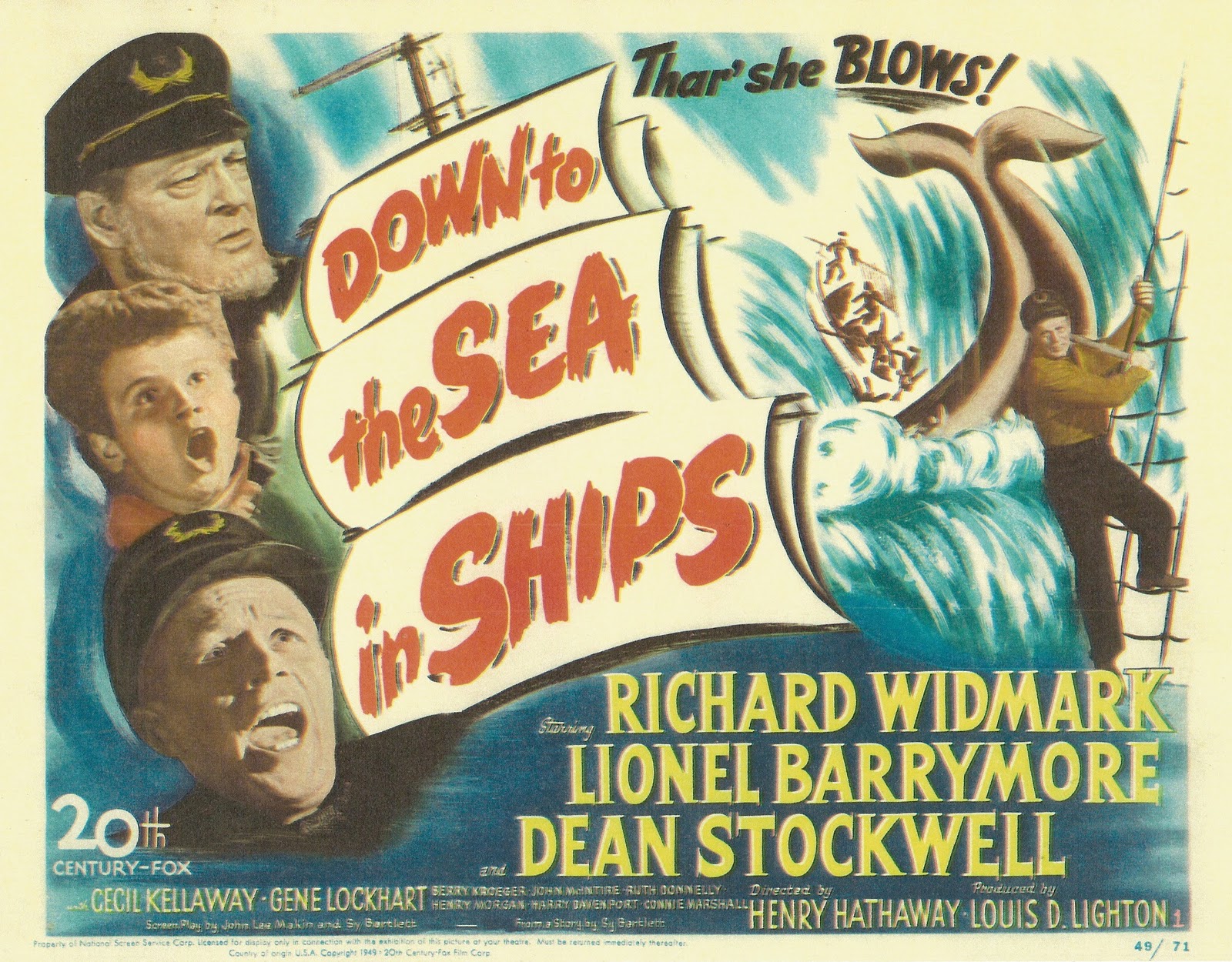
Films of Henry Hathaway: Down to the Sea in Ships

Jim Lane's Cinedrome Posted on December 16, 2010 by Jim LaneNovember 10, 2021

In 1949 Henry Hathaway made one of the best movies of his long career. In it, his three stars, Richard Widmark, Lionel Barrymore and Dean Stockwell (and for that matter, most of the supporting cast) each gave one of his own best performances. Down to the Sea in Ships is in fact one of the finest movies ever to come out of the Hollywood studio system, and almost nobody has ever heard of it.

I know I run the risk of overselling the product here, but I simply don’t understand why Down to the Sea in Ships isn’t one of the best-loved movies of all time. When the talk turns to the great seafaring stories of the screen — Treasure Island, Mutiny on the Bounty, Captains Courageous, Moby Dick et al. — it’s a mystery to me why Down to the Sea in Ships never comes up. If there are such things as flawless movies, and there surely are, Henry Hathaway’s Down to the Sea in Ships is one of them.

I say “Henry Hathaway’s” to distinguish this picture from the other Down to the Sea in Ships, from 1922. That one made a star out of Clara Bow, and curiously enough, it’s available on home video — no doubt because it’s in the public domain, while Hathaway’s picture is still under copyright and quarantined in the 20th Century Fox vault. In the 1960s and ’70s it was the other way around: Down to the Sea in Ships (1922) was gone and long forgotten, but if your local TV station had a decent film library and you were willing to stay up till two or three in the morning, you could count on seeing Down to the Sea in Ships (1949) two or three times a year. 

Before we leave the subject of Clara Bow’s breakout vehicle for good, let’s get one point clear: Wikipedia says that the 1922 picture “was remade by Twentieth Century Fox in 1949,” but — well, that’s Wikipedia for you. (Whoever wrote the article didn’t even know that it’s “20th Century Fox,” not “Twentieth.”) In fact, there is no connection whatsoever between the two pictures — other than the fact that they both deal with whaling ships out of New Bedford, Mass., and they both take their title from Psalm 107:23 (“They that go down to the sea in ships, that do business in great waters…”). These aren’t two versions of the same story, they’re two different movies with the same title; henceforth, when I use the title, I’ll be talking about only one of them.

Fox chief Darryl Zanuck first set out to produce Down to the Sea in Ships in 1939 — if not this picture precisely, at least one with this title and setting. Things got as far as sending a second unit crew into the waters of the Gulf of California to shoot background footage. But when World War II made it impossible to shoot on the open sea, or even in California’s harbors, the picture went on a back burner.
 
After the war, Zanuck reactivated the project and handed it over to producer Louis D. (“Buddy”) Lighton and director Hathaway. Both men were working for Fox now, but they had been paired before in the 1930s at Paramount: Lighton had produced the Shirley Temple vehicle Now and Forever, The Lives of a Bengal Lancer, and Peter Ibbetson, all of which Hathaway directed. The first draft of the script was by Sy Bartlett — that’s him at right — born Sacha Baraniev in Russia (now Ukraine) in 1900 but raised in America from the age of four. Originally a newspaper reporter, he became a screenwriter for various studios in the ’30s, but he was noted more for hobnobbing in Hollywood society, hosting Sunday barbecues, and the occasional gossip-column appearance. He served with the U.S. Army Air Corps during World War II, then returned to Hollywood and a job at Fox. At the time that he took his first cut at Down to the Sea in Ships, Bartlett’s most memorable work was still ahead of him: he later turned his wartime experience into the novel and screenplay Twelve O’Clock High (1949) for director Henry King and star Gregory Peck.

Music historian Jon Burlingame (in his notes for the movie’s soundtrack CD) says Bartlett’s script underwent a rewrite by John Lee Mahin — shown here (on the left) in a rare acting stint in Hell Below (1933) with Robert Montgomery. Like Bartlett a reporter-turned-screenwriter, Mahin already had a number of major credits on his resume, many of them — including Red Dust, Treasure Island (1934), Test Pilot, Captains Courageous and Dr. Jekyll and Mr. Hyde (1941) — for Hathaway’s mentor Victor Fleming.
 

Without access to what records might be in the 20th Century Fox archives, it’s impossible for me to say exactly how credit for Down to the Sea‘s script should shake out — which is a pity, because the script is a truly masterful piece of work; if the picture ever gets the kind of attention it has deserved for over 60 years, maybe someone will shed some light on the subject. The writing credit on screen reads “Screen Play by John Lee Mahin and Sy Bartlett; From a Story by Sy Bartlett,” which matches the general drift of the two writers’ careers: story was Bartlett’s long suit, dialogue Mahin’s. Making an educated guess, I’d say Bartlett was responsible for Down to the Sea‘s distinctive blend of rousing adventure and psychological acuity, Mahin for the unerring cadence and vocabulary of the speech of 19th century New England whalermen. Or it may have been more complicated than that; Mahin gets top billing on screen, which suggests that his rewrite probably amounted to more than just touching up the dialogue.

Down to the Sea in Ships opens in New Bedford in the summer of 1887. The whaling ship Pride of New Bedford returns from a four-year voyage under the command of Capt. Bering Joy (Lionel Barrymore), the best whaler on the New England coast. He’s just about the oldest, too, though he shows no signs of being ready to retire from the sea. The reason for that is his 11-year-old grandson Jed (Dean Stockwell), the youngest in a line of the whaling Joy family that extends back “mighty nigh two hundred years.” Capt. Joy, though still on crutches from an injury that kept him bunk-ridden for much of the voyage, is unwilling to retire, at least until Jed is thoroughly brought up in the ways of the sea and can continue the family tradition. Jed himself is (if you’ll pardon the expression) entirely on board with this; he loves the seafaring life, the only life he’s ever known. He’s spent the last four years — nearly half his life — as his grandfather’s cabin boy, and is now eager to ship out again as an apprentice member of the fo’c’sle crew.
 

Unfortunately, the decision may be taken out of both their hands. The whaling firm’s insurance company refuses to cover Capt. Joy; moreover, Massachusetts law will not allow Jed to return to sea unless he can pass an exam covering the four years of schooling he missed while he was away. Fortunately, a sympathetic school superintendent (Gene Lockhart, in a warmhearted cameo) fudges Jed’s test results rather than disappoint the captain.

And a tentative compromise is reached on the insurance issue when Capt. Joy is persuaded to sign Dan Lunceford (Richard Widmark) as first mate. The firm’s president (Paul Harvey) says Lunceford is a promising young seaman who only needs some experience under a master mariner like Capt. Joy, but the captain isn’t fooled: he realizes that Lunceford, who has a master’s license, is being foisted on him at the insurance company’s behest, to be in a position to take command of the Pride of New Bedford if age or infirmity should overcome the old man.
 

For his part, Dan Lunceford doesn’t care much for the look of Capt. Joy, nor for his sneering at Lunceford’s “book-learnin'” and his college degree in marine biology; only a sweetening of his percentage of the voyage’s profits persuades the younger man to ship out with Capt. Joy after all.

Once the Pride of New Bedford is out to sea, Capt. Joy plays his trump card. He tells Lunceford that he sees “the hand of Providence” in Lunceford’s presence on board. Jed was allowed to ship out, he says, only on the condition that his studies be continued, and Capt. Joy is hereby assigning Lunceford, in addition to his regular duties as first mate, to be Jed’s tutor during his off-duty hours. In this way, the crafty old mariner intends to kill two birds with one stone: he’ll see to Jed’s education, and he’ll keep Lunceford too busy to undermine his authority.

Lunceford has no choice but to accept the assignment, but he does so with ill grace. Resentful at what he regards as essentially a babysitting chore, he is impatient, sarcastic and dismissive. Resentful in turn, Jed is obstreperous and uncooperative. Lunceford decides Jed is just as ornery and pigheaded as his grandfather, and he give up the lessons as a waste of his time.

Stung, Jed applies himself and in time surprises Lunceford with answers to all the questions that had stumped him before. Lunceford suddenly approaches his duties as tutor in earnest, tailoring lessons more carefully to Jed’s quick and lively but unsophisticated intelligence. As the friendship grows between Jed and Lunceford, Capt. Joy begins — rightly or wrongly — to fear that his grandson’s respect and affection are drifting away from himself and attaching themselves to Lunceford; he responds to the unexpected competition by looking more carefully at Lunceford’s ideas, which he had formerly dismissed as not worth his attention. All this happens even as the Pride of New Bedford roams the waters of the South Atlantic, stalking and taking whales.

That’s about as much of the plot as I care to go into here; better that you should discover the rest for yourself. Down to the Sea in Ships isn’t available on home video*, but it does surface (pun intended) from time to time on the Fox Movie Channel, and it’s worth seeking out to discover how the three-generation, three-way relationship of Capt. Joy, Jed and Dan Lunceford plays itself out against the background of a perilous voyage contending with the forces of nature and the leviathans of the deep. Each of the three discovers qualities of strength and character in the others that he either never suspected or did not properly value at first. Each brings out the best in the other two, and allows the other two to bring out the best in him.

 
All this, mind you, while the movie does not skimp on action and high adventure. There are scenes of whale chases and boats lost at sea, suspenseful and beautifully shot (Joe MacDonald) and edited (Dorothy Spencer), with excellent special effects (Fred Sersen and Ray Kellogg). Capping it all is a climactic sequence in which the Pride of New Bedford runs aground on an iceberg in the fog near the horn of South America…


…with the crew desperately struggling to free themselves and repair the damage before the sea pounds their ship to splinters against the unforgiving ice. Not to mince words, it’s an absolutely brilliant action/suspense set piece. Amazingly enough, it was shot entirely in a soundstage tank on the Fox lot, but it’s spectacularly convincing and harrowing for all that.


Down to the Sea in Ships was Lionel Barrymore’s last starring role, on loan from MGM. Once, when introducing Barrymore on a 1939 radio broadcast, Orson Welles referred to him as “the most beloved actor of our time.” It was probably an exaggeration, but not by much; Barrymore’s stock in trade was playing cantankerous old codgers with hearts of gold. Ironic, then, that the only role for which he’s widely remembered today is Old Man Potter in It’s a Wonderful Life (1946), one of the most thoroughly heartless characters in the history of movies. In his own day Barrymore was more closely identified with wise old Dr. Gillespie in MGM’s Dr. Kildare series, and with his annual holiday performances as Ebenezer Scrooge on radio. In fact, Barrymore had been slated to play Scrooge in MGM’s A Christmas Carol (1938) until he broke his hip in an auto accident. That injury landed him in a wheelchair, then advancing arthritis kept him there for the rest of his career — until Down to the Sea in Ships.
 
Henry Hathaway remembered, at first, a testy working relationship with Barrymore. As he told interviewer Polly Platt:
 
“He had everything wrong with him, most of it in his head…I said, “You’re not sick, you’re just destroying yourself…I have no sympathy for you. You’re a glutton, you drink too much…You want to destroy yourself, you’re really doing it.”
 

Is this callousness or tough love? Po-tay-to, po-tah-to. Hathaway had a reputation for being tough on actors. His side of it was simply that he refused to mollycoddle them; he expected actors to report to the set ready to work. He also remembered the day they finished shooting Barrymore’s scenes:

“We finish the picture, he walked off the set. No wheelchair. No crutches. And he came to me and said, “Mr. Hathaway, I want to tell you, you did more for me and for my life on this picture than ever happened to me before. From my father or my mother, or from anybody. I was just simply sitting there and waiting to die.”

Hathaway went on to say that they remained friends for the rest of Barrymore’s life. In any case, whatever the validity of Hathaway’s recollection, the evidence is there on screen: Barrymore responded — whether out of spite or chagrin — by giving one of his strongest performances in years. For once he’s not merely being wheeled around the set acting crusty (although in his more physically active shots he was often doubled by assistant director Richard Talmadge).

I don’t mean to minimize the genuine pain Barrymore surely suffered, but that wheelchair must have been a real convenience for a man who had never been all that crazy about being an actor to begin with. In youth, his real interests were in painting, writing, and composing music, but the pressure to enter the family trade (and the money to be made from it) kept him on stage, screen and radio for nearly sixty years. The role of Capt. Bering Joy was a recognizable “Lionel Barrymore type”, but it was also a complex and vigorous character betrayed by age and ill health, and Barrymore the self-described ham connected with it on a more profound level than almost any part he ever played. He deserves to be remembered for this performance as much as — indeed, more than — for the unalloyed wickedness of Henry Potter. 

Down to the Sea in Ships was Richard Widmark’s fifth movie, after his sensational debut as the giggling psycho killer Tommy Udo in Hathaway’s Kiss of Death (1947). In the intervening three pictures, Widmark played a woman-beating gang lord (The Street with No Name), a murderously jealous bar owner (Road House) and an underhanded western outlaw (Yellow Sky). The studio realized he was in danger of being typecast as a succession of nutjobs, sleazeballs and unsavories (because he played them so well), when what the studio really needed was another leading man. Casting him as Dan Lunceford was a conscious effort to help him segue into more sympathetic roles. It worked. Widmark went on to be one of Fox’s most stalwart leading men, playing good guys (Slattery’s Hurricane, Panic in the Streets), bad guys (No Way Out, O. Henry’s Full House) and guys in between (Pickup on South Street, Don’t Bother to Knock) — until, like many other stars, he went free-agent in the mid-1950s.

In Down to the Sea, Widmark is top-billed, although he doesn’t appear until half an hour in. His Dan Lunceford is the character who goes through the most self-surprising changes in the course of the picture. After all, Jed is an adolescent coming of age, and changes are to be expected, while Capt. Joy, though seemingly set in his ways and defiantly so, proves to be flexible, open to change, and willing to learn — when he thinks nobody is watching and he can do it without losing face.

Capt. Joy blusters, but it’s Dan Lunceford who is most nearly arrogant at the outset; part of the reason the captain scoffs at Lunceford’s education is that he senses Lunceford is more than a little puffed-up about it. For his part, Lunceford treats Capt. Joy with an exaggerated politeness that stops just short of insolent sarcasm. (Capt. Joy: “You may have noticed that most of my crew generally sign on again.” Lunceford [drily]: “Out of affection no doubt, sir.”) His sarcasm towards Jed’s lessons, on the other hand, is undisguised — at first. In time, he comes to realize he has misjudged them both, especially the captain. By the end he’s telling Jed that his grandfather is “more of a man than you or I could ever hope to be.” It’s an admission Lunceford could hardly have imagined making when the voyage began.

And then there’s Dean Stockwell. Stockwell’s first screen role came in 1945, when he was eight years old, and he’s still working today — which means that his career has now lasted longer than Lionel Barrymore’s or Richard Widmark’s. When I screened my print of Down to the Sea in Ships for some friends, one of them said, “Dean Stockwell was a revelation!” She was familiar with Stockwell as an adult actor, and knew he had started as a child star, but had no inkling he was ever as good as he is here. (“He was marvelous,” remembered Hathaway, “just a great actor. Intense little guy.”) My friend was right: Dean Stockwell’s performance here is a revelation, easily (at the age of twelve) the best of his career — and for an actor whose résumé includes Gentleman’s Agreement, The Boy with Green Hair, Compulsion, Long Day’s Journey into Night, Blue Velvet, and the TV series Quantum Leap, that’s saying something. Jed Joy is the fulcrum upon which the plot of Down to the Sea in Ships pivots, and in Stockwell’s performance we see him grow from an uncertain, sometimes petulant child into the makings of a fine, strong young man — he seems even to grow taller as the story progresses (and it’s all in his acting; the shooting schedule wasn’t that protracted).
 
Jon Burlingame says that Down to the Sea cost $2.5 million, one of Fox’s most expensive pictures of 1949, and that despite good reviews and high expectations (“…so engrossingly done that the box-office appeal should be sturdy,” said Variety, “…dotted with tremendously moving scenes that will stick in the memory.”), it failed to break even. Not an unfamiliar story in the history of Hollywood.
 
I’ve been dancing all around something here, and I might as well come right out and say it: Down to the Sea in Ships is a masterpiece. It’s not one of those “miracle pictures” I’ve talked about before, like Peter Ibbetson or A Midsummer Night’s Dream. Making it was no departure for the Hollywood studio system; on the contrary, pictures like this were right up Hollywood’s alley. If there’s a miracle here, it isn’t that it was made in the first place, but that it turned out so well in the end.
 
Henry Hathaway never worked with a better script; for that matter, neither has anyone else. Whether the credit goes mainly to John Lee Mahin or to Sy Bartlett — or some magical, once-in-a-lifetime chemistry between the two — Down to the Sea‘s script is nothing less than a work of genius. It’s a rousing sea adventure, a sharp-eyed psychological study, a near-documentary reconstruction of the 19th century whaling trade, and a subtle examination of the customs and dynamics of a shipboard community in the age of sails. Nearly every line is memorable, every scene layered with nuances that reward repeated viewings. Even the name of the ship — Pride of New Bedford — is pregnant with symbolism: the many facets of pride, as both virtue and vice, is a major theme that runs through the story and all three of the central characters. This superb text inspired everyone who touched it — Hathaway, his actors, photographer Joe McDonald, editor Dorothy Spencer, composer Alfred Newman, everyone — to give it the best of their considerable abilities. The result of their efforts is (I say it again) a flawless movie. Not a work of art, perhaps — perhaps — but of such a high order of craftsmanship that it’s all but indistinguishable from the real thing.

If you ever get the chance to see Down to the Sea in Ships, don’t pass it up. I’ve never shown it to anyone who didn’t love it. I guarantee it: this is one of the greatest movies you never heard of.

_______________

*UPDATE 11/4/2021: Down to the Sea in Ships is now available on DVD from 20th Century Fox Cinema Archives; it’s available here from Amazon.

Posted in Blog Entries, Henry Hathaway

Camera Beauty

Jim Lane's Cinedrome Posted on November 15, 2010 by Jim LaneJuly 16, 2016


I once mentioned to my uncle (a movie buff like me)
that I thought Ava Gardner was the most beautiful
woman who ever stood in front of a movie camera.
Of course, that’s a subjective call if there ever was
one; plus, considering how much movie-camera
time has been devoted exclusively to photographing
beautiful women over the past ninety years or so,
the field of candidates is awfully crowded. You could
run the question by anybody — even limiting the
time period to, say, 1915-65 — and I’ll bet you’d
have to collect several hundred votes before you
got ten who picked the same woman.

Anyhow, meaning no disrespect to whoever’s name
popped into your head just now, that’s what I said
at the time: Ava Gardner topped my list. My uncle
considered the idea, and said two words: “Maureen O’Hara.”

Well, now, there was food for thought. So I
considered his idea, and I said, okay,
Ava Gardner for black and white …


… and Maureen O’Hara for Technicolor.
No doubt about it, when those old
three-strip cameras were cranking
and those blistering kilowatts of
light flooded the set, red hair and
green eyes — to say nothing of the
face that went with them — could be 
pretty powerful selling points.
 

Which raises the question: How much does the
camera matter?  A lot, obviously, but exactly
how much? Can it even be quantified?
I never met Ava Gardner or Maureen O’Hara,
but I’ve certainly seen plenty of their movies,
and publicity and paparazzi photos, in both
black and white and color — enough to
convince me that neither of them were
exactly dowdy scullery drudges
away from the set.

On the other hand, I have met Elle Macpherson; I interviewed her in 1994 when her supermodel career was at its peak. And you know what? She was more gorgeous in person than she is in any photograph I’ve ever seen of her, and even more than she was in the movie (Sirens) that I was interviewing her for. I know it sounds like a bizarre thing to say about a woman who appeared on a record five Sports Illustrated swimsuit issue covers, but I was there and I saw it with my own eyes: no camera has ever captured the full beauty of Elle Macpherson.
 
We’re used to thinking about all the things the camera adds — I mean besides the proverbial fifteen pounds. Garbo was famously ordinary off-camera, and she knew how much her mystique owed to cinematographer William H. Daniels; he shot 21 of her 25 Hollywood pictures, and the men who shot the others — Joseph Ruttenberg, Karl Freund and Oliver Marsh — were no slouches either. But the camera can take away, too. I saw it with Elle Macpherson, and it makes me wonder whether (incredible as it seems) Ava Gardner and Maureen O’Hara might have looked even more stunning in person than they do in that glamour shot above, or that frame from The Quiet Man.
 
Movie lovers are slaves to technology, every bit as much as the stars and directors. We’re dependent on the technology for our perceptions, and perceptions change as the technology improves or deteriorates. For example, the recent Blu-ray and DVD release of The Red Shoes has forced me to come up with a new choice — at the very least, a new candidate — for Most Beautiful Woman Who Ever Stood in Front of a Movie Camera:
 

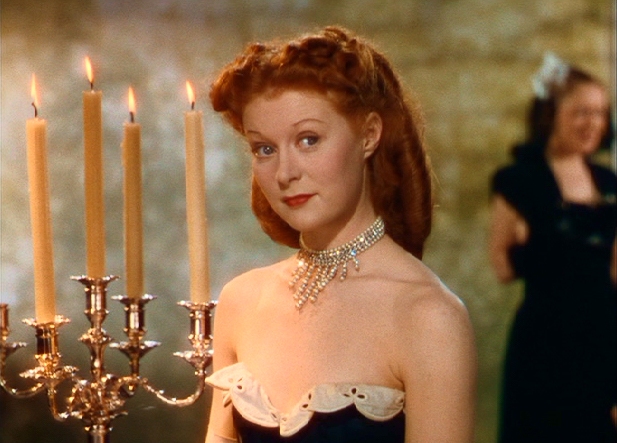
Moira Shearer as the doomed ballerina Victoria Page. The painstaking restoration of The Red Shoes undertaken by the UCLA Film & Television Archive and the British Film Institute reportedly took two-and-a-half years, and it was worth every minute. I read somewhere once that The Red Shoes was the Technicolor Corp.’s own official choice for the most beautiful Technicolor movie ever made. I don’t know if that’s true, but I believe it; I’ve never seen a print of Red Shoes that was less than gorgeous. Even so, I’ve never seen — scarecely imagined — it looking like this. The movie itself, I think, is one of the unique works of art, though to be honest, it’s one I admire without entirely enjoying; for sheer pleasure I prefer other Powell-Pressburger pictures like I Know Where I’m Going, A Matter of Life and Death or The Life and Death of Colonel Blimp. But as a sheer exercise in sumptuous pictorial splendor, The Red Shoes is without equal, and this new restoration leaves me wide-eyed and gasping at nearly every shot.

The chief beneficiary of the UCLA/BFI facelift, besides Jack Cardiff’s matchless cinematography (only the spiteful insularity of Hollywood can explain why he wasn’t even nominated for an Oscar), is Moira Shearer — the dancer who never really wanted to be a movie star. Whether she’s dressed to the nines for a formal reception, as above…


…strolling in the warm Monte Carlo sun…


…tousled after a strenuous rehearsal…


…togged out for a formal dinner date…


…larded over with seven pounds of ballet makeup…


  …or beaded with sweat during a performance, Shearer always looks like seven billion bucks. 
 
What I’m driving at is that all this is the result of improved technology. When my uncle and I had our discussion of Ava Gardner vis a vis Maureen O’Hara, and when we were considering all the legendary screen beauties (Garbo, Dietrich, Grace Kelly, Hedy Lamarr, Louise Brooks, insert favorite name here), I don’t think either of us gave a thought to Moira Shearer. Is Moira Shearer — the Moira Shearer of 1948 — suddenly more beautiful than she was the last time he or I saw The Red Shoes? 
 
Robert Gitt of the UCLA Film & Television Archive suggests that The Red Shoes may look better now — clearer, sharper, richer — than it did even when it was new, simply because of the digital techniques that allow for a precision in processing the Technicolor matrices that goes beyond anything possible in the 1940s, ’50s, ’60s, or for decades even beyond that. The process of shooting The Red Shoes is over and done with; we can’t change what happened on the set, or how Jack Cardiff lit the actors and focused and moved the camera. But what happens from there, between the time the negative comes out of the camera and the moment the finished image is splashed across a screen for discerning eyes — that process remains malleable, and probably always will (any collector who has watched the color shift and fade on a 16mm Eastman print can easily grasp the concept). Shooting a movie is a finite process, but making the movie can go on and on for years, decades — in the case of The Red Shoes, even after nearly everyone involved in getting the picture into theaters in the first place is dead and gone. That’s why movie buffs before the age of video would travel miles to see yet another print of a picture they already knew by heart, and why they might buy 16mm prints over and over — then, when video came in, the VHS, the laserdisc, the DVD, the Collector’s Edition, the Blu-ray. It’s like Shakespeare scholars taking in an infinity of Hamlets; the experience is different every time, and this one just might prove definitive.
 
So suddenly The Red Shoes looks more glorious than it ever did — which hardly seemed possible — and I have a new personal nominee for Most Beautiful Woman Who Ever Stood in Front of a Movie Camera.
 
And yet, all this may change. If, say, Mogambo or The Quiet Man ever get the kind of laborious restoration that UCLA and the BFI have lavished The Red Shoes, there could be clearer, sharper, richer beauties revealed in Ava Gardner and Maureen O’Hara, and they may again challenge Moira Shearer for the title. Then again, just such a restoration is underway even now on another Powell-Pressburger picture, The Life and Death of Colonel Blimp, and who knows…


…the 21-year-old Deborah Kerr just might come out of nowhere to knock them all out of the running.
 
Posted in Blog Entries

The Fog of Lost London, Part 4

Jim Lane's Cinedrome Posted on October 30, 2010 by Jim LaneJuly 16, 2016

The concluding chapters of London After Midnight by Marie Coolidge-Rask:

Chapter 19 – The Man in the Beaver Hat


At Balfour House, the man in the beaver hat, lantern in hand, climbs the stairs to the secret room where the bat-woman hovers near the ceiling. Come down, he says, all is ready; she is on her way.

In the overgrown garden the bat-woman waits as Lucy approaches. As the two come together, a shriek like a woman’s voice rends the air. Lucy cowers, but the bat-woman soothes her: “It’s nothing. They’re awake — coming.” Lucy feels herself taken in two strong arms and carried bodily into the house. She sees that her bearer is the man in the beaver hat described by Smithson.

Lucy looks around; tears well in her eyes as she takes in the home she has not seen since her father’s death five years before. She begs the pair with her to tell her who they are.

The man in the beaver hat silences her with a gesture. Footsteps are heard outside. Suddenly there’s the crash of a shattering window and a man tumbles into the room at their feet.

Chapter 20 – Hibbs’ Madness

In Hamlin House, Hibbs dashes downstairs to where the servants cluster, roused from their sleep by the sudden hue and cry from Lucy’s room. They urgently entreat Hibbs to tell them what’s going on, but he is incoherent, raving — They’re coming! They’re all around! I go to destroy them!

The unfortunate Hibbs rummages around the kitchen, yard and outbuildings of the estate, raving about an axe and a hickory stake, the implements he must have to destroy the “vampyrs.” He finds an axe in a chopping block and sharpens two pieces of wood into stakes, muttering madly all the while. The servants watch in amazement, afraid to intervene in his maddened state. Soon he is off on his way to Balfour House on his desperate, fevered mission.

At Balfour House he lurks outside a window, his eyes wide, barely suppressing the wild beating of his heart. What he sees through the window drives him madder still: Lucy standing with the man in the beaver hat and the bat-woman. She doesn’t run, she doesn’t flee; she is in their wicked power! She must be saved before it’s too late!

Hibbs leaps through the window, falling at the feet of Lucy and the two fiends in a shower of glass. Before he can move or clear his fevered brain, creatures of unimaginable strength have pounced upon him, overwhelmed him, bound him, borne him off. Is this the end? Has he failed to save Lucy? Is he doomed to be a vampire himself?

Chapter 21 – Help from Scotland Yard

At Scotland Yard, the summons to Hamlin House has been received and a squad of constables is ready to set out. The assistant commissioner knows now that Inspector Burke’s preparations — carefully set in motion by the work of an undercover agent — are about to bear fruit.

The constables pile into a car and swiftly depart for their destination, an estate outside London. They are told that when the car is sighted there will be a signal — a siren; they are to reply with a howl, just like the other night.

As the car speeds along, they hear the siren — a long, piercing shriek like a woman’s scream. The car replies with its own special signal, a blaring electric horn like the howl of a dog. Peering into the darkness, the constables see the outline of Hamlin House straight ahead.

Chapter 22 – A Strange Conference

At Hamlin House, Colonel Yates hears the howl of a dog, just like the one the night of his and Sir James’s visit to the Balfour crypt. Looking out the window, he sees a car approaching. It must be Scotland Yard, he tells Sir James, and not a minute too soon.

As Yates and Sir James go downstairs, the butler is admitting the police, who have arrived in response to Sir James Hamlin’s request. Sir James introduces the policemen to Colonel Yates, saying he will explain the situation to them; Sir James himself is too distraught.

The colonel surveys the police detail with a military eye, apparently deciding that they will do. Quickly he summarizes the weird train of events that have led to their presence here. Now, he says, they have reason to believe that Miss Lucy Balfour is in dire peril in her former home. The police should proceed at once to Balfour House and be prepared for “instant action.”

Yates turns to Sir James; does he have his revolver ready? Sir James does. Let me see it, says the colonel. Examining the gun, he notes that it has not been fired in a long time and may not be reliable. Turning to one of the officers, he asks for a spare pistol that Sir James can carry in case the need for it arises.

Sir James, seated at his desk, tries to insist that his own revolver will do, but something in Colonel Yates’s eyes stops him. Sir James, in his highly nervous state, seems suddenly transfixed. Colonel Yates moves his hands before the man’s face but gets no response.

Satisfied, the colonel takes Sir James’s desk clock and sets the hands to eight o’clock. He places the clock before Sir James. At twenty-five minutes past eight, he tells Sir James, come to the verandah door at Balfour House.

Colonel Yates leaves with the police. Sir James, he says, will be joining them later.

Chapter 23 – From Out of the Past

Lucy is upset at what is happening to Hibbs — those men seizing him, binding him, carrying him away, saying he must be drunk. Jerry is never drunk! The bat-woman tries to calm her. Please, dear, she says, didn’t he tell you to remember your part and do it, no matter what? Yes, Lucy says, but he said he’d take care of Jerry, see that he comes to no harm. And so he will, the woman says, we all will. She turns to the man in the beaver hat. What was wrong with him? Too much excitement, the man says; he’ll be taken care of and kept out of harm’s way. But now we have to work fast.

Lucy pulls herself together. You’d better see the man in the next room, the bat-woman says to Lucy, prepare yourself. It might be a shock and you should get it over with.

Lucy parts a frayed curtain and looks into the next room at the man sitting at her father’s desk. It is a shock. The resemblance is uncanny, eerie. For a moment she feels like a little girl again, the little girl who came into this very room and found her father dead, sitting where that man is now. Lucy looks down at herself and sees that she is not that little girl at all anymore. This man can’t be her father — but he looks so like him.

Lucy prays for the strength to do what she must. She goes up to the man, who rises to greet her. They talk briefly. She answers his questions about the night she last saw her father alive. He tells her he can only imagine how difficult this is for her. He has three daughters of his own, and he hopes any one of them would feel just as Lucy does. But he also hopes that they would find the strength to do what must be done. It’s so important. “Play the role,” he says, “and make it a success.”

Chapter 24 – Metamorphosis
Lucy returns to the waiting bat-woman. The woman dresses her in a girlish white frock identical to one she had as a young girl. The woman tells her it is the same dress, that Smithson has retrieved it for Lucy to wear tonight. Again, as so often this night, Lucy is surprised; she thought she was being so clever in stealing away from Hamlin House, and Smithson knew all the time!
 
Colonel Yates strides into the hall with several men. One of them Lucy recognizes as one of the men who subdued Hibbs; in a flash she realizes that the other man who grappled with her sweetheart was the man who so resembles her father. Who are all these people? And who is Colonel Yates?
 
The man in the beaver hat removes his cloak and hands it to the colonel. Is everything ready? 
Yates asks. The man says yes, handing his hat to the colonel, then removing his wig and handing that over as well. In the hat, wig and cloak, stooped over and contorting his face, Colonel Yates looks exactly like the other man — except for the absence of those spiky teeth, which he conceals by raising the collar of the cloak. 
 
And now Smithson is there, telling Lucy how sweet she looks. I followed you to the edge of Hamlin grounds, she says, to make sure you were safe. 
 
Colonel Yates also compliments Lucy on her appearance — just what he wanted. As he takes her by the hand and leads her toward the other room, questions swim in Lucy’s head. What is this all about? Why isn’t Sir James here? Who are these people? Who is Smithson, really? And who is Colonel Yates?
 
Chapter 25 – Sinister Preparations
 
A steady stream of commands, directions and questions comes from Colonel Yates. Where is the notary? The stenographer? He questions Lucy about the arrangement of the furnishings in the room, making adjustments as she points them out. He orders everyone to their positions. He turns to Lucy and asks if she is ready. Yes, she says, but how can going through that night again bring a guilty person to justice? All will be clear in good time, he assures her. And he reminds her, after she has said good night, not to linger but to go directly to the room where the bat-woman waits for her. 
 
The colonel disappears behind a screen, but Lucy can just see his eyes watching through the slits between the panels. How she wishes this were all over and done. But now the house is silent, waiting. Someone is approaching along the verandah. 
 
Chapter 26 – Sir James Pays a Call
 
When the desk clock reads 8:25 Sir James rises and leaves the house, pausing briefly to tell Billings, the butler, that he is going to call at Balfour House. Billings says nothing, as he was directed by Colonel Yates, merely watches Sir James go. Billings reflects on the mystifying events of the last few days, most mystifying of all being the note left by Anna Smithson, thanking him for his many kindnesses and saying, regretfully, that it is necessary for her to leave Hamlin House immediately; a baggageman will call for her luggage in the morning. 
 
Sir James proceeds steadily to Balfour House, pausing to look around as he enters the grounds. What a fine estate he will have, he reflects, when these grounds are combined with his own. 
 
As Sir James enters the house, the butler, Mooney, announces him. His friend Roger rises to greet him. And there is dear Lucy, that lovely little girl of Roger’s. Sir James observes with envy the affection between father and daughter as she kisses Roger good night. Lucy smiles at Sir James and extends her hand, wishing him a good night. Aren’t you going to kiss me too? Sir James asks. 
 
Lucy’s smile vanishes. She tells Sir James she doesn’t like him when he talks like that. Then she is gone; Sir James and Roger Balfour are alone.
 
Chapter 27 – In Hypnosis
 
In Sir James’s mind, it is five years ago, the night he last saw Roger Balfour alive; the man with him is Roger Balfour; and they are alone. But the man he takes for Roger — whose real name is Drake — knows that none of those things are true. They are certainly not alone; every move they make is being watched, every word heard and taken down for the record. Now that Lucy is out of the room, there is only one person who knows how the conversation went between the two men that last night. Sir James is reliving his half of that scene; Drake must now play a very delicate game. He must deduce from Sir James’s behavior what he, as Roger Balfour, should do or say next. The slightest misstep can shatter Sir James’s hypnotic trance. 
Sir James, unable to quite conceal his annoyance, tells “Roger” that he has come here tonight in a spirit of friendship to help his friend in his financial difficulties. I know about your troubles, he says, more than you realize. 
 
Drake plays a hunch. He tells Sir James that he knows exactly the extent of his knowledge — he sees that his hunch has hit home, and continues — knows that Sir James has been stealing from him right and left, made him penniless. Now that you have me in your power, he says, what do you want?
 
I want Lucy, says Sir James. I have loved her since she was a baby, and I want her for my wife. You have always distrusted me, suspected me. You have called me a drug user and a sensualist, but you could never prove it. 
 
Now Drake, with the revulsion of a father with daughters of his own, knows what Roger Balfour must have said, the only thing that could have caused events to turn out as they did. I can prove it, he says, now.
 
Sir James’s eyes blaze with hate as he draws his revolver. He demands these “proofs.” The other man refuses, and Sir James fires. Drake crumples to the floor, a bloody wound in his temple. 
 
Sir James searches the desk. Those proofs, whatever Roger had, must be here, he is certain. He goes through every drawer quickly but carefully, finding nothing. The fool was bluffing. Well, now he’s dead, and good riddance. Sir James takes out his handkerchief, wipes his pistol clean, and lays it on the floor near the dead man’s lifeless fingers. Now he must escape before he is found here. He backs toward the door. 
 
As he reaches for the doorknob his arm is seized in a powerful grip, then his other arm. Sir James struggles in a desperate frenzy, unable to break free. He hears a voice: Don’t let him get away! He’s still under hypnosis! I’m coming!
 
Chapter 28 – A Dramatic Awakening
 
 As Sir James struggles, the man in the beaver hat emerges from behind a screen. Under the man’s penetrating gaze, Sir James ceases to struggle. He looks around. Balfour House! How did he get here? He sees Roger Balfour dead on the floor, exactly where he left him. But that was five years ago! Or was it? Has it all been a dream, these five years, all his patient plotting and planning to possess Lucy? All a dream during the few seconds as he made his way to the door? 
 
It must have been! Roger had been too clever, had his men in hiding. But not clever enough; they’ve prevented my escape, but they’re too late to save his life. Sir James looks at the man in the beaver hat. Have I been asleep?
 
No, says the man, and neither have I. He reaches out and rips the sleeve from Sir James’s jacket. Sir James recoils from the searing pain. There! says the man. I knew I clipped you when I shot at you tonight. You thought you’d finish Hibbs with your poison needle, but I was there instead waiting for you. 
 
Chapter 29 – Surprising Revelations
 
Drake rises from the floor, wiping the stage blood from his face, grateful that Sir James had been handed a doctored revolver back at Hamlin House. The man with Sir James removes his beaver hat, cloak and wig, revealing —
 
Yates! cries Sir James. I thought the years had changed you, but now I see you’re an impostor. You’ve set this trap to blackmail me! You’ll get nothing from me! Sir James shrieks with indignation.
 
“Colonel Yates” takes off his glasses, removes the subtle disguise from his face, rearranges his hair, and shows Sir James his badge: Inspector Burke of Scotland Yard. I have what I want from you, he says. I’ve spent the last three days carefully breaking down your defenses, creating a mental strain that would make you susceptible to hypnotic influence. My theory that a criminal in hypnosis, faced with the circumstances of his crime, will repeat that crime exactly — my theory has been proven correct.
 
Cornered, broken, trapped, Sir James crumbles and confesses all. He murdered Roger Balfour just as Burke and his crew have seen him reenact the crime tonight. He murdered Harry Balfour with a poison injection to the throat for fear that Harry would discover the proof of his wicked life that he could not find before — and worse, would take Lucy away from him. He tried to do the same to Hibbs to get him out of Lucy’s life, before Yates/Burke’s intervention sent him fleeing for his life. 
 
The stenographer has it all. Inspector Burke orders the statement typed up. He tells Sir James that the law will see to it that every last farthing he stole from Roger Balfour will be restored to Lucy as the last survivor of her murdered family. And finally, he orders his men to examine Roger Balfour’s desk closely for evidence of a secret drawer; those proofs must be in there somewhere.
 
Chapter 30 – Recapitulation
 
Burke tells Sir James that he suspected him from the start; if only he could have acted sooner, he might have saved Harry Balfour’s life. Burke’s investigation had uncovered evidence of Sir James’s embezzlement from Roger Balfour. A former policewoman, Anna Smithson, was planted in Sir James’s household, where she uncovered evidence of Sir James’s drug use and degenerate activities. She had also overheard conversations between Sir James and Harry — no one ever notices the servants — and knew that Harry intended to remove his sister from Sir James’s influence. She had even found the vial of poison with which Sir James murdered Harry (and intended to murder Hibbs) and replaced it with a harmless liquid. The real poison is now in police hands, to be used as evidence.
 
Chapter 31 – Professional Pride
 
Inspector Burke goes upstairs to where Lucy is sitting by the bedside of Hibbs, now all but recovered from his derangement. Burke tells Lucy and Hibbs his true identity, and that he has the murderer of Lucy’s father and brother in custody. He spares her any details for the moment. She must know all in time, of course, but later, when she’s stronger. 
 
Burke apologizes for keeping Hibbs in the dark, but it was necessary to the operation; Hibbs is not dissembler enough to have been able to play a role. Hibbs sheepishly admits that he now wishes he’d taken “Colonel Yates’s” advice and gone to bed. It would have saved everyone a lot of trouble — especially himself. 
 
Smithson comes in to say goodbye; she will miss Miss Lucy and Mr. Jerry. She playfully scolds Burke for that “terrible tarradiddle” he made her tell about the green mist through the keyhole. 
 
Finally come the man in the beaver hat and the bat-woman; their part in Burke’s elaborate charade is done, and now it’s back to the music halls for them. Come see us, the woman says, Mooney and Luney — Jimmy Mooney and Lunette the bat: “I fly by night an’ I sleep by day, the looniest kind of a bat!”
 

Afterword

So there you have it, friends: London After Midnight — a Halloween treat with a trick. If you’ve seen 1935’s Mark of the Vampire, the twist came as no surprise to you; for that matter, even in 1927 the New York Times commented that whether the ending surprised anyone would be “a matter of opinion.”

I haven’t read Philip J. Riley’s reconstruction of the picture — honestly, I can’t remember now whether it was the opportunity to buy it or the good sense that I lacked in 1987 — but I have seen the Turner Classic Movies reconstruction, and there are major discrepancies between it and the story told by Marie Coolidge-Rask. In TCM’s version, Hibbs is identified as Arthur, not Jeremiah (Jerry), and he’s Sir James’s nephew, not his secretary. (Variety’s Mori says Hibbs is Roger Balfour’s nephew, but that doesn’t make sense and is probably a mistake on Mori’s part.) Neither the TCM version nor the reviews mention the murder of Harry Balfour, or even his existence, although the illustration in the novel (see Chapter 2, “Another Mystery”) suggests Harry must have been in there somewhere. (Oddly enough, in the caption Jules Cowles, who played Gallagher the chauffeur, is identified by his own name rather than his character’s.)

Most important of all, the idea of Inspector Burke operating incognito as Colonel Yates seems to have been entirely Ms. Coolidge-Rask’s invention; in the reconstruction and both reviews Burke is openly himself throughout. He is even shown investigating the “mysterious” death of Roger Balfour and deciding it was suicide, then coming back five years later to prove it was murder — the Times reviewer pinpointed the howling illogic of that (“…Burke of Scotland Yard, the genius who wills to solve a murder mystery five years after he has declared it to be a case of suicide.”).

All things considered — and with no true copy of London After Midnight, having only Variety’s detailed recounting, the New York Times’s musings, and TCM’s version to go on — I have to say there’s good reason to believe that Marie Coolidge-Rask, despite her cumbersome way with words, made a considerable improvement on Tod Browning’s story. Once you accept the basic premise — an elaborate police sting to hypnotize a murderer into reenacting his crime — her story has its own clear logic and builds a good amount of suspense. There are many nicely creepy moments — not least the eye-opening whiff of pedophilia in Sir James’s character, which in the novel surely goes beyond what the Hays Office would have tolerated in 1927. Much of the plot as it reads must have been the novelist’s creation; there seems far too much to fit into a picture that Variety says ran only 65 minutes (TCM’s reconstruction runs 46). And the book has a good sense of pace, becoming quite breakneck as the climax approaches — just about the time Hibbs goes crazy we begin to feel as if we have, too; as Lucy’s world is turned topsy-turvy, so is ours.

I hope you’ve enjoyed Marie Coolidge-Rask’s spooky little Halloween campfire story. Have a safe and happily creepy Halloween Weekend, everyone.


Posted in Blog Entries

The Fog of Lost London, Part 3

Jim Lane's Cinedrome Posted on October 28, 2010 by Jim LaneJuly 16, 2016

Continuing with London After Midnight by Marie Coolidge-Rask:

Chapter 10 – A Question of Vampires

The howling of the dog, coming from the direction of Balfour House, continues as Sir James and Yates make their way home from the crypt. They recount their experience to Hibbs, and the three discuss aspects of vampire lore as written in Colonel Yates’s book. Since murdered men and suicides are supposedly liable to become vampires, and since Roger Balfour’s coffin was still undisturbed at the time of Harry’s interment, it is cautiously suggested that the son’s unsolved murder may have had some supernatural effect on Roger Balfour’s restless soul. Sir James is clearly rattled by the night’s experience; Hibbs and Yates realize that there is some unknown factor at work over in Balfour House, and the mystery seems to deepen with every new event. It is near dawn when Sir James and Colonel Yates go to bed. Hibbs steals back downstairs to the library for further study of Colonel Yates’s book.

Chapter 11 – Harrowing Tales

All three men rise late the next day, leaving Lucy feeling quite lonely in the house, oppressed in the heat that has been intensified, rather than dispelled, by the early-morning electrical storm. At dinner that evening, conversation is kept trivial; by tacit agreement among the three men, Lucy is given no hint of what happened the night before.

Later that night, after Lucy has gone to her room, the three men resume their discussion of the night before. Suddenly they hear a piercing scream from upstairs, in the direction of Lucy’s room. Rushing upstairs, they find Lucy’s door locked. They try to break down the door, but before they have to, the door opens. In the room they find Smithson, the maid, trembling and sobbing, her eyes wide with fear, two small wounds at her throat, similar to the ones seen on the body of Harry Balfour. Sobbing, she tells the men that Lucy is locked in her dressing room, and they release the confused and frightened young lady from her confinement.

Finally, Smithson pulls herself together and tells
the men what happened. As Miss Lucy was
getting ready for bed, she says, she left her
to fetch some towels from the linen closet.
In the hallway she saw the man in the beaver
hat, the one she saw on the steps of Balfour
House as she was passing the night before.
The man was stooped over and creeping
toward her, his skeletal hand outstretched,
his spiky teeth gleaming. Smithson was too
frightened even to scream.

Thinking of Miss Lucy, Smithson says, she
rushed back to the young lady’s room,
shoved Lucy into the dressing room and
locked her in. Then she locked the door to
the outer room and thought they were safe.
But before her horrified eyes, a green mist
streamed through the keyhole and formed
itself into the man in the beaver hat. The
man came to her; she was unable to speak
or scream, or even move. She felt him
bending over her, felt his teeth on his throat.
That must have been when she screamed,
she says, but she doesn’t remember it.
She knew nothing more until she heard
Sir James, Colonel Yates and Hibbs
pounding at the still-locked door.

Lucy, greatly excited, calls their attention
to the window, where all of them see
the man in the beaver hat skulking
across the grounds in the direction
of Balfour House. Colonel Yates tells
Hibbs to remain with Lucy and see
that she is not left alone; he and
Sir James will investigate the matter
further.

Chapter 12 – Panic

Left alone with Lucy and Hibbs, Smithson realizes that the two young people (whose feelings for each other have not escaped her notice) wish to be alone, so she tells them she is going down to the kitchen; after her experience she could use a nice cup of hot tea. Downstairs she finds the servants — butler, housekeeper, cook, maids and footmen — cowering in the kitchen, wondering about all the commotion earlier but afraid to go and see what it was. They mill around her, clamoring for news. Deciding she could use something a little stronger than tea, Smithson asks Billings, the butler, for “a little drop of spirits.” Thus fortified, she proceeds to regale the servants with another recounting of her experience in Lucy’s room, this one much embellished for dramatic effect as Smithson relishes the attentions of her rapt and horrified audience. At this inopportune moment, a cat knocks over a tin pan from the sink onto the floor; the sudden clatter sends the servants into an uproar. Upstairs, Lucy and Hibbs hear the melee downstairs and wonder what can possibly happen next.

Chapter 13 – The Woman on the Ceiling

Colonel Yates and Sir James make their way to Balfour House, proceeding slowly by a roundabout route, pausing frequently to watch and listen for prowlers or anything untoward. Once again Sir James’s heart is racing, and once again he depends entirely on the resoluteness of Colonel Yates to keep him going.

It is well after midnight when they approach Balfour House. The house is dark, but they can see a faint light glimmering from one of the upper windows — in fact from the “secret chamber” that has been unoccupied for centuries, the one in which a woman’s ghost is said to roam. Slowly forcing their way through the tangled grass and foliage of the overgrown grounds, they find a large tree from which they should be able to see into the lighted chamber. Taking the lead as usual, Yates climbs into the tree. At that moment they hear, low but clearly audible, the insistent sobbing of a woman in despair.

Through the high windows of the secret room they can see only the ceiling and the upper walls inside. There they behold a sight that confounds them. By the dim light inside, they see a mysterious shape in the secret room — now sharp and clear, now blurry and indistinct, now rising to the ceiling, now swooping below the level of the windows, now contracting, now expanding as if carried by huge bat-like wings. At one point the apparition turns its head to the light, and the two men clearly see the profile of a woman — a woman hovering and swooping high in the secret room on the wings of a bat!

From their perch in the tree they are able to step gingerly and noiselessly onto a narrow balcony by one of the windows, from which they have a wider view of the room. They see three men, all with a ghastly pallor to their faces, absorbed in watching the movements of the bat-woman over their heads. One of them is the man in the beaver hat. Another is unidentifiable, but the third man, as Sir James confirms in a trembling whisper, is Roger Balfour.
 
 
The bat-woman, where she hovers near the ceiling, turns her face toward the window, her eyes intent, as if to pierce the darkness beyond. Yates and Sir James take an involuntary step back into the shadows. The figure of Roger Balfour also turns to the window, his eyes keenly searching, his face ghostly pale, a small open wound crusted and discolored at his temple. Sir 
James shudders.
 
Colonel Yates whispers that they have seen enough for one night, and Sir James readily agrees. They stealthily return to the tree and cautiously climb back down to the ground. Sir James is highly agitated. In a distraught whisper he urges that they return at once to Hamlin House; God only knows what has happened to Lucy in their absence. In a sudden flash of insight, Colonel Yates realizes that Sir James’s feelings for Lucy are not merely those of a guardian for his ward. 
 
From a rise a little distance from Balfour House they look back. In the dim light of the upper window they see a shape standing at the window, and they hear a voice, low and plaintive, calling: “Lucy — Lucy — Lucy — “
 
Chapter 14 – By the Light of Day
 
Sir James spends a sleepless night, his mind going over and over the weird events of the night and the uncanny things he and Colonel Yates have seen. The next day at noon, Lucy, alarmed at his tired and ill appearance, asks him what happened while he and the colonel were out. Feeling it best to keep her unaware, he says that they were unsuccessful in their attempt to follow the man in the beaver hat; he had eluded them, and their long walk was for nothing. 
 
Sir James and Colonel Yates decide to return to Balfour House by daylight; they tell Hibbs that if they are not back in an hour he should send a party in search of them. Under the hot summer sun on a cloudless day, Balfour House looks impressive and looming, but empty and unthreatening. Sir James wonders, was what they saw the night before merely a figment of their imaginations? No, says Yates; they saw what they saw, but what it can mean is impossible to say. Sir James is not reassured.
 
They knock at the door, but there is no answer. Entering cautiously, they see no signs of occupancy, no disturbance in the dust on the tables, chairs and floor. The door to the secret room is still locked and bolted, the lock rusted and untouched. As they creep from room to room, searching, Sir James again has the unsettling feeling he had on the night they visited the Balfour crypt, that some unseen presence is following them, watchful. 
 
As they enter the library, the room in which Roger Balfour died five years ago, a strange sight greets them: High in a corner of the ceiling are a group of five bats, hanging in silent slumber. 
 
Chapter 15 – Two Suitors
 
Back at Hamlin House, Lucy waits for Colonel Yates in the rose garden; she has promised to give him a tour of the garden and a description of the blooms cultivated there. Hibbs scolds her for being alone, even in the daytime. She laughs, saying she wishes she had seen the man in the beaver hat herself; she’d have captured him! Hibbs, realizing she has been kept in the dark as to the extent of her danger, restrains himself from telling more than he should. 
 
Sir James and Colonel Yates come into the garden. As they discuss what to do about the previous night’s events, Yates notices the flash of suspicion on Sir James’s face at the apparent intimacy between Hibbs and Lucy. Yates urges Sir James to ask Scotland Yard to investigate Balfour House; involving the local police, he says, could lead to unwanted and harmful gossip, but the Yard is renowned for its discretion. Have Hibbs write Scotland Yard, he says, asking them to send several good, able-bodied men — “men who are not afraid of man, ghost or devil” — under cover of darkness. 
 
Sir James and Hibbs go into the house to draft the letter, leaving Yates and Lucy to their tour of the garden. As they chat, Lucy confides something she has never told anyone, not even her brother Harry: When she was a little girl, she was strangely afraid of Sir James, although she never knew exactly why; he was always so good to her. And since her father’s death, he has been kindness itself; she feels she could never repay him for all he has done for her and Harry. 
 
Colonel Yates assures her that he understands. He tells her that he wants to have “a serious talk” with her, on a matter that concerns her closely. 
 
From the house, Hibbs watches Lucy and the colonel in the garden. He sees Lucy throw her arms around Colonel Yates and kiss his cheek, then begin weeping on his shoulder. His jealousy flares, and it is with difficulty that Sir James recalls him to the task of writing Scotland Yard. 
 
Later, Hibbs confronts Lucy and demands an explanation. She cannot say anything, she says, and begs him not to ask. But she mollifies him by assuring him that she intends to break the news to Sir James of her and Hibbs’s feelings for one another. 
 
Lucy finds Sir James in the music room, as eager to speak with her as she is with him. Sir James wonders: Has Lucy been annoyed by the unwanted attentions of his secretary? No, not at all, she assures him. Before she can go on, he tells her he is glad to hear it. Hibbs could never support Lucy in a way to which she is entitled. On the other hand, he — Sir James himself — has long looked forward to making Lucy his wife. 
 
Surprised and alarmed, Lucy runs sobbing from the room. 
 
Chapter 16 – Exorcisms
 
Sir James and Colonel Yates find a passage in Yates’s book: “A wreath of tube roses at the window, a sword across the door, will make it impossible for the Vampyr to enter a sleeping room at night.” It may sound absurd, but after the past two nights nothing should be discounted; at least it can do no harm. 
 
Hibbs is tense and upset as they place a wreath of tube roses from the garden and a sword that had hung on the wall, according to the directions in the book; lack of sleep, concern for Lucy, and mistrust of Yates are taking their toll. Reading from the book, he speaks the prescribed incantation: “They shall not pass this threshold.”
 
As everyone retires for the night, Yates draws Hibbs into the upstairs study, saying he has something to tell him. Ignoring the smoldering anger in Hibbs’s eyes, Yates guides him to a chair and gently forces him to sit. He tells him that Lucy’s love for Hibbs speaks well of him, that Yates can see through her eyes what a fine fellow Hibbs is. 
 
All thought of Yates as a rival is suddenly gone from Hibbs’s mind. In the colonel’s steady gaze he sees the eyes of a friend and feels an urge to confide in him. Too bad about Lucy’s brother, Yates says; did he and Hibbs get along? Ruefully, Hibbs says no, Harry objected to Hibbs’s love for Lucy and was resolved to separate them for good. 
 
As they talk, Hibbs is overcome with drowsiness. He sleeps. 
 
Chapter 17 – An Assassin Foiled
 
Midnight. The house is still. A crouching, shadowy figure moves stealthily to the door of one of the sleeping rooms. Slowly, silently, the figure turns the knob, opens the door and slips inside. The figure approaches the sleeper in the bed, in its hand a long thin object, gleaming in the dim moonlight from the window. 
 
As the figure is poised to strike, the sleeper lunges bolt upright, startling the attacker to flight — out the door, down the hall, with the intended victim — none other than Colonel Yates — in pursuit. Yates fires his revolver at the fleeing figure, rousing the house. Lucy calls from inside her room, asking that someone remove the sword and let her out.
 
Sir James comes from his room, his hands shaking as he ties the belt of his robe. What was that? Nothing, says Yates; I must have had a nightmare. Sir James and Lucy are reassured, and the house settles down.
 
Alone again in the hall, Yates reflects that Hibbs did not appear after the gunshot. He kneels and searches the carpet. Finally he finds what he seeks: a spot of blood. His assailant did not escape untouched after all.
 
Yates makes sure that Lucy’s room is still secured with the sword and tube roses, then goes to Hibbs’s room. The door is open, the bedclothes rumpled, but the room is empty. Yates deftly makes up the bed, then goes into the study, where he finds Hibbs, still sound asleep in the chair where he dozed off while they talked. 
 
Chapter 18 – The Fallen Sword
 

Upon being awakened, Hibbs apologizes for his rudeness in dropping off. Don’t mention it, says Yates; on the contrary, I apologize for keeping you up so late. Yates leaves Hibbs in the study, telling him they both should be in bed.

 
Hibbs looks at his watch. Two-thirty! Have they really been talking so long? He hardly remembers a word they said. Before retiring, he decides to check on Lucy’s room. He is horrified to find the protecting sword missing. He pounds on the door, calling her name. 
 
Sir James appears, alarmed at Hibbs’s display — and outraged that he addresses Lucy by her first name. Colonel Yates joins them and they break in the door to Lucy’s room. It’s empty. She’s gone.
 

Finally the strain of the past few days has its way, and something in Hibbs snaps. He becomes hysterical, babbling that “vampyrs” have taken Lucy, that they must all be destroyed. Colonel Yates tries to calm him, to no avail. As Hibbs runs off, delirious, there comes from the direction of Balfour House the wild, piercing scream of a woman in distress. Could that have been Lucy?

No, says Gallagher, Sir James’s Irish chauffeur. That wasn’t Miss Lucy; ’twas the wail of “the banshee o’ Balfour House,” foretelling tragedy to come.

To be concluded…


Posted in Blog Entries

The Fog of Lost London, Part 2

Jim Lane's Cinedrome Posted on October 25, 2010 by Jim LaneJuly 16, 2016

Here begins a chapter-by chapter synopsis of London After Midnight, a novel by Marie Collidge-Rask, based on the scenario of the Tod Browning production. Like the book, the synopsis will be

ILLUSTRATED WITH SCENES
FROM THE PHOTOPLAY
A METRO-GOLDWYN-MAYER PICTURE
STARRING LON CHANEY
Chapter 1 – Balfour House

Balfour House is an old ancestral home on the outskirts of London whose origins stretch back to before the time of Charles II. Successive generations of the Balfour family have added to it until it is a weird and mystifying architectural abnormality, a labyrinth of chambers, corridors, passageways and dark, massively furnished and heavily curtained rooms. One room, heavily bolted and padlocked, has not been opened in centuries. It is said that a beautiful young woman once met a horrible death in that room, and that her ghost walks restlessly moaning and sobbing whenever some tragedy is about to occur in the house. Those sobs are heard the night Roger Balfour is found dead in the house, a bullet in his head, driven to suicide by depression and money problems.

Roger’s son Harry, 15, and daughter Lucy, 13, become the wards of their father’s friend and neighbor Sir James Hamlin. Since there was no will, Sir James supervises the settling of Roger Balfour’s estate and takes the two children into his home. Balfour House and its grounds become shunned and neglected and, with no money left for their upkeep after settling Roger’s debts, fall into disrepair.

Five years pass. Harry Balfour, now 20 and more than a little resentful of his and Lucy’s dependence on Sir James’s generosity, returns from school and announces that he wants to reopen Balfour House. Sir James says this is impossible without major repairs, either by finding a wealthy tenant or a wealthy bride for Harry. Harry refuses to marry for money. Sir James offers to buy the Balfour estate outright, to give Harry a stake in life. Again, Harry indignantly refuses: “So long as I live the Balfour estate shall not revert to other hands.”

Soon after this, Harry has an unpleasant scene with Jerry Hibbs, Sir James’s secretary. An agitated Hibbs mutters to himself that Harry is “courting disaster” if he goes near Balfour House.

Chapter 2 – Another Mystery


Two days after his confrontations with Sir James and Hibbs, Harry fails to show up for a riding date with his sister Lucy. No one has seen him since dinner the night before, and his bed has not been slept in. At first Lucy pouts that Harry has ruined her day, but as the day wears on she begins to worry.

That night Hibbs sends one of the servants on a confidential errand. Overheard by the maid, Anna Smithson, Hibbs asks her to say nothing to anyone.

An hour later a group of Sir James’s servants, lashed by wind and rain, spooked and unnerved as they search through the overgrown grounds at Balfour House, find the body of Harry Balfour. As they lift the body to carry it to shelter, one of the servants swears he can hear, beneath the whistling of the wind, the wails of the ghost in the secret room of Balfour House.

Chapter 3 – Who Killed Harry Balfour?

 Lucy Balfour is still worrying about Harry’s disappearance when her brother’s body is brought in. She is distraught at his death and horrified, as are the others, at the sight of two red wounds on his throat. The coroner’s inquest returns a verdict of death at the hands of “person or persons unknown.” In testimony at the inquest, neither Sir James nor Hibbs mentions their respective run-ins with Harry before his disappearance. The maid Smithson testifies that on the night of the murder, she was looking out a window into the storm and saw a man heading toward Balfour House. The man was definitely not Master Harry, she says. It is assumed that the person she saw was the murderer, but there is no clue as to his identity, his motive, or why he would make those wounds on Harry’s throat.

Chapter 4 – Hypnotic Hypotheses

Chief Detective Inspector Burke of Scotland Yard, dining with the assistant commissioner of his division, discusses the unsolved murder of Harry Balfour. Burke believes that the murder of Harry confirms his suspicion that Roger Balfour was murdered as well, even though all signs seemed to point to suicide at the time. He says that he has a number of leads but no firm evidence, and plans to test his theory that under hypnosis and the proper conditions, a criminal will reenact his crimes. Burke borrows a book from the assistant commissioner’s library, saying that he expects to be busy with his investigation for some time, but when next they dine together, Burke says, he is sure he’ll have the proof he needs.

Chapter 5 – A Betrothal

Seven months have passed since Harry’s death, and Lucy is finally beginning to emerge from her grief. As May turns to June, Lucy finds herself turning more and more to Jerry Hibbs for companionship, and her feelings for him have grown more than sisterly. At last, in a sun-bathed arbor scented by the blooming roses of Hamlin House, Lucy and Hibbs profess their love for one another. They agree to say nothing to Sir James for the time being, for fear that he will disapprove and dispense with Hibbs’s services.

Chapter 6 – Uncanny Tenants

Night. Two men stand under a tree on the grounds of Balfour House, near where Harry Balfour’s body was discovered. They are representatives of the London realtor’s office that administers the Balfour property and are waiting while prospective tenants inspect the premises by lantern-light. The people came into the office near closing time and expressed an interest after seeing a picture of the house in a magazine (the realtors having long since given up advertising the property). If satisfactory, the tenants propose to move in at once. This has all happened so quickly that the agent hasn’t had time to notify Sir James, though he did get in touch with Hibbs. Hibbs told him to go ahead with the transaction if the tenants’ references are satisfactory. The agent is waiting outside for the tenants because, he said, nothing would induce him to enter the house.

Meanwhile, Anna Smithson and Thomas, another of the Hamlin House servants, are returning from the village station in a cart with the luggage of a guest Sir James is expecting. They see the light in Balfour House. They can see two shadowy figures moving about with the lantern; one of them is a woman, but they can make out no other details. Thomas believes the woman is the ghost of the house, but Anna scoffs. As they watch, the door of Balfour House opens and a man emerges, tall but stooped, shrouded in a heavy Inverness coat and wearing a high beaver hat. That’s all it takes for Thomas to crack his whip and hurry the horse on to Hamlin House.

 
The man in the beaver hat crosses slowly to where the realtor’s agents wait. The agents apologize for not accompanying him into the house, but he reassures them — in his spooky way: “Life is a mystery no man can solve. It extends beyond the grave.” They remind him that the owner will make no improvements, but he doesn’t mind; the house will suit his purposes.
 
The agent hands the man the lease papers and he peruses them, only briefly looking up when a mournful wail rises from somewhere out in the darkness. By now the agents are thoroughly unnerved and eager to be off. With a “horrible” smile, the man in the beaver hat slowly signs the lease. As he heads back into the house, the agents scurry off to apprise Sir James of the transaction.


Chapter 7 – Sir James Receives a Shock

At Hamlin House, preparations are under way for the coming of Colonel Yates, Sir James’s guest, when the realtor’s agents arrive. Sir James is astonished to learn that Balfour House has been let, and it is evident that the surprise is not an entirely pleasant one. Hibbs explains that he did not expect the tenants to take immediate possession; he thought they would merely inspect the property and then negotiate terms. The agents report that the tenant’s references were impeccable and he paid the entire term of the lease in cash, in advance.

Reassured, Sir James glances at the papers the agents have handed him. His calm demeanor vanishes and his face goes white when he sees the signature on the lease. It is signed “Roger Balfour.” And it is in Roger Balfour’s handwriting.

Chapter 8 – An Unexpected Guest

Why wasn’t this noticed at the office? Sir James asks. The agent replies that the matter was handled by a new employee who didn’t know the house’s history; the agent himself had simply presumed that this Roger Balfour was perhaps a distant relation wishing to see the ancestral home. Sir James says there are no other branches of the family and demands a description of the man in the beaver hat.

At this point, the butler announces Colonel Yates. Sir James’s consternation is almost complete, because in addition to this shock about Roger Balfour, he has been trying all day to remember who Colonel Yates is; he learned only today that this “old friend from India” was coming, and has been unable to place the name. As Yates is ushered in, however, Sir James remembers him at once and is reassured by Yates’s solid, dependable, no-nonsense presence. In fact, he welcomes his guest’s opinions on the matter of the new tenant at Balfour House, and briefly explains the situation to him.

It turns out Yates had known Roger Balfour years before, but had lost touch and did not know of his death; he says suicide seems unlike the Balfour he knew. When the agents describe the new tenant as “creepy” and “un-holy,” Yates scoffs. “You chaps must have been smoking something…” His laughter diffuses the tension in the room; even Sir James looks less upset.

Chapter 9 – Ghouls

As Yates and Sir James discuss the matter later, alone, Sir James shows Yates some documents signed by the late Roger Balfour, and Yates concedes that the handwriting on the lease is unmistakeably the same. Mulling this over, he cautions Sir James not to dismiss out of hand the idea of supernatural; years in India, he says, have taught him the folly of that. In fact, he has a book with him that he thinks might bear on the subject, and promises to give it to Sir James. Later, after dressing for dinner, Yates gives the book to Hibbs to place in the library, where it will be available to anyone interested. Hibbs (who for some reason has taken an instant, mild dislike to Colonel Yates) does so, and a glance at the book’s contents interests him enough to make him resolve to come back to it later.


All through dinner, and even afterward as Lucy plays for diversion, Sir James’s mind is elsewhere. He had insistd to Yates that he does not believe in ghosts, but he nevertheless has a superstitious nature and is troubled.
After Lucy finishes playing, Yates invites her to take a walk on the verandah. Hibbs, miffed and a little jealous, decides to take a closer look at Yates’s book in the library. He finds Sir James in the library, himself so absorbed in the book that he doesn’t hear Hibbs’s approach. Hibbs suggests that a study of the book might “throw light upon the mysteries of Balfour House.” Sir James says the mysteries be damned, he just wants to know who signed Roger Balfour’s name to that lease. 
 
When Yates joins them in the library, Sir James shows him a passage in the book, printed in early English text, that has particularly alarmed him: “Men who have died by murder or suicide frequently become vampyrs.” The two agree that, unpleasant as the idea is, nothing will do but that they inspect the vault on the grounds of Balfour House where all the Balfours, including Roger, have been entombed. The sooner the better. 
 
After midnight Yates and Sir James set out, armed with revolvers and carrying a lantern. Almost immediately Sir James’s courage begins to fail. He senses that someone, or something, is following them and trying to stop them on their errand, but every time he turns around, nothing is there. Only Yates, in his “military determination,” is unwavering, and Sir James forces himself to go on. At one point something suddenly flaps at them out of the darkness. A bird? A bat? No way to tell. Slowly, carefully, onward they creep. 
 
At the door to the Balfour crypt Yates raises his lantern. The door is closed and locked, seemingly undisturbed since the day months earlier when Harry Balfour was interred there. Sir James’s hand shakes as he inserts the key into the locked door. The rusty lock resists, but eventually yields, and the door slowly swings inward. 
 
The two men halt at a sudden sound — it sounded almost like a sigh. They wait, tensed, but now there is only silence. 
 
Standing in the yawning doorway, they peer into the darkness of the tomb. Yates raises the lantern and holds it forward in the gloom. By the dim yellow light, Sir James’s eyes search the shadows. His blood freezes as he sees that the lid of Roger Balfour’s coffin is open. The coffin is empty. 
 
There is a flash of lightning, a rumble of thunder, and somewhere in the night, the mournful, blood-curdling howl of a dog. 
 
 
To be continued…
 
 
Posted in Blog Entries

The Fog of Lost London, Part 1

Jim Lane's Cinedrome Posted on October 23, 2010 by Jim LaneJuly 16, 2016

London After Midnight (MGM; 1927) is the Holy Grail of Lost Films. Oh sure, there’s the complete Greed. But we do have the incomplete Greed, and it’s a masterpiece as it stands. Besides, tell the truth: Isn’t there just the tiniest little fear, deep down in your heart, that if Stroheim’s 42-reel, ten-hour cut should miraculously turn up, it just might turn out to be a letdown, maybe even (Heresy! Heresy!) a bit of a bore? But be that as it may, we do have Greed; all we have of London After Midnight is an assortment of stills like this one of Lon Chaney in makeup and costume as the Man in the Beaver Hat.

There are enough of these remnants that Philip J. Riley was able to publish a reconstruction of Tod Browning’s movie in book form, but if you didn’t have the opportunity or good sense to pay $29.95 for it in 1987, you’ll have to shell out ninety bucks or more now. A few years ago Turner Classic Movies did a similar reconstruction, this time on film, and that one’s available on The Lon Chaney Collection.

In 1970 the Museum of Modern Art staged a “Lost Films” exhibit and published an accompanying book by the same title. At least two of the pictures in MoMA’s exhibit — Street Angel (1928) with Janet Gaynor and Charles Farrell, and Rex Ingram’s The Garden of Allah (1927) — have surfaced since then, so there’s always hope. But London After Midnight remains lost, and the pages devoted to it in the MoMA book are sparse. Author Gary Carey wrote: “It is almost impossible to synopsize a mystery film which one has not seen because critics, bound by professional ethics, divulge little of the plot let alone its solution.”

Mr. Carey should have read the review that appeared in Variety on December 14, 1927. Variety’s reviewer, “Mori,” didn’t much care for the movie (“Will add nothing to Chaney’s prestige as a trouper, nor increase the star’s box office value.”), nor did he shrink from discouraging potential viewers by recounting the entire plot, solution and all. Then, amazingly, in his last paragraph, he said: “The usual suspicions, planted while the situations are worked out, succeed in leaving an impression of mystery regarding the outcome.” (Not anymore, Mori!)

As a side note, let me add that Mori wasn’t the only Variety reviewer to do this sort of thing. It’s our good luck now that the Spoiler Police weren’t so powerful back then; the detailed descriptions in Variety’s reviews from 1907 to 1930 are virtually all we have to go on for movies now lost beyond recall. I’ve found them invaluable in researching the careers of the stars in the M.J. Moriarty deck of movie playing cards.

But back to London After Midnight. There’s always hope it may someday surface, like Street Angel and The Garden of Allah, but it hasn’t happened yet; the last known print was destroyed in a studio fire in the 1960s. Director Browning did a loose remake in 1935 — Mark of the Vampire, with Bela Lugosi and Lionel Barrymore taking over the equivalent roles that were both originally played by Lon Chaney — but that time Browning made major changes; for one thing, the new picture didn’t even take place in London. If we want any sense of the original, we still have to depend on the Riley and TCM reconstructions.


Or…there is this. I came across this book while perusing the shelves at the estate sale of a popular Sacramento TV personality. The novelization is the work of Marie Coolidge-Rask, who evidently made a decent living out of this kind of piecework. She’s known to have also novelized Mary Pickford’s Sparrows (1926) and the King Vidor-Lillian Gish La Boheme that same year (now there’s a literary platypus for you: a novelization of a silent movie of an opera). 
 
Otherwise, Ms. Coolidge-Rask’s literary output seems not to have left much impression on the shifting sands of time. These movie tie-ins weren’t a terribly lucrative field for the writer-for-hire; usually there was just a flat fee — probably, in the 1920s, no more than a thousand dollars or so, if that — and that was that, no royalties. A shame, because London After Midnight may have sold pretty well; Mori’s opinion notwithstanding, the movie was the most successful Browning-Chaney collaboration. Whatever MGM or Grosset & Dunlap paid her for her efforts, I hope for her sake she invested it wisely.
 
In any case, she doesn’t seem to have slavishly followed Browning and Waldemar Young’s script: Her novel features at least one character, a certain Colonel Yates, who doesn’t appear in the movie’s cast list on IMDB. And she isn’t bound by the limits of silent movies — her characters are certainly a talkative bunch. For that matter, so is Ms. Coolidge-Rask herself — she crams words in like a canner stuffing sardines in a tin. Here she is describing Sir James Hamlin (Henry B. Walthall):
 
“Sir James, despite the studied calmness of his demeanor when with Lucy Balfour or in the presence of those he deemed his inferiors, was of a nervous temperament, at times easily influenced, again firm to the point of stubbornness, according to his mental reaction to whatever force against which he found himself in opposition.”
 
Got all that? Here she is again, later on the same page: 
 
“In his presence, the baronet felt himself unusually helpless. Like a fly, pinned against the wall for scientific inspection with a microscope.” 
 
I don’t know what kind of scientist would pin a fly to the wall to see it through a microscope, but I suppose Ms. Coolidge-Rask might have known some.


Anyhow, now, just in time for Halloween, I propose to spend the next few posts hacking through the purple undergrowth of Marie Coolidge-Rask’s prose (I do these things so you don’t have to), distilling it into a chapter-by-chapter synopsis of her novelization. In this way I hope to get some sense of what audiences at Browning’s vampire/murder mystery might have seen in 1927 — sort of like Tod Browning, Polly Moran and Lon Chaney here pretending to commune with the spirit world for the MGM publicity department. This will be, so to speak, by the book, without reference to either Philip J. Riley’s or TCM’s reconstructions; if there are differences, maybe we can talk about those later.


So be warned: if you’re worried about spoiling the ending of London After Midnight (which you can’t see anyhow) or Mark of the Vampire (which you can), proceed at your own risk.
Posted in Blog Entries

Movie Playing Cards: 3 of Hearts – Geraldine Farrar

Jim Lane's Cinedrome Posted on October 15, 2010 by Jim LaneAugust 16, 2022


Geraldine Farrar was not the first star to occupy the M.J. Moriarty deck’s 3 of Hearts; that distinction (if Cliff Aliperti’s guess at the deck’s provenance is correct) belongs to Cleo Madison. But Ms. Farrar is the only Metropolitan Opera star in the deck. Other great singers would make the transition from Met to movies, but not until the sound era; and while some (Lawrence Tibbett, Grace Moore, Lily Pons, Maria Callas) would be more successful than others (Kirsten Flagstad, Luciano Pavarotti), only Geraldine Farrar managed to become a movie star without ever once depending upon her voice to get her there.

No wonder. She was a natural actress without a trace of self-consciousness, and the camera loved loved loved her. The picture on the card isn’t the most flattering, with that hairstyle like a leather aviator’s helmet, but you can see what I mean, especially with those enormous, all-seeing eyes — they make you want to glance over your right shoulder to see what she finds so fascinating and amusing; not even that huge corsage can pull your attention away from her eyes for very long. 

Here’s another look at those eyes, this time smoldering and looking straight into your own. The portrait is by the German painter Friedrich August von Kaulbach (1850-1920), and is now part of the Geraldine Farrar Collection in the Music Division of the Library of Congress. It was probably painted in late 1901 or early ’02, about the time the 19-year-old Geraldine created a sensation as Marguerite in Gounod’s Faust and became the toast of Berlin.
 
That Berlin triumph was the culmination of a course of study that had taken her from her birth in 1882 in Melrose, Massachusetts — where she determined at an early age to become an opera star — through voice study in Boston, New York, Paris, and finally Berlin, where her big splash in Faust brought her under the tutelage of the great soprano Lilli Lehmann. She remained with Berlin’s Royal Court Opera for several seasons and became a favorite of the Kaiser and his family; there were scandalous rumors of an affair with Crown Prince Wilhelm which Farrar’s family and friends (protesting too much?) were at great pains to deny. Berlin was the springboard to a brilliant European career — Monte Carlo, Stockholm, Paris, Munich, Warsaw — that brought her home to America and the Metropolitan Opera in 1906. 
 
Geraldine Farrar was perhaps the world’s first multimedia star — if only because for the first time in history, a performer could have more than one medium to be a star in. Besides her dazzling success on the opera stage and recital circuit, she made over 200 recordings for the Victor Talking Machine Company; you can still hear plenty of them on YouTube.
 

And then, in 1915, yet another medium. Moving pictures came calling, in the form of Cecil B. DeMille and the Jesse L. Lasky Feature Play Company. Lasky and DeMille had been making a go of their venture out in sleepy Hollywood, shooting in a converted barn at the corner of Vine and Selma Streets. I don’t know what prompted them to approach Farrar; perhaps they read the interview where she described herself not as a singer but “an actress who happens to be appearing in opera” and figured an actress in any other vehicle… Whatever the impetus, it was a masterstroke. Farrar agreed to work eight weeks during the Met’s off season, making three pictures for a fee of $35,000. The news, and the announcement that the diva’s first picture would be a silent version of her Met success Carmen, electrified the industry. The William Fox Co. was inspired to do a quickie knockoff Carmen with their house vamp Theda Bara (Fox’s picture went into release the day after DeMille’s Carmen but doesn’t seem to have cut very deeply into its business).

The DeMille-Lasky Carmen wasn’t planned as an adaptation of the opera; the work was still under copyright, and the proprietors were asking too much for the movie rights. Instead, DeMille and his scriptwriter brother William turned to Prosper Mérimée’s original novella, now in the public domain, which had a story much changed in the opera. Still, the opera was too familiar to ignore completely, so a musical score was commissioned adapting Bizet’s themes (Lasky could afford that much).

Before shooting on their big-money title, though, DeMille made a canny decision: he would shoot Farrar’s other two pictures (Temptation and Maria Rosa) first, just in case his leading lady needed a little experience to put her at ease in front of the camera. This was probably prudent, but it proved to be unnecessary; Geraldine Farrar took to movies like a duck to water. Here she is in Carmen’s classic pose — a cliché by now, but at that time you could hardly get away with leaving it out — the rose clenched in her teeth, lasciviously eying the unfortunate Don Jose (Wallace Reid), whom she intends to seduce to help her smuggler cohorts.

And here she is again, assuring her gypsy confederate (Horace B. Carpenter) that the trap is ready to be sprung. As DeMille biographer Scott Eyman observes, Farrar wasn’t exactly beautiful, but she was alluring. Her Carmen moves like a cat, slinky, self-assured and radiating a confident, even aggressive sexuality. (Apparently in real life, too; Crown Prince Wilhelm wasn’t the only name linked romantically with hers. While at the Met she carried on a torrid six-year affair with conductor Arturo Toscanini that ended only when she gave him an ultimatum: leave your wife or else. The maestro abruptly resigned from the Met and beat a hasty retreat back to Italy, wife and family in tow.)
Carmen was a big hit for the Lasky Co., in both money and prestige. Not since the aging Sarah Bernhardt hobbled around on her wooden leg in Queen Elizabeth had a star of such international magnitude graced a movie screen. And it must be said, whatever the Great Sarah’s power on stage, she had hardly a tenth of Farrar’s instinctive understanding of movie acting. By the time the picture was released — on October 31, 1915 — Farrar had returned to the Met; the other pictures she had shot that summer were spaced out for release the rest of the season, Temptation at the end of December and Maria Rosa at the beginning of May 1916.

Farrar enjoyed her eight week stint in Hollywood, where every man and woman in the Lasky Co. was completely won over by her professionalism and her down-to-earth personal charm; people used to gather outside the window of her dressing room and listen to her sing as she prepared to go on the set. Between pictures she met the handsome actor Lou Tellegen, whom she married in February 1916. That following summer, with the Met again going dark, she was back at the Lasky Studio, again working for DeMille. 
 
This time the subject was even bigger than Carmen: Farrar would play Joan of Arc in Joan the Woman. Joan had not yet been elevated to sainthood, but it was only a matter of time; she had been beatified in 1909 (sainthood would finally come in 1920). As the title suggests, Farrar’s allure was not to be entirely subsumed into the religious fervor of the Maid of Orleans; DeMille and writer Jeanie Macpherson defied history by giving Joan a chaste romance with an English soldier, teaming Farrar again with Wallace Reid. (In the movie it plays better than it probably sounds.) 
 
Joan the Woman was the first example of the kind of movie most people think of when they think of Cecil B. DeMille today: a sweeping historical epic with semi-florid acting and none-too-subtle religious overtones. A second historical epic followed: The Woman God Forgot, with Farrar bizarrely cast as an Aztec princess, daughter of Montezuma, whose intervention on behalf of her Spanish lover (shades of Pocahontas and Capt. John Smith!) brings about the downfall of her father’s empire. (Both Variety and the New York Times commented that Miss Farrar was noticeably more pale-skinned than the rest of her Aztec family.) 
 
The Woman God Forgot wasn’t released until 1917; the big money picture for ’16 was Joan the Woman. DeMille and Macpherson drew a direct parallel between the Hundred Years War and the war then raging in Europe, telling the story of Joan’s battle for France within a framing story of an English officer in the trenches of the Great War (also played by Wallace Reid) who takes heart from Joan’s devotion (and attains a similar shall-not-have-died-in-vain martyrdom under the barbed wire). This publicity still was presumably approved for release by DeMille and Lasky, but unfortunately it isn’t terribly becoming to Ms. Farrar; granted, she was some years over-age (and some pounds overweight) for the role, but in the finished picture she never looks quite as tomboy-silly as she does here.
 

In fact, it was in working on Joan the Woman that Farrar demonstrated the quality that DeMille, throughout his career, would especially prize among his actors: absolute fearlessness. Well, not absolute; she was actually afraid of horses and had to be doubled in many of her riding scenes. But fearless nevertheless; you can see it in the battle scenes, as she strides resolutely in full armor (only without that dear little pleated skirt) among the flailing swords, maces and pikestaffs.


You can particularly see it in the scene of Joan’s execution at the stake, one of the most horrific scenes of the silent era, all the more effective for the stencil-tinting process that colored the flames of her pyre. Looking at a single frame, this closeup might look easy to fake, and it probably would be, but believe me, the flames in action look a lot closer and more dangerous than they do here. But if this shot of Joan appealing to her saints at the moment of death doesn’t convince you Geraldine Farrar was a real game ‘un…


…then how about this?…


…or this?

As Scott Eyman says, “How Farrar managed to survive without third degree burns or, at the very least, smoke inhalation remains a mystery.”


Alas, the honeymoon with Lasky and DeMille did not last, chiefly because of the honeymoon with Lou Tellegen. The Dutch-born Tellegen had come to America in 1910 at 29, as leading man (and offstage consort) to Sarah Bernhardt. After marrying Farrar in 1916, when she returned to Hollywood he began throwing his weight around and interfering in her films. To keep him out of their hair (and hers), DeMille and Lasky allowed him to direct a picture, What Money Can’t Buy. When they judged that one to be a dog — along with another, The Things We Love — Tellegen got his nose bent out of shape, and Farrar (out of what she later ruefully called “wifely loyalty”) sided with him. Both of them left the Lasky Co. and signed with Samuel Goldwyn.

Working her customary off-season shifts, Farrar made six pictures for Goldwyn (three co-starring Tellegen). When Goldwyn complained that her pictures were not doing well, she suggested (with no hard feelings) that they cancel the remaining two years of her contract. She left movies for good in 1920, though she appears to have remained in the M.J. Moriarty deck until it ceased production — perhaps in the hope that she might return to the screen; anyhow, it was back to the Metropolitan Opera, where she retired amid great fanfare in 1922 at the age of 40.

The marriage to Lou Tellegen (her only one, the second of four for him) suffered from his chronic infidelities and succumbed to divorce in 1923. Tellegen himself came to a sorry end in 1934, a month short of his 53rd birthday. By then he had lost his looks (to a combination of age and facial injuries in a fire) and his career. He was ailing (it was cancer, but he wasn’t told). In 1931 he had published an autobiography, Women Have Been Kind, essentially a long boast about his sexual conquests that made him widely despised as a kiss-and-tell cad. (That year, the old Vanity Fair magazine had spotlighted him in their monthly “Nominated for Oblivion” feature, referring to his memoir as Women Have Been Kind [of Dumb].) Now, three years later, he elected himself to the oblivion Vanity Fair had nominated him for: While visiting friends in Hollywood, he locked himself in the bathroom, stood naked before the mirror, stabbed himself seven times with a pair of sewing scissors, and bled to death over an array of his clippings he had strewn on the floor. Approached by a reporter for a comment, Geraldine Farrar said, “Why should that interest me?”                   

 
Now that’s a bitter divorce. 
 
What might have been if Geraldine Farrar had not joined in Lou Tellegen’s falling-out with Cecil B. DeMille is a tantalizing question mark. Even more tantalizing is the thought of how her career might have gone if she’d been born 20 years later, if she had made that hit in Berlin in 1921 instead of 1901. Then, when Hollywood went ransacking New York for musical talent during the sound revolution, she would have been about the age she is here, when she created the role of the Goose-Girl in Humperdinck’s Königskinder (The King’s Children) at the Met in 1910. Jeanette MacDonald and Irene Dunne, among others, may have had reason to be grateful that they never had to deal with any competition frrom Geraldine Farrar.
 
As it is, Geraldine Farrar is doubly unique in the Moriarty deck: the only opera star, and the star with the shortest movie career — where others made dozens, even hundreds of pictures, she made only 14 features (plus one Liberty Bonds short to aid the war effort in 1918) during five years in Hollywood. In her autobiography, she wrote of her movie experiences: “I had greatly enjoyed them, and only regret that my own era was too early for the combination of the present acting and talking features.” Yes indeed, the movie musical would have known exactly what to do with Geraldine Farrar. And vice versa.


The determination, hard work and self-confidence of little Alice Geraldine Farrar, who decided before age 10 that she would be a great opera star, served her well through a long and healthy life. After retiring from the Met, she continued on the concert stage until 1931, and appeared in a 1926 Franz Lehar operetta, Romany Love, that closed after one performance. From there she made occasional appearances on the radio, published an autobiography (Such Sweet Compulsion) in 1938 to go with an earlier one in 1916 (Geraldine Farrar: The Story of an American Singer by Herself), and served as a Red Cross Volunteer during World War II. She lived in comfortable retirement in Ridgefield, Connecticut as the well-loved Dowager Queen of American Opera until her death on March 11, 1967. She was 85.


Posted in Blog Entries, Movie Playing Cards

Post navigation

← Older posts
Newer posts →
index sitemap advanced
search engine by freefind

Recent Posts

  • Twinkle, Twinkle, Little “Star” (Republished)

  • Sixty-Six Years’ Worth of Oscars

  • A Visit with Jody Baxter, Chick Mallison, Trooper Jeff Yorke et al.

  • Ave Atque Vale, Jody Baxter

Articles A – Z

You will find 222 posts in the category  on this blog.


Jump to , 4, A, B, C, D, E, F, G, H, I, J, L, M, N, O, P, R, S, T, U, W, Y

4

  • 40th Anniversary Tour: Jesus Christ Superstar

A

  • “A Genial Hack,” Part 1
  • “A Genial Hack,” Part 2: The Trail of the Lonesome Pine
  • “A Genial Hack,” Part 3: Peter Ibbetson
  • A “Christmas Wish” Returns
  • A Cinedrome “Christmas Tradition” Returns
  • A Cinedrome Pop Quiz
  • A Hitch in the Get-Along: State Secret
  • A Holiday Treat (I Hope!) for Cinedrome Readers
  • A Jigsaw Mystery
  • A Mystery Photo
  • A Time-Travel Studio Tour
  • A Treasure Trove of MGM Shorts, Part 1
  • A Treasure Trove of MGM Shorts, Part 2
  • A Visit with Jody Baxter, Chick Mallison, Trooper Jeff Yorke et al.
  • A Weekend With David O. Selznick
  • A-a-a-and We’re Back…!
  • Addio, Cinevent 42!
  • After a Brief Intermission…
  • America’s Canadian Sweetheart, 1921-2013
  • Andrew Sarris, 1928-2012
  • Auditioning for Immortality
  • Ave Atque Vale, Fairy Princess!
  • Ave Atque Vale, Jody Baxter

B

  • Bright Eyes, 1928-2014
  • Browsing the Cinevent Library, Part 1
  • Browsing the Cinevent Library, Part 2

C

  • C.B. Gets His Due
  • Camera Beauty
  • Cary-ing On
  • Catching Some Rays
  • Catting Around
  • CHAPTER I
  • CHAPTER II
  • Cinedrome Does Its Part
  • Cinedrome Wins 2012 CMBA Award
  • Cinedrome’s Annual Holiday Treat Returns
  • Cinerama-Rama!
  • Cinevent 2016 (Continued)
  • Cinevent 2016, Concluded
  • Cinevent 2016, Part 3
  • Cinevent 2016, Part 4
  • Cinevent 2017 – No. 49 and Counting, Part 1
  • Cinevent 2017 – No. 49 and Counting, Part 4
  • Cinevent 2017 — No. 49 and Counting, Part 2
  • Cinevent 2017 — No. 49 and Counting, Part 3
  • Cinevent 42
  • Cinevent 45
  • Cinevent 50 – Day 1
  • Cinevent 50 – Day 2
  • Cinevent 50 – Day 3 (Part 2)
  • Cinevent 50 – Prelude
  • Cinevent 50 — Day 3 (Part 1)
  • Cinevent 50 — Day 4
  • Cinevent 51 – Day 1, Part 1
  • Cinevent 51 – Prelude
  • Cinevent 51 — Day 1, Part 2
  • Cinevent 51 — Day 2
  • Cinevent 51 — Day 3
  • Cinevent 51 — Day 4
  • Cinevent Turns 50
  • Cinevent, Day 2
  • Cinevent, Day 3
  • Cinevent, Day 4
  • CMBA Blogathon: Come Next Spring (1956)
  • CMBA Blogathon: Kitty (1945)
  • Crazy and Crazier, Part 1
  • Crazy and Crazier, Part 2
  • Crazy and Crazier, Part 3
  • Crazy and Crazier, Part 4

D

  • “Don’t Stay Away Too Long…”

E

  • Elizabeth Taylor, 1932-2011

F

  • Films of Henry Hathaway: Brigham Young (1940)
  • Films of Henry Hathaway: Down to the Sea in Ships
  • Films of Henry Hathaway: Down to the Sea in Ships
  • Films of Henry Hathaway: Fourteen Hours (1951)
  • Films of Henry Hathaway: Prince Valiant
  • Films of Henry Hathaway: The Shepherd of the Hills
  • First Comes the Phone Call
  • Five-Minute Movie Star: Carman Barnes in Hollywood — Epilogue
  • Five-Minute Movie Star: Carman Barnes in Hollywood, Part 1
  • Five-Minute Movie Star: Carman Barnes in Hollywood, Part 2
  • Five-Minute Movie Star: Carman Barnes in Hollywood, Part 3
  • Flo Chart

G

  • “Glamour Boys” Begins…
  • “Glamour Boys” Continues…
  • Grand Opening!

H

  • “Here’s a Job for You, Marcel,” Part 1
  • “Here’s a Job for You, Marcel,” Part 2
  • “Here’s a Job for You, Marcel,” Part 3
  • Harlow in Hollywood

I

  • “Is Virginia Rappe Still Alive?”
  • Items from the Scrapbook of Cosmo Brown
  • Items from the Scrapbook of Cosmo Brown

J

  • Jigsaw Mystery — Solved?

L

  • Liebster Blog Award
  • Lost & Found: Alias Nick Beal
  • Lost & Found: Night Has a Thousand Eyes
  • Lost and Found: Miss Tatlock’s Millions (1948)
  • Luck of the Irish: Darby O’Gill and the Little People, Part 1
  • Luck of the Irish: Darby O’Gill and the Little People, Part 2
  • Luck of the Irish: Darby O’Gill and the Little People, Part 3
  • Luck of the Irish: Darby O’Gill and the Little People, Part 4

M

  • “MOVIE” Souvenir Playing Cards
  • Merry Christmas from Cinedrome!
  • MERRY CHRISTMAS from Cinedrome!
  • Mickey and Judy — Together at Last
  • Minority Opinion: The Magnificent Ambersons, Part 1
  • Minority Opinion: The Magnificent Ambersons, Part 2
  • Minority Opinion: The Magnificent Ambersons, Part 3
  • Minority Opinion: The Magnificent Ambersons, Part 4
  • Minority Opinion: The Magnificent Ambersons, Part 5
  • Minority Opinion: The Magnificent Ambersons, Part 6
  • Movie Playing Cards: 3 of Hearts – Geraldine Farrar
  • Movie Playing Cards: 5 of Spades – George Walsh
  • Movie Playing Cards: 9 of Diamonds – Mary Miles Minter
  • Moving Right Along…
  • Mr. Stewart Goes to War

N

  • Nuts and Bolts of the Rollercoaster

O

  • Our Mr. Webb

P

  • Picture Show 02 — Day 1
  • Picture Show 02 — Day 2
  • Picture Show 02 — Day 3
  • Picture Show 02 — Day 4
  • Picture Show 02, Day 00 — Prelude at the Wex
  • Picture Show 2022 – Day 2
  • Picture Show 2022 — Day 1
  • Picture Show 2022 — Day 3
  • Picture Show 2022 — Day 4
  • Picture Show 2022 — Prelude
  • Picture Show No. 3 — Day 1, Part 1
  • Picture Show No. 3 — Prelude
  • Picture Show No. 3 — Tying Off a Loose End
  • Please Stay Tuned

R

  • R.I.P. Ray Harryhausen, 1920-2013
  • Remembering the Night
  • Remembering the Night
  • Return of “Movie” Souvenir Playing Cards
  • Returning to Lost London
  • Returning to Lost London (Reprinted)
  • Rex the First
  • Rhapsody in Green and Orange – EPILOGUE
  • Rhapsody in Green and Orange, Part 1
  • Rhapsody in Green and Orange, Part 2
  • RIP Dean Stockwell, 1936-2021

S

  • Say, What Ever Happened to Carman Barnes?
  • Shirley Temple Revisited, Part 1
  • Shirley Temple Revisited, Part 10
  • Shirley Temple Revisited, Part 11
  • Shirley Temple Revisited, Part 12
  • Shirley Temple Revisited, Part 13
  • Shirley Temple Revisited, Part 14
  • Shirley Temple Revisited, Part 2
  • Shirley Temple Revisited, Part 3
  • Shirley Temple Revisited, Part 4
  • Shirley Temple Revisited, Part 5
  • Shirley Temple Revisited, Part 6
  • Shirley Temple Revisited, Part 7
  • Shirley Temple Revisited, Part 8
  • Shirley Temple Revisited, Part 9
  • Silent Weekends
  • Silents in Kansas 2011, Part 2
  • Sixty-Six Years’ Worth of Oscars
  • Songs in the Light, Part 1
  • Songs in the Light, Part 2
  • Songs in the Light, Part 3
  • Speak (Again) of the Devil
  • Speak of the Devil…

T

  • “The Best of Us,” Part 1
  • “The Best of Us,” Part 2
  • “The Best of Us”, Part 1
  • “The Best of Us”, Part 2
  • Ted Sierka’s Brush with Greatness
  • The 11-Oscar Mistake
  • The Annotated “Lydia the Tattooed Lady”
  • The Bard of Burbank, Part 1
  • The Bard of Burbank, Part 2
  • The Could-Have-Been-Greater Moment
  • The Duke of Hollywood
  • The Fog of Lost London, Part 1
  • The Fog of Lost London, Part 1
  • The Fog of Lost London, Part 2
  • The Fog of Lost London, Part 2
  • The Fog of Lost London, Part 3
  • The Fog of Lost London, Part 3
  • The Fog of Lost London, Part 4
  • The Fog of Lost London, Part 4
  • The Kansas Silent Film Festival 2011
  • The Last Cinevent, the First Picture Show — Day 1
  • The Last Cinevent, the First Picture Show — Day 2
  • The Last Cinevent, the First Picture Show — Day 3
  • The Last Cinevent, the First Picture Show — Day 4
  • The Man Who Saved Cinerama
  • The Mark of Kane
  • The Museum That Never Was, Part 1
  • The Museum That Never Was, Part 2
  • The Return of the King
  • The Rubaiyat of Eugene O’Neill
  • The Sensible Christmas Wish
  • The Shout Heard Round the World
  • The Stainless Steel Maiden, 1916-2020
  • The Stamm
  • Tony Curtis 1925-2010
  • Tragedy in Nevada, January 1942
  • Twinkle, Twinkle, Little ‘Star’
  • Twinkle, Twinkle, Little “Star” (Republished)

U

  • Ups and Downs of the Rollercoaster, Part 1
  • Ups and Downs of the Rollercoaster, Part 2
  • Ups and Downs of the Rollercoaster, Part 3
  • Ups and Downs of the Rollercoaster, Part 4
  • Ups and Downs of the Rollercoaster, Part 5
  • Ups and Downs of the Rollercoaster, Part 6

W

  • “Who Is the Tall Dark Stranger There…”
  • Wings, Again
  • Wyler and “Goldwynitis”
  • Wyler and “Goldwynitis” (reprinted)
  • Wyler Catches Fire: Hell’s Heroes
  • Wyler Catches Fire: Hell’s Heroes
  • Wyler’s Legacy
  • Wyler’s Legacy (reprinted)

Y

  • Yuletide 2018

Copyright Notice

All textual content Copyright © date of posting by Jim Lane. All rights reserved. Unauthorized use and/or duplication of this material without express written permission from this blog’s author is strictly prohibited. Excerpts and links may be used, provided that full and clear credit is given to Jim Lane and Jim Lane’s Cinedrome with appropriate and specific direction to the original content.

↑