
 There’s just no getting around the fact that Stanley Warner’s management of Cinerama was a disaster from the word go. To be fair, the limits imposed by the court gave SW little incentive to think beyond the short term: They could have no more than 24 Cinerama theaters, and they had to be out of Cinerama by the end of 1958 (SW did get a court-approved extension to that deadline). Still, with the purchase of International Latex, Stanley Warner behaved like a kid with a new toy. Cinerama became the old toy.
SW never operated more than 22 Cinerama theaters at one time, and they never produced enough pictures to keep even those busy (and nowhere near the court-imposed limit of 15 pictures). When they did produce a new Cinerama picture, all they could think to do was produce yet another travelogue, the only real change being where the picture traveled to. Even then, as we have seen, SW would delay release until they had wrung the current release dry; they insisted every picture had to premiere in New York, yet they wouldn’t open a second New York theater. Nor would they even consider beginning a new picture while they had one waiting in the wings; the idea of creating a backlog of pictures ready to go appears never to have been considered.
In 1957, when the foreign-rights agreement with Robin International expired, Stanley Warner ventured into that area themselves. They learned a lesson, though, from Nicolas Reisini’s practice of sub-licensing Cinerama to local exhibitors, who would pay to convert a theater, then lease rather than purchase the equipment from Cinerama Inc. Essentially, what Reisini had done, and what SW did now, was to sell Cinerama “franchises”. It was a policy that might have served Cinerama well from the outset — and indeed Reisini would employ it with some success after he took the driver’s seat — but it seems not to have occurred to anyone before Reisini came along.
Part of the problem all along was Cinerama’s Byzantine corporate structure, which hampered any attempt to strategize Cinerama for the long run. Instead of one central corporation, Cinerama was first three, then four, all severely under-capitalized and with complicated financial relations. A serious simplification of the arrangement was called for, but Stanley Warner never made any effort in that direction.
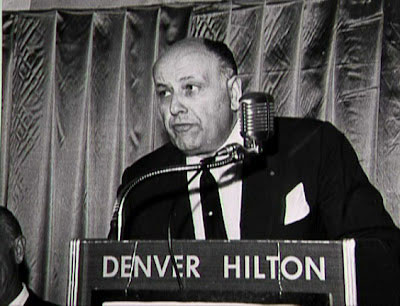 Reeves’s proven management skills might have turned Cinerama around even then if he had taken the reins in a firm hand, but evidently that was never his intention. With hindsight, it appears that Reeves was simply tired of dealing with Cinerama; his concerted efforts to streamline Cinerama’s corporate structure may have been just a way of getting it in good order — like a real-estate speculator fixing up and flipping a rundown house — so he could sell it and roll the capital into his own company, Reeves Soundcraft. In any event, Reeves had control of Cinerama for less than a year before he put it on the market — negotiating first with Walter Reade Jr. of Reade Theatres, then with Nicolas Reisini of Robin International. In the end Reisini bought Reeves out, becoming president and CEO of Cinerama Inc. (In his history of Cinerama, Thomas Erffmeyer mentions that in 1947 Reisini had purchased a California asbestos mine for $350,000 — which now, in 1959, he sold for $4 million. Dr. Erffmeyer doesn’t say if it was this windfall which enabled Reisini to buy Cinerama Inc., but it strikes me as a logical inference.)
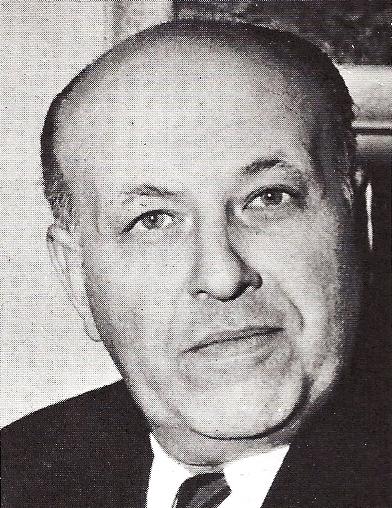
Nicolas Reisini was, if nothing else, an energetic and ambitious entrepreneur and wheeler-dealer, and he hit the ground running. Even before assuming the presidency of Cinerama in May 1960, he accomplished something nobody before him had been able to do: He established a co-production agreement with a major studio. The studio was MGM (then flush with the critical and box-office success of Ben-Hur), and the agreement was announced on December 11, 1959: They would produce at least two and as many as six features; MGM production chief Sol C. Siegel would supervise them, with Cinerama having script, director and cast approval; Cinerama would distribute and exhibit the pictures in their theaters, and MGM would handle distribution of 35mm general release versions after the Cinerama roadshow engagements.
 A top priority for Reisini was to bring Cinerama to the widest possible audience — to increase its fan base, if you will. To that end he followed through on an idea Stanley Warner had flirted with in the mid-’50s but (typically) abandoned before doing much with it: portable Cinerama. A caravan of trucks criss-crossed France and other countries in Europe, visiting towns and villages like a 19th century travelling circus. The caravan would set up an enormous inflatable rubber tent — inflatable so it would be self-supporting with no internal columns or poles to block the view of the screen — that could seat up to 3,000 spectators on folding chairs. (Reisini had always been adept at thinking outside the box. In 1954, when Robin International undertook to open theaters overseas, he had tried to interest the United States Information Agency in mounting a travelling Cinerama theater on a retired aircraft carrier. USIA was game, and even President Eisenhower liked the idea, but Congress nipped it in the bud.)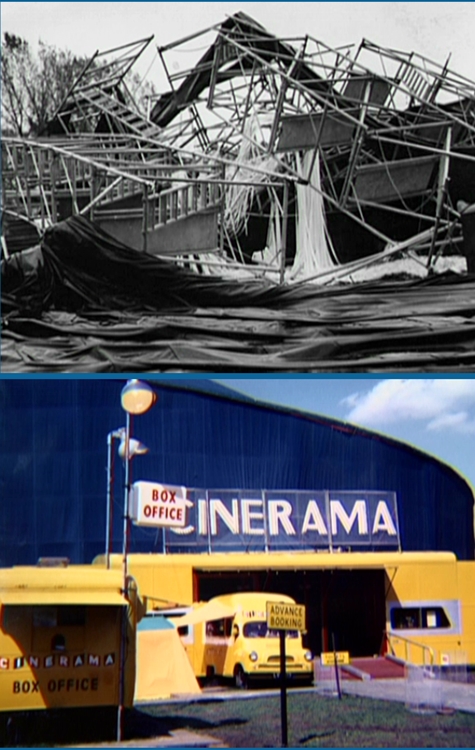
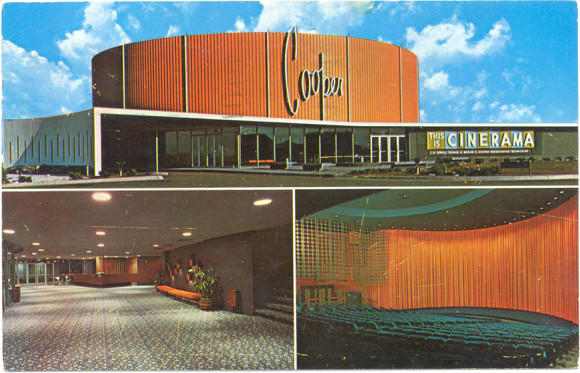
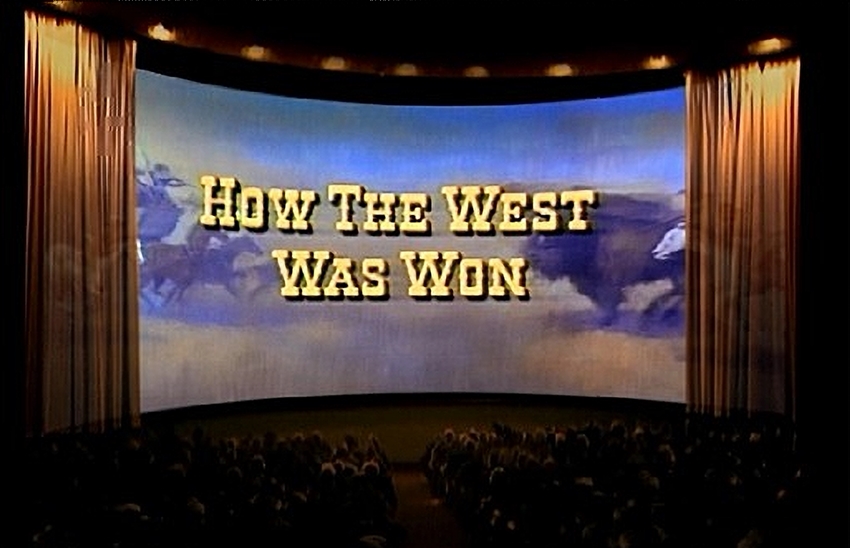
It wasn’t enough to save his job. Enter William Forman of Pacific Theatres. Several of his theaters had installed Cinerama equipment, and Forman jumped in with both feet in February ’63: for $15 million he bought up the note Prudential Insurance Co. held from their 1959 loan of $12 million, and with it he acquired a series of stock options, all of which he excercised, to the point where he replaced Nicolas Reisini as president and CEO in December ’63. Reisini remained as chairman of the board for the time being, but in September ’64, with Cinerama Inc. teetering on the edge of bankruptcy, he resigned even from that, effective immediately.


 Cinerama Inc. made most of its money from the equipping of Cinerama theaters — the sale or lease of equipment and supplying of replacement parts — and was annoyed that Stanley Warner wasn’t opening theaters at a quicker pace. The remaining investors in Cinerama Productions were annoyed that SW wasn’t opening more theaters and producing a steadier stream of pictures to show in them. And Stanley Warner, who had to put up all the money for both the theaters and the pictures but had to share almost half of any profits (when operating costs alone could eat up as much as 90 percent of gross ticket sales), was beginning to wonder if investing in the process had been such a good idea in the first place. The cracks among the partners in Cinerama were beginning to show, and were the subject of chatter in the trade press.
 There had been talk of plans to expand Cinerama into foreign countries almost from the first opening in September 1952, but nothing had ever come of that idea. In the spring of 1954, Stanley Warner sought to farm out the foreign exhibition rights — find somebody who would foot the bill for overseas expansion and pay SW for the privilege. After three months of negotiations, S.H. Fabian hammered out a deal with Nicolas Reisini, president of Robin International.
 Remember all those movie-industry honchos trekking out to Oyster Bay to see Cinerama? One of them was Joseph M. Schenck, chairman of the board of 20th Century Fox. Like everybody else, Schenck passed on Cinerama, but as he did so he added ruefully: “I’ll be buying this process someday, and it will cost me ten times as much.”
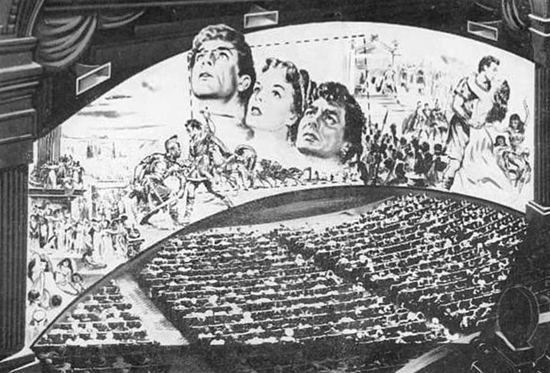 Early ads for CinemaScope, like the one I’ve reproduced here, emphasized a resemblance to both Cinerama and 3-D (“It’s the miracle you see without glasses!”) that didn’t really exist. While CinemaScope did originally call for a curved screen, most theaters didn’t bother with that. Even in The Robe‘s first-run engagements, the curve was much shallower than in this ad, and nowhere near as deep as Cinerama’s. (A good thing, too: you have to feel sorry for that poor sucker on the left end of the seventh row — what kind of view could he have had?) Anybody who compared Cinerama and CinemaScope side-by-side (so to speak) could see there was no real comparison. But in truth, most moviegoers couldn’t do that. Among Hollywood professionals, CinemaScope didn’t have to be as good as Cinerama, as long as they could sell it that way to the millions who hadn’t yet seen the real McCoy. Besides, it was still a huge change from movies-as-usual, and something folks couldn’t get on those newfangled 17-inch black and white TV screens in their living rooms.

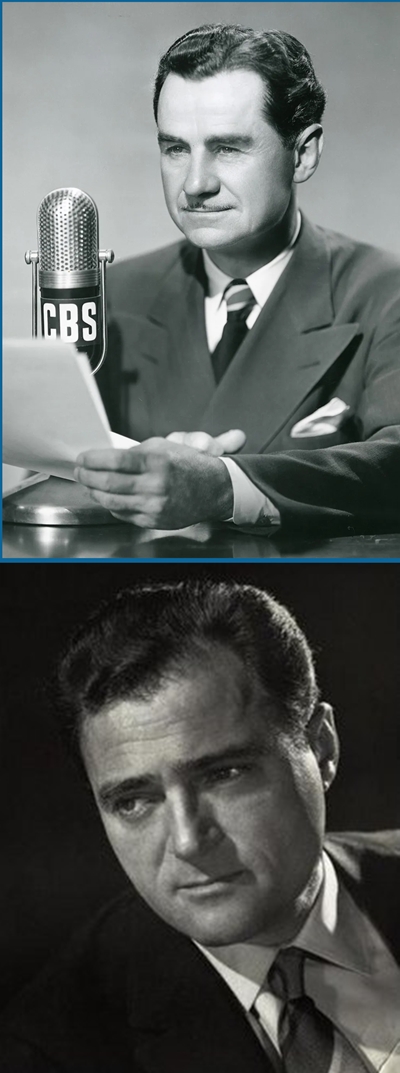
 Lowell Thomas decided right off the bat — and Merian Cooper, when he came aboard, concurred — that the star of the first Cinerama picture would be Cinerama itself. “If Charlie Chaplin had offered to do Hamlet for us,” Thomas remembered, “I’d have turned him down. I didn’t want people judging Chaplin or rediscovering Shakespeare…The advent of something as new and important as Cinerama was a major event in the history of entertainment and I was determined to let nothing upstage it.” In other words, This Is Cinerama wasn’t a movie, it was a demonstration, just like Waller and Reeves’s screenings at their tennis court command post in Oyster Bay. The difference this time was that the presentation was more organized and formal, with tuxedo-clad personnel escorting the audience to their seats — and it was in Technicolor. (Mostly, anyhow; when opening night loomed and the feature was still a little short, Thomas and Cooper decided to splice in Waller’s black-and-white clip of the Long Island Choral Society singing Handel’s Hallelujah Chorus — it made a good demo of the sound system, with an invisible choir marching down the aisles of the theater before coming into view on the screen.) So in a sense, Cinerama was exactly where it was before the opening — only now the whole world was watching.
 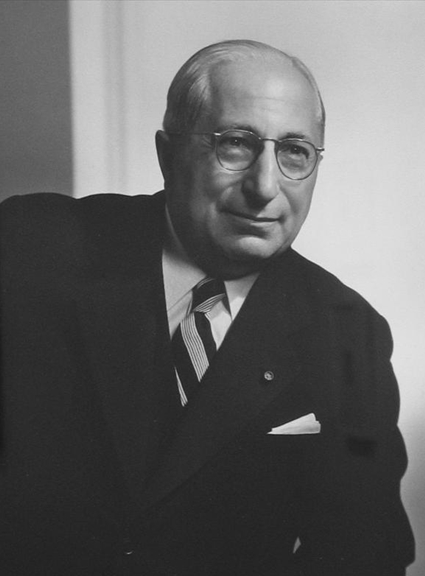 The first new development, barely three weeks after the premiere, was the appointment of Louis B. Mayer as chairman of the board of Cinerama Productions Corp. (with Lowell Thomas stepping down to vice-chairman). There was a certain irony in this; Mayer was one of the movie industry figures who trooped out to Long Island for those demonstrations, only to take a pass on investing. Back then, Mayer had been probably the most powerful man in Hollywood, but this was now. In the interim there had been that ugly power struggle at MGM between Mayer and Dore Schary, ending in a humiliating palace coup that sent Mayer packing in July 1951. By October ’52, Mayer was restless in forced retirement, and Cinerama looked like his passport back into the business. For Cinerama it was a windfall in both money (Mayer’s personal investment reportedly amounted to over $1 million) and prestige: Mayer’s status as a pioneer and longtime chief of the Tiffany of Hollywood studios gave an aura of solidity to Cinerama, and his reputation for showbiz acumen was expected to reassure and attract investors. He brought along some possible material, too: Mayer personally held the screen rights to several properties. One of them, Blossom Time, a moldy Viennese operetta of the sort Mayer had once so lovingly dusted off for Nelson Eddy and Jeanette MacDonald, would never do. But others might work very nicely, like the Lerner and Loewe musical Paint Your Wagon and the Biblical epic Joseph and His Brethren.
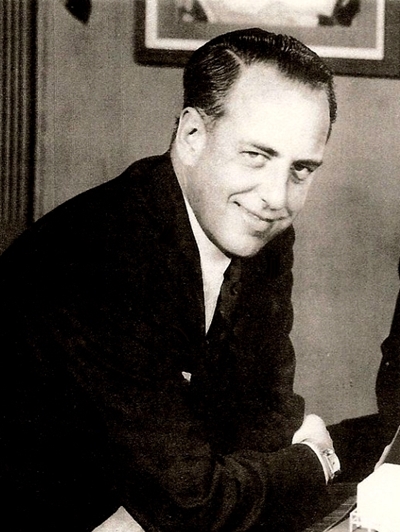 There was a flurry of announcements in trade papers. Dudley Roberts, president of Cinerama Productions, said Cinerama would open theaters in 100 cities, to be supplied with six to eight full-length features a year. Merian Cooper, now head of production, promised that Cinerama would either buy or build its own studio in Hollywood. (Might Cooper have had his eye on RKO? The studio was then in the process of being run into the ground by Howard Hughes, and ripe for the picking. If so, it didn’t happen; when RKO finally sold it went first to General Tire and Rubber Co., then to Lucille Ball and Desi Arnaz, who renamed it Desilu.)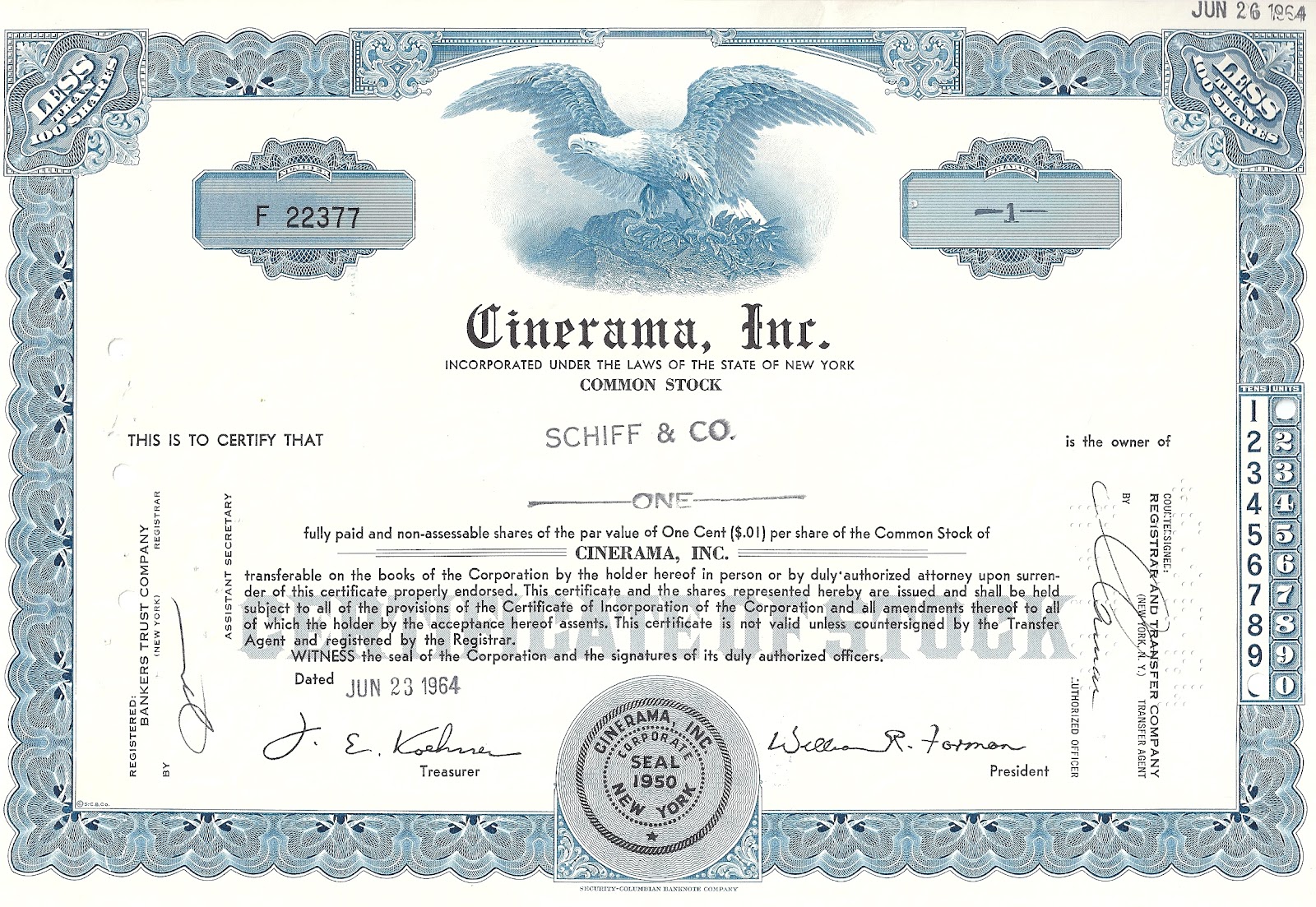

 When Rockefeller and Luce bailed on Cinerama in July 1950, those other East Coast investors decided to take a pass as well, and Cinerama Corp. was dissolved in August. After buying out Rockefeller and Luce for a song, Hazard Reeves doubled down — he quite a bit more than doubled, in fact. In September he formed a new corporation, Cinerama Inc., in which Reeves Soundcraft was the principal stockholder, and set about tackling the challenges of moving Cinerama forward. The demonstration screenings at the converted tennis court continued. There were nibbles from independent producer Hal B. Wallis and a consortium of theater owners, but nothing came of them.
 Also in early 1951 Thomas-Todd, or so the story goes, approached documentary master Robert Flaherty to direct the first Cinerama picture. Flaherty reportedly agreed, but he died in July ’51 as shooting was about to begin, leaving behind no notes or records to indicate what, if anything, he intended to do with Fred Waller’s process. This put Thomas and Todd back at square one.
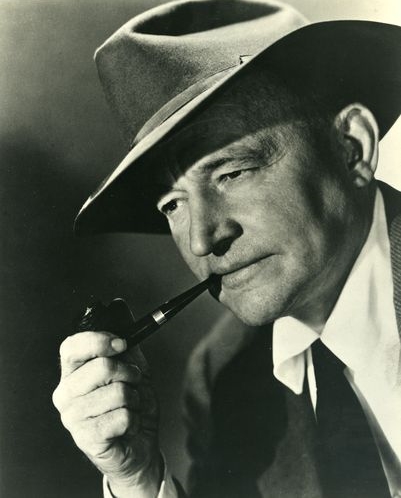 When all this footage was edited together in late 1951, it became clear that there wasn’t enough to make a full feature picture, so Thomas invited his friend Merian C. Cooper to come aboard. Even today, Cooper’s most famous production remains the original King Kong, but he has other ornaments on his résumé too: he was an early investor in the Technicolor process, and he partnered with John Ford on several of the director’s classic films: Fort Apache (1948), She Wore a Yellow Ribbon (’49), Wagon Master and Rio Grande (both ’50), with The Quiet Man (’52) and The Searchers (’56) still to come. Cooper had known Fred Waller in the early days at Paramount, and with that instinct for innovative ideas that made him an early passenger on the Technicolor bandwagon, he’d been following the industry buzz about Waller’s experiments out on Long Island.