Chapter II of Glamour Boys is now published. Look under the Fiction menu, or click here to go directly without having to scroll down through Chapter I.
Again, I hope it meets with your approval…
Chapter II of Glamour Boys is now published. Look under the Fiction menu, or click here to go directly without having to scroll down through Chapter I.
Again, I hope it meets with your approval…
The tests for Randall Anthony and Nancy Shannon showed up at the studio in September. Howard sat through a screening with Sterling and came back in a thoughtful mood.
“Well, they’re not bad,” he said. “Maybe not bad is good enough. The boy’s got talent, sure enough. But he acts for the stage and he doesn’t photograph all that well. The girl, I don’t know. She photographs like a million bucks, but she’s stiff. Her dancing…well, she can hoof it okay, but she also does this kind of Isadora Duncan crap that might work all right for vaudeville, but I don’t know about pictures.
“Listen,” he went on, “O.B.’s beginning to have his doubts, but he still thinks the kid’s worth taking on if we can get him short term for a couple or three hundred a week. He’s going to have some directors look at the tests with Merv — ” Mervin Katz was head of casting — “and see what they say. If we decide to bite, O.B.’ll send a lawyer back east to sign them up. I want somebody from here to go along, and I can’t go myself. You feel like a week in New York?”
“Autumn in Manhattan? I’ll say.”
“Good. Count on it, ’cause I think O.B.’s going to bite. Give Margo a ring and find out when they’re running the tests tomorrow. I think you should see them.”
I called Margo, O.B.’s secretary, and found out when to show up and at which screening room the next day. When I got there I mounted up to the back row and took a seat. O.B. had already assembled his audience. Mervin Katz was there, sitting in the back not far from me, hunched over a ten-inch cigar. In the row in front of us and a few seats closer to the door was Dan Parkman of hair and makeup. There were a few directors: Frank Harmon, who shot pictures as if his hair was on fire, always coming in days ahead of schedule and thousands under budget; Jack Overman, the studio’s specialist in weepers and women’s pictures; and Harry Walker, who handled the westerns that were shot at the Sterling Ranch up in the Valley. Sitting next to O.B. was one of the pool stenographers, and on the other side of her was Leo Sharp, O.B.’s favorite cameraman.
O.B. dimmed the lights with the dial on his chairside console and buzzed the projectionist to roll, and I began to understand why Oliver Sterling’s enthusiasm had started to go cool.
The first test was seven or eight minutes long, silent, a series of closeups and medium shots of Anthony in different lighting. You could get an idea of the photographer trying different lights, filters and lenses. Some looked better than others, but I could see what Howard meant: Anthony didn’t look as good on film as he did in person. His head looked too big, his eyes too prominent. The aristocratic nose was bulbous and his full lips looked flabby and sensuously weak. Seen full-on his eyes were off center, and he hadn’t learned not to look directly into the lens. It wasn’t hopeless, but it would take some work, behind the camera and in front of it, to make him come off. Down front, Leo Sharp was muttering to O.B. and the stenographer, probably telling them the kind of things I was thinking as I watched the test, plus a lot of other stuff that he would know and I wouldn’t.
The next test had sound, a scene from Thief in the Night, the murder mystery the studio had bought after our last trip east. It was Anthony in a medium shot, being interrogated by a voice off camera. The voice was barely audible but female, probably a script girl, and you could occasionally hear a man’s voice coaching from the side. The sound recording wasn’t too good, even with the microphone sitting in plain sight on the table right in front of him, but at least he had a voice. And boy did he use it. He read lines like a politician on the night before election.
Then came a two-scene with Anthony and an actress I didn’t know, probably some New York kid hired for the day. It was okay, but it had all the problems Anthony had shown in the other tests. Once again, it wasn’t exactly a lost cause, but he wasn’t a natural either.
When the film ran out O.B. turned up the lights and swiveled his chair around to face the others. They talked over what they’d seen, and they had more or less the same reaction to Anthony that I did. Harry Walker said forget him for westerns; he’d look like Little Lord Fauntleroy playing cowboys and Indians. But Harmon and Overman saw possibilities. Dan Parkman said the face could use the right emphasis but he didn’t need anything serious; besides, he had good teeth and that could count for a lot. Merv Katz said it was O.B.’s money, but as far as he was concerned the more people they had under contract the better; if everybody else could work with him, then so could Merv.
O.B. gave Leo Sharp the last word, and Leo approved. “Whoever shot these tests must be losing his eyesight,” he said. “The boy’ll need work, sure, but I think he’ll pay off in the end. We can use a good general-purpose second lead.”
O.B. nodded and turned back to the screen, buzzing the booth to run Nancy Shannon’s tests. They were pretty good. Howard was right, she did look great on camera. He was right about the dancing, too — especially the Isadora Duncan crap. That would never go in pictures. Even so, the dancing was the only time she was really comfortable with the camera, probably because she could ignore it, and it made her look good. She had a grace and suppleness that didn’t surprise me at all, having seen her striding across the Algonquin lobby. It made you see hope in her even when she recited the dialogue in her sound tests like she was reading the Times obituary column. She may have been in vaudeville, but I got the feeling she hadn’t spoken much on stage.
When the lights came up, the talk about her was much the same. Nobody was panting with enthusiasm about either one of them, but they all thought there was a chance, that the price would probably be right, and that the studio needed to build up its stable of contract players.
O.B. turned and looked at me for the first time. “Dill,” he bellowed, “did Howard talk to you about this?”
“Yeah, sort of, Mr. Sterling,” I said. I stood up and walked down to the front so he didn’t have to yell. “He said if you decided to sign them he’d want me to go along with the lawyer who closes the deal.”
“Well, go home and pack. I think what we’re gonna do is sign them for a year, see if we can coach them along. If the year works out, we’ll offer them a standard contract after that. And Dill,” he went on, stopping me as I turned to go, “if these kids want to know what the reaction to their tests was, you tell ’em, and give it to ’em straight. But make it sound like you’re going behind my back. Got it?”
“Got it, Mr. Sterling.”
O.B. wasn’t kidding about going home and packing. As I got back to the office, Howard hung up the phone and said, “You’re leaving tomorrow. We’ll have a driver pick you up and someone will meet your train in New York and take you to your hotel.”
I caught the L.A. Limited from Central Station at nine the next morning with Herman Rambauer, one of the boys from the legal office, and three days later we tranferred to the Broadway Limited in Chicago. Herman would do all the talking and sign the papers, Howard told me. I was there to get to know Randall Anthony and Nancy Shannon, since I would be working on making them famous after Sterling National put them to work.
We pulled into Penn Station on a Thursday; we would stay through the weekend and head home the following Monday. When we got to our hotel — the Algonquin again — Herman called and made an appointment to see the Anthonys. It took some doing, as they didn’t have a phone and the play Anthony had been doing had closed, but Herman managed to get a message to them through a hall phone in the boarding house they lived in over on West Fifty-Third.
When they came to see us at the hotel, of course, they knew why we were there. O.B.’s office had wired them the offer while Herman and I were traveling; he was just there to talk about the details and get their names on the dotted line. I noticed a difference in them this time from what I had seen on our trip back that spring. Before, when they talked in generalities with O.B. and Howard, they had been breezy and carefree, as if this were all just a lark; they had been like a couple of penniless kids window shopping at Tiffany’s. Now things were different. They had the brass ring in sight and things really mattered. Their eyes were a little sharper, their laughter — when they laughed, which wasn’t often — a little more forced. They tried to make a show of nonchalance, but I could tell they were eager to sign.
Herman could tell too. He was authorized to go as high as $500 a week for each of them, but he started at $175 and they bit at $300. They made a show of being persuaded, even stepped into the next room to pretend to talk it over, but I don’t think they’d ever seen $300 a week in all their time in New York.
“All right then,” Herman said as he leaned over the coffee table to blot the signatures on the contracts, “we’re all set. You are to report for work at Sterling National Studios one month from today. Any time during the day will do, but it will be better if you can report before noon. Give your names to the guard at the gate and someone will come out to escort you to the casting office. And one more thing.” He reached over and picked up a ledger-sized checkbook, opened it and started to write. The room was quiet as he did so, the only sound the scratching of his pen. Randall and Nancy glanced at each other and craned their necks, ever so slightly, in an effort to see what Herman was doing.
When he finished he tore the check out, waved it to dry the ink, then blotted it. “I am authorized,” he said, “to pay you the sum of six hundred and fifty dollars. This constitutes a $100 signing bonus for each of you, plus an allowance of $250 to cover your travel expenses to California. The rest is an advance on your salaries to be deducted from your pay envelopes at the rate of $25 per week for four weeks. Please sign this receipt.” He slid the receipt across and rotated it with his fingertips to face them. They signed, and Randall took the check. His hand trembled slightly.
Herman stood, and the rest of us followed suit. He held out his hand. “Welcome to Sterling National, Mr. Anthony.” Then, shaking hands with Nancy, “Miss Shannon. We look forward to working with you both.”
The two of them made similar noises, and as Herman and I walked them to the door, he went on. “Do you have plans for this evening? I’d like to invite you both to join me and Mr. Diller here at the hotel for dinner.”
Anthony shook his head with a smile. “I’m afraid I have a previous engagement. But I think Nancy is free. Dear?”
She shot him a glance of irritation, but washed it away almost before I could see it. “Couldn’t you, just this once…?”
“Afraid not, honey, you know that,” he said, and all at once, for some reason, there was a current of simmering tension between them. Herman ignored it, maintaining a bland lawyer’s poker face, while I looked back and forth between our newest contract players wondering what was up.
The moment quickly passed, shoved aside by Nancy as she turned and flashed a smile at Herman and me. “Well, then, thank you, I’ll be glad to. What time?” She said it so brightly that if I hadn’t been paying attention, I might have thought I’d imagined the little duel of wills between husband and wife in the last couple of seconds.
She met us in the lobby at half past eight that evening, dressed to the nines in blue and black with a long string of knotted white beads, and carrying a little sequined clutch bag. The dress looked great on her, but I got the impression that either she had borrowed it or she didn’t get many chances to wear it.
Over dinner Herman and I drew her out about her career on the stage. She protested that she didn’t like to talk about herself, but she was a performer, so I didn’t really think I needed to believe that. I told her that I was in publicity and I had to know as much about her and Randall as I could. That gave her the permission she needed to open up.
Her parents had been a double act in vaudeville and Nancy and her older sister joined the act as kids. They ran afoul of the Gerry Society from time to time, but the two girls, by the time they were in their teens, were the mainstay of the act. Five years ago, Nancy’s sister got married and quit the biz, and she’d been doing a solo since then. Jobs were getting scarce, even the big-time circuits couldn’t guarantee the work they used to, and she had found herself laying off for longer and longer periods. She had gotten a little legit work in town, but they usually wanted hoofers. She had a little tap, she said, but she didn’t really hoof; she billed herself as an “artistic” dancer.
I asked her if she’d ever tried acting. She kind of grimaced, as if she knew how awkward she looked in her tests, then turned it into a game smile. “Not much, a couple of lines here and there. Even in vaude, first my folks then my sister did most of the talking. Randy coaches me. He’s very good, you know.”
“You both are.”
She changed the subject back to Randy, telling us about his experience — high school and college dramatics, supernumerary work with touring companies after he dropped out of Penn State, waiting tables while trying to get work in New York, all the usual stuff. Frankly, I figured I could make up a more interesting story for him, and I made a mental note to do just that when I got back to the office.
About ten-thirty Herman excused himself, saying something about having to review some papers he’d brought with him. As he headed out to the elevators, Nancy gave me a sidelong look. “Am I keeping you up too?”
“Not me. I finished my homework hours ago.” We both sat back down.
“Good,” she said. “I’m not tired either. As a matter of fact…” She looked around, then leaned toward me and lowered her voice. “I’m thirsty, and I’m tired of drinking coffee. There’s a nice little speakeasy over on Eighth Avenue and I know the password. What do you say?”
To tell the truth, this sounded good to me, but just to be a dutiful studio man, I decided I’d better offer the straight-arrow line. I cleared my throat and took a deep breath. “If you read your contract, Miss Shannon, you’ll see that there’s something called a morals clause, stating that you agree, among other things, not to engage in any unlawful conduct, or in any activity detrimental or deleterious to the fortunes of Sterling National Pictures.”
Her eyes went wide and she chuckled. “Well now, that’s quite a mouthful. Do they make you memorize it?”
“And recite it every night when we go to bed, like the Lord’s Prayer.” I stubbed my cigarette out in the ashtray between us. “If you were to be discovered at such an illegal establishment, I’m afraid it would embarrass the studio and jeopardize your career before it had even begun.”
She leaned back and paused, looking straight and level into my eyes. “Well then,” she said at last, “I guess you’d better come with me and make sure I don’t get into any trouble.”
I grinned. “I’d say it’s the least I can do. Do we need a cab?”
She shook her head. “Let’s walk.”
The place she took me to looked quiet on the outside. It was a nondescript jewelry store with dustcloths spread over the window displays and arranged to make the window look empty. It occurred to me that nobody was likely to smash a window and grab anything; anyone who might do that would know who owned the place, and would know better than to try.
Nancy tapped lightly. A lookout opened the door a crack and, when Nancy gave the word, let us in. “Straight back,” he said. At the back of the store was a little sort of storeroom. We opened the door and stepped inside. The room was pitch dark and I could hear the muffled sound of music. She laid a hand on my chest. “Stay here,” she said, “and don’t move.” She stepped away and I heard the metal creak of a doorknob. The muffled music turned to a full blare and the room was flooded with light, blinding me for a second.
Nancy came back, took me by the hand, and led me into the main room of the speak. It was slightly smaller than the dining room at the Algonquin and jammed with tiny tables about as big around as a good-size waiter’s tray. There were maybe two hundred people crammed into the place, at the tables, the bar along the wall to our left, leaning against the walls all around, and on the postage-stamp dance floor. The place was stuffy and misty-white with cigarette and cigar smoke. Crammed into an alcove behind the dance floor was a ten-piece band with a brunette girl singer in a silver-fringed dress banging through a lively rendition of “Auntie Skinner’s Chicken Dinner”.
A dapper little man in a tuxedo greeted us. “Good evening, Miss Shannon.”
“Hi Danny. This is Mr. Diller; he’s okay.” The little man nodded and smiled at me. “Got a table for us tonight?”
“Will Mr. Anthony be joining you?”
“No, just two tonight.”
“Hmmm.” Danny craned his neck. “Ah! Follow me.” Grabbing a couple of menus and napkins and raising his hands over his head like a Spanish dancer, he threaded his way through the crowd to a table in the corner away from the band. “Enjoy your evening, folks,” he said as he held Nancy’s chair for her. “Welcome, Mr. Diller. We rely on your discretion.” And he was gone.
The menu was the usual innocent-sounding assortment of pastries and petit fours. Nancy ran through it with me, decoding it, letting me know what name on the menu represented which item the joint actually served. A waitress appeared at my elbow and took our orders; she was hardly gone long enough, I thought, before she was back with our coffee, glasses of ice water, and liquor in little unmarked ceramic pots.
Nancy touched the waitress on the wrist. “Don’t go yet,” she said. She drank off her water and poured her liquor — scotch — over the ice, then she knocked back her drink and set the empty glass of ice on the waitress’s tray. “Hit me again,” she said.
I hadn’t even touched my booze — rye — yet, but the waitress gave me an inquisitive look. I shrugged. “Might as well keep up.” The girl nodded and was gone.
The band finished off “Auntie Skinner’s Chicken Dinner” with a flourish of banjos and saxophones, then launched immediately into “Five Foot Two, Eyes of Blue”.
Nancy was taking a deep bite out of her second drink while I was still sipping at my first when a man materialized out of the crowd beside us. “Nancy, darling!” he squealed, stretching the words out for several seconds. He leaned down and pecked her once on each cheek, holding his cigarette daintily behind his head. “Where is that luscious husband of yours? And who is this handsome stranger? Does Randy know?”
Nancy gave him a small but not unfriendly smile. “First, it’s Randy’s poker night. I thought you’d be there yourself. This is Maurice Diller. And yes, Randy knows.”
“Maurice?” He held out his hand.
“Call me Dill; everybody does,” I said, half standing, as I took his hand. He had a handshake like a jeweler examining a Fabergé egg.
“This is Billy Hayfield,” Nancy said. “First runner-up in the 1926 Pola Negri look-alike contest.”
“Don’t be naughty, sweetie,” he said, “it spoils your complexion.” He turned to me. “She’s being funny. There was no such contest, you understand. Frankly, that Polack tramp should look this good in black.” He rotated in a tight circle, showing off his suit. Then he wedged himself down onto her lap. “Let me sit a while, honey. Don’t make me bend over to talk. It kills my back.” He looked remarkably like a ventriloquist’s dummy perched on her knee.
“All right, Billy,” she said. “You can stay till you get bored, my legs fall asleep, or you make me lose my temper, whichever comes first.” She looked at me. “I’m betting on boredom. Billy can’t concentrate on anything for more than thirty seconds.”
Billy grabbed her drink. “Scotch?” She nodded, and he knocked it back, ice and all, grimacing and roaring as the lump of it bulged its way down his throat. Then he swatted the elbow of our waitress as she sidled past behind Nancy’s head. “Honey, honey,” he called, “some oaf stole this lady’s drink. Be a doll and bring her two more. And one more for handsome here too.” The girl nodded and continued on.
Billy lowered his chin and glared through his eyebrows at Nancy. “Did you say poker? Is it Randy’s poker night again already? My gawd, didn’t the time just fly?”
“Yes, it did,” she said. “Why aren’t you there? I thought you never missed.”
“I didn’t hear. I think Randy’s mad at me or something.”
“Don’t be a dope. What did you do to him?”
“Tell me, darling, and then I’ll know too. I’ve never known him to be a sore loser, but I haven’t the foggiest idea what else it could be.”
He stretched his neck to the bandstand. The girl singer was taking a break and the vocal was being handled by a male trio. Billy sang along with them. “Now if you run into…a five-foot-two…covered with fur…diamond rings…and all those things…” He stopped suddenly, turning back to Nancy. “Maybe I’ll crash the game if it’s still going on. Is it at Marshall’s again?”
“I don’t know. I suppose so.”
Billy leaned back and grinned at her. If he was sober when he appeared at our table, which I doubted, he wasn’t anymore. I could see his eyes glaze from the scotch he had gulped and he leaned on the table as he climbed off her lap; I had to steady the table from my side to keep him from taking the whole thing down with him.
“Well,” he said, another three-second word, “maybe I’ll just toddle on over and see.” He leaned down, touching his unsteady forehead to hers. “Have a good time, sweetie, and don’t stay out too late.” Before I even knew what was happening, with surprising dexterity for a man so drunk, he lifted the hem of her skirt and slid his right hand far up under it between her thighs, exposing her knees and the tops of her stockings.
“Billy, please!” she hissed, mortified, seizing his wrist and pushing it sharply away, twisting her knees under the table and smoothing out her disarrayed skirt.
He waggled his head and leered. “My mistake, love. I thought you’d be grateful. Must be getting pretty dusty down there.”
Her face flushed red, her eyes hardened and her right hand flashed out in a blur, slapping him hard across the chops. Spit flew out the corner of his mouth. I jumped to my feet. The slap was so loud it carried over the band and the noise of the crowd, turning heads and stopping talk at the tables all around us.
I didn’t know what I was going to do, but I didn’t have to. Billy raised his hand. “No need, Galahad,” he said. “We’re old friends.” He turned to Nancy, one small hand rubbing his jaw. “Baby, you know I love you like a sister and I’m drunk. I’ll apologize now –” it came out something like “apojisize” “– because I prob’ly won’t even remember this tomorrow.”
“I know, Billy.” She looked at him, still stricken, eyes welling. “Go home. Don’t go to Marshall’s.”
“I believe that’s good advice,” he said.
The waitress appeared with our drinks, a burly goon at her side. “Everything okay here?” he asked.
“Yes, Jake, don’t worry,” Billy said. “Just an intemperate chat about politics.” He pulled his wallet from his breast pocket, plucked out a bill, and handed it across to the waitress. I got a look as it passed; it was a c-note. “These good people are my guests” — “guesssss” — “tonight. If they drink more than this, I’ll settle up next time I’m in. If they don’t, keep the change.”
He looked briefly and blearily at Nancy as if he were about to say something, or bow, or nod, but he didn’t; he just tottered away with the bouncer Jake following behind him.
I sat back down and glanced at Nancy. She was still flushed, breathing heavily, her eyes shifting quickly here and there as if she were looking for someone. I thought it better to look away.
We sat like that for the rest of the song, not speaking or looking at each other. At last she said, “If you’ll excuse me, I’ve got to visit the powder room.” She grabbed her clutch-purse and got up.
I stood up to see her away, looking at her as I did so, and she met my eyes. Hers were dry but red with the effort of contained humiliation. As she moved through the crowd I sat back down. I still had two untouched pots of rye to get through.
When she came back and sat down, one of the pots was empty and I was halfway through the other. I could see she had washed and powdered her face, reapplied her lipstick, and generally recomposed herself. She gave me a tight little smile as she took her seat, but she didn’t say anything.
When she picked up her drink, her hand shook slightly. She set her drink down and pressed her palm against the table, as if she were trying to leave an impression on the cloth. After a moment she picked up the drink again, steady this time, and downed half of it. Then she leaned back in her chair, stretching out her long legs as much as she could in the space we had, leaning her elbow on the table and resting her chin on the flesh between her thumb and forefinger. I pretended not to notice all this while she stared straight ahead at the band over the heads of the drinkers in front of us.
I took a couple more pulls on my drink. After a while I looked across at her. “Do you want to leave?”
“Hell, no,” she said. She finished the first of the two drinks Billy had ordered for her and waved to get the attention of our waitress. “What I want is to drink up as much of that little bastard’s hundred bucks as I can.” The waitress came up. “Are you ready to go again?” Nancy asked me.
“I’m all right for now, thanks.” I took another swig of my little ceramic pot and chased it with water.
“Just me, then,” she told the waitress. “Make it two. This one’ll be gone by the time you get back. And tell him,” she went on, waving at me, “that I’m fine. I can hold it.”
The waitress looked at me. “She’s right, she can.”
I shrugged with a show of good cheer. “Nothing to me. It’s her head.”
I don’t know how long it was before she spoke again. It seemed like two or three songs. Whatever it was, the band had left to take a break and the noise level in the room had dropped to the dull rumble of a hundred conversations.
She looked up from her scotch at me with a sort of appraisal, as if she were trying to decide whether to say something. If she was drunk she didn’t look it. She was right, she could hold it. I had had maybe half what she had and I wasn’t feeling nearly as steady as she looked.
She leaned forward, her forearms folded on the table, and spoke so quietly I almost couldn’t hear her. “You know,” she said,”he’s not fooling anybody with that poker talk. Not me, anyhow. And he’s not trying to fool anybody else.” She looked down at her cup of cold coffee. “Poker my eye! If he’d been playing poker all this time every card shark in Manhattan would be lining up to break his legs. He’s no poker player. He can’t bluff.” She leaned back again and took another long swallow of her drink.
After a while she stood up. “Powder room,” she said.
I stood and laid a hand on her arm. “Why don’t we just go?” I said. “It’s getting late. Can it wait till you get home?”
She stood and looked at me, not drunk but level, patient, waiting, as if the sound of my words were taking its time reaching her. “I guess,” she said at last, turning aside and leading the way to the door.
Coming out of the smoky glare of the speakeasy, the storeroom was much darker than it had seemed on the way in. I stood in the blackness, stone blind, while Nancy went ahead. I stood there, the muffled sound of the band resuming behind me, and listening for the sound of the other door opening out into the shop. It didn’t come.
Maybe I simply smelled her perfume, or the scotch, but somehow I sensed that, rather than being on the other side of the room, she was standing very close to me. No sooner that, than I felt her hand on my arm, moving lightly, slowly up to my shoulder. Then she took my head in her hands and pulled me toward her, turning my head to the side. I could feel the sequins of her purse against my cheek.
“Don’t get any wrong ideas,” she whispered in my ear, her breath warm and her words barely audible in the darkness. “Talk about this and I’ll call you a liar to your face.” Then her mouth was on mine, softly at first, exploring, then going deeper. Her lips parted and I could taste the scotch. Her arms encircled my neck and mine went around her, one hand sliding down her back, past her waist, cupping her. She moved against me, rolling her hips to press where she knew she had stirred me.
After a long moment she drew away, reaching behind to disengage my hands. “I shouldn’t have done that,” she whispered. “I just…” She let the words hang. “Never mind.”
She stepped away and opened the outer door. I followed her through the dark shop to the street entrance, where the lookout cracked open the door and we slipped outside.
Once the door was secure behind us she stepped out of the shadow to the curb, looking for a cab in the passing traffic. She spotted one and hailed it silently with one raised hand. The cab pulled over and she opened the door, turning back to me. It was the first time she’d looked at me since we left the storeroom. There was no sign of the Nancy who had kissed me, or the Nancy silently guzzling scotch in the speak; in their place was the Nancy from dinner, poised and sociable. “You want a ride to your hotel?”
I thought it over. If I had thought we would pick up in the cab where we left off in the storeroom, I might have taken her up on it. But I knew that moment was gone. “Thanks, I’ll walk,” I said. “You need fare?”
She shook her head. “I’ve got it.” She got in and closed the door, then rolled down the window and leaned out. “Have a nice trip back. See you next month.”
I nodded and waved. She turned to the cabbie and gave him her address. Her window slid shut as the cab pulled away into the Eighth Avenue traffic.
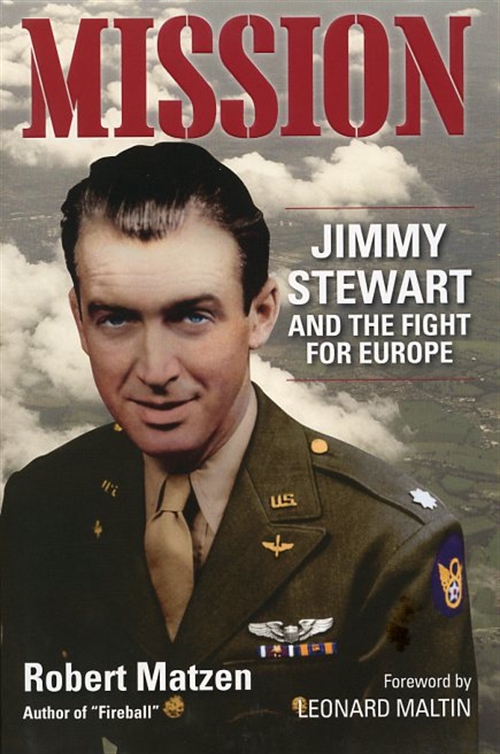 I’m preparing a post now on Clara Bow’s career in talking pictures, a career that was longer and more estimable than posterity has given her credit for. Well, as so often happens here at Cinedrome, that post is growing and deepening as I work on it, and has been accordingly delayed. But it has to go on a back burner for now in any case, because my friend Robert Matzen is about to publish his latest book. It’s one that belongs on the bookshelf of every Cinedrome reader — and a lot of other bookshelves besides. This new book not only goes a long way to fill a decades-old gap in our knowledge of the life and times of one of America’s most beloved movie stars, it also adds significantly to our knowledge — at least it added to mine — of the rigors and terrors of aerial warfare during World War II.
This is the book: Mission: Jimmy Stewart and the Fight for Europe. Robert Matzen, Cinedrome readers will recall, is the author of Fireball: Carole Lombard and the Tragedy of Flight 3, a riveting page-turner about the death of Carole Lombard, who became the first celebrity casualty of World War II when her plane crashed on the way home from a war bond rally in Indiana. Mission tells us, in harrowing detail, how close James Stewart — Hollywood’s “boy next door” and an Oscar winner for 1940’s The Philadelphia Story — came to becoming another casualty of that same war. And not in a stateside bond tour, but in combat in the skies over Germany.
It’s common knowledge that James Stewart is one of the greatest stars in the history of Hollywood; in the American Film Institute’s 1999 list of the screen’s 50 greatest legends, he ranked third among men behind Humphrey Bogart and Cary Grant. Less commonly known is that he was the highest-ranking actor in military history (not counting Ronald Reagan’s two terms as Commander in Chief), retiring from the U.S. Air Force Reserve as a brigadier general in 1968. He always kept his screen and military careers carefully separate, especially during the war. There was a flurry of publicity when he enlisted in the U.S. Army Air Corps in March 1941 (nine months before Pearl Harbor), but that media circus led him to hold the press at arm’s length thereafter, and his military higher-ups generally cooperated by shielding him. Throughout the war, hopeful reporters were often reduced to filing pouty dispatches about how Lt. (later Capt., Maj., Lt. Col. and Col.) Stewart wouldn’t talk to them. And after the war, in the 52 years that remained to him, he spoke sparingly and in the most general terms about his war service. Of his experiences flying bombing missions over France and Germany — aside from a brief stint as a talking head on Thames Television’s documentary series The World at War, identified only as “James Stewart, Squadron Commander” — he spoke hardly at all.
 Stewart may have virtually taken the story of his wartime service, and his 20 combat missions in B-17 and B-24 bombers, to his grave, but Robert Matzen has exhumed the bones of the story from official military records and mission reports, and fleshed them out with the diaries, memoirs and recollections of the men who flew with Stewart and others like him, and with his own understanding of aeronautics born of ten years working in communications for NASA. He also gives us a keen insight into the tradition of military service that ran back generations in Jimmy Stewart’s family, something Stewart himself never elaborated on — perhaps because it would sound too much like bragging, perhaps because it was too internalized to bring to the surface.
Strictly speaking, Jimmy Stewart was actually James Maitland Stewart II (though his birth certificate didn’t put it that way). J.M. the First was his paternal grandfather, a Signal Corps sergeant during the Civil War who rode with Sheridan and Custer in the Shenandoah Valley in 1864, saw action at Cedar Creek, Five Forks and Sailor’s Creek, and was present at Appomattox Court House as Robert E. Lee surrendered to Ulysses S. Grant. Fifty years later, he would regale young Jim with tales of seeing Lee, Grant, Sheridan, Custer and Lincoln all in the flesh. “This,” Matzen tells us succinctly, “wasn’t history in a book.” (Did young Jim reflect on this family lore in 1938, when he played a Union Army doctor receiving an audience with President Lincoln in Of Human Hearts? How could he not?) Sgt. Stewart also had a brother Archibald who didn’t survive the war, falling at Spotsylvania.
Then there was Jim’s maternal grandfather, Col. Samuel M. Jackson, who fought in the Wheatfield at Gettysburg and helped hold the Federal left on the second day, rising to the rank of general by war’s end. Gen. Jackson died before Jim was born, but his devotion to serving his country remained legendary in the family and mingled with that of Sgt. Stewart and his brother Archie.
And with that of Jim’s own father Alexander. He served briefly in the Spanish-American War but saw no action; he fell ill in Puerto Rico, and that “splendid little war” was over before he recovered. He didn’t give up; 20 years later, age 45 and married with children, he re-enlisted when America entered the Great War and served in France in the Ordnance Repair Dept.
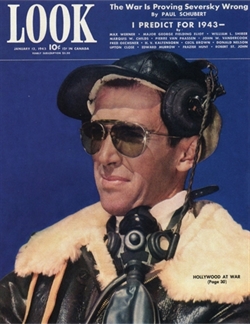
A future in military service for James Stewart the Younger was a foregone conclusion, and he began preparing for it even as he was climbing the ladder to stardom in Hollywood (and, as a playboy bachelor, cutting a swath through Tinsel Town’s female population, amusingly recounted by Matzen). An early fascination with aviation (and hero-worship of Charles Lindbergh, whom he would later play in the movies) made him set his sights on the Army Air Corps, plunging into flying lessons as soon as he could afford them. (Fun Little-Known Fact: James Stewart got his commercial pilot’s license even before his first Oscar nomination.)
When Mission follows Capt. Stewart to combat duty in England, after a frustrating two years stateside training men to face the action he wanted to see, the book becomes an eye-opening chronicle of the nightmare of aerial combat. Robert Matzen puts us on the flight deck and in the bomb bays and gun turrets as vividly as Laura Hillenbrand put us in the saddle in her brilliant Seabiscuit. Reading Mission is as close as you’ll ever want to get to flying at 20,000 feet swaddled in a heated suit against the 40-below weather, icicles dangling from (and occasionally clogging) your oxygen mask, struggling to keep your behemoth plane in formation while anti-aircraft flak rips holes in your fuselage and hundreds of Luftwaffe fighters swarm around you like death-dealing wasps. Twenty times Oscar-winner Stewart went through it — eight, nine, ten hours in the air, never knowing which split-second might be his last. No wonder he never talked about it.
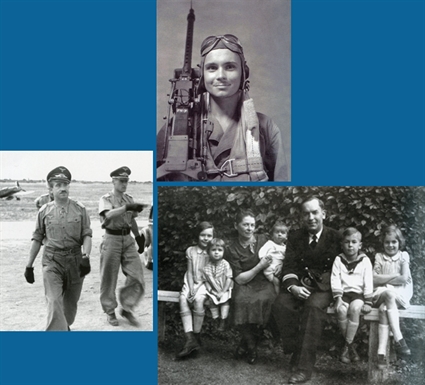 As he did in Fireball, Matzen completes the picture he paints by recounting the experiences of others who lived through the air war over Europe from perspectives of their own. From top to bottom here:
Sgt. Clement Leone of Baltimore, a radio operator in Stewart’s combat wing, who was a senior in high school when Pearl Harbor was attacked, and whose fascination with airplanes, like Stewart’s, channeled him into the Air Corps once he turned 18. Leone’s exploits, especially after being blown out of his exploding plane over German territory, would make a book in themselves. (Non-spoiler alert: Leone survived, came home, and is today alive and well; he was a key source of Robert Matzen’s insight into life in a bomber crew.);
Gen. Adolf Galland (with the moustache) of the Luftwaffe’s fighter wing, who flew hundreds of missions against American bombers, and did not share Reichsmarschall Hermann Göring’s contempt for the Americans and their Flying Fortresses and Liberators; and
The Siepmann family of Wilhelmshaven, later Eppstein near Frankfurt. Papa Hans was a naval engineer working on U-boats. Mama Riele and their children lived through the Allied bombing campaign as civilians cowering in the shadow of those planes overhead; they didn’t share Göring’s contempt either. Their oldest child Gertrud (far left) later married an American G.I. and emigrated to America in 1956. Robert Matzen knew her for years as Trudy McVicker before learning of her childhood in Hitler’s Germany and coaxing her to contribute her memories to Mission.
Whether you’re interested in Jimmy Stewart, Hollywood, World War II, or all three, you want to read Mission. The official publication date is Monday, October 24. You can order the book here from Amazon. And you can learn more about the book here, about stops on the upcoming Mission National Book Tour here, and about Robert Matzen himself here.
Take my advice and don’t let any grass grow under your feet. I won’t be surprised if the first printing sells out.
Today marks the beginning of my first work of new fiction here at Cinedrome; the title is Glamour Boys. Now here, I guess, if I was really good at this sort of thing, I’d launch into some tantalizing inside-flap-of-the-dust-jacket copy describing the story and the characters, hooking and reeling you in like an expert fisherman. But honestly, that’s not really my long suit; I think I’d rather just let Chapter I, and those that follow, speak for themselves. To begin reading, hover on Jim’s Fiction at the top and select the title.
Glamour Boys, I say again, is a work of fiction. The persons, firms and events portrayed therein are products of the author’s imagination or are used fictitiously. No identification with any real firms, or with any real persons living or dead, is intended, and none should be inferred.
That said, I hope it meets with your approval…
I don’t socialize much outside the industry. Few of us do. It’s the only way to avoid all the usual questions about how many movie stars we know and what they are really like. If I’m at a wedding back east, or visiting my brother’s family at Thanksgiving, somebody will always ask if I know Clark Gable or Bette Davis or Ronald Colman. I have to explain to them that I work six days a week, sometimes late into the night, and I seldom get to see anyone from studios other than my own. It’s not really true, of course. Just about everybody in town knows everybody else, at least to say hello to or to wave at across the dance floor. But when outsiders ask like that, they’re really only interested in hearing gossip, and there’s enough of that already. No point in adding to it, even if you work in publicity like I do.
When a woman finds out I’m with Sterling National, it never fails: the first person she asks about is Barry Collam. Her eyes get a dreamy look, she nibbles at her lower lip, and I have to pretend not to notice the way she’s sort of absent-mindedly rubbing her thighs together. If she’s with her husband or boyfriend, she’ll sneak a sidelong glance at the guy to see if he can tell what she’s thinking. Usually he can’t, but I can, every time. Then sometimes she’ll give him a second glance, a real once-over that tells me, as plainly as if she said it out loud, that the poor guy just can’t measure up to what she’s thinking about.
There was a time when these girls might have asked about Randall Anthony, but they don’t anymore. They probably don’t even remember him. Then again, maybe they do. Maybe that’s why they don’t mention him.
Randy Anthony started with Sterling National right after sound came in. Or I should say, right after sound came in at Sterling National; it took Oliver and Hiram Sterling longer than the other studio bigwigs to read the writing on the wall. They held back, waiting to see if talkies were just a fad that was going to blow over, and while they waited they saw the returns on their pictures getting softer and softer. Finally, in the spring of 1929, they took the plunge. They closed down for six weeks and soundproofed all the stages. That alone ate up nearly all their profits from 1928, and it just about killed them to have to spend the money, but they didn’t see that they had much choice. Then they went another three million dollars into debt buying sound equipment. At any rate, some of it they bought. Some they rented from Fox, and some they borrowed in the dead of night with the help of a few bribed watchmen at the other studios.
Once the studios realized that sound was here to stay, every one of them ran to New York and raided the city for actors who knew how to talk, writers who knew how to come up with real dialogue, and directors who knew how to deal with both. The Sterling brothers were a little late about hopping on the bandwagon, and a lot of talent got snapped up by the competition while they hesitated. All the same, Oliver Sterling took the train to New York that same spring while the studio was shut down, looking for anyone we could use who hadn’t already been signed by somebody else. He figured that even if nothing came of his trip, the publicity would be good for the studio. That’s why he took Howard Grant and me along.
Oliver B. Sterling, on the whole, wasn’t such a bad guy to work for. I guess he was a notch or two above the general run of studio bigshots. He certainly liked being the boss. To the department heads like Howard Grant and some of his top stars he was “O.B”, but to everybody else, including me, he was “Mr. Sterling.” His suits were expensive but he never really seemed to be well-dressed. He looked like a day laborer in stolen clothes, beefy, broad-faced and thick-necked, with a shiny forehead on the perpetual verge of a serious sweat. He wasn’t particularly smart, but he wasn’t mean or stupid either. He wasn’t coarse or vulgar, but he was loud. When he walked around the lot you could hear him coming three stages away. He loved to tell jokes, but he couldn’t do it. One of the contract writers called him a “no-waiter”, meaning that he would start telling a joke, get halfway through it, then suddenly say, “No, wait!” and throw in something he’d forgotten to say earlier, something that would somehow manage to kill the whole joke. He laughed louder at his jokes than anyone else did, but everybody laughed because, well, he was the boss. Besides, most of us liked him anyway.
He was about forty and took pretty good care of himself. He and his older brother Hiram had gone into the picture business in their twenties, shooting one- and two-reelers in Ft. Lee, New Jersey. When they decided to set up a studio on the West Coast, Oliver was eager to make the move while Hiram stayed and ran the home office in New York. Oliver loved the California weather because it let him get in plenty of golf and tennis, which were his main activities away from work. When Oliver and Hiram got together, which was three or four times a year, it was clear which one lived where; Hiram was three years older but he looked almost like Oliver’s father, stringy and sallow, bald and pale as the fat on a slab of bacon where Oliver was tan and hearty. They looked like a pair of mismatched salt and pepper shakers.
Oliver had a list of people he wanted to take a look at while we were in New York, and Hiram had assigned some of his boys to put together files on likely prospects. Oliver had a couple of meetings with Howard and me on the train to talk about what we were going to do when we got there, but our compartments were too cramped for comfort and Sterling was too suspicious of eavesdroppers to talk out in the open in the club car or the diner. The first night out of Los Angeles he divided up the files that had been rush-airmailed from Hiram’s office in New York, and the three of us spent most of the trip looking them over by ourselves.
One of the files I got, mainly a handful of clippings and a few handwritten notes by whoever put the file together, was for Randall Anthony. His real name was Randolph Anthony Betzinger, born in Harrisburg, Pennsylvania in 1906. He dropped out of Penn State after a year in 1925 and went to New York to make the rounds of producers’ offices. He’d done pretty well, getting a few parts here and there and working little summer theaters in Connecticut and Massachusetts. He hadn’t made much of a name for himself. At least, I hadn’t heard of him, though I had heard of a couple of the plays he’d been in. One of them, Her Favorite Family, had even been filmed at Sterling, though we’d used our own players for the picture. Last year, according to a clipping from Variety, he’d gotten married to a vaudeville dancer named Nancy Shannon. I’d never heard of her either.
Hiram Sterling met our train when we pulled into Penn Station. He took us to lunch at Lindy’s and he and Oliver talked over the shows we had to see while we were there. We got in on Tuesday, so Hiram had us booked for a show that night, a matinee and evening on Wednesday, then evening shows on Thursday, Friday and Saturday.
“Listen, O.B.,” Howard said, “that’s a hell of a lot of shows. Why don’t we split them up, each of us see a couple of shows and talk about it afterward?”
“Nothing doing,” Sterling waved his big hand. “I don’t sign nobody till I’ve seen them work and liked them, and even then I don’t sign them until somebody I trust likes them too. Hiram can back out if he wants too, but you, me and Dill are seeing all of these shows.”
The first show that night was a musical comedy called What a Card! and it was more or less a waste of time, since the studio wasn’t set up to make musicals yet and this one had already been bought, along with the two stars. But it was the hottest thing on Broadway and Hiram wanted us to look at a couple of chorus girls. So we did, but Oliver only shrugged. “They can dance. Big deal.”
The next day’s matinee was Thief in the Night, an okay murder mystery. Oliver liked it and asked Hiram to see if the picture rights were available. But still there were no players he seemed inclined to pursue.
At the show that night it was a different story. The play was Losers Weepers, a love drama about a girl who falls for her sister’s fiancé. She gets pregnant by him in the second act after he’s married her sister, then in the third act she gives the baby up when it turns out her sister can’t have children. It was as corny as Abie’s Irish Rose but probably wouldn’t run as long.
What made the show interesting, for Sterling at least, was Randall Anthony. He had a small part, playing the kid brother of the two sisters. He came sailing onstage halfway through Act One in white tennis clothes with the sleeves of a sweater tied jauntily around his neck, grinning and laughing and unaware of the family melodrama. He had a couple of scenes in Acts Two and Three that showed the kid brother was beginning to grow up, and he was onstage alone with the star, the unwed sister, at the final curtain. Most actors love that, if they can’t be the star themselves.
“I like this kid,” Sterling said at the first intermission. At the second, he said, “I really like this kid. What do you think?” Howard thrust out his lower lip in thought. “He’s all right, I guess. I don’t not like him. He could have possibilities. You got something particular in mind?”
“I dunno,” Sterling shrugged. “We’ll see. Why don’t you see if we can talk to him after the show.”
Before we went back for Act Three, Howard sent an inquiry to the play’s producer. When producers talk among themselves, especially when one of them might be willing to buy something the other one might be willing to sell, it’s not always easy to tell a request from a command, and a smart producer can foster and profit by that confusion. The producer of this play, Marcus Feldman, was an expansive little man that O.B. had dealt with before, and he was eager to please. The house lights were barely up before an usher appeared to show us backstage.
There was the usual crowd of friends and fawners clustered around the two leads, and nobody noticed us as we were taken to Randall Anthony’s dressing room. He shared the room with a guy who played a chauffeur in Act One and a gardener in Act Three, but he, Anthony, was alone when we came in.
Howard took the lead. “Mr. Anthony,” he said, “we really liked the show; congratulations. I’m Howard Grant. I’m head of publicity for Sterling National Pictures. This is my associate, Mr. Diller.” Anthony and I nodded and smiled at each other. “And this,” Howard went on, raising the pitch of his voice a little to let Anthony know he was getting to the important part, “is Mr. Oliver B. Sterling. He wanted particularly to meet you.”
I want to say right now, with everything that happened after that first meeting, that I liked this Randall Anthony right away. He was only about four years younger than I was, but, like Sterling, I already thought of him as a kid. He was thin and narrow-shouldered but tall, a little over six feet. Looking at him in camera terms, I could see he had the kind of frame that looked a little too skinny in person but would be solid and substantial on film. He had long arms and a long, handsome face with large, expressive eyes — they would photograph well, too — an aristocratic nose, and full lips that smiled easily. He didn’t overdo the gee-whiz boyish charm, and showed he was grateful for O.B.’s attention without seeming to toady or curry favor.
He invited us to sit down, but there was only one free chair (apparently it had been recently occupied by his fellow actor; the others were piled with costumes and towels), so Sterling took it while Howard and I leaned casually against the wall.
O.B. gave the kid a pleasant smile. “You did a good job tonight, Mr. Anthony, a good job. I have to tell you, to be perfectly honest, it’s not really my kind of story, and you don’t have much of a part, but I liked the way you carried it off.”
“How very kind of you to say so, thank you.” Anthony leaned forward and raised a conspiratorial hand, with his palm facing O.B. “Please don’t tell anyone I said this, but it’s not really my kind of story either.” Then he laughed, a short, loud “Ha!” like a gunshot. “How long are you in New York for? Will you be seeing many shows while you’re in town?”
Howard and I glanced at each other, and I could see we were both thinking the same thing. The kid was good and smart. Some actors, maybe most of them, would have prompted O.B. to tell them again how good they were, but he turned the conversation back to O.B. and seemed really interested in him. I was impressed, and I think Howard was too.
O.B. rolled his head to the side. “Oh, a few,” he said. “We’re only in town for a few days. Listen,” he cleared his throat, “have you ever thought about working in pictures?”
Anthony looked, or pretended to look, mildly surprised. “Well…no, not really. I mean, I think everybody has it in the back of their mind somewhere, but…well…not really. Don’t get me wrong, it’s nothing against moving pictures. I’m not one of those actors.”
He looked like he was about to go on, but O.B. interrupted. “I mean talking pictures, of course. Take my word for it, the kind of pictures we’ve been making are getting old hat. They already are. In another year they’ll be as dead as cave paintings and magic lanterns. We’re going to need people who have voices and know how to use them, who can learn lines and get through a scene on their own without a director walking them through it while a fiddle player gets them in the mood. And we’re going to want new faces to go with the new kind of pictures we’ll be making.”
He stood up. “Well, don’t let me give you any wrong ideas. I’m not offering you a job or anything. Hell, we’re so up in the air right now I don’t know what we’ll be doing next year or the year after. Just think about it, that’s all, and you may be hearing from us. Anyhow, we won’t keep you; I know you’ll want to be getting home. Congratulations on the show. Nice meeting you.”
Anthony stepped to the door to see us out and thanked us for dropping backstage. As we were leaving, the chauffeur-gardener actor shouldered past us into the room and I heard him say, “Who was that?” just as the door closed.
In the cab on the way back to the Algonquin, where we were staying, O.B. said, “Let’s let this Anthony simmer a while. See if you can get him to have lunch with us on Friday.”
“Where? The hotel?” Howard asked.
“Oh, hell no,” O.B. said, rolling his eyes. “Those noisy writers have lunch there every day and the place is always crawling with gawkers and reporters.”
“Sardi’s? It ought to be pretty quiet for lunch.”
“Yeah, but the columnists still hang out there. Listen,” O.B. shifted in his seat, “I don’t know if this kid’s gonna be any use to us. I’m thinking of maybe teaming him with Binnie Gray for a few. She could use something fresh.” Binnie Gray was Sterling National’s “flaming youth” flapper and her pictures and fan mail had been dropping off. Howard thought her time had passed and wanted O.B. to drop her, but he hadn’t pressed the point and he didn’t now. He just nodded as O.B. went on: “But I don’t want to pick up the paper Saturday morning and read some gossip columnist spouting off about how I’m interested in this rising young star. It’ll only up the ante. Bring him upstairs, we’ll have room service.”
So that’s how it came about that two days later I was in the lobby of the Algonquin waiting for Randall Anthony to show up for lunch. We sent him a message to the theater Thursday night inviting him and his wife to drop by the hotel at noon. Howard arranged with Marcus Feldman to make sure Anthony kept the invitation on the q.t. if he didn’t want to queer the pitch with premature gossip or publicity, and late that morning I took a chair facing the door near one of the pillars where I could see him when he arrived.
He came in at ten minutes to twelve, ushering a long-legged strawberry blonde through the door ahead of him. They were heading to the desk when I intercepted them and told him that Mr. Sterling had sent me downstairs to watch for him. He introduced me to his wife Nancy, the vaudeville dancer I’d read about in his file on the train east.
“How are you, Mrs. Anthony?” I said. “Or would you rather I called you Miss Shannon?”
She laughed and used the middle two fingers of her right hand to brush a wisp of her red-gold hair back off her forehead. “I’m famous, Randy,” she said, “he’s heard of me somehow.” Then to me, “Either one will be fine. ‘Nancy’ would be even better.”
Nancy Shannon Anthony was statuesque, standing a little higher than her husband’s shoulders. She wore a sleek gray skirt that emphasized her long legs, as if she thought they were her best feature. They were good, but they weren’t the best thing about her. At best it was a three-way tie: her legs, the strawberry blonde hair that flowed in sweeping waves past her shoulders, and her green Irish eyes. She had a dancer’s grace and the pale creamy complexion of someone who didn’t get a lot of sun. She was younger than her husband, or looked it, but she seemed somehow less ingenuous, more guarded around the eyes, which gave her the air of a careful older sister. As we walked to the elevator she had a comradely arm threaded through his, while he had his fist thrust deep into his pocket and carried his fedora in the other hand. He looked jaunty and she looked protective rather than possessive.
When we got to Sterling’s room O.B. and Howard were waiting for us. Once again, as he had in Anthony’s dressing room Wednesday night, Howard took the lead. He introduced himself to Nancy, then to O.B., adding, “Mr. Diller you already know.”
We all took our places at a table Howard had had some bellhops set up in the drawing room of our suite, then fell silent for a moment while we studied our room service menus. Myself, I studied Randall Anthony and his wife, and I think Howard did too; that sort of thing becomes second nature in our job. While Sterling phoned our orders downstairs and Howard pretended to busy himself with papers in his briefcase, I saw the couple exchange a surreptitious wide-eyed glance, a pinch-me-I-must-be-dreaming sort of look. She looked almost slyly conspiratorial; he looked like he was clenching his jaw to suppress a giggle.
Once our lunches came, Sterling led the talk for the next two hours, steering his words carefully around bites of his corned beef sandwich. He talked about his plans for the studio once talkie production was going full steam ahead, and how he thought Randall Anthony might fit into them. O.B. mentioned his idea about teaming him with Binnie Gray, asked if he could sing or dance — we were going to have to get into musicals eventually, and O.B. wanted to know how versatile Anthony would be and how much training the studio would have to invest in him.
When the subject of musicals came up, Anthony turned the conversation to his wife. She could do it all, he said, act, sing and dance. Sterling would probably be smarter to talk to her rather than to him. O.B. gave a deprecating wave; plenty of time to talk about that.
We left it at this: Randall Anthony and Nancy Shannon would make some tests for us in the next few weeks at a studio out on Long Island; Hiram Sterling would set it up. They’d do a little of everything — comedy, drama, song and dance. Then O.B. would pass the tests around to the producers and directors on the lot to see what the reaction was. Once that was done, if everything else worked out, we could talk about contracts.
The party broke up with smiles and good cheer all around. O.B. closed the door behind them, then stood there a moment with his hand on the knob, his head cocked to make sure he could hear the sound of their retreating footsteps on the hall carpet. Then he turned to me and Howard and said quietly, “Kid’s got a head on his shoulders. The girl too.”
Howard stuck out his lip and nodded. I felt the same way. I liked these two. I’d seen him in the play, and while I didn’t know what she could do, she certainly had the looks to go places. Both of them were affable and respectful, but they weren’t pushovers or softies. No matter how the tests worked out or what happened, I figured these two had what it took. They’d get by. Whether they came west to Hollywood or stayed in New York, show business wasn’t going to eat them alive.
Welcome to the New! Improved! Cinedrome! As you can see, there’s a new look and a lot of new features. I’ll go over some of them with you now.
First, in the right column:
And up top:
In addition to these, there’s my Links and Resources page, imported from before, and a Contact page for info on how to get in touch with me; it’s always a pleasure to hear from any and all of you.
I’m grateful to my good friend Jean Black at My Big Fat Sites for bringing all this to fruition. I hope you like the new Cinedrome; feel free to look around, make yourself comfortable, and come back often.
Coming up next – Clara Talks!
Sunday, the last day of Cinevent 2016, got off to a vivacious start with a double feature showcasing that most utterly, charmingly, irresistibly delightful of movie stars, Clara Bow. Only the persistent prejudice against silent movies keeps Clara Bow from her rightful place among the movies’ greatest stars — in the minds of the general public, that is; true movie buffs know her worth. Greta Garbo and Marilyn Monroe, at the height of their careers, were never as popular or as sexy as Clara. But Greta and Marilyn are enshrined in the Temple of Screen Immortals, even to people who know them only by name, while the name of Clara Bow is something out of a quaint, distant, forgotten prehistory, like Nell Gwyn or Minnie Maddern Fiske.
This is unfair. To see Clara Bow at her best — in Mantrap (1926), or in It or Wings (both ’27) — is to see someone who is still as animated and as immediately alluring as she was the day she reported to the set. Everybody who ever worked with Clara spoke of her ever after with a wistful smile. More to the point, the camera loved her as it has loved few other women who ever stood in front of one.
She’s been the victim, perhaps, of the legend that her atrocious Brooklyn accent doomed her when sound came in. Not so. While it’s true that the microphone terrified her at first, she rolled with the punch and gamely soldiered on. In her 11-year career she appeared in 56 features, and 11 of them were talkies. There was nothing wrong with her voice, any more than there was with Jean Harlow’s (the two women’s careers overlapped by a few years). Clara’s sound pictures did reasonably well at the box office, though it’s true, not as well as her silents. But that’s not because Clara was talking now. The simple truth is that her day was passing, while Jean Harlow’s was coming on.
I’ll save any further thoughts for another day. For now, let’s turn to Clara’s Sunday double bill in Columbus.
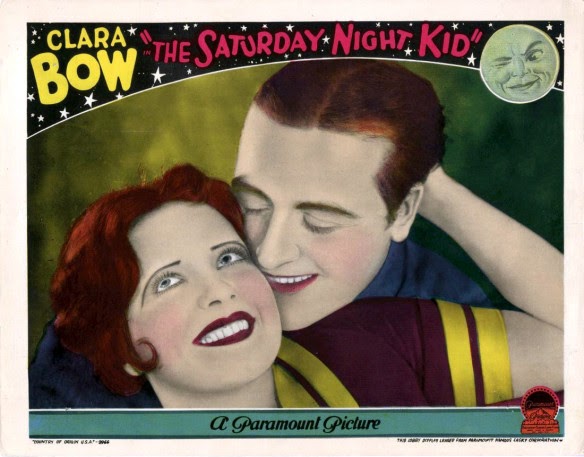 First came The Saturday Night Kid (1929), based on Love ‘Em and Leave ‘Em, a 1926 play by George Abbott and John V.A. Weaver. The play was filmed silent (also in ’26) under its original title (and screened at Cinevent in 2010), with Evelyn Brent and Louise Brooks playing Mame and Janie Walsh, two sisters who work together at a big department store. Mame is the older, more responsible one, forever mother-henning her hedonistic, troublemaking kid sister Janie. For this talkie remake, Clara played the slightly renamed Mayme and Jean Arthur was Janie (though she was in fact five years older than Clara). Janie is a hell-raiser and borderline sociopath, playing the ponies with the store empoyees’ charity fund, losing it, then blaming Mayme for the embezzlement — and even trying to steal Mayme’s boyfriend (James Hall). Clara wasn’t looking her best (she was, just this once, a trifle overweight and a bit frowzy), but the picture was a hit in 1929 and it still plays well; when Mayme finally got fed up and slapped Janie clear across their bedroom, applause rippled through the Cinevent audience.
Next, Kid Boots (1926) was one of those oddities, a silent movie based (albeit loosely) on a Broadway musical comedy produced by Florenz Ziegfeld. Ziegfeld’s star Eddie Cantor made his screen debut here, playing a man hired to flirt with a rich man’s gold-digging wife and give the husband grounds for divorce. At a mountain resort, Eddie hits it off with the swimming instructor — but their romance proceeds awkwardly because every time she sees him he’s wooing somebody else. Since Eddie couldn’t resort to song-and-dance, he was teamed with Clara (as the swimming instructor) for box-office insurance. It was a felicitous pairing. The two got along famously; Eddie helped Clara with her comic timing and she helped him learn how to act for the camera, and their rapport and mutual affection still come through on the screen.
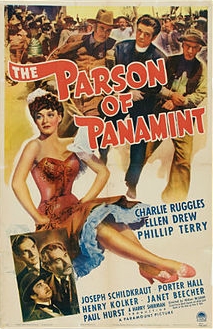 After lunch there was a new wrinkle this year. They called it the Audience Choice Picture: Earlier in the year, on the Cinevent Web site, those of us planning to attend were polled as to which of four titles we’d like to see screened in this slot. I can’t remember what the four choices were, nor which one I voted for, but we wound up with The Parson of Panamint (1941), from a story by Peter B. Kyne. Like Kyne’s perennially popular The Three Godfathers, the story was a parable. Charlie Ruggles (in a change-of-pace straight dramatic role) plays the mayor of the rough-and-tumble mining town of Panamint, California. The mayor goes to the big city of San Francisco to hire a preacher for his town’s new church, and that’s where he finds the Rev. Philip Pharo (Phillip Terry) — not in a church, but taking the mayor’s part in a saloon fight. The Rev. Mr. Pharo accepts the job and rides back with the mayor to his new congregation.
Day 3

Another regular — and eagerly anticipated — feature of Cinevent is the Saturday morning cartoon program, compiled and curated by animation maven Stewart McKissick. This year the bill included a specimen from each of the major cartoon studios of the 1930s through ’50s — Disney, Warner Bros., MGM, Fleischer, UPA, etc. The clear highlight of the morning was MGM’s Magical Maestro (1952) by the great Tex Avery, in which a spurned vaudeville magician wreaks vengeance by disrupting an operatic recital by “the Great Poochini” (as the poster shows, the cartoon is populated by dogs). It’s a wild and zany ride that anticipates (may even have inspired) Chuck Jones’s Duck Amuck over at Warners the following year, and it’s better seen than described.
Fortunately, that can be arranged. Click here to see the cartoon complete from beginning to end — including a few fleeting (and fairly harmless) seconds of non-p.c. ethnic humor. It’s only six-and-a-half minutes, and worth the side trip. I’ll wait till you get back. (NOTE: The cartoon is on a Romanian-language Web site and is preceded by a commercial for one product or another. Look for a white “X” in the top right corner of the frame or the word “Inchide” [“skip”] in the bottom right; click on either of those and it’ll go directly to the cartoon.)
The cartoon program was followed by Houdini (1953), a purported biopic starring a youthful Tony Curtis and then-wife Janet Leigh as the legendary escapologist and his wife Bess. A big hit in 1953, the picture was a mainstay of Saturday afternoon kiddie matinees when I was going to them — I remember seeing it three or four times — and I’ve always had a soft spot for it. There was, of course, a magician and escape artist (born Erik Weisz) who billed himself as Harry Houdini, and his wife Wilhelmina Beatrice was known as Bess; aside from that, the movie is arrant fiction from first frame to last — but it’s as entertaining as it is made-up. Seeing it in Columbus this year — especially right after a whole slew of cartoons — made me feel seven years old again.
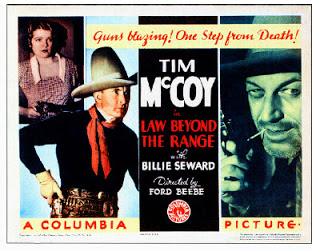 This was followed by Tim McCoy in Law Beyond the Range (1935), an unpretentious and quite entertaining B western from Columbia. Tim McCoy was one of those interesting characters who sort of backed into movies because making movies was fun and he himself was fairly comfortable in front of camera. Born in Saginaw, Michigan, in 1891, he became fascinated with the Wild West as a student in college; he dropped out and resettled in Wyoming, where he became a ranch hand and expert horseman. After serving in World War I (he rose to the rank of colonel and later, in his movie career, was sometimes billed as Col. Tim McCoy), he was appointed adjutant general of the Wyoming National Guard. In that capacity he worked diplomatically and well with Wyoming’s native Arapaho and Shoshone tribes, and in 1922, when Paramount came to Wyoming to film their epic The Covered Wagon, McCoy served as liaison between the company and several hundred Indian extras. That gave him the bug. He resigned his commission and cried “Westward ho!” once again, settling in Hollywood, where he worked steadily through the 1940s, then tapered off into retirement, making his last appearance in Requiem for a Gunfighter in 1965.
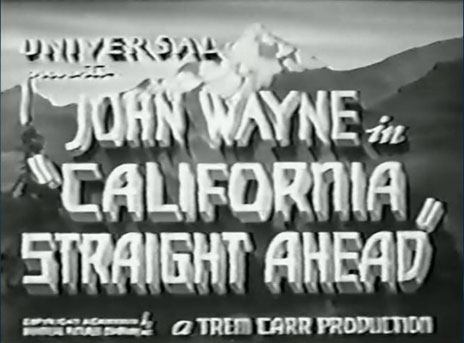 After dinner came of two of the highlights of the whole weekend — both, as it happened, from Universal. First was California Straight Ahead (1937). I here reproduce the title card from the movie’s credits, rather than a poster or lobby card, to make a point: It’s 1937, two years before Stagecoach, and John Wayne is billed above the title. And not in a B western from Monogram or Republic, but in one of six pictures he made at Universal (none of them westerns) before returning to the saddle at Republic. It’s still a B picture, of course; it would take John Ford to promote the Duke out of B’s once and for all. But California Straight Ahead has a better-than-B professional gloss to it; with Universal’s backlot and production infrastructure a few dollars could go a lot farther than they could on some location ranch up in the San Fernando Valley.
In his introduction to the screening, Wayne biographer Scott Eyman told us that Wayne regarded his six-picture foray at Universal as a mistake; it had failed to take him out of the “juvenile ghetto” of Saturday afternoon B westerns, and when it was over he found himself back at Square One in Republic horse operas — without his former momentum and unsure when, or if ever, he could work his way out of them. (He couldn’t know, of course, that his big break was just around the corner.) I quote Scott at length on California Straight Ahead and the Duke’s five other Universal B’s: “This is a good movie; they are all good, solid movies. They’re better, frankly, I think, than the Republic westerns he’d been making, because the technicians are a little bit better, the scripts are a little bit better, and the production schedules a little bit longer, and you can get more of where he’s not just riding and roping and slugging people. He actually gets a chance to do a little acting in these movies. And as you’ll see, he’s getting better and better. By 1937, and finishing up this series of pictures, he’s ready. He’s ready for John Ford, he’s ready for the Big Time.”
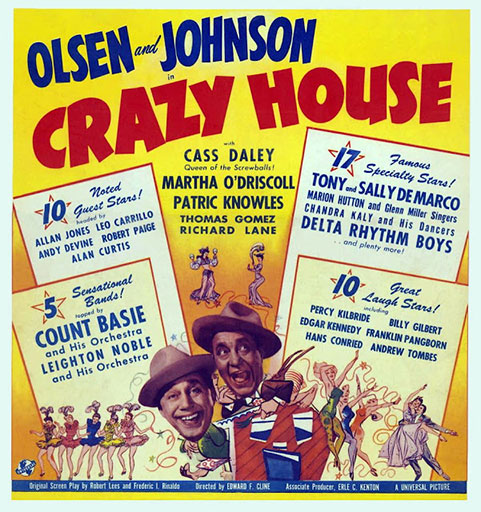 And then came the deluge, again courtesy of Universal Pictures. The title of this onslaught was Crazy House, and the leading inmates of the loony bin were two slap-happy vaudevillians named Ole Olsen and Chic Johnson. How do you describe these two to someone who’s never seen them? In my last post I called them the Monty Python of the 1940s, but the truth is, Olsen and Johnson made Monty Python look like a Sunday afternoon game of whist between Oscar Wilde and James MacNeill Whistler.
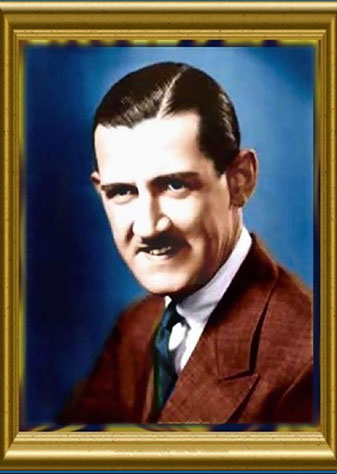 A regular feature at every Cinevent is a program of Charley Chase shorts. If you don’t recognize the name, it’s worth the effort to familiarize yourself. Unlike some other greats of silent comedy (Chaplin, Keaton, Lloyd, Laurel and Hardy), Chase never graduated from shorts to features (though he turned in a delightful supporting performance in Laurel and Hardy’s Sons of the Desert in 1933). Still, his output was prodigious; Cinevent could present a program of five of his shorts (assuming they all survived, which unfortunately they don’t) and go 50 years without repeating one. Cinevent regulars and others familiar with him may skip the next two paragraphs.
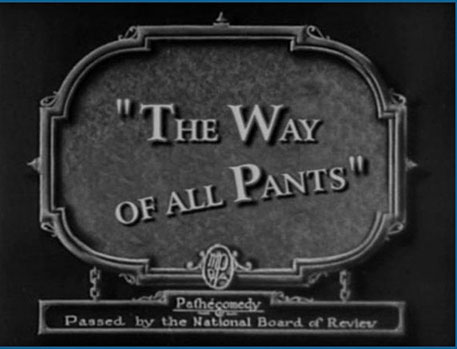 That’s the quick-and-dirty version of Chase’s career, and some day I may post on him in more detail. For now, suffice it to say that Cinevent is doing its share to keep Chase’s name alive (as Richard Roberts aptly put it, he’s not so much neglected as taken for granted) with these regular annual tributes. This year the Cinevent audience got a real scoop: in addition to the shorts Powder and Smoke, Stolen Goods, Too Many Mammas (all 1924), and Looking for Sally (’25), the Chase program included The Way of All Pants (‘27), complete for the first time in a couple of generations. A truncated version of Pants has survived in the Robert Youngson compilation The Further Perils of Laurel and Hardy (’67), but the complete two-reeler was long believed lost. A British release print was recently discovered, with some damage due to age and decomposition; it was digitally restored, then transferred back to 16mm film for screening in Columbus. The whole thing was touch-and-go right down to the wire: the print wasn’t completed until just a few weeks beforehand; it wasn’t even mentioned in the program book because they weren’t sure it would be ready in time to be “re-premiered” at Cinevent.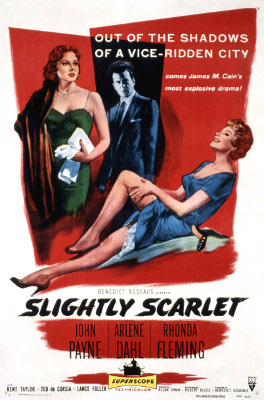

The second day of Cinevent began with a departure from custom and a real curiosity: Die Reise nach Tilsit (The Trip to Tilsit), a 1939 German film. That’s the departure; Cinevent has heretofore screened almost exclusively (if not entirely so) English-language movies. The curiosity is that The Trip to Tilsit is based on the same Hermann Sudermann story that inspired F.W. Murnau’s Sunrise (1927): a cheating husband plots to murder his wife and make it look like an accident, but changes his mind when the couple visit the big city and rekindle their love for each other. The compare-and-contrast lends The Trip to Tilsit a fascination it doesn’t have all by itself; it’s well-crafted and well-acted, especially by Kristina Soderbaum (wife of director Veit Harlan) as the wronged wife. But Sunrise is one of the supremely transcendent visual poems of movie history, a movie that, once seen, is never forgotten; The Trip to Tilsit, well-made as it is, is just a mundane Teutonic soap opera. Historian and Cinevent regular Richard M. Roberts dismissed it as “the Nazi Sunrise“, and that just about nails it. (Director Harlan was an ardent Nazi who joined the party in 1933 and prospered during the ’30s turning out propaganda for Josef Goebbels, culminating in the viciously anti-Semitic Jew Suss in 1940.)
One more point of interest about The Trip to Tilsit. Playing the philandering husband (and also good) was a Dutch actor named Hein van der Niet, billed as Frits von Dongen. Unlike his director, van der Niet fled the Nazis at the outbreak of World War II and wound up in Hollywood working as a freelance actor under the name Philip Dorn. He was Hal Wallis’s first choice to play Victor Laszlo in Casablanca — personally, I say it’s a pity he didn’t — but he had already signed for Random Harvest at MGM and the scheduling wouldn’t work. No telling how Dorn’s career might have gone if he had done Casablanca instead of Paul Henreid, but as it was he still managed to rack up a pretty good career — Ziegfeld Girl, Tarzan’s Secret Treasure, Calling Dr. Gillespie, Passage to Marseilles and The Fighting Kentuckian, among others (he was especially fine as Irene Dunne’s husband in I Remember Mama) — before ill-health forced his retirement in 1955. He died in Los Angeles 20 years later, age 73.
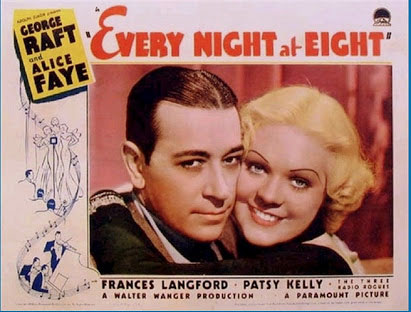 After “the Nazi Sunrise” it was back to Hollywood and the English language for Every Night at Eight (1935), a well-above-average musical from Paramount. George Raft and Alice Faye (on loan from 20th Century Fox) were top-billed, but the prime role went to radio singer Frances Langford, in her feature debut. Alice and Frances played two of three pals (the third was Patsy Kelly) seeking and finding radio stardom with bandleader Raft. Raoul Walsh, better known for movies like High Sierra, They Died With Their Boots On and White Heat, directed at a lively pace, and there was a bunch of first-rate songs, two of which are still with us: “I Feel a Song Comin’ On” and “I’m in the Mood for Love”.
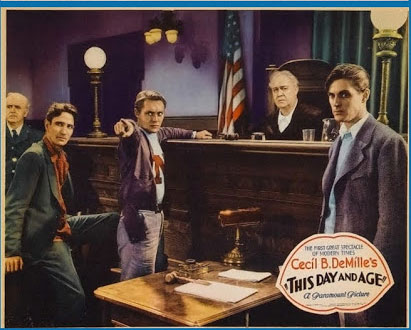 …And then came Cecil B. DeMille’s This Day and Age (1933). Talk about a curiosity! Richard Cromwell plays the leader of a group of high school students who get appointed to ceremonial positions in city government — judge, chief of police, district attorney, etc. — as a way to give them an on-the-job view of how the grownups run things. When a friend of theirs is murdered by a local gangster (Charles Bickford) who gets off scot-free thanks to an oily high-priced attorney, the kids take over the government for real, kidnapping the gangster and torturing a confession out of him (“We haven’t got time for rules of evidence!”), after which the adults see the error of their ways. The trauma of the Great Depression spawned more than one movie like this — check out a little oddity called Gabriel Over the White House (’33) sometime — movies where audiences could vent their frustrtion with “the System” by vicariously experiencing things they’d never get away with (or seriously contemplate) in real life.