↓
 
  • Home
  • About the Author
  • Series
    • Carman Barnes: Five-Minute Movie Star
    • Crazy and Crazier
    • Films of Henry Hathaway
    • History of Cinerama: “Cinerama-Rama!”
    • Luck of the Irish: Darby O’Gill and the Little People
    • Marcel Delgado
    • Minority Opinion: The Magnificent Ambersons
    • Movie Souvenir Playing Cards
    • Shirley Temple Revisited: “Bright Eyes, 1928-2014”
    • The Bard of Burbank
    • The Fog of Lost London
    • The Museum That Never Was
    • William Wyler
  • Links and Resources
  • Jim’s Fiction
    • Glamour Boys
    • Items from the Scrapbook of Cosmo Brown
    • Sensible Christmas Wish, The
  • Contact

Jim Lane's Cinedrome

Classic Hollywood

Author Archives: Jim Lane

Post navigation

← Older posts
Newer posts →

Andrew Sarris, 1928-2012

Jim Lane's Cinedrome Posted on June 23, 2012 by Jim LaneJuly 16, 2016

I was saddened to learn of the death of movie critic Andrew Sarris, who passed away Wednesday at the age of 83. I didn’t always concur with his judgments, but that sort of thing is overrated. What makes a critic valuable isn’t how often you agree with him (or her), but how clearly his passion for the art and craft of movies comes through in his writing, and whether he enriches your understanding with his own perceptions and observations. On that score, Sarris was one of the best.

Sarris’s great adversary Pauline Kael, in her 1963 essay “Circles and Squares”, which inaugurated her and Sarris’s longstanding feud, wrote: “The role of the critic is to help people see what is in the work, what is in it that shouldn’t be, what is not in it that could be. He is a good critic if he helps people understand more about the work than they could see for themselves; he is a great critic, if by his understanding and feeling for the work, by his passion, he can excite people so that they want to experience more of the art that is there, waiting to be seized. He is not necessarily a bad critic if he makes errors in judgment. (Infallible taste is inconceivable; what could it be measured against?) He is a bad critic if he does not awaken the curiosity, enlarge the interests and understanding of his audience. The art of the critic is to transmit his knowledge of and enthusiasm for art to others.” By this measure, both Kael and Sarris, whatever their differences, were great critics. (About their feud, Sarris once graciously said, “We made each other. We established a dialectic.” I seem to recall that Kael once expressed similar sentiments about him, but I’ve been unable to confirm this.) (UPDATE: Oh wait, I can too: Kael biographer Brian Kellow tells us that she was “often quick to point out that she thought Sarris had a lively intelligence”.)

Kael and Sarris had another thing in common: They both came of age and found their voices at a time when movies were an explosively vibrant art. I’ve been reviewing movies off and on since 1967, and steadily since 1989. When people ask me what is the greatest change I’ve seen in that time, I tell them: It’s harder now. In the 1960s and ’70s, even the bad movies were worth writing about; nowadays, even the good movies, there’s just not all that much to say about them. Andrew Sarris, like Kael, was one of a dwindling corps who wrote often and well at a time when there was one helluva lot to be said.

Pauline Kael died in 2001. By that time, we’d already lost Otis Ferguson, Graham Greene, James Agee, Dwight Macdonald, Penelope Gilliatt, Vincent Canby — the list goes on. Sarris’s death deprives us of yet another critical voice that arose amid the ferment of those heady days, and one that uniquely championed the vigor and vitality of American movies against the “higher” forms of Cinemah coming from other countries.

Requiescat in pace.

.

Posted in Blog Entries

Please Stay Tuned

Jim Lane's Cinedrome Posted on June 9, 2012 by Jim LaneJuly 16, 2016


Deepest apologies to my patient readers for making them wait so long between posts. To tell the truth, my six-part series on The Magnificent Ambersons turned out to be a more exhausting effort than I thought it would be when I embarked on it, and my batteries have been slower to recharge than I expected. I do have some things in the hopper, though, to go up once they’ve ripened, so if you’ll kindly bear with me, I’ll try to make them worth the wait.

In the meantime, something else has cropped up that may delay me a little longer: Warner Home Video has finally delivered the long-promised Maverick: The Complete First Season, and I’m afraid just about everything must go on a back burner while I reacquaint myself with one of the Best. TV Series. Ever. Certainly the best western series — pace Gunsmoke, Have Gun Will Travel etc. Not to mention the show that made James Garner an overnight sensation. It’s available here from Amazon, and I think everybody in America should buy it — if only to make sure that Warner stays with it and brings out subsequent seasons for me to add to my collection.

If plugging Maverick seems like an almighty stretch for a blog supposedly dedicated to classic Hollywood — it’s not. Maverick hails from a time (the mid-to-late 1950s) when Warner Bros. all but dominated prime-time television, even as it breathed the last gasps of the dying studio system. Here — as in Cheyenne, Sugarfoot, Jim Bowie, 77 Sunset Strip, Hawaiian Eye, Surfside 6 and others — was the last flowering of the legendary Warner Bros. stock company, with Garner and co-star Jack Kelly (as Bret Maverick’s brother Bart) supported by a wonderful mix of seasoned veterans (Edmund Lowe, John Litel, Jane Darwell, Esther Dale, Stanley Andrews, Buddy Ebsen, Patric Knowles, Morris Ankrum) and rising young comers (Mike Connors, Clint Eastwood, Troy Donahue, Edd “Kookie” Byrnes, Efrem Zimbalist Jr., Roger Moore). The well-written stories were often recycled from Warners’ B-westerns of the ’30s and ’40s (average running time 65 minutes, easy to trim down for an hour time slot minus commercials), and production values were enhanced by frequent trips to the Warner Bros. library of stock footage (that spectacular saloon brawl from 1939’s Dodge City crops up time and time again).

Think of these episodes as B-westerns in the best sense — economical, densely plotted, crisply directed, well-cast and -acted — only delivered to your TV instead of to your neighborhood theater. Which, come to think of it, is where most of Golden Age Hollywood is playing these days anyway. Remember the name: Maverick. A legend of the West.
.

Posted in Blog Entries

Wings, Again

Jim Lane's Cinedrome Posted on May 4, 2012 by Jim LaneJuly 16, 2016

As a postscript to my last entry here at Cinedrome, I’ve just learned that Cinemark Holdings, Inc. is presenting one-night- only screenings of Wings this month as part of their Reel Classics series. There were two of them scheduled, but the first one (on May 2) was over before I knew about it. That leaves one more, on Wednesday, May 16. Go here on the Cinemark Web site and click on the Wings/Reel Classics box at the bottom of the page to see if there’s a participating Cinemark theater near you. If there is, you’ll find it well worth your while.

Based in Plano, TX, Cinemark has theaters all over the country, though not all of them are participating in this Reel Classics series (upcoming titles include Citizen Kane, The Searchers, North by Northwest and Cabaret); other chains under the Cinemark umbrella include Century, CineArts and Tinseltown theaters.

The screenings, of course, will be the brilliant Paramount restoration I wrote about last time; kudos to Paramount for doing it right and standing behind their product to the extent of furnishing these big-screen showings. If all extant silent pictures got the same loving care, we’d have an embarrassment of riches on our hands.

I plan to catch the screening here — if only to see how many people show up (the attendance at Casablanca in March was quite impressive — but of course, that was Casablanca). I may be there all by myself, for all I know — but if I’m not, those other folks can hardly imagine the treat they have in store.

Posted in Blog Entries

Silent Weekends

Jim Lane's Cinedrome Posted on April 23, 2012 by Jim LaneNovember 16, 2022

I recently spent two consecutive Saturdays in a sort of time machine, living the silent movie experience of 1927 — what seemed back then to be its culmination, but was in fact a final blaze of glory before the whole structure collapsed under the onslaught of talking pictures. The first Saturday (on March 31) was a once-in-a-lifetime experience I never expect to repeat, but the second (on April 7) was one I can recreate for myself any time I want — and so can you.

First, on March 31, there was this:


Seeing Abel Gance’s Napoleon as it was meant to be seen — with a live symphonic accompaniment and its climactic three-panel “Polyvision” sequence, including this Tricolor triptych — truly is a once-in-a-lifetime thing. I’ve been lucky; I’ve seen it three times. The first time was Bastille Day (July 14) 1981, when just about everybody who was anybody in Hollywood — plus a hefty contingent of nobodies like me — crammed the Shrine Auditorium in Los Angeles to see Gance’s masterpiece and to hear Francis Ford Coppola’s father Carmine conduct his own score. That engagement was such a thundering triumph that Napoleon and Coppola père returned to the Shrine for nine days in December and January ’82, and I saw it again.
 
But this third time topped them both, and it came my way courtesy of the San Francisco Silent Film Festival (SFSFF). The movie I saw at Oakland’s Paramount Theatre was an hour and 45 minutes longer than the one I saw at the Shrine in 1981 and ’82. Some of the extra time was additional footage, some the result of a proper running speed of 20 frames per second (the Shrine speed had been 24 fps).
 
The great Kevin Brownlow — on top of everything else he’s done — has made the restoration of Gance’s picture a lifelong project, ever since he first bought two 9.5mm reels as a teenager in the 1950s. His efforts have been tireless and positively superhuman. In his 1983 book on the subject he lists no fewer than 19 different versions of Napoleon, beginning with its April 1927 premiere at the Paris Opera (4 hours 5 minutes) and Gance’s so-called “definitive version” (9 hours 20 minutes) shown only twice the following month — through various re-edits and reissues, right down to Brownlow’s own 1983 reconstruction for the Cinematheque Francaise (5 hours 13 minutes). But Brownlow didn’t stop there; additional footage has continued to surface from time to time in the nearly 30 years since his book. The version screened in Oakland was assembled by Brownlow and Patrick Stanbury in 2000 for the British Film Institute and has never been shown outside Europe; these four screenings were the first in the U.S., and no others are contemplated. With the expense and time involved in hiring and rehearsing a live orchestra (to say nothing of, in the SFSFF’s case, bringing composer Carl Davis over to conduct the score in person), plus the technical demands of three synchronized projectors, Napoleon is insanely expensive to present. The San Francisco Festival’s efforts in this regard were heroic to the point of foolhardiness: it cost more than their entire budget for a normal year, and even if they sold every one of the Paramount’s 3,100 seats (at $40-150 a pop), they would only break even. (They sold out, sure enough, at the screening I saw; I can’t speak for the other three. I stuffed some extra cash in the Festival’s donation jar in the lobby, saying, “It’s a noble thing you people are doing, and I know you’re taking a bath on it.” The attendant smiled and shrugged: “It’s the mission of the festival.”)

Well, God bless ’em for it.  

Gance regarded Napoleon as a tragic hero, and he planned a biography in six installments that would take his protagonist from his early revolutionary fervor and triumph through growing tyranny and megalomania to final downfall. But the best-laid plans, you know: Gance blew his budget for all six pictures on the first one, and the rest were never made. Probably just as well in the long run; it makes it possible for the one he did make to end on an exultant note, with the conquest — oops! “revolutionary liberation” — of Italy. But it matters little whether or not you accept Gance’s historical analysis (personally, I don’t; I think Bonaparte was pretty much a Megalomaniac in Waiting from the word go, biding his time while the thugs and jackals of the Reign of Terror lopped each other’s heads off); Napoleon is still a sensual and emotional feast that makes the word “movie” sound too puny to contain it. Seeing it the way we saw it in Oakland was a rare privilege, and I’m telling you right now: If you ever hear of this picture coming to anyplace within a thousand miles of you, do not let this golden opportunity slip by, and do not imagine that it will ever come again. Hop a plane, book a hotel, rent a car, do whatever it takes.

UPDATE 11/16/2022: When I published this post in 2012, I closed this half of the post with an embedded YouTube clip of the Napoleon trailer prepared for the SFSFF. For reasons that have never been clearly explained to me, I’m no longer able to embed YouTube videos, and the link I had has gone dead — even though that trailer is still here on YouTube. For good measure, there’s also this trailer advertising Napoleon‘s release on DVD and Blu-ray (alas, only in Europe Region 2, incompatible with North American players). I direct your attention to those trailers. Whichever one you watch, be sure to take it full-screen; it’ll give you (just barely) an inkling.


*                         *                         *

 
Moving from the sublime to the merely first-rate, I come to my second time-machine excursion to 1927, on April 7:


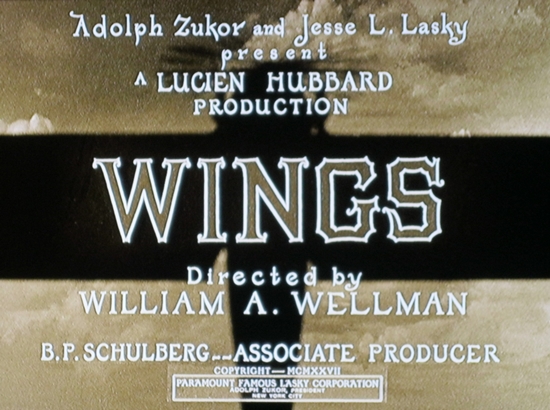
My sister-in-law mentioned a while back that she was embarking on a project to see all the Oscar-winners for best picture that she hadn’t managed to catch up with over the years. First on her list, naturally enough, was Wings — the first (and until this year the only) silent movie to win the Oscar for best picture.

(Strictly speaking, that’s not exactly true. There was no actual “best picture” category that first year; what Wings won was “best production”. There was also “artistic quality of production”, which went to F.W. Murnau’s Sunrise. So in a sense you could say that that year — for the only time — there were really two best pictures. Frankly, I think this production/artistic-quality-of-production dichotomy might be worth bringing back.)

Anyhow, back to my sister-in-law’s see-all-the-best-pictures project. It so happened that I had just gotten the new Blu-ray restoration of Wings and had been looking for an excuse to host a screening of it. I urged her not to settle for Wings from Netflix. I learned last year at the Kansas Silent Film Festival that to see Wings on home video is one thing, but to see it projected on a large screen is to understand at last why it won the Oscar (something it has in common with both Lawrence of Arabia and Oliver!). I suggested she wait until I could screen it for her and my brother, she agreed, and the date we settled on was April 7.

I would venture to guess that in the transfer to home video, no silent picture — perhaps no picture, period — has ever been as lovingly and carefully treated as Wings; Paramount Home Video can be as proud of the transfer as they are of the picture itself, for both are justified.
 

Leonard Maltin’s Movie Guide gives Wings two-and-a-half stars, saying: “One of the most famous silent films is, alas, not one of the best, despite rose-colored memories.” I say it’s Leonard who needs a memory check; Wings is a whopping piece of entertainment, and it set the template for Oscar-winning best pictures, with only rare (and usually regrettable) exceptions, from that day to this: well-crafted crowd-pleasers rather than groundbreaking works of art.

While it’s no work of art, Wings is certainly a crowd-pleaser, and extraordinarily well-crafted. The craftsmanship is evident even in straight black-and-white silent prints like the one I saw in Topeka last year, but on Paramount’s Blu-ray it shines like a beacon. The source material was a dupe negative in the Paramount vault that had nevertheless suffered significant deterioration in 85 years and required a frame-by-frame digital repair. The result is…well, in the supplement documentary, Tom Burton of Technicolor Corp. says, “It’ll never be like Day One in 1927 seeing this release, but it cleaned up a great deal.” Indeed it did; Wings looks like it was shot last week, an impression enhanced by the surprisingly frequent use of telephoto and even zoom lenses.
 
Almost as important as that dupe negative, Paramount also had the original documentation for how the picture was to be tinted — both stock-tinting (amber, violet, sepia etc.) and the Handschiegel process (shown here), which added color to highlight flames, machine-gunfire and explosions; the documents specified exactly the shades to be used and the frames where every tint was to begin and end.
 
Paramount also had access to a single copy in the Library of Congress (perhaps the only copy in existence) of J.S. Zamecnik’s original score (well, substantially original — it incorporates numerous popular tunes of the World War I era, and the music for the flying scenes was cribbed from Felix Mendelssohn’s incidental score for A Midsummer Night’s Dream). Zamecnik was a usually anonymous studio musician who did yeoman work assembling Wings‘s music, particularly his main theme, which serves as a wistful love theme, a stirring march, or a soaring anthem, according to the needs of individual scenes.
 
Oscar-winner Ben Burtt recreated Wings‘s sound effects. No, that’s not a misprint, and on the Blu-ray the sound effects aren’t an anachronism. Wings was state-of-the-art in 1927 (although the art was changing faster than anybody realized at the time), and it originally played with a soundtrack for sound effects — explosions, machine guns, auto and airplane engines, things like that (music was nonstop and performed live, and of course there was no spoken dialogue). The original track still existed as a guide to when there should be sound and what would remain silent, and Burtt and his associate Dustin Cawood worked with the earliest sound libraries from the 1930s to keep the sounds as authentic as possible. (Even so, the Blu-ray’s 7.1 surround audio allowed Burtt to indulge in effects the sound technicians of 1927 could only dream of — planes roar up behind you and pass overhead before swooping into view on the screen.)

Wings is famous, even among people who’ve never seen it, for its scenes of aerial combat, and rightly so — they’re still breathtaking after 85 years and countless fighter-pilot movies, from Hell’s Angels to Top Gun. Wings invented the genre, only 24 years after Kitty Hawk, using aircraft that were little more than motorized kites. No process photography, certainly no CGI in those days; there was nothing for it but to strap the camera to a plane and get up there and fly around. (And remember, of all the people who saw Wings on its first run, probably not one in a thousand had ever been up in a plane; if these scenes are amazing now, how must they have looked in 1927?)
 
But even on the ground, Wings has some of the most spectacular battle scenes ever filmed, climaxing in director William Wellman’s recreation of the battle of St. Mihiel, the first major American offensive of the war (and one in which the U.S. Army Air Service played a significant role). With 19 cameras posted in trenches, in shell holes, and on towers all over the five-acre location, it’s a sight to see — in fact, I’ve seen some of this footage (uncredited) in a number of documentaries about World War I, and you probably have too. 
 
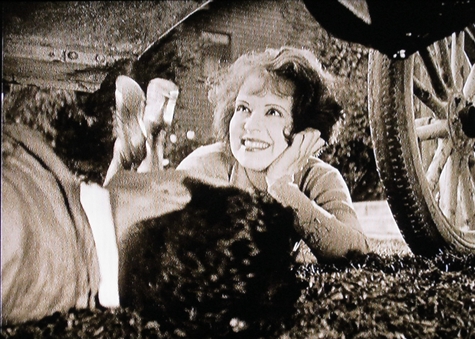
Last but absolutely not least, Wings has this young lady. Let me say this as plainly as I can: There was never a more charming and delightful movie star than Clara Bow. Plenty who were as delightful, certainly, but none more so. Ever. (If you don’t know Clara’s work, Mantrap [1926] and It [’27] are good places to start. For that matter, so is Wings.) She was the hottest star in Hollywood in 1927 (in every sense of the word), so naturally she’s top-billed in Wings, but it’s really a supporting role, almost a cameo; she plays the adoring, neglected girl next door who follows Buddy Rogers to France as a member of the Women’s Motor Corps. When Buddy’s leave in Paris is cancelled but he’s too drunk to respond, Clara goes to fetch him, only to find he’s too drunk even to recognize her, and she must dress as the flapper her fans have come to expect, all to lure him away from a French demimondaine with designs on him. (This scene also has Wellman’s most amazing non-combat shot, as the camera glides across table after table at the Folies Bergere, each with its own little drama going on: an angry woman tossing her drink in her lover’s face, a matron slipping cash to her gigolo, an adulterous couple nervously looking over their shoulders, even a pair of love-struck lesbians!)
 
In Silent Stars Jeanine Basinger describes Wings as “an epic war movie enclosing a small Clara Bow movie”, and that sums it up neatly. The structure of the story is Hollywood showmanship at its best; without interrupting the war story or making Bow look like a cornball play for the box-office, Paramount created a picture that absolutely everyone who went to movies would want to see.
 
They still would, and Leonard Maltin really needs to take another look. The review in his book dates back at least as far as the 1980 edition; I’ll bet it was based on watching a VHS tape on a 19-inch TV (Leonard himself may not even have written it). As Ben Burtt says, “I can’t imagine that audiences today would not get excited by seeing Wings.” But as I told my sister-in-law, you have to see it as large as possible; the screen in my home theater is 70 inches wide, and that’s really the bare minimum you need to appreciate it fully.  
 
My screening that night certainly made my point. As the music swelled to its crescendo, the final end title faded out, and I brought up the lights, I said: “And that’s why it won the Oscar for best picture.” “No kidding!” somebody said.
 
For my brother, whose only experience of a silent movie had been an 8mm Blackhawk print of Laurel and Hardy’s Two Tars 46 years ago, Wings was a revelation. He told me, “You know, Jim, I thought this was just going to be a sort of archaeology lesson. I didn’t expect it to be…you know…a really good movie.” And the next day at an Easter backyard barbecue, I heard my sister-in-law telling her adult children about it. She too had half-expected to be impatient and a little bored with a silent movie, but she had an interesting take on it now: “After the first few minutes,” she said, “it simply never occurs to you that they’re not speaking.”


*                         *                         *

 
I have no doubt that I’ve seen Abel Gance’s Napoleon for the last time, and I’m completely fine with that; as I said, I’m lucky to have seen it as many times as I have. But Wings, thanks to Paramount Home Video, a 70-inch screen and an Epson Powerlite 6100 projector, is at my beck and call anytime, almost exactly as the audience saw it at New York’s Criterion Theatre on August 12, 1927.*
 
And as the saying goes, that ain’t chopped liver.
 
____________________
*Almost: The battle scenes were originally shown in widescreen “Magnascope” — a surprising link with Napoleon — but none of that footage has survived.
 
Posted in Blog Entries

Minority Opinion: The Magnificent Ambersons, Part 6

Jim Lane's Cinedrome Posted on March 29, 2012 by Jim LaneDecember 3, 2024
I worked with Robert Wise once. In 1986 I played a small role in Wisdom, on which he served as executive producer and all-round good shepherd for first-time writer-director Emilio Estevez. My scene was a small one, only about 45 seconds on screen, but it meant two twelve-hour days on the set. As I reported for work on my first day, Wise came up to me and introduced himself (as if it were necessary!). There was something I had thought and said about  him more than once in the past, but now, to my amazement, I actually had the chance to say it to him in person: “I have to tell you, Mr. Wise, I think you’re the greatest film editor who ever picked up a pair of scissors.”
 
He looked pleased and surprised in equal measure. “What makes you say that, in particular?” 
 
“In particular,” I said, “The Magnificent Ambersons. You might have ruined that movie, but instead you saved it.”
 
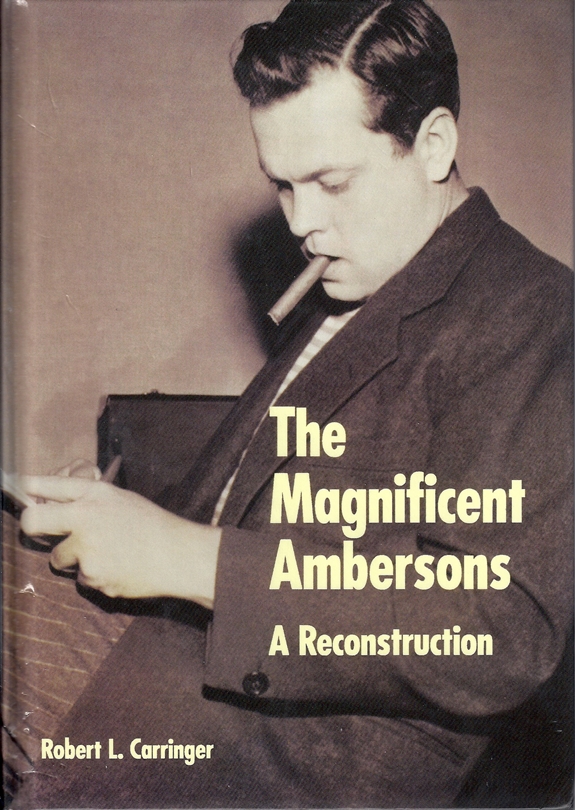
I said this to Robert Wise before I had ever seen Robert L. Carringer’s reconstruction, or even read Booth Tarkington’s novel. Now that I’ve done both, I haven’t changed my mind. But it must be said, mine is not the generally held view on the matter (that’s where the “Minority Opinion” title to these posts comes in). To most critics and historians, Robert Wise is the chief culprit in the mutilation of The Magnificent Ambersons — a judgment planted, watered and grudge-nursed for over 40 years by Orson Welles himself. Because make no mistake, whenever Welles said “they” destroyed the picture, he was talking about one single individual.
 
“They destroyed Ambersons,” Welles said late in life, “and the picture itself destroyed me; I didn’t get a job as a director for years afterwards.” That’s dramatic, but probably not true. Regardless of what Charles Koerner and his minions at RKO might have thought of Ambersons, or of the prospect of ever hiring Welles again, nobody could deny that with Ambersons, there was a picture there. If anything destroyed Orson Welles in Hollywood, it was It’s All True. With that one, he came back from spending six months and half a million dollars in South America with almost nothing to show for it — miles and miles of footage, but no picture.
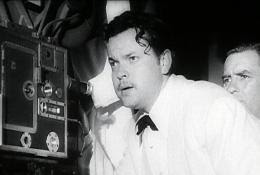
 
Nowadays, in hindsight, with World War II safely won and South America no longer leaning toward the U.S.’s Axis foes (beyond playing host to the occasional Nazi fugitive), we can see that flying down to Rio to make It’s All True was probably the biggest mistake Orson Welles ever made; it cut short (like a brick wall) the momentum of his rocketing career, and he never really got it rolling again. Welles no doubt came to see it that way himself, judging from the way he distanced himself from the decision. “I was sent to South America by Nelson Rockefeller and Jock Whitney,” he said. “I was told that it was my patriotic duty to go and spend a million dollars shooting the Carnival in Rio.” Sounds almost as if he was drafted, doesn’t it? Uncle Sam walked up out of the blue, poked a finger in his chest and growled “I want you!” Actually, when Whitney and Rockefeller made their proposal, Welles took little persuading; he deliberated barely 24 hours before agreeing to go.
 
And nobody ever had to tell Orson Welles to spend a million dollars — he could do that all on his own. In fact, the Office of Inter-American Affairs only underwrote It’s All True to a total of $300,000; RKO was on the hook for anything over that. (Welles made it clear that this was to be an RKO production with assistance from the U.S. government, not vice versa.) It was when the studio’s budget projections forecast an eventual cost over $1 million that Charles Koerner finally pulled the plug on It’s All True.
 
Welles’s mistake wasn’t in letting Whitney and Rockefeller talk him into something against his better judgment — in his best judgment, and everybody else’s, it seemed like a great idea at the time. His mistake was in thinking he could do anything: He could make an ambitious documentary about South America even though neither he nor anyone on his crew had ever made one before (he didn’t even take any newsreel cameramen along); he could leave The Magnificent Ambersons and Journey into Fear behind while still controlling what became of them — when Ambersons had yet to take final shape, and Journey hadn’t even finished shooting. (In fairness, Welles couldn’t have foreseen that Wise wouldn’t be allowed to join him in Rio — but that one glitch was all it took to undo his whole plan. Besides, whether it would have made any difference to have Wise in Rio rather than Hollywood is another question; it might have made things worse.) The bitter lesson in store for Welles was this: It was one thing to dash around Manhattan from stage rehearsals to various radio gigs a mile or so apart, or to shuttle from one set to another at RKO. But to edit a troubled picture from 6,000 miles away with makeshift equipment and only a telephone, telegraph and shortwave radio to help — that was something entirely else.
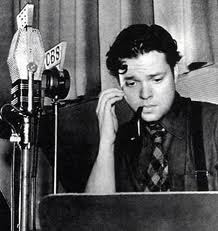
 
Orson Welles was, let’s admit it, a man of prodigious, even titanic gifts — the kind of artist who comes along not once in a lifetime, or once in a century, but once in history. Three major media of the first half of the 20th century — radio, the stage and motion pictures — had never seen anything like him. He was a unique phenomenon, like Joan of Arc (meaning no other comparisons, of course). But he wasn’t omniscient, omnipotent or infallible. If I seem to be hard on him in these posts, it’s because I think he blundered badly on both It’s All True and The Magnificent Ambersons, and because I think that in his public remarks about Robert Wise he was often shabby and small; Wise — at least in his conversations with me — showed far more sympathy for Welles’s situation than Welles ever showed for his. (Welles, for his part, called Wise an idiot.) The fact is, Welles walked into his situation with his eyes wide open; Wise’s situation was thrust upon him willy-nilly by Orson Welles.
 

In 1984, complaining to Barbara Leaming about Joseph Cotten’s “Judas” letter, Welles said Cotten had become “an active collaborator with Wise, and the janitor of RKO, and whoever else was busy screwing it up.” This is frankly disgraceful. For the record, the men who were wrestling with The Magnificent Ambersons — while Welles was in Rio lecturing cultural groups, hatching grandiose plans for It’s All True, tossing furniture out his apartment window, and screwing chorus girls — wrestling with Ambersons were Robert Wise, whose authority was not to be questioned (until Welles chose to question it); Jack Moss, who had Welles’s full confidence (until he didn’t); and Joseph Cotten, who was probably Welles’s best friend (until, in Welles’s eyes, he wasn’t). 

In This Is Orson Welles Peter Bogdanovich expands on that “janitor at RKO” crack. He asserts that RKO “approached several directors — among them William Wyler” — to recut Ambersons, but all refused out of respect for Welles. (Prof. Carringer’s history of the editing makes no mention of this.) Bogdanovich also says that producer Bryan Foy of Warner Bros.’ B-picture unit was called in. Foy’s verdict: “Too fuckin’ long. Ya gotta take out forty minutes.” Asked what to cut, he said to “just throw all the footage up in the air and grab everything but forty minutes — it don’t matter what the fuck you cut. Just lose forty minutes.” Bogdanovich cites Jack Moss as the source of this story, but I’ve been unable to find it corroborated anywhere else. I tend to suspect that the real source was Welles himself, as in “Jack Moss told me…” (If I’m mistaken about this, I’ll be happy to post an update when I know better.)

Easier to corroborate is David O. Selznick’s reaction to the editing of Ambersons. Selznick biographer David Thomson says Selznick, an admirer of Welles who had loaned the services of Stanley Cortez to photograph the picture, tried to have “the original version” deposited at the Museum of Modern Art. A worthy suggestion, Mr. Selznick, but just what is the original version? The 132-minute answer print that Wise prepared after Miami and shipped to Welles in Rio? The 110-minute version prepared at Welles’s instruction and previewed in Pomona? It couldn’t be the 148-minute version Welles mentioned to Bogdanovich because Ambersons never existed at that length. 

This brings us to the central fallacy in the Magnificent Ambersons legend: the idea that Welles created a masterpiece that was slashed and mangled afterwards to what we have now. In fact, there really was no “original version” of Ambersons because Welles never finished the picture. He left for Brazil while Ambersons was in its final stages — before music and visual effects had been added, transitions (fades, dissolves, etc.) put in place, even before the order of scenes had been settled. Then, from Rio, before even seeing the 132-minute version, Welles ordered extensive changes: making the “big cut” (everything from Eugene’s letter to Isabel’s death) and removing the “Indian legend” scene and George’s auto accident; this trimmed a total of 22 minutes. If anything, that should be considered Welles’s “original version”, even though he never actually saw it, since it was ordered by him before the first preview (and before any studio panic had set in). When Orson Welles went to Rio, The Magnificent Ambersons was an unfinished work. Welles’s partisans cry that Ambersons was taken out of his hands, and they’re right. What they will never say is that he abandoned it — but in effect (if not in intention) that’s exactly what happened.

In “Oedipus in Indianapolis” Robert L. Carringer theorizes that leaving for Rio with Ambersons incomplete was Welles’s way of distancing himself from it, a process that began with his choosing not to play George Minafer himself. This distancing, Prof. Carringer thinks, rose out of Welles’s unresolved feelings about his parents — his imperious mother and feckless father — and his discomfort with the Oedipal subtext in Tarkington’s novel. Prof. Carringer’s theory is forcefully argued, but I don’t find it entirely persuasive; if that’s how Welles felt about it, why would he have filmed Ambersons at all, or done it on the radio (when he did play George) in the first place? 
I think it may have been something simpler: that Orson Welles, for all his mastery of moviemaking so manifest in Citizen Kane, didn’t fully grasp the nuances of the editing process — not as early as 1942, anyhow. Certainly his first edits from Rio must have looked capricious and arbitrary, so much so that Wise and Moss immediately reversed them after they played so badly in Pomona. Then when Welles doubled down on the “big cut”, wanted to eliminate the end of the Amberson ball and the iris-out in the snow scene, and capped it all with a bizarre idea for a cheery curtain call “to leave audience happy”, how could it not look as if Welles had lost his train of thought on Ambersons, or simply didn’t understand how these changes would play?
 

Simon Callow is firmly in the mutilation-and-destruction camp regarding The Magnificent Ambersons (he calls Wise, Moss and George Schaefer “partners in crime”), but even he admits that there was never a time when anyone connected with it could honestly say, “It’s perfect; don’t change a thing.” Welles’s new contract entitled him to edit the picture through its first preview, which had been a disaster. After that came the changes — and like it or not, the farther Wise and Moss took the picture from Welles’s last edit, the better the previews were received. Callow relates an unconfirmed anecdote about pages and pages of Welles’s telegrams going straight into the wastebasket, the phone from Brazil ringing on and on with no one bothering to answer. Enough has survived in RKO archives to suggest that sort of thing wasn’t common, but it does seem that Welles’s demands were looking more irrelevant and less helpful to those back home. Moss later said, “If only Orson could communicate his genius by telephone”; Robert Wise expressed similar sentiments to me. He and Moss and Mark Robson wanted to follow Welles’s wishes, but the bottom line was Orson wasn’t there — in Pomona or in Hollywood.

Robert Wise was under a threefold mandate: (1) from himself, preserve the spirit (and as much of the letter as possible) of Welles’s (and Tarkington’s) Ambersons; (2) from George Schaefer, get the picture into releasable form; and (3) from Charles Koerner, keep it to no more than 90 minutes. In the end, Wise had to do more than simply assemble the picture. He had to edit it — in the literary, Maxwell-Perkins-to-Thomas-Wolfe sense of the word. In later years, as the auteur theory took hold, this would be considered the crowning effrontery.

And yet. A comparison of Prof. Carringer’s reconstruction with the release version gives the lie to the notion so snidely implied in Peter Bogdanovich’s Bryan Foy anecdote — the idea that 40 minutes were cut thoughtlessly, at random. The cutting may seem drastic in places — especially to Welles, seeing the hard-won ball sequence, which he (mis)remembered as “one reel without a single cut”, shortened from 12 minutes 25 seconds to 6 minutes 56 seconds — but it’s not random. Wise followed the compromise plan worked out in late March with Jack Moss and Joseph Cotten, with a few differences. He kept in the kitchen scene but ended it before George (and Tim Holt) began raving in the rain about the new construction; and he retained the bathroom scene between George and Jack but trimmed George’s melodramatic overreaction (“unspeakable”, “monstrous”, “horrible”). Both of these moves, if they didn’t exactly create sympathy for George, at least helped keep Tim Holt’s performance from going over the top.

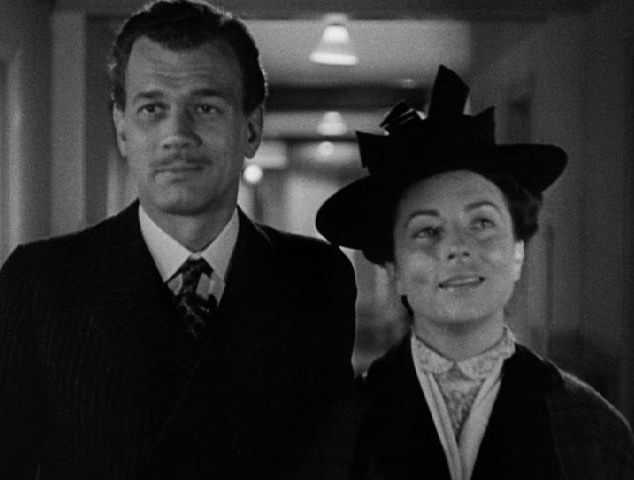
And Wise replaced the boarding house scene with the new one between Eugene and Fanny in the hospital corridor. Admittedly, this scene is hard to defend. It’s frankly so awkward — with its shallow-focus photography, Joseph Cotten’s line readings a little too chipper, Agnes Moorehead’s expression a little too blissful — that I tend to believe it was directed by Jack Moss. Wise and Freddie Fleck did better with the added scenes they directed. But at least the new scene was more faithful to Tarkington, albeit an over-compensation for Welles’s somber, downbeat ending.

To be sure, there are lines, passages and scenes whose loss is regrettable; Robert Wise admitted that the 132-min. cut was superior to what was finally released. But running much over 90 minutes simply was not an option. In 1984, Welles complained to Barbara Leaming: “The plot of course was really what they took out. Using the argument of not central to the plot, what they took out was the plot…” Excuse me, but that is rich coming from the man who wanted to take out the end of the Amberson ball, the “big cut”, the Indian legend, and George’s auto accident, all to protect his long ballroom sequence and boarding house scene. If anyone tried to cut “plot” out of The Magnificent Ambersons, it was Orson Welles (Robert Wise is roundly denounced for what he cut, but never gets any credit for what Welles wanted to cut that he left in). In fact, with two exceptions, nothing essential in Booth Tarkington’s novel is left out of the picture as it was finally released.

The first exception is the ruinous investment in the headlight company by Major Amberson, Uncle Jack and Fanny. In the release version there are only two rather cryptic references to it, with no explanation. But the only other mention in the cutting continuity is in the second porch scene, which not even Welles ever wanted to keep (possibly because of Richard Bennett’s struggle with the lines), so that would surely have been a problem no matter how long the release version ran. (Welles wanted to add some voice-over references in the closeup of the dying Major Amberson, but this was deemed too much information for that short, simple scene.)

The second exception is the portrayal of George’s “comeuppance”. In the finished film, Welles reads Tarkington’s narration in voice-over (“George Amberson Minafer had got his comeuppance…three times filled and running over…but the people who had so long for it were not there to see it…Those who were still living had forgotten all about it and all about him.”) But the scene is Isabel’s bedroom in the abandoned Amberson mansion, with George praying, “Mother, forgive me! God, forgive me!” In Tarkington’s novel, the comeuppance comes later, in his and Fanny’s new boarding house, when George consults the book of the city’s 500 most important families and finds nothing between “Allen” and “Ambrose”. That is Prince George’s comeuppance: the sudden knowledge that he and his whole family are, in the great scheme of things, not worth mentioning. It would have been a simple matter to include it, but Welles never shot it, never even wrote it into his screenplay.

An instructive (and nearly simultaneous) comparison is to look at what happened over at Paramount to the picture Preston Sturges wrote and shot with the title Triumph over Pain, but which finally went out as The Great Moment. (I wrote about that one in detail here.) To be sure, The Great Moment was never going to be as good as The Magnificent Ambersons, but it was going to be a lot better than it turned out, and contrasting it with Sturges’s published script shows clearly that the men who took it away and cut it didn’t know what they were doing — and didn’t care. The same comparison with Ambersons shows that Robert Wise et al. did care, and did know what they were doing.

Anyone willing to shell out 60 bucks for Prof. Carringer’s reconstruction can see that there’s really no “aha!” moment in the reconstructed version, no scene that clearly says “This absolutely should have been left in.” But the fact that the reconstruction is “a print-on-demand volume” testifies that there’s no great demand for it. Most people instead fall in with Orson Welles’s 43-year tantrum over being ignored, and they call Wise’s editing of Ambersons a mutilation instead of what I think it truly is: one of the most heroic feats of film editing — against unique, almost overwhelming odds — in the history of Hollywood. The picture’s high esteem to this day (though often qualified with “even in its present form…”) testifies to how well Wise preserved the picture Orson Welles left in his hands on February 6, 1942.

I said it before and I’ll say it again: Robert Wise — besides being an Oscar-winning producer and director, National Medal of Arts and AFI Life Achievement Award recipient, and past president of the Academy and the Directors Guild — was the greatest film editor who ever picked up a pair of scissors. 

*               *               *

There’s a persistent question that won’t die: What happened to the answer print that Wise sent to Welles in Rio? When Welles returned to the U.S., he left the print behind with Adhemar Gonzaga, head of Brazil’s Cinedia Studios. Gonzaga wired RKO for guidance, they told him to destroy it, and he told them he did. But Gonzaga was a film collector when film collecting wasn’t cool, and…well, would you have destroyed it? Someone claimed in 1995 to have seen the print in the 1960s, but it’s never turned up. Gonzaga’s daughter, present head of Cinedia, has looked but can’t find it. But hope never dies; remember Metropolis. 

*               *               *

A MINOR AFTERTHOUGHT:   There was a version of The Magnificent Ambersons produced in 2002 for A&E — with absolutely no sense of style, period or history, and a lamentable mix of good actors miscast and bad actors who shouldn’t have been cast at all. It would be a kindness not to mention it, but I have to, because it had the gall to pass itself off as a “restoration” of Welles’s original. The writing credit reads only “Based on a Screenplay by Orson Welles”, but there is no relation between the two except that they are, of course, based on the same novel. The 2002 version has no narrator, no opening sequence describing the styles of the period, no showing of Eugene Morgan’s mishap in the serenade, and no prologue of George Minafer’s childhood (these last two are inserted in clumsy flashbacks). The term “comeuppance” is never mentioned. And Isabel Amberson Minafer smokes cigarettes. A&E’s pathetic attempt to hang this abomination on Orson Welles is really beyond the pale. It’s false advertising, and I wish someone had warned me about it before I wasted my time.
 
Posted in Blog Entries, Magnificent Amerbersons

Minority Opinion: The Magnificent Ambersons, Part 5

Jim Lane's Cinedrome Posted on March 14, 2012 by Jim LaneDecember 3, 2024
In March 1942, Charles W. Koerner replaced Joseph I. Breen as head of production at RKO. The previous July, George Schaefer had lured Breen away from the Hays Office to RKO, and ever since then Breen had served more or less as a rubber stamp for Schaefer’s decisions.
 

Charles Koerner, however, was made of more contentious stuff. His background was in theater operation; before replacing Breen he had been head of RKO’s exhibition arm in New York. In that position he had surely seen the theater owners’ reports in Motion Picture Herald’s “What This Picture Did for Me” column, and in the case of Citizen Kane the verdict had been “Nothing.”

Koerner was the point man and chief organizer of those who were alarmed at RKO’s march toward insolvency under Schaefer’s stewardship; millions of dollars were gushing out of studio coffers, pittances trickling in. The studio had managed to climb out of receivership only in January 1940, and now it was in danger of falling back into it. Koerner was angling to get Schaefer out of the way, then to put RKO back on a sound financial footing, and he meant to curb what he and his allies saw as the studio throwing good money after bad.

Just to show how the wind was blowing, one of Koerner’s first acts in his new Hollywood office was to send out a memo to the studio at large: The Magnificent Ambersons, Journey into Fear and It’s All True would all proceed — for now — but everyone should check with him before entering into any new agreements with Orson Welles or Mercury Productions. Clearly, George Schaefer wasn’t the only one whose days at RKO were numbered.

Koerner brought an exhibitor’s perspective to his new job; it told him that the shorter the feature, the more showings per day and the more money a theater could make. Koerner also believed that the double feature was the wave of the future (giving credit where it’s due, he was right; the double feature would outlast the studio system itself). He decreed that 90 minutes, give or take a few, was to be the target length for all RKO features, and this edict was conveyed to Robert Wise as he and Mark Robson toiled away on The Magnificent Ambersons.

Meanwhile, down in Rio, Orson Welles was devising his latest and last plan for re-cutting Ambersons. He transmitted his instructions to Jack Moss and Wise in a 30-page telegram on March 27. He probably didn’t know about Koerner’s 90-minute cap on feature length, but it may not have made any difference if he did.

We can’t know what the running time of Welles’s March 27 cut would have been because it was never assembled, much less screened for an audience. Welles ordered some major changes from the last version he had called for, the one previewed in Pomona. In the Christmas ball scene, he wanted a dissolve from the moment when George and Lucy dance away from the camera (after she asks “What do you want to be?” and he replies “A yachtsman.”) directly to the scene of Lucy and Eugene putting their horseless carriage away in the barn as they return home (a scene that is not in the release version). As Robert L. Carringer says, this would entail losing this shot of Eugene and Isabel dancing alone after all the other guests have gone, “what many regard as the single most beautiful shot in the film.” 
 
The shot is beautiful and evocative, but much more would have been lost if Welles had had his way. Also out would be the conversation between George and Lucy on the stairs (you can just glimpse them in the background coming down to take their seats on the steps) in which they banter about Eugene’s automobile business (“Papa would be so grateful if he could have your advice.” “I don’t know that I’ve done anything to be insulted for!”) and George presses Lucy for a sleighing date the next afternoon (“Tomorrow? I can’t possibly go.” “I’m going to sit in a cutter at your front gate and if you try to go out with anybody else he has to whip me before he gets to you.”); the party breaking up as the Morgans prepare to leave; George quizzing Uncle Jack (“Who is this fellow Morgan?” “Why, he’s a man with a pretty daughter, Georgie … Do you take this same passionate interest in the parents of every girl you dance with?” “Oh, dry up!”); Lucy finally giving in on that date (“No, I won’t.” “Yes, you will. Ten minutes after two.” “Yes, I will.”); the goodbyes in the snow; and Lucy and Eugene talking about George and Isabel on the ride home (“You liked her pretty well once, I guess, Papa.” “Do still.”) Prof. Carringer marvels that Welles would contemplate cutting Eugene and Isabel dancing; personally, I’m amazed that he would cut everything else. 
 
Welles also called for cutting this shot, the iris-out on the horseless carriage as it trundles along in the snow with everyone singing “The Man Who Broke the Bank at Monte Carlo”. This would entail no substantial loss, but the iris-out is a truly lovely moment that evokes the period as vividly as any four seconds in the whole picture. Prof. Carringer calls cutting it “another great surprise”, but I’d go further than that; I’d say it’s a real head-scratcher, a cut that loses far more than the time it saves. I think, just maybe, if I’d been Robert Wise, I might have started to wonder if, in all the bustle and flurry of It’s All True, Orson had perhaps begun to lose touch with the movie he was making before he flew off to Brazil. But never mind, that’s just me thinking out loud; I don’t want to put thoughts into Wise’s 1942 head.
 

I don’t want to put thoughts into Welles’s head either, but I have to speculate on why he was willing to trim so much meat (a little over four minutes) off the tail end of the ball scene after the “yachtsman” line. I suspect Welles was focused on preserving the sequence that made up the centerpiece of the Amberson ball — the one that had consumed nine ten-hour days and occupied a crew of 100 to shift walls, doors and step units in and out of place as Tim Holt, Anne Baxter, Joseph Cotten, Ray Collins et al. strolled and chatted amid their splendid surroundings, alternately basking in them and taking them for granted.

The sequence is represented here by (top) a frame from the release version of Lucy and George strolling across the parquet floor, George wondering why so many “nobodies” at the ball seem already to know this young lady he’s only just met; and (bottom) a production photo of a portion of the shot that didn’t make the final cut, as George and Lucy climb to the third floor of Amberson Mansion, where the dancing and most of the celebrating are going on.
 
This series of long takes, so intricate and time-consuming to get on film, loomed large in Welles’s heartsick memory of Ambersons. “It was the greatest tour de force of my career!” he told Barbara Leaming, and it may well have been. “The entire sequence was one reel without a single cut.” Here, however, Welles’s memory played him false. In fact, according to the 132-min. cutting continuity, the twelve-and-a-half minute sequence consisted of ten separate shots, the longest of which ran 376 feet, a little under four-and-a-quarter minutes. Even so, with all the choreographed movement of actors, sets and camera, it’s no surprise that Welles remembered it as one long uninterrupted take. Nor is it surprising that he would want to preserve it. The scenes of the end of the ball that he wanted to cut run about a minute less than what was eventually cut out of that ten-shot sequence. The question is, did Welles want the earlier footage left in because it advanced the picture as a whole, or because he was proud of it as a technical and logistical achievement all by itself?
 
Welles was similarly protective of the boarding house scene that ended the picture (“much the best scene in the movie”). The loss of these two scenes — the bookends, if you will, of The Magnificent Ambersons — were what Welles most bitterly lamented for the rest of his life (along with that long tracking shot through the deserted Amberson Mansion that Stanley Cortez was so proud of — Welles evidently having forgotten that he never included that shot in the first place). For what came between the bookends, Welles on March 27 had other, rather radical changes in mind.
 

Two scenes — (1) the buggy ride scene, where George and Lucy quarrel over George’s reluctance to “make something of himself”, and (2) the following carriage scene between Uncle Jack and Major Amberson, talking about the changes in their town and the decline in the family fortune — Welles wanted to move to much earlier, before Wilbur Minafer’s funeral. This would, as Robert L. Carringer notes, get on more directly with the development of George and Lucy’s relationship — and perhaps compensate somewhat for the loss of the development of their relationship as they sit on the stairs at the end of the ball. At any rate, this was not done — both scenes remained later in the picture — but another of Welles’s edits was implemented: At Wilbur’s death, instead of the shot of Wilbur’s tombstone that was in place, he ordered a new shot of townspeople, with one saying “Wilbur Minafer. Quiet man. Town will hardly know he’s gone.” (“Phone me to get correct reading for line.”) In the release version the line is spoken by Erskine Sanford as Roger Bronson.

At Welles’s direction, a shot of George Minafer’s diploma was cut, which leads to some inevitable confusion in the beginning of the kitchen scene between Fanny and George (and later Jack); at first it seems to follow Wilbur’s funeral rather than coming months later after George’s graduation and return home. This is probably unavoidable since scenes of George’s life at college, and Jack, Isabel and Eugene attending his commencement — all of which are in the novel — were never shot. Welles also directed that the kitchen scene end before George sees the construction outside in the yard, and this was also done in the final version.

Welles called for keeping the first porch scene, ending it before George’s fantasies about Lucy, but the scene remained out.

As for the “big cut” that so truncated the lingering death of Isabel Amberson Minafer, and which Moss and Wise had restored for the Pasadena preview, Welles wanted that footage taken out again, with other changes and re-shoots that he felt would improve what remained. But he had evidently had second thoughts about the Moss-Wise-Cotten compromise plan he had dismissed out of hand on March 25, and now was willing to go along with some of their suggestions, especially the major restructuring after Isabel’s death: Jack and George’s farewell at the railroad station, the “Indian legend” scene with Lucy and Eugene, the scene of Fanny’s breakdown as she and George discuss their financial straits, George in Bronson’s office giving up his hopes for a career in law, and George’s last walk home to Amberson Mansion, where he gets his come-uppance (“Mother, forgive me … God, forgive me.”)

In a letter to Welles dated March 31, Robert Wise summarized the audience reaction at both previews (“I have never tackled a more difficult chore … it’s so damn hard to put on paper in cold type the many times you die through the showing…”) Wise went through the picture step by step; he didn’t always distinguish between one audience and the other, but he made a point to say how well some of the “big cut” scenes had played, which the Pomona crowd hadn’t seen but the Pasadena audience had. Wise again emphasized the problematic nature of the last scene between Fanny and Eugene: “The boarding house got us several laughs, one on the man’s face when the door opens and several through the scene on Fanny’s strange behavior, and here again we could feel great restlessness.” 

Welles was determined to retain the boarding house scene, and he thought he had the solution to everyone’s concerns. It would come in the closing credits, which were to be spoken by Welles with shots illustrating each name as it came up. “To leave audience happy for Ambersons,” he wired Jack Moss on April 2, “remake cast credits as follows…” First he wanted an oval framed picture of Richard Bennett “in Civil War campaign hat”, presumably made up to look younger than he does in the movie itself; then, “live shot of Ray Collins … in elegant white ducks and hair whiter than normal seated on tropical veranda ocean and waving palm trees behind him … [then, Agnes Moorehead] blissfully and busily playing bridge with cronies in boarding house.” And so on, down to Joseph Cotten looking out a window at Tim Holt and Anne Baxter as they drive away, waving at Eugene/Joseph behind them: ” … they turn to each other then forward both very happy and gay and attractive for fadeout.”
 

“As solutions go,” says Prof. Carringer, “this one could only have raised doubts about how fully Welles comprehended the gravity of the situation.” Indeed so, if Welles thought he could win an audience over with a cheerful curtain call of George/Tim and Lucy/Anne waving and smiling at the audience as they drive off into the sunset. This would surely register only as a breezy non sequitur. The same goes for Welles’s intention to show Richard Bennett in a Civil War uniform or Ray Collins basking on a tropical beach; these poses would have looked particularly odd since no version of the picture ever referred to Major Amberson’s Civil War service or Uncle Jack’s obtaining a South American consulship. To someone who had just sat through the picture, it would look as if Richard Bennett was dressed for a costume party and Ray Collins off on a vacation from Hollywood; if an audience was inclined to laugh at The Magnificent Ambersons, none of this would have persuaded them to stifle their giggles. In the end this suggestion was not followed; the cast list showed the actors in medium closeup, turning to regard the camera with friendly half-smiles.

There is in fact some reason to believe that Robert Wise had begun to think Welles had lost touch with the picture. “I’ve always felt,” Wise said years later, “that if Orson had been at the preview and had seen and heard that reaction, he’d have understood better what did and didn’t work in it. As it was, Mark Robson and I were in touch with him almost every day, these long, long telegrams — 20, 30 pages sometimes. It would have been so much easier if he could have been there.” Schaefer — deciding, perhaps, that the law of diminishing returns was kicking in — called a temporary halt to any activity on Ambersons, to let Wise, Robson and Moss recharge their batteries, and to try to reach some agreement with Welles.

Adding to the fear that Welles had lost touch with Ambersons was the very real fact that he seemed to have lost control of It’s All True — if, indeed, he’d ever had control of it in the first place. After Carnival, the weather in Rio had turned awful and wouldn’t let up — constant bitter cold and thundering rains that made outdoor shooting impossible. An expected shipment of supplies and equipment seemed endlessly delayed. The crew idled and grumbled, piddling along with what interior pickup shots could be managed, often without Welles even being present, and with little sense of exactly what they were shooting (when they were shooting) or why.  “Everything here proceeding beautifully,” Welles blithely wired Schaefer, but production manager Lynn Shores — a querulous, irascible man who was virtually a spy for the anti-Welles faction at RKO — painted a much bleaker picture. Shores carped about everything, from spending all night in “meaningless conferences” with Welles to having to be the one calling “action” and “cut” when Orson wasn’t around. Shores, ever the proud martyr, portrayed himself as the only thing standing between the crew and demoralized, mutinous chaos.

Schaefer probably knew to consider the source, but enough reports were coming in from second, third and fourth parties to suggest that Shores’s sour perspective was closer to the truth than Welles’s. Finally, in mid-April, Schaefer transferred full responsibility for editing Ambersons to Robert Wise and told him just to do whatever was necessary to get the picture in a releasable form.

Actors were called back to shoot retakes and new inserts. There was a new scene (directed by Wise) between George and Isabel after they’ve read Eugene’s letter, omitting or softening some of George’s wilder overreactions (“It’s simply the most offensive piece of writing that I’ve ever held in my hands … if he ever set foot in this house again … I … I can’t speak of it.”). A scene (by assistant director Freddie Fleck) of Eugene being turned away by George, Fanny and Jack as Isabel lies dying upstairs. A shortened opening (directed by Jack Moss) for the scene between George and the hysterical Fanny in the empty Amberson Mansion. Another scene (Fleck again) in which first Lucy, then Eugene, decide to visit George in the hospital after his auto accident.

And, most notoriously, this. Audience reaction and response cards had convinced everyone but Welles that his beloved boarding house scene had to go, so it was replaced with this one between Eugene and Fanny in the corridor outside George’s hospital room. Much of the dialogue was the same, but with a more upbeat reading from Joseph Cotten and a more serenely blissful reaction from Agnes Moorehead; the result was closer to Tarkington’s ending — though a far cry from the melancholy, even sullen tone that Welles had so carefully set, and which Joseph Cotten had found more Chekhov than Tarkington. Simon Callow says this scene was directed by Jack Moss; Prof. Carringer says it was Freddie Fleck. But whoever was responsible, they both hate it, as does nearly everybody who’s ever had an opinion on Ambersons.
 
For the music in this and other new scenes, composer Bernard Herrmann was not consulted. Instead, the studio brought in Roy Webb, more malleable than the notoriously prickly Herrmann, albeit vastly less talented. In the end, 30 of the 56 minutes Herrmann had written were used, supplemented by 6 minutes 45 seconds from Webb. The furious Herrmann threatened to sue unless his name was removed from the picture, and he got his way.
 
Another recut of Ambersons (running time unknown) was previewed in Inglewood on May 4, and yet another (87 minutes) in Long Beach on May 12, with (according to Prof. Carringer) “encouraging results”. But by now, Charles Koerner and his anti-Welles faction were only too eager to stick their thumbs in the Ambersons pie; Schaefer, Wise and Moss were forced into a rear-guard action to try to preserve what they could (within a 90-minute deadline) of the great movie they knew was in there somewhere. Moss was a fish out of water whom nobody outside Mercury Productions regarded with even an ounce of respect. Schaefer, outflanked by Koerner, was increasingly a dead man walking the halls at RKO. The struggle fell largely to Wise, since he was the man most intimately familiar with all the footage, and the one whose job at the studio ultimately proved much more secure than either Moss’s or Schaefer’s. The cutting and pasting continued — this scene out, that scene in, this one trimmed, that one moved, another back in, another back out — as The Magnificent Ambersons inched ever closer to final form, the form (with a few minor differences) proposed in the “compromise” version worked out by Robert Wise, Jack Moss and Joseph Cotten and wired to Welles on March 23. Finally, Schaefer ordered a handful of last-minute tweaks and a print was shipped to him in New York on June 5. Three days later Schaefer screened the print and approved it for release. The picture now ran 88 minutes 10 seconds.
 

The Magnificent Ambersons finally saw release on July 10, missing not only Easter Week, but Memorial Day, Flag Day and the Fourth of July as well. And forget Radio City Music Hall; in New York it played the 4,000-seat Capitol — still a picture palace, but hardly the RKO flagship.  And not all of the picture’s play dates were that prestigious; in some places it ran on a double bill with Lupe Velez in Mexican Spitfire Sees a Ghost — with Ambersons as the bottom half. Despite RKO’s malign neglect and a $625,000 loss, the picture impressed enough Academy voters by early 1943 to garner four Oscar nominations: for best picture, best art direction/interior decoration, Stanley Cortez’s cinematography, and Agnes Moorehead’s harrowing performance as the neurotic, sexually frustrated Fanny.

But even before the picture’s release, the game was up. George Schaefer, maneuvered by Charles Koerner into a lame duck, finally resigned on June 26. Koerner had been stewing since May over a report from the budget office that It’s All True had cost $526,000 so far and would take at least another $595,000 to finish; now, finally rid of Schaefer, Koerner pounced. He cut off Welles’s money and ordered the unit back to Hollywood forthwith. When Welles, enthusiastic about the Four Men on a Raft episode he was currently involved in, pleaded to finish it, Koerner granted him $10,000, one camera, and 40,000 feet of film; let him see how long that would last. Finally, the killing blow: Koerner evicted Mercury Productions from the RKO lot, giving them 24 hours to vacate the premises. In a telegram from Brazil, Welles tried to buck up his people’s spirits: “Don’t get excited. We’re just passing a rough Koerner on our way to immortality.” In rebuttal, the Koerner faction had a pun of their own: “All’s well that ends Welles.”

To be concluded…


Posted in Blog Entries, Magnificent Amerbersons

Minority Opinion: The Magnificent Ambersons, Part 4

Jim Lane's Cinedrome Posted on March 2, 2012 by Jim LaneDecember 3, 2024
“Who knows what happened?” Orson Welles asked Barbara Leaming in 1984. “I was all covered in confetti trying to pretend I like carnivals, you know. I hate carnivals…” Welles may have been indulging in a little rueful hindsight 40 years after the fact. Simon Callow’s magisterial biography of Welles (two volumes so far, a third and fourth to come), draws on contemporary letters, telegrams, memos and news stories to present a very different picture of Orson Welles in Rio from the one he drew for Leaming.
 

For one thing, this wasn’t any old “carnival”, some smattering of rides set up in a pasture somewhere with booths for the locals to shoot pellets at plywood ducks and toss dimes into glass candy dishes. This was Carnival, a four-day samba-flavored bacchanal leading up to Ash Wednesday that made Mardi Gras in New Orleans look like a Methodist ice cream social, with a history stretching back to 1723. It’s clear from the record that Welles waded into Carnival with both feet — literally, grabbing one of his crew’s 16mm cameras and venturing out among the millions of revelers to get close shots, emerging drenched with sweat like a man coming out of the sea, all while his Technicolor cameras stood back to get the big picture, lit by the carbon-arc glare of anti-aircraft searchlights. Moreover, his notes and directives to his on-scene staff show that he saw the social and historical roots of Carnival as the core of the Brazilian section of It’s All True — a picture that was growing in scope and ambition by the day, even as Welles remained sketchy about the nuts and bolts of precisely how to get it made.

I don’t want to get sidetracked onto It’s All True, that landmark fiasco from which Welles’s career never recovered. That’s a whole other can of worms. What concerns me here is its effect on Ambersons. When Welles told Barbara Leaming about hating carnivals, he was burnishing the legend of Ambersons being snatched from his loving hands while his back was turned. In fact, at the time, he was reveling in his Brazilian adventure; the movie he was planning appealed to his experimental impulse to let a project find its own shape without conforming to a script, and he reveled as well in immersing himself in this exotic foreign culture. To say nothing of the patriotic duty he was discharging in the cause of inter-American relations.

Welles was fully engaged in shooting Carnival, in recreating sections of it afterward to shoot details his crew had been unable to capture during the crush and riot of the real thing, in mapping out (however vaguely) the other episodes of It’s All True, and in being feted and celebrated as the U.S.’s goodwill cultural ambassador. Fully engaged, but not, it must be said, to the exclusion of all other things; he was still in frequent contact with Robert Wise about Ambersons and with Jack Moss about both Ambersons and Journey into Fear. His ambitious ideas for It’s All True even spilled over into the two pictures he’d left behind: He wanted to shoot some new scenes for himself in Journey, which would mean sending his costume and makeup as Col. Haki to Rio. He wanted to hold the world premiere of Ambersons in Buenos Aires (“resultant international publicity will be enormous”, he wired Schaefer), and to record the picture’s narration in both Spanish and Portuguese. For his part, Schaefer didn’t relish the thought of Welles venturing another 1,200 miles farther from home; a Rio premiere maybe — maybe — but Buenos Aires was out of the question. On February 27, he politely reminded Welles that they still needed to get Ambersons ready for its Easter Week opening in New York (Easter Sunday that year would be April 5); time and tide, Orson, time and tide.

In response, Welles put the Ambersons crew in Hollywood on triple shifts editing and shooting new footage; Wise’s assistant Mark Robson later remembered the two of them moving into a motel near the studio and working as much as 120 hours a week. Even before Welles received Wise’s 132-minute cut, he had ordered the “big cut” and other changes, which Wise made in time for the first preview in Pomona. 

The Pomona preview was — there’s no other word for it — a disaster.
 
The regular feature at the Fox Theatre that night was The Fleet’s In, a rousing musical with Dorothy Lamour, Betty Hutton and the Jimmy Dorsey Band. Simon Callow sneers at The Fleet’s In as yokel-bait, with songs like “Arthur Murray Taught Me Dancing in a Hurry” and “Conga from Honga”. That’s a cheap shot; the score also included the standards “I Remember You” and “Tangerine”. Still, Ambersons was an unhappy match that night, facing what Robert L. Carringer calls “a raucous, largely teenage audience”.  Pomona is also close by what later became the Claremont Colleges, whose students were no doubt regular patrons of the Fox. Anybody who’s ever sat through a screening of a vintage movie with a smartass college audience knows what that can be like, and the boys from RKO got it with both barrels that night. (Not to mention the fact that the preview was on St. Patrick’s Day; the audience may have been well-oiled by the time they got to the theater.) As Ambersons unspooled, the audience  — those who didn’t walk out — laughed, jeered, talked back at the screen, and generally carried on like the robots on Mystery Science Theatre 3000. At the conclusion, when Welles the narrator said, “Ladies and gentlemen, that’s the end of the story,” there was sarcastic applause and an audible sigh of relief.
 
The reaction wasn’t unanimously negative. Forty-two percent of the response cards praised the picture, some in glowing terms, and a few even apologized for the behavior of other patrons. But that “42 percent” can be misleading. Only 125 cards were filled out, in a theater that seated 1,750. More important was the hostile reaction, and the fact that some cards even mentioned it was telling; it proved that the men from RKO weren’t overreacting or imagining things. The people who didn’t like this picture absolutely loathed it.
 
That Pomona audience of 70 years ago has earned the scorn and contempt of critics and historians for years — from Callow and Prof. Carringer to Peter Bogdanovich and, well, Orson Welles himself. But let’s remember what they saw. This wasn’t the 132-minute cut, which everyone agreed needed some fine tuning. This was the 110-minute cut made according to Welles’s instructions from Rio, including the “big cut”. You can see in Part 3 of this post what the “big cut” entailed; on the screen that night in Pomona it meant that the dramatic center of The Magnificent Ambersons played as follows:
 

1. George tells Eugene that he’s not welcome at Amberson Mansion, slamming the door on him; then —

2. Eugene writes to Isabel, begging her to be strong; then —

3. Isabel reads Eugene’s letter and drops dead (or at least dying) on the spot.

To paraphrase Oscar Wilde, it would take a heart of stone not to weep with laughter at a turn of events like that.

There were other things the Pomona audience didn’t care for. Most of all, they didn’t like Tim Holt. Or more to the point, they didn’t like George Amberson Minafer; Wise reported to Welles that Holt got “a reaction that said: ‘Oh, God, here he is again.'” Indeed, it’s hard to deny that the protagonist of The Magnificent Ambersons is an arrogant, destructive little bastard. In the novel, Tarkington had built sympathy for George despite the awful things he does, giving readers his inner thoughts (however misguided), and sugar-coating this pill much the way Margaret Mitchell finessed the fact that Scarlett O’Hara is a cruel, selfish, conniving bitch. Tyrone Power might have created more sympathy in an audience, as Vivien Leigh did for Scarlett (Prof. Carringer says the same about Welles himself), but Holt had a tougher time hoeing that row. The second half of the so-called “kitchen scene”, where George and Uncle Jack tease Fanny until she runs from the room in tears, originally continued with George spotting the Major’s new houses under construction through the window and running out into the rain to shout his outrage over the roar of the storm — and, in Pomona, over the screams of laughter from the audience.

George Schaefer was in the house that night, and he was rattled to his very bones. RKO had $1 million in Ambersons, and his position at the studio was on the line. Schaefer was Orson Welles’s best friend at RKO, but Schaefer himself had enemies who had been biding their time, ready to pounce. His support for Welles was a large part of it, but not all.  Besides the uproar over Citizen Kane and its under-performance at the box office, there had been other expensive losses on Schaefer’s watch. Two of his closest lieutenants had already been sent packing; the tigers were at the gate.

The next day a panicky Schaefer queried RKO’s lawyers about the possibility of — if need be — taking Ambersons out of Welles’s hands. Their answer: Welles’s new contract relinquished his unprecedented right of final cut. He now had the right to cut the picture up to and including the first sneak preview; after that he was subject to the studio’s behest. Reassured, Schaefer waited to see what would happen.

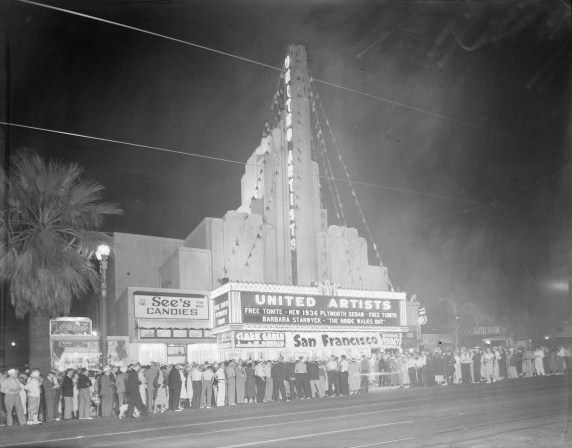
Ambersons‘ second preview was held on March 19 at the United Artists in Pasadena, where it got a better reception. Pasadena was a more upscale location, with a more sophisticated audience; it may also have made a difference that the main feature that night was Captains of the Clouds, a wartime drama with James Cagney and Dennis Morgan. But the venue and the lead feature weren’t all that had changed: the folks in Pasadena saw a substantially different picture from the one that had been hooted out of town in Pomona.
 
Wise and Jack Moss had re-cut the picture in the 48 hours since the St. Patrick’s Day debacle. Back in was all of Welles’s “big cut”, and the so-called “Indian legend” scene, in which Lucy conveys to her father the fact that she misses George, telling it in the form of a supposed Native American folk tale that she makes up on the spot (this scene had been left out in Pomona, again on Welles’s orders, since without Lucy and George’s conversation on the street earlier it no longer made sense). Out was the scene of Isabel, Fanny and George’s visit to Eugene’s auto factory, and the argument between George and Uncle Jack after George’s run-in with the gossipy Mrs. Johnson; both porch scenes remained out and would never be back in. There were trims and minor adjustments to other scenes, and the running time was about 117 minutes, seven minutes longer than in Pomona. The response cards were 79 percent favorable, but again the percentage is misleading; there were only 85 cards, and the United Artists seated 912. For every one of those 67 positive cards, there were several people walking out long before the picture was over, and a general air of restlessness prevailed. “This can be attributed, I think,” Wise wrote to Welles, “to the great length and slow pace. The picture does seem to bear down on people.” All in all, things weren’t as bad as in Pomona, but they still had a way to go. 
 
At this point, Palm Sunday was only ten days away. Schaefer had reluctantly given up the idea of an Easter Week opening, and with it any hope of recouping RKO’s investment. If he had any thoughts about the future of his own job, he kept them to himself.
 

Boarding house scene02bSomewhere around this time Joseph Cotten chimed in, with a letter that Welles never answered and apparently never forgave — in 1984, talking to Barbara Leaming, he was still comparing Cotten to Judas Iscariot. After attending the Pomona preview, Cotten wrote that Welles’s script for Ambersons was “doubtless the most faithful adaptation that any book has ever had” but that “the picture on the screen seems to mean something else…It’s more Chekhov than Tarkington.” (“Yes, exactly!” Welles told Leaming. “That’s just what I was making!”)

The focus of Cotten’s concern was the picture’s final scene, when Eugene visits Fanny at her boarding house and tells her of his reconciliation with George in the hospital room after George’s accident. That scene has been the focus of a lot of concern: Cotten was concerned at the time because it was in the picture; others since then, Welles among them, have been concerned because it was cut out and replaced. Even reading the scene in the cutting continuity, and looking at the surviving production photos like this one, it’s easy to see Cotten’s point. The scene is indeed Chekhovian — in fact, it’s reminiscent of the last scene of Chekhov’s Uncle Vanya. In the play, Vanya’s niece Sonya speaks wistfully of the days to come, when their troubles will be behind them and “We shall rest”, while Vanya sits desolate and unhappy and a servant plays softly on the guitar. In the boarding house scene, Eugene tells of his making peace with George and being “true at last to my true love” while Fanny sits listless and impassive in her rocking chair and a corny comedy record plays on a Victrola in the background.

Simon Callow suggests that the boarding house scene was an improvement on Tarkington, something that’s beyond confirming or refuting now. What is certain is that it was a departure from Tarkington. Tarkington’s novel ends on a note of reconciliation and hope, even uplift; the boarding house scene ended Welles’s movie on a note of bleak melancholy, suggesting that the reconciliation was too little too late. Cotten, by calling the finished picture “something else” from what he experienced reading the novel, may not have grasped that something else was exactly what Welles was going for. On the other hand, Welles may not have fully grasped the unpleasant taste the scene left in its audience, and the pall it cast over the whole picture, because he never saw it with an audience  — or indeed with anyone other than Robert Wise, once, in Miami, a month and a half ago, before the riotous distractions of Carnival and It’s All True.

On March 23, Jack Moss wired Welles with a detailed report describing both preview versions of Ambersons (which makes it possible now to calculate the running times and differences of both versions). Moss also laid out for Welles a compromise plan thrashed out by Robert Wise, Joseph Cotten and himself, which they felt would “remove slow spots and bring out heart qualities” of The Magnificent Ambersons.

It was, as things turned out, almost exactly the form in which the picture was finally released. Orson Welles was having none of it. “My advice absolutely useless,” he wired back on March 25, “without Bob [Wise] here…cannot see remotest sense in any single suggested cut of yours, Bob’s, Jo’s…cannot even begin discussing on proposals as received without doing actual work on actual film with Bob here.”

Moss assured Welles, rather disingenuously, that “every effort being made secure immediate passage for Bob”. But Welles probably knew better. In any case, he now prepared his own detailed plan. It would be his last attempt to retain control of the editing process going on a quarter of the world away. 

To be continued…


Posted in Blog Entries, Magnificent Amerbersons

Minority Opinion: The Magnificent Ambersons, Part 3

Jim Lane's Cinedrome Posted on February 22, 2012 by Jim LaneDecember 3, 2024
When the U.S. declared war on Japan on December 8, 1941, the Roosevelt administration felt sure (thanks to confidential intelligence) that Nazi Germany would soon, in turn, declare war on the U.S. And sure enough Hitler did, on December 11. Even before that, however — on December 10 — the U.S. State Department approached Orson Welles. Hitler’s diplomats had been cozying up to South America for years, knowing full well that Germany would come to blows with the U.S. sooner or later, and Washington was alarmed at the number of south-of-the-border governments that had been cozying back. Shoring up relations with Latin America was a top priority. A request came from John Hay Whitney, head of the motion picture section of the State Dept.’s Office of Inter-American Affairs: Would Welles be willing to go down to South America, make a picture, and serve as a goodwill ambassador in the interests of hemispheric solidarity?
 

Would he ever. The request, forwarded through RKO and with George Schaefer’s blessing, appealed to Welles’s patriotism and political philosophy; better yet, it fit right in with one of his back-burner projects, Pan-America, since retitled It’s All True. (The new title was in fact a bit of a misnomer; the components of the project, insofar as Welles and his staff had thought them through at all, consisted of fictitious episodes, though each dealt with some sort of “truth” about life in the western hemisphere.)

There was a catch: The government wanted Welles to film Rio de Janeiro’s famous Carnival, which would begin in mid-February.  Welles and his production team would have to be in place and ready to go by then. One episode of It’s All True (Bonito the Bull) was already shooting in Mexico, but plans for the rest were still pretty vague. In any case, none of them had anything to do with Carnival or Brazil, which meant rethinking and fast-tracking a picture that hadn’t had all that much thought so far. For starters, the Bonito shoot in Mexico was summarily closed down; if Welles decided to finish it, it would happen in California. A start date of January 6, 1942 was set for shooting Journey into Fear, with Norman Foster (reassigned from Bonito) directing, under Welles’s supervision and at his instruction.
 
And finally on the to-do list before leaving for Rio, The Magnificent Ambersons had to be finished. The picture had already ballooned well past its original $600,000 budget — $853,000 so far, with a full million just around the corner. George Schaefer wanted Ambersons to open Easter Week at Radio City Music Hall in Manhattan — that was traditionally a strong week for the box office, and offered the best chance to recoup RKO’s investment.
 
With the pressure building, Welles’s impatience with Stanley Cortez, Ambersons‘s slowpoke cinematographer, boiled over time and again; Welles later called Cortez “criminally slow”. The way editor Robert Wise remembered things, Welles unofficially demoted Cortez to second unit photographer, letting Cortez potter around with unimportant stuff while he shot principal scenes with studio photographers Jack MacKenzie and Harry Wild. (Studio records don’t entirely bear this out, but there may be something to it: In interviews for the rest of his life, Cortez spoke with pride of a long tracking shot through the deserted Amberson mansion after the family’s fortune disintegrates. He spent four days setting up, rehearsing, and making the shot, and he often lamented that it had been eliminated in the picture’s tortuous editing process; that long tracking shot became part of the legend surrounding the “destruction” of The Magnificent Ambersons. In fact, however, the shot never appeared in any version of the picture, even before the cutting began — leaving the possibility that it was simply a piece of busy-work to keep Cortez out of Welles’s hair.)
 

Principal photography on Ambersons wrapped up on January 22, 1942; it had lasted a little over 13 weeks. Welles spent the rest of the month making pickup shots, working with Norman Foster on Journey into Fear and finishing his on-screen role in that picture, making his last broadcast of the Lady Esther radio show, and preparing to leave for South America. On February 2 he left for Rio by way of Washington D.C., where he was to be briefed by officials of the Office of Inter-American Affairs before continuing on to Brazil.

During those same two weeks, Robert Wise assembled a rough cut of Ambersons and traveled with it to Florida to intercept Welles on his way south. They spent February 5 at the Fleischer Animation Studios in Miami, recording Welles’s voice-over narration, screening the rough cut and conferring on Welles’s plans for the final cut — at least, as they stood at that point in time.
 

It’s important to remember that what Welles and Wise worked on in Miami was just a rough cut — the barest assemblage of scenes with no music, special effects or fade/dissolve transitions. A rough cut is the movie equivalent of what in live theater is called a stumble-through, plowing through the show from beginning to end just to see what still needs work. The work that the rough cut needed is what the two men talked about that day in Miami; Wise would return to RKO and cut the picture to Welles’s specifications.

At the airport before flying out, Welles dictated a telegram to Jack Moss, the Mercury Theatre’s business manager, whom Welles had appointed a sort of surrogate producer; the telegram specified that Wise was to have the final word on editing Ambersons and that Wise’s authority was not to be questioned. In a wire from Rio three weeks later, Moss was further directed to “start running Ambersons nightly” and taking input from Norman Foster, Joseph Cotten and Dolores Costello “as many times as possible … [Y]ou know I trust you completely.”

For a clear account of what happened over the four months after Welles flew to Brazil, I am indebted — we all are — to Robert L. Carringer’s The Magnificent Ambersons: A Reconstruction, published by the University of California Press in 1993. The book includes a prefatory essay, “Oedipus in Indianapolis”; an annotated copy of the cutting continuity of the first draft of the picture assembled by Robert Wise after his meeting with Welles in Miami; and a documentary history of the editing process compiled from extant studio records now housed at UCLA and Indiana University. My own conclusions regarding The Magnificent Ambersons differ somewhat from Prof. Carringer’s, but the fact that I even have conclusions is thanks to his painstaking research sifting through the surviving records of RKO and Orson Welles’s personal papers.
 

“Who knows what happened?” Welles rhetorically asked Barbara Leaming in the 1980s, referring to the editing of Ambersons while he was in Rio de Janeiro. In fact, the paper trail is thorough and, while cluttered, surprisingly clear — surely one of the most complete editing records for a single picture to survive from the entire Golden Age of Hollywood. And it often flies in the face of the accepted Ambersons legend.

There’s one point on which Prof. Carringer isn’t really clear, however, and that has to do with Wise’s plans to join Welles in Rio to finalize the editing of Ambersons. On p. 27, Prof. Carringer says that Welles asked for Wise to come to Rio after their daily communications via telephone, telegraph and short-wave radio had proved frustrating and “impracticable”; then on p. 280 he implies that the plan all along was for Wise to bring the completed picture to Rio for a final check, along with alternate shots, dissolves and a spare music track for “the widest possible latitude in making changes.” Welles himself always held to the latter explanation, saying he had been “promised” a print and cutters in Rio. In one interview, he seems to imply that he would never have gone to Brazil in the first place if he had known Wise wouldn’t be joining him. This idea is not really credible; once Welles accepted the assignment, it was a matter of in for a penny, in for a pound. He couldn’t send somebody else to film Carnival the way Norman Foster had shot Bonito for him in Mexico. Not only the U.S. State Department but the government, press and people of Brazil were all expecting the one and only Orson Welles, in person. No underling would do. Besides, Foster had gone to Mexico with a clear story (by Roberty Flaherty), if not a detailed script, on paper. It’s All True was still nebulous; Welles, RKO and State were counting on on-the-scene inspiration to firm up the shape and dimensions of the movie they were going to make.
 
In any case, Robert Wise never made it to Rio. The first cut was ready, and Wise’s travel was approved by George Schaefer. But at the last minute, Wise’s request to leave the country was denied due to wartime restrictions on civilian travel. RKO might have successfully appealed the decision, since Welles was in Rio at the government’s behest, but they didn’t try. It’s also possible that the studio had second thoughts about letting Wise go. The first cut wasn’t ready till March 10, and Schaefer was still hoping for and planning on an Easter Week opening, barely a month away. Having both the director and the editor 6,000 miles away in Brazil, and with a war going on, would just be asking for trouble, especially with the unpredictable Orson Welles. So instead, Wise shipped that first cut off to Welles on March 11 (it arrived March 15) and continued the long-distance consultations by wire and radio.
 

The spine of Prof. Carringer’s reconstruction of Ambersons is the cutting continuity compiled by RKO from the print Robert Wise shipped to Orson Welles in Rio on March 11. The running time at that point was precisely 2 hours 11 minutes 45-and-one-third seconds. (This clarifies another part of the legend, which over the years has alleged various running times, some as high as three hours, for Welles’s version of the picture.) But while this was the most complete version of Ambersons, it was never intended to be the final one; it was understood by all concerned, including Welles, that the picture was running long at 132 minutes and needed further tuning, which could include cutting or retaking scenes (or shooting new ones), and would certainly incude sneak-previewing the picture, standard practice at the time. 

The picture at 132 min. contained at least some scenes that evidently never pleased anyone and were among the first things to go. For example, there were what came to be called the first and second porch scenes. The first porch scene, a long take lasting nearly six minutes, involved Isabel and Fanny chatting about their changing town while George sits lost in his own thoughts. After Isabel goes inside, Fanny worries to George that Isabel is being too hasty to leave off mourning her dead husband Wilbur. Fanny then goes inside and George, alone, fantasizes first about Lucy begging his forgiveness, then about her socializing with other young men without a thought for him. This scene might have been deemed too static; also, George’s fantasies may have played badly, may have in fact strained the resources of Tim Holt and Anne Baxter. (A significant number of the edits in the final release version of Ambersons seem to have been aimed at protecting Tim Holt’s performance.)

The second porch scene, another long take lasting a little over three minutes, came later in the picture and showed Fanny and Major Amberson discussing the Major’s financial problems and their mutual plans to invest in the ill-fated headlight company. This was in fact Richard Bennett’s longest scene in the picture, and the 71-year-old Bennett was unable to remember dialogue; Welles had been forced to feed him his lines one-by-one from off-camera, Welles’s voice to be edited out later. If that was the case here, it could well have played havoc with the timing of the scene and made it ultimately unusable. Whatever the reasons, neither porch scene (by unanimous agreement) was ever shown to an audience.

While Wise was still preparing the first cut for shipment, Welles ordered some radical changes, which came to be known as the “big cut”. The following scenes were to be taken out, beginning after George’s slamming the door in Eugene’s face and Eugene’s letter to Isabel pleading with her to stand up to George:

1. George and Isabel discussing Eugene’s letter (a different, shorter version of this scene was eventually reshot for the release version);

2. Isabel slipping a letter under George’s door telling him she will break with Eugene (this scene is not in the release version);

3. George’s walk with Lucy on the street where he tells her he and Isabel are going away, and she frustrates him by her light and trivial attitude;

4. Lucy entering a nearby shop and fainting in front of the startled clerk;

5. A poolroom scene where the clerk tells his buddies about the pretty young lady who fainted in his shop that day (not in release version);

6. The second porch scene between Fanny and Major Amberson (not in release version);

7. Uncle Jack’s visit to Eugene and Lucy, telling them of Isabel’s failing health and George’s refusal to let her come home; and

8. Isabel’s return, when she is too weak to walk a step.

In place of all this, Welles (probably by telephone) ordered Wise to insert a new scene of George finding Isabel unconscious in her bedroom, with Eugene’s letter in her hand. (This scene, not in the release version, was shot under Wise’s direction on March 10.)

Wise went ahead and shipped the first 132-minute cut off to Welles in Rio as planned. Then he made the changes Welles had called for as he prepared Ambersons for its first preview. With the changes Welles had ordered, the picture now ran approximately 110 minutes.

The Magnificent Ambersons had its first sneak preview on Tuesday, March 17, 1942 at the Fox Theatre in Pomona, Calif.

Then all hell broke loose. 

To be continued…

 
Posted in Blog Entries, Magnificent Amerbersons

Minority Opinion: The Magnificent Ambersons, Part 2

Jim Lane's Cinedrome Posted on February 6, 2012 by Jim LaneNovember 29, 2024
Somewhere around the time the story of The Magnificent Ambersons closes — Booth Tarkington was a little hazy on dates — George Orson Welles was born, on May 6, 1915, in Kenosha, Wisconsin. This is how little Orson looked when The Magnificent Ambersons was published in 1918.
 
Late in life, Orson Welles professed a lifelong affinity for the works of Booth Tarkington, and for The Magnificent Ambersons in particular. In “My Father Wore Black Spats”, an autobiographical essay published in Paris Vogue in 1982, Welles reminisced about Grand Detour, Ill., a quaint little village and artist colony 75 miles west of Chicago where Welles and his family often spent long weekends and summers. “[A] childhood there,” he wrote, “was like a childhood back in the 1870s…a completely anachronistic, old-fashioned, early-Tarkington, rural kind of life.” (He used the exact same words in an interview with Peter Bogdanovich published in This Is Orson Welles.) Here Welles was referring to the Tarkington of the Penrod books and Seventeen, the author’s turn-of-the-century idyl of adolescence. Elsewhere in that same Vogue article Welles was more Ambersons-specific: “It has long been a family assumption that the author had my father in mind when he created the character which I will always think of as the Joseph Cotten role [Eugene Morgan] in The Magnificent Ambersons.”


In other remarks and interviews, Welles went even further: His father, Richard Head Welles, was Booth Tarkington’s best friend. Welles Sr. actually invented an early automobile, but didn’t carry it any further because he couldn’t see any future in it. I wasn’t able to find references to any of these assertions until years, even decades after Welles’s movie of Ambersons.

Then there’s the fact that Orson Welles had a penchant for, well, making things up, especially when he was talking about his father; a 1963 monograph by Maurice Bessy includes a highly amusing load of malarkey about Orson’s father, obviously gleaned from Orson himself. (“Seventy-five percent of what I say in interviews,” he once warned, “is false.”) In fact, other than Orson’s say-so, there’s no evidence that Tarkington and Richard Welles ever met. It’s not entirely out of the question; Richard does appear to have been acquainted with George Ade (another Hoosier writer and contemporary of Tarkington’s, less famous in their day and even more forgotten than Tarkington now). But “best friends” with Tarkington? Unlikely; certainly Orson never said anything about it before 1946, when Tarkington would have been around to weigh in on the subject.

As for inventing the motorcar, the closest Richard Welles ever got to that was acquiring a patent for an automobile jack in 1904. It may be somehow significant that in Orson’s telling, his father becomes something of an amalgam of Eugene Morgan and George Minafer — inventing a car on one hand, deciding it would never amount to anything on the other. 

 
If The Magnificent Ambersons had really loomed so large in his family history, it would have seemed logical of Welles to choose Tarkington’s novel for his first movie, but of course he didn’t. In fact, Ambersons wasn’t even the first choice for his second. Welles always had more ideas percolating in his head than he could ever follow up on, especially in the first flush of his carte blanche contract with RKO — Cyrano de Bergerac; a Life of Christ set in the American West the way Renaissance painters used to portray Biblical scenes in Renaissance settings; Conrad’s Heart of Darkness; a life of Henri Landru, the French serial wife-killer (this idea Welles eventually sold to Charlie Chaplin, who turned it into Monsieur Verdoux); Nicholas Blake’s novel The Smiler with a Knife; Arthur Calder-Marshall’s The Way to Santiago, etc.
 
Eventually, Welles settled on two nearly simultaneous projects to follow Citizen Kane for his Mercury Productions unit at RKO (typically, several others would simmer on back burners for later consideration), both of them adaptations of best-selling novels:  Eric Ambler’s Journey into Fear and The Magnificent Ambersons; Welles would produce and act in the former, write and direct the latter. Besides these, there was another pot on the stove: Pan-America, an episodic picture that would eventually morph into It’s All True. This pot would at length boil over, with a resounding effect on Ambersons. In fact, it was already having an effect — Welles delayed the start of production to fly off to Mexico to consult with Norman Foster, who served as Orson’s on-the-spot “co-director” shooting Bonito the Bull, one of Pan-America‘s episodes. Oh, and I almost forgot — there was also his weekly radio show for Lady Esther Cosmetics. In light of what came later, it’s important to remember that from the outset, The Magnificent Ambersons never had Orson Welles’s undivided attention.
 

Not that this was anything new; at this stage of his career, divided attention was Orson Welles’s modus operandi. In New York he was famous for keeping busy enough for three men, shuttling back and forth between the stage and radio, even keeping an ambulance on call to ferry him from one live broadcast to another, siren blaring. Now in Hollywood he was doing the same thing, stretching himself as far as Mexico for the Bonito jaunts; even on a slow day he’d be hopping from Ambersons to Journey into Fear and back, sometimes dictating his direction onto phonograph records when he wouldn’t be on the Ambersons set in person. No wonder he thought he could do anything, he’d been doing it so long.

Whatever Welles might have said regarding “family assumptions” about his father and Booth Tarkington, his first experience with The Magnificent Ambersons (that we know of, anyhow) was a dramatization aired on his Campbell Playhouse radio show on October 29, 1939, exactly 52 weeks after his notorious War of the Worlds. Welles narrated the production and — cranking his voice up to an adolescent whine — played George Amberson Minafer. Guest star Walter Huston was Eugene Morgan (sounding old enough to play Major Amberson, a character dropped from the adaptation), while Nan Sunderland (Mrs. Huston in real life) played Isabel Minafer. Ray Collins was Uncle George Amberson, the name changed to Fred to avoid confusing the listening audience, and Marion Burns was Lucy Morgan. Other roles went to Eric Burtis, Everett Sloane, Richard Wilson and Bea Benaderet.
 
Conspicuous by her absence — at least to anyone familiar with Tarkington’s novel — was the character of Fanny Minafer, and she left a much bigger hole than Major Amberson. The Major’s main contribution to the story occurs before it starts, and most of what he does and says in the course of the novel can be transferred to Uncle George/Fred. (Welles would do exactly that in the movie, mainly because the aging Richard Bennett, though he was Major Amberson to the life, simply could no longer remember lines.) Fanny’s presence, on the other hand, is all but indispensable. It’s her unthinking mischief that sets Georgie on the course that will drive his mother to an early grave; it’s her reckless enthusiasm that sends the last dribbles of Amberson money down the drain with her own; and it’s her pathetic helplessness that draws out Georgie’s better nature and sets him on the road to redemption. The Campbell Playhouse Ambersons is a solid piece of radio drama, but listening to it is like watching a wagon limp by with one wheel missing.
 

When Welles presented Ambersons on Campbell Playhouse he was already under contract to RKO, though he wouldn’t start work on Citizen Kane for several months. Maybe he really did have an early affection for Tarkington’s book — why else would he have done it on radio in the first place? — but when it came time to choose his second picture as writer-director, he may well have picked it largely because the radio drama had already given him a head start on it. With everything else he had going on, who could blame him? He played a recording of the show for RKO president George Schaefer, who green-lighted the production on the strength of that. (Welles told biographer Barbara Leaming that five minutes into the recording, Schaefer dozed off, waking up only at the end, then giving the go-ahead. Like the story of Tarkington and his father, this one seems not to have surfaced while Schaefer was around to dispute it; he died in 1981 at 92, and Leaming’s 1985 biography was the earliest mention I could find of Schaefer’s nap.)
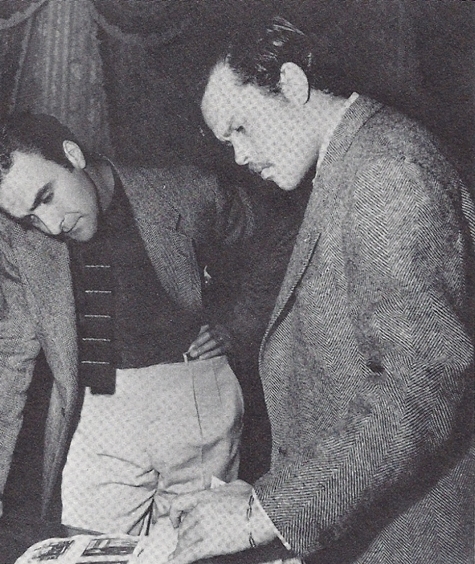
Anyhow, awake or asleep, Schaefer approved Ambersons to proceed, alongside Journey into Fear and the still-percolating (and partially shooting in Mexico) Pan-America — but with a renegotiated contract for the Mercury Productions unit. The battle with Hearst over Citizen Kane was still raging, and the RKO board pressured Schaefer to rein Welles in; gone was the free hand and final cut Welles had enjoyed on Kane, and the budget for Ambersons was capped at $600,000. Welles signed, with a confidence he would come to rue.

On Ambersons, Ray Collins was set to repeat his Uncle George/Fred role from the radio show (renamed again, to Jack). Stage and silent screen veteran Richard Bennett (father of Constance and Joan) was Major Amberson, Dolores Costello (silent star, ex-wife of John Barrymore and grandmother of Drew) was Isabel Amberson Minafer, Joseph Cotten was Eugene Morgan, and 18-year-old Anne Baxter was Morgan’s daughter Lucy. For the crucial role of Aunt Fanny, Welles tapped Agnes Moorehead, who had played his mother in Citizen Kane; in Ambersons, only her second picture, Moorehead would give the performance of her long and distinguished career — but more of that later. 

The other crucial role, of course, was George Amberson Minafer, the role Welles himself had played on radio. Already almost overextended, Welles opted not to spread himself thin enough to play the part again — and I say “thin enough” pun-intended: Welles later said he had grown “too fat” for the part, having given up the do-or-die weight control he undertook during Kane. Instead he cast 22-year-old Tim Holt, perhaps on the strength of Holt’s brief role in Stagecoach (which Welles called his “bible” of moviemaking, and said he had screened over 100 times). Welles was probably wise not to play Georgie himself; his radio performance reaches a pitch of squealing hysteria that would be hard to stand at feature length (indeed, Holt himself would have a tough reception from audiences — more of that later, too). Holt may have been most familiar as a star of B-westerns, but he had ventured into A-pictures (Stella Dallas, History Is Made at Night, Swiss Family Robinson, Back Street), and he came to Ambersons one of its more seasoned players — only Dolores Costello had him decisively outgunned on that score. Before Ambersons, Collins, Moorehead and Cotten had only Kane to their credit (plus a handful of shorts for Collins). Baxter had appeared in four features. Holt had made twenty-nine.
 
Welles biographer Simon Callow says Holt was less-than-ideal casting — “stocky, plebeian in manner, sulky and impetuous.” Callow has a point. Tarkington says, “George’s imperious good looks were altogether manly, yet approached actual beauty as closely as a boy’s good looks should dare.” There was probably only one actor in 1941 — or ever after — who could have played Tarkington’s George Minafer: Tyrone Power. Power had the beauty, and for such a popular star his roles often had more than a touch of the cad. But if Welles ever considered him for Georgie — and evidently he didn’t — the idea was a non-starter; RKO wasn’t about to pay for him and Darryl Zanuck wasn’t about to lend him out. Moreover, I think Callow does Holt an injustice; I’ll get to that too.  
 
Principal photography began in late October 1941 with the dinner table scene where Georgie denounces the automobile and deliberately offends Eugene Morgan. All things considered, the shoot went well. But there were things to be considered. For one thing, Welles lost cinematographer Gregg Toland, his most valuable and stimulating collaborator on Kane, when Toland enlisted in the U.S. Navy’s photography unit. A last-minute replacement was Stanley Cortez (shown here with Welles). Cortez proved to be an inspired choice, but his slow, methodical style contrasted sharply with the swift, no-nonsense Toland and caused Welles no end of frustration.
 

Then there was Welles’s idea of having his cast pre-record their dialogue, lip-synching to playback on the set like singers in a musical. The idea, he said, was to keep actors in touch with the dialogue as they first read it, without camera-induced self-consciousness — plus it would (theoretically) free the camera from worries about boom mikes in the frame, wobbling sound levels and the like. All well and good in theory — but it proved a disaster in practice; if anything, the actors were even more self-conscious, trying to match lips with readings laid down long before. The idea was eventually abandoned, but like most of Welles’s ideas it died hard (he tried it again later for Macbeth over at shoestring Republic, with far more success).

When cast and crew adjourned to an ice house in downtown L.A. for the winter outing sequence — George and Lucy in his sleigh, Eugene, Isabel, Fanny and Jack in Eugene’s horseless carriage — the stocks of frozen fish were cleared out of camera range and a Currier and Ives landscape created by feeding massive blocks of ice into crushers to make real snow. The oil froze in the camera. The 500- and 1000-watt arc lights shattered in the cold — or when they didn’t, the heat from them melted the snow.  The director wasn’t always there — this was where he sent his direction to the makeshift set on phonograph records. Once again Welles’s lip-synching idea came a cropper; ultimately, all the dialogue had to be post-dubbed. Through it all the cast and crew huddled and shivered, breathing through their mouths to lessen the overwhelming stench of frozen fish. Ray Collins came down with pneumonia.
 
But in the end it was worth it. So was the time — nine ten-hour days — and effort — a crew of nearly 100 grips and gaffers — required to shoot the ball at the Amberson mansion that opens the picture. Welles’s actors and Cortez’s camera threaded their way through a jigsaw maze of wild walls, doors and stairways flying or gliding out of the way, then back into place, ballroom mirrors rotating out and back, in a long fluid motion like the workings of an ornate Swiss clock. 
 
All worth it; when George Schaefer and a few other RKO suits were shown about an hour of the work in progress (including, not incidentally, a couple of Agnes Moorehead’s most electrifying scenes), he was ecstatic: “I am very happy and proud of our association,” he wired Welles. The Magnificent Ambersons was shaping up to be one of the outstanding pictures of the year. 
 
Almost exactly halfway through shooting on Ambersons came the Japanese attack on Pearl Harbor, changing everything. It changed the fate of The Magnificent Amberson, too, because in the wake of America’s entry into the war, the U.S. State Department was about to make Orson Welles an offer he couldn’t refuse. 
 

To be continued…


Posted in Blog Entries, Magnificent Amerbersons

Lost and Found: Miss Tatlock’s Millions (1948)

Jim Lane's Cinedrome Posted on January 23, 2012 by Jim LaneMay 31, 2025
I interrupt my consideration of The Magnificent Ambersons for this entry in the Classic Movie Blog Association’s Comedy Classics Blogathon. For other posts in the blogathon, click on the link; you’ll find my colleagues at CMBA holding forth on comedies from City Lights to Pillow Talk, from Ball of Fire to The Producers, and on stars from Jean Harlow to Gene Tierney. There are a lot of famous names and revered titles on the agenda; trust me to pick one you never heard of.
 
Miss Tatlock’s Millions (1948) is another one of those pre-1950 Paramounts now owned by Universal that I used to see regularly in late-night TV syndication, like Night Has a Thousand Eyes and Alias Nick Beal. That’s where I discovered it in the late 1960s — our local CBS affiliate dipped freely into the Paramount package, and after local news signed off at 11:30 p.m. it was movies every weeknight until the wee hours. Tatlock was one of the titles I used to search for every week in the Late Late Show listings as soon as we got the TV Guide home from the supermarket.
 

If (as it’s sometimes said) Charade and Witness for the Prosecution are the best Hitchcock movies Hitchcock never made, then Miss Tatlock’s Millions is one of the best Preston Sturges movies Preston Sturges never made. Of course Sturges (like Hitchcock) remains peerless, and I wouldn’t necessarily rank Miss Tatlock’s Millions up there with The Lady Eve or Sullivan’s Travels. But The Great McGinty? Christmas in July? Definitely. (And for that matter, miles ahead of The Sin of Harold Diddlebock or The Beautiful Blonde from Bashful Bend.)

For starters, just take a gander at — feast your eyes upon — the roster of names on this poster. That’s what I call a pretty deep bench. I’ll get to all of them in time, but let’s begin with the fine print way down there at the bottom.

Charles Brackett’s name probably rings a bell, and well it should. He was Billy Wilder’s writing partner for 13 years; they turned out scripts for other directors (Bluebeard’s Eighth Wife, Midnight, Ninotchka, Hold Back the Dawn) and, once Billy turned director, for Wilder himself (The Major and the Minor, Five Graves to Cairo, The Lost Weekend, and their mutual masterpiece Sunset Blvd.) Brackett teamed almost as often with young Richard Breen (Breen was 30 in 1948, Brackett 56), and five years later they would share an Oscar (with Walter Reisch) for writing the first Titanic with Clifton Webb and Barbara Stanwyck. Brackett and Breen came to Miss Tatlock’s Millions fresh from collaborating with Wilder on A Foreign Affair. (And by the way, for info on another Brackett-Breen collaboration, hop over to Tales of the Easily Distracted and read DorianTB on Henry Hathaway’s Niagara, another terrific Hitchcock movie that Hitchcock didn’t make. But I digress.)
 
Miss Tatlock’s Millions begins, like Sullivan’s Travels, with a midnight brawl between two men, this time in a seedy room rather than on a speeding train. Also like Sullivan’s Travels, the opener turns out to be a movie-within-the-movie tease. Not on the screen, but on the set: One of the two men crashes through a window, rolls across an overhang, falls on his back in the street below, and a voice shouts, “Okay, cut!” The director is Paramount ace Mitchell Leisen (“I had hoped he’d hit his head on the chimney coming down, but I guess that’s the best we can get.”), and the man who took the tumble is stuntman Tim Burke (John Lund), doubling for star Ray Milland. Leisen and Milland here make in-joke cameos, a favor to Brackett in return for ones he’s done them: scripts for Leisen (Midnight, Hold Back the Dawn, To Each His Own), roles — and an Oscar — for Milland (The Major and the Minor; Arise, My Love; The Uninvited; The Lost Weekend). (And say, check out that nameless script girl standing between them; eager to make an impression, or what?)
 
As he leaves the set, Burke is approached by Denno Noonan (Barry Fitzgerald), who found him through a picture file at Central Casting. Noonan is the social secretary (i.e., “keeper”) for one Schuyler Tatlock, the eccentric (i.e., “barking mad”) scion of the wealthy Santa Barbara Tatlocks, shipped off by his concerned (i.e., “embarrassed”) family to the safe distance of the Hawaiian Islands. That is, he was Schuyler’s keeper — until two years ago, when Schuyler, indulging his weakness for matches, burned himself to death while Noonan was in the village indulging his own weakness for Irish whisky. Noonan never told the family, just stayed there enjoying the sunshine, tropical breezes, and $500-a-month allowance checks. But now Schuyler’s grandparents have both died, and Noonan must produce him for the reading of the will; he wants to hire Burke to impersonate Schuyler, “a thousand dollars in 48 hours and no physical discomfort whatsoever.” Noonan insists the family won’t know the difference — “They haven’t seen him in ten years and they didn’t look at him then.” Looking at a snapshot, Burke admits there is a strong resemblance. Of course, he’ll have to darken his blonde hair, adopt the glasses Schuyler always wore…


…and put the proper expression on his face.


Burke is still dubious, but as Noonan wisely points out, it beats falling off buildings for 150 bucks a pop, so before long they’re motoring up the Pacific Coast Highway toward Santa Barbara. That’s where Burke gets his first glimpse of the Tatlock estate. “Just a sweet little family cottage,” Noonan explains, “with 22 bathrooms.” “How come they didn’t buy the Pacific Ocean too?” asks Burke. “They would’ve,” Noonan says, “only they couldn’t landscape the other side.”

In that sweet little cottage up there, the heirs of Grandfather and Grandmother Tatlock have started to gather. Already there is Schuyler’s younger sister Nancy (Wanda Hendrix), who lived with her grandparents, joined by her uncles Gifford (Dan Tobin) and Miles (Monty Woolley) and Miles’s wife Emily (Dorothy Stickney). Emily is sweetly engrossed in her embroidery, but the two brothers are already licking their chops. Miles calculates that after all the assorted taxes and fees, their parents’ estate will come to “only” about $6 million. “As a practicing communist, you should be pleased.” “Gifford’s not a communist, Miles dear,” Emily says; “he just likes to see his name on letterheads.” “Oh, I admit you’re not one by conviction,” says Miles. “You just haven’t the guts to face being a rich man.” Nancy is appalled at their naked greed and goes for a walk in the vast garden (with its $900-a-month watering bill).


Noonan comes in with the ersatz Schuyler, announcing that Schuyler is “a turtle” today, and he refuses to talk to anybody but other turtles…


…so Miles, Gifford and Emily have no choice but to follow suit — only to have “Schuyler” change the game and guffaw at their silly poses. 
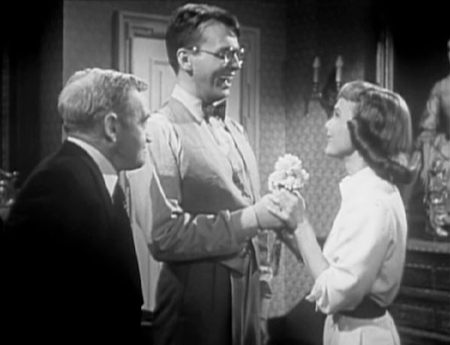
 
Next to arrive is Nicky Van Alen (Robert Stack), Schuyler and Nancy’s cousin. He’s a shallow, conceited Polo Lounge Lothario who’s never given a second’s thought to anyone but himself — but he’s the first one to notice that there’s something different about Schuyler.
 
Finally, Burke/Schuyler meets 19-year-old Nancy, who greets him with affection, remembering how he was “so sweet to me when I was little.” Burke is speechless, not sure how to respond, and Nancy turns dolefully to Noonan. “He’s worse, isn’t he?” Nancy is beautiful, fetching and open-hearted, and it’s a real effort for Burke to maintain Schuyler’s idiot grin. This job is getting more complicated by the minute.
 
 
The last relative to arrive is imperious Cassie Van Alen (Ilka Chase), Nicky’s mother and Miles and Gifford’s sister. But when the will is finally opened and read, there are a couple of surprises in store for the acquisitive branches of the Tatlock-Van Alen clan. Grandfather Tatlock, after a few small bequests to the servants, left his entire estate to “my beloved wife Annette Tatlock, for distribution to our heirs” — never suspecting that she would outlive him by only an hour. And what nobody suspected until now is that Grandmother Annette left a hand-written holographic will leaving “everything I possess” to her unfortunate grandson Schuyler — and as things turned out, everything she possessed at her death consisted of the entire Tatlock estate, lock, stock and barrel. Schuyler gets absolutely everything.
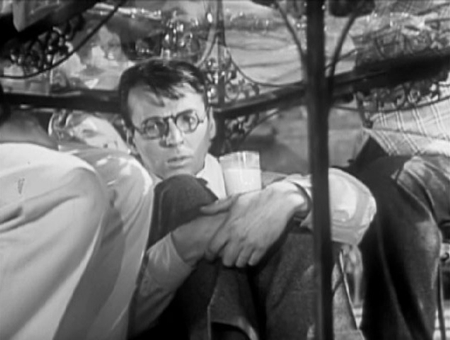
 
The next morning at breakfast, Miles, Cassie and Gifford fawn over their new favorite nephew, then ignore him as he climbs under the patio table, complacently sure that their conversation will go over his head — literally and figuratively. From his perch at their feet, Burke hears the three siblings cut a deal: Miles and Gifford will have themselves made Schuyler’s trustees, and will then settle a generous allowance — “Say, $100,000 a year for life” — on Nancy, which Cassie will gain control of by marrying Nancy off to Nicky. 
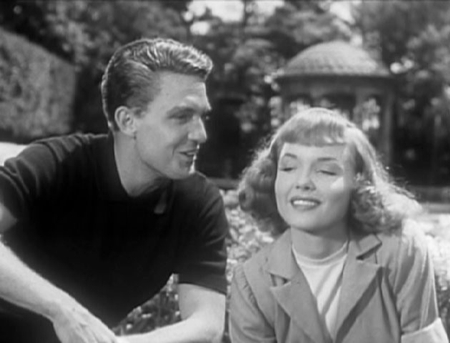
 
Once Cassie has explained the facts of life to Nicky, he turns on the oily charm to Nancy, nurturing the crush she has had on him since childhood. “It just hit me all of a sudden,” he preens, “I haven’t been giving you a break. Did a miracle happen overnight? You’ve stepped right up into my class. I could show you around with a lot of pleasure.”
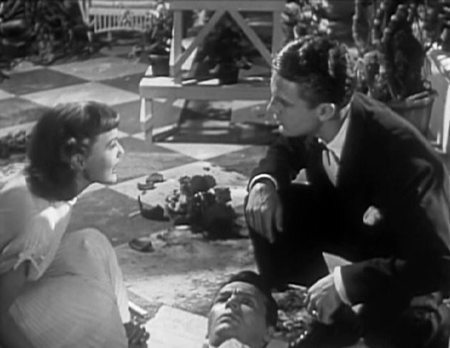
 
That night after dinner, Nicky turns up the heat over candlelight and cocktails in the greenhouse. Meanwhile, Burke prowls protectively (and jealously) in the trees overhead, keeping an eye on the snake Nicky’s progress. Suddenly he slips and falls through the glass roof, landing flat on his back at Nicky and Nancy’s feet, in a real-life reprise of the stunt that opens the picture. This time, however, he’s injured and momentarily stunned. Before his head can clear, he speaks to Nancy, forgetting to keep up the babbling Schuyler act. Nancy is thrilled, convinced that the shock has knocked Schuyler into his right mind, and that she has “a real brother” at last.
 
In the days that follow, Nancy appoints herself Schuyler’s personal therapist, moving him into the room next to hers, nursing him back to health, planning to take over his education and ease him into adult society. The aunt and uncles scramble to ingratiate themselves with their newly-competent nephew. And Nicky pouts and fumes that suddenly Nancy has no time for him.
 
Things quickly get complicated, especially for Burke, who has fallen in love with Nancy. For Nancy too, who can’t imagine why all at once her lifelong crush on Nicky pales beside her affection for her “brother”. (Here the script plays with sexual taboo in much the way Brackett and Wilder did in The Major and the Minor: In the earlier picture, Ray Milland was disturbed by his feelings for the “child” Ginger Rogers, and the movie got away with it because we knew she was really an adult. In the same way, we know here that “Schuyler” isn’t really her brother — but Nancy doesn’t.)
 
Things begin to tumble out of control, just as Burke did when he fell through the greenhouse roof. Aunt Cassie finds a mysterious bottle of hair dye under the mattress in Noonan’s room, which sets her thinking, and doing a little homework. She still has a few tricks up her sleeve.
 
Well, I think that’s about as far as I want to go; mustn’t spoil everything. Miss Tatlock’s Millions is one of the forgotten pleasures of 1940s Hollywood. I’m told that it was a moderate success at the box office with a loyal cult following (rather similar, I imagine, to the response to the original Peter Cook-Dudley Moore Bedazzled in 1967). A quick glance at the picture’s user reviews (including my own) on the IMDb testifies to the fondness for it among those who saw it, either in theaters in 1948 or (like me) later in its TV syndication.
 
Miss Tatlock’s Millions was directed by veteran character actor Richard Haydn, who also appears (under the name “Richard Rancyd”) as the family attorney who breaks the good news to “Schuyler” and the bad news to Miles, Cassie and Gifford. As Lawyer Fergel (accent on the second syllable, please), Haydn uses the patented hyper-nasal, super-enunciated voice for which he was famous, the same voice he used as the Caterpillar in Walt Disney’s Alice in Wonderland (“Ah-whooo…aaaarrrrrre…Ah-yooo?”). Haydn could be just as memorable without the voice, most noticeably as “Uncle” Max Detweiler in The Sound of Music in 1965. (I’ve heard many people bemoan the fact that Christopher Plummer was passed over for an Oscar nomination in that picture, and I agree with them. But even more unjust, I think, was the failure to nominate Haydn as best supporting actor. It should have been the capstone of his career.) For Tatlock — the first of only three pictures he directed — Haydn adopted a style and pace less headlong and frenetic than Preston Sturges at his best, but still sprightly, giving his sterling cast plenty of room to stretch out and enjoy themselves. (Brackett and Breen’s sparkling dialogue even gave Monty Woolley one of his signature lines, often quoted by people with no idea of where it came from: “California, the only state in the Union where you can go to sleep under a rosebush in full bloom — and freeze to death.”)
 
Haydn could take considerable pride in the performance he got from John Lund. Lund’s career never quite fulfilled its early promise; he seems to have spent much of it — certainly at Paramount — being palmed off as a taller version of Alan Ladd, and playing the parts Ladd didn’t want. Certainly, he shows here a flair for semi-slapstick comedy that was seldom given rein, and never exploited as fully as Brackett, Breen and Haydn do here. Miss Tatlock’s Millions is — not to mince words — a riot, and it’s largely thanks to John Lund.
 
Miss Tatlock’s Millions is harder to find than it was in 1948, or during the 1960s and ’70s on TV, but it hasn’t entirely dropped off the face of the earth. It briefly appeared on VHS during the Video Stone Age. Still, it was rare enough that I considered myself lucky to score a 16mm print on eBay about six years ago. No sooner did I do that than it came out on DVD-R from Hollywood’s Attic (as a general rule of thumb, if you want to ensure that a movie comes out on DVD, talk me into buying a 16mm print of it). That disc appears to have been transferred from a 16mm syndication print, but it’s decent enough; the pictures in this post are frame-caps from it. But even that is out of print now, though you can still (as of this writing) find a few copies on Amazon. Miss Tatlock’s Millions is long overdue for a proper DVD transfer from the Universal Vault label, using original elements, or at least a 35mm print — a transfer that does justice not only to the performances, but to Victor Young’s music and Charles Lang’s cinematography. 
 
How about it, Universal?
 
Posted in Blog Entries

Post navigation

← Older posts
Newer posts →
index sitemap advanced
search engine by freefind

Recent Posts

  • Twinkle, Twinkle, Little “Star” (Republished)

  • Sixty-Six Years’ Worth of Oscars

  • A Visit with Jody Baxter, Chick Mallison, Trooper Jeff Yorke et al.

  • Ave Atque Vale, Jody Baxter

Articles A – Z

You will find 222 posts in the category  on this blog.


Jump to , 4, A, B, C, D, E, F, G, H, I, J, L, M, N, O, P, R, S, T, U, W, Y

4

  • 40th Anniversary Tour: Jesus Christ Superstar

A

  • “A Genial Hack,” Part 1
  • “A Genial Hack,” Part 2: The Trail of the Lonesome Pine
  • “A Genial Hack,” Part 3: Peter Ibbetson
  • A “Christmas Wish” Returns
  • A Cinedrome “Christmas Tradition” Returns
  • A Cinedrome Pop Quiz
  • A Hitch in the Get-Along: State Secret
  • A Holiday Treat (I Hope!) for Cinedrome Readers
  • A Jigsaw Mystery
  • A Mystery Photo
  • A Time-Travel Studio Tour
  • A Treasure Trove of MGM Shorts, Part 1
  • A Treasure Trove of MGM Shorts, Part 2
  • A Visit with Jody Baxter, Chick Mallison, Trooper Jeff Yorke et al.
  • A Weekend With David O. Selznick
  • A-a-a-and We’re Back…!
  • Addio, Cinevent 42!
  • After a Brief Intermission…
  • America’s Canadian Sweetheart, 1921-2013
  • Andrew Sarris, 1928-2012
  • Auditioning for Immortality
  • Ave Atque Vale, Fairy Princess!
  • Ave Atque Vale, Jody Baxter

B

  • Bright Eyes, 1928-2014
  • Browsing the Cinevent Library, Part 1
  • Browsing the Cinevent Library, Part 2

C

  • C.B. Gets His Due
  • Camera Beauty
  • Cary-ing On
  • Catching Some Rays
  • Catting Around
  • CHAPTER I
  • CHAPTER II
  • Cinedrome Does Its Part
  • Cinedrome Wins 2012 CMBA Award
  • Cinedrome’s Annual Holiday Treat Returns
  • Cinerama-Rama!
  • Cinevent 2016 (Continued)
  • Cinevent 2016, Concluded
  • Cinevent 2016, Part 3
  • Cinevent 2016, Part 4
  • Cinevent 2017 – No. 49 and Counting, Part 1
  • Cinevent 2017 – No. 49 and Counting, Part 4
  • Cinevent 2017 — No. 49 and Counting, Part 2
  • Cinevent 2017 — No. 49 and Counting, Part 3
  • Cinevent 42
  • Cinevent 45
  • Cinevent 50 – Day 1
  • Cinevent 50 – Day 2
  • Cinevent 50 – Day 3 (Part 2)
  • Cinevent 50 – Prelude
  • Cinevent 50 — Day 3 (Part 1)
  • Cinevent 50 — Day 4
  • Cinevent 51 – Day 1, Part 1
  • Cinevent 51 – Prelude
  • Cinevent 51 — Day 1, Part 2
  • Cinevent 51 — Day 2
  • Cinevent 51 — Day 3
  • Cinevent 51 — Day 4
  • Cinevent Turns 50
  • Cinevent, Day 2
  • Cinevent, Day 3
  • Cinevent, Day 4
  • CMBA Blogathon: Come Next Spring (1956)
  • CMBA Blogathon: Kitty (1945)
  • Crazy and Crazier, Part 1
  • Crazy and Crazier, Part 2
  • Crazy and Crazier, Part 3
  • Crazy and Crazier, Part 4

D

  • “Don’t Stay Away Too Long…”

E

  • Elizabeth Taylor, 1932-2011

F

  • Films of Henry Hathaway: Brigham Young (1940)
  • Films of Henry Hathaway: Down to the Sea in Ships
  • Films of Henry Hathaway: Down to the Sea in Ships
  • Films of Henry Hathaway: Fourteen Hours (1951)
  • Films of Henry Hathaway: Prince Valiant
  • Films of Henry Hathaway: The Shepherd of the Hills
  • First Comes the Phone Call
  • Five-Minute Movie Star: Carman Barnes in Hollywood — Epilogue
  • Five-Minute Movie Star: Carman Barnes in Hollywood, Part 1
  • Five-Minute Movie Star: Carman Barnes in Hollywood, Part 2
  • Five-Minute Movie Star: Carman Barnes in Hollywood, Part 3
  • Flo Chart

G

  • “Glamour Boys” Begins…
  • “Glamour Boys” Continues…
  • Grand Opening!

H

  • “Here’s a Job for You, Marcel,” Part 1
  • “Here’s a Job for You, Marcel,” Part 2
  • “Here’s a Job for You, Marcel,” Part 3
  • Harlow in Hollywood

I

  • “Is Virginia Rappe Still Alive?”
  • Items from the Scrapbook of Cosmo Brown
  • Items from the Scrapbook of Cosmo Brown

J

  • Jigsaw Mystery — Solved?

L

  • Liebster Blog Award
  • Lost & Found: Alias Nick Beal
  • Lost & Found: Night Has a Thousand Eyes
  • Lost and Found: Miss Tatlock’s Millions (1948)
  • Luck of the Irish: Darby O’Gill and the Little People, Part 1
  • Luck of the Irish: Darby O’Gill and the Little People, Part 2
  • Luck of the Irish: Darby O’Gill and the Little People, Part 3
  • Luck of the Irish: Darby O’Gill and the Little People, Part 4

M

  • “MOVIE” Souvenir Playing Cards
  • Merry Christmas from Cinedrome!
  • MERRY CHRISTMAS from Cinedrome!
  • Mickey and Judy — Together at Last
  • Minority Opinion: The Magnificent Ambersons, Part 1
  • Minority Opinion: The Magnificent Ambersons, Part 2
  • Minority Opinion: The Magnificent Ambersons, Part 3
  • Minority Opinion: The Magnificent Ambersons, Part 4
  • Minority Opinion: The Magnificent Ambersons, Part 5
  • Minority Opinion: The Magnificent Ambersons, Part 6
  • Movie Playing Cards: 3 of Hearts – Geraldine Farrar
  • Movie Playing Cards: 5 of Spades – George Walsh
  • Movie Playing Cards: 9 of Diamonds – Mary Miles Minter
  • Moving Right Along…
  • Mr. Stewart Goes to War

N

  • Nuts and Bolts of the Rollercoaster

O

  • Our Mr. Webb

P

  • Picture Show 02 — Day 1
  • Picture Show 02 — Day 2
  • Picture Show 02 — Day 3
  • Picture Show 02 — Day 4
  • Picture Show 02, Day 00 — Prelude at the Wex
  • Picture Show 2022 – Day 2
  • Picture Show 2022 — Day 1
  • Picture Show 2022 — Day 3
  • Picture Show 2022 — Day 4
  • Picture Show 2022 — Prelude
  • Picture Show No. 3 — Day 1, Part 1
  • Picture Show No. 3 — Prelude
  • Picture Show No. 3 — Tying Off a Loose End
  • Please Stay Tuned

R

  • R.I.P. Ray Harryhausen, 1920-2013
  • Remembering the Night
  • Remembering the Night
  • Return of “Movie” Souvenir Playing Cards
  • Returning to Lost London
  • Returning to Lost London (Reprinted)
  • Rex the First
  • Rhapsody in Green and Orange – EPILOGUE
  • Rhapsody in Green and Orange, Part 1
  • Rhapsody in Green and Orange, Part 2
  • RIP Dean Stockwell, 1936-2021

S

  • Say, What Ever Happened to Carman Barnes?
  • Shirley Temple Revisited, Part 1
  • Shirley Temple Revisited, Part 10
  • Shirley Temple Revisited, Part 11
  • Shirley Temple Revisited, Part 12
  • Shirley Temple Revisited, Part 13
  • Shirley Temple Revisited, Part 14
  • Shirley Temple Revisited, Part 2
  • Shirley Temple Revisited, Part 3
  • Shirley Temple Revisited, Part 4
  • Shirley Temple Revisited, Part 5
  • Shirley Temple Revisited, Part 6
  • Shirley Temple Revisited, Part 7
  • Shirley Temple Revisited, Part 8
  • Shirley Temple Revisited, Part 9
  • Silent Weekends
  • Silents in Kansas 2011, Part 2
  • Sixty-Six Years’ Worth of Oscars
  • Songs in the Light, Part 1
  • Songs in the Light, Part 2
  • Songs in the Light, Part 3
  • Speak (Again) of the Devil
  • Speak of the Devil…

T

  • “The Best of Us,” Part 1
  • “The Best of Us,” Part 2
  • “The Best of Us”, Part 1
  • “The Best of Us”, Part 2
  • Ted Sierka’s Brush with Greatness
  • The 11-Oscar Mistake
  • The Annotated “Lydia the Tattooed Lady”
  • The Bard of Burbank, Part 1
  • The Bard of Burbank, Part 2
  • The Could-Have-Been-Greater Moment
  • The Duke of Hollywood
  • The Fog of Lost London, Part 1
  • The Fog of Lost London, Part 1
  • The Fog of Lost London, Part 2
  • The Fog of Lost London, Part 2
  • The Fog of Lost London, Part 3
  • The Fog of Lost London, Part 3
  • The Fog of Lost London, Part 4
  • The Fog of Lost London, Part 4
  • The Kansas Silent Film Festival 2011
  • The Last Cinevent, the First Picture Show — Day 1
  • The Last Cinevent, the First Picture Show — Day 2
  • The Last Cinevent, the First Picture Show — Day 3
  • The Last Cinevent, the First Picture Show — Day 4
  • The Man Who Saved Cinerama
  • The Mark of Kane
  • The Museum That Never Was, Part 1
  • The Museum That Never Was, Part 2
  • The Return of the King
  • The Rubaiyat of Eugene O’Neill
  • The Sensible Christmas Wish
  • The Shout Heard Round the World
  • The Stainless Steel Maiden, 1916-2020
  • The Stamm
  • Tony Curtis 1925-2010
  • Tragedy in Nevada, January 1942
  • Twinkle, Twinkle, Little ‘Star’
  • Twinkle, Twinkle, Little “Star” (Republished)

U

  • Ups and Downs of the Rollercoaster, Part 1
  • Ups and Downs of the Rollercoaster, Part 2
  • Ups and Downs of the Rollercoaster, Part 3
  • Ups and Downs of the Rollercoaster, Part 4
  • Ups and Downs of the Rollercoaster, Part 5
  • Ups and Downs of the Rollercoaster, Part 6

W

  • “Who Is the Tall Dark Stranger There…”
  • Wings, Again
  • Wyler and “Goldwynitis”
  • Wyler and “Goldwynitis” (reprinted)
  • Wyler Catches Fire: Hell’s Heroes
  • Wyler Catches Fire: Hell’s Heroes
  • Wyler’s Legacy
  • Wyler’s Legacy (reprinted)

Y

  • Yuletide 2018

Copyright Notice

All textual content Copyright © date of posting by Jim Lane. All rights reserved. Unauthorized use and/or duplication of this material without express written permission from this blog’s author is strictly prohibited. Excerpts and links may be used, provided that full and clear credit is given to Jim Lane and Jim Lane’s Cinedrome with appropriate and specific direction to the original content.

↑