Silent Weekends
I recently spent two consecutive Saturdays in a sort of time machine, living the silent movie experience of 1927 — what seemed back then to be its culmination, but was in fact a final blaze of glory before the whole structure collapsed under the onslaught of talking pictures. The first Saturday (on March 31) was a once-in-a-lifetime experience I never expect to repeat, but the second (on April 7) was one I can recreate for myself any time I want — and so can you.
 Seeing Abel Gance’s Napoleon as it was meant to be seen — with a live symphonic accompaniment and its climactic three-panel “Polyvision” sequence, including this Tricolor triptych — truly is a once-in-a-lifetime thing. I’ve been lucky; I’ve seen it three times. The first time was Bastille Day (July 14) 1981, when just about everybody who was anybody in Hollywood — plus a hefty contingent of nobodies like me — crammed the Shrine Auditorium in Los Angeles to see Gance’s masterpiece and to hear Francis Ford Coppola’s father Carmine conduct his own score. That engagement was such a thundering triumph that Napoleon and Coppola père returned to the Shrine for nine days in December and January ’82, and I saw it again.
 But this third time topped them both, and it came my way courtesy of the San Francisco Silent Film Festival (SFSFF). The movie I saw at Oakland’s Paramount Theatre was an hour and 45 minutes longer than the one I saw at the Shrine in 1981 and ’82. Some of the extra time was additional footage, some the result of a proper running speed of 20 frames per second (the Shrine speed had been 24 fps).
The great Kevin Brownlow — on top of everything else he’s done — has made the restoration of Gance’s picture a lifelong project, ever since he first bought two 9.5mm reels as a teenager in the 1950s. His efforts have been tireless and positively superhuman. In his 1983 book on the subject he lists no fewer than 19 different versions of Napoleon, beginning with its April 1927 premiere at the Paris Opera (4 hours 5 minutes) and Gance’s so-called “definitive version” (9 hours 20 minutes) shown only twice the following month — through various re-edits and reissues, right down to Brownlow’s own 1983 reconstruction for the Cinematheque Francaise (5 hours 13 minutes). But Brownlow didn’t stop there; additional footage has continued to surface from time to time in the nearly 30 years since his book. The version screened in Oakland was assembled by Brownlow and Patrick Stanbury in 2000 for the British Film Institute and has never been shown outside Europe; these four screenings were the first in the U.S., and no others are contemplated. With the expense and time involved in hiring and rehearsing a live orchestra (to say nothing of, in the SFSFF’s case, bringing composer Carl Davis over to conduct the score in person), plus the technical demands of three synchronized projectors, Napoleon is insanely expensive to present. The San Francisco Festival’s efforts in this regard were heroic to the point of foolhardiness: it cost more than their entire budget for a normal year, and even if they sold every one of the Paramount’s 3,100 seats (at $40-150 a pop), they would only break even. (They sold out, sure enough, at the screening I saw; I can’t speak for the other three. I stuffed some extra cash in the Festival’s donation jar in the lobby, saying, “It’s a noble thing you people are doing, and I know you’re taking a bath on it.” The attendant smiled and shrugged: “It’s the mission of the festival.”)
Well, God bless ’em for it.
Gance regarded Napoleon as a tragic hero, and he planned a biography in six installments that would take his protagonist from his early revolutionary fervor and triumph through growing tyranny and megalomania to final downfall. But the best-laid plans, you know: Gance blew his budget for all six pictures on the first one, and the rest were never made. Probably just as well in the long run; it makes it possible for the one he did make to end on an exultant note, with the conquest — oops! “revolutionary liberation” — of Italy. But it matters little whether or not you accept Gance’s historical analysis (personally, I don’t; I think Bonaparte was pretty much a Megalomaniac in Waiting from the word go, biding his time while the thugs and jackals of the Reign of Terror lopped each other’s heads off); Napoleon is still a sensual and emotional feast that makes the word “movie” sound too puny to contain it. Seeing it the way we saw it in Oakland was a rare privilege, and I’m telling you right now: If you ever hear of this picture coming to anyplace within a thousand miles of you, do not let this golden opportunity slip by, and do not imagine that it will ever come again. Hop a plane, book a hotel, rent a car, do whatever it takes.
UPDATE 11/16/2022: When I published this post in 2012, I closed this half of the post with an embedded YouTube clip of the Napoleon trailer prepared for the SFSFF. For reasons that have never been clearly explained to me, I’m no longer able to embed YouTube videos, and the link I had has gone dead — even though that trailer is still here on YouTube. For good measure, there’s also this trailer advertising Napoleon‘s release on DVD and Blu-ray (alas, only in Europe Region 2, incompatible with North American players). I direct your attention to those trailers. Whichever one you watch, be sure to take it full-screen; it’ll give you (just barely) an inkling.
* * *

My sister-in-law mentioned a while back that she was embarking on a project to see all the Oscar-winners for best picture that she hadn’t managed to catch up with over the years. First on her list, naturally enough, was Wings — the first (and until this year the only) silent movie to win the Oscar for best picture.
(Strictly speaking, that’s not exactly true. There was no actual “best picture” category that first year; what Wings won was “best production”. There was also “artistic quality of production”, which went to F.W. Murnau’s Sunrise. So in a sense you could say that that year — for the only time — there were really two best pictures. Frankly, I think this production/artistic-quality-of-production dichotomy might be worth bringing back.)
Anyhow, back to my sister-in-law’s see-all-the-best-pictures project. It so happened that I had just gotten the new Blu-ray restoration of Wings and had been looking for an excuse to host a screening of it. I urged her not to settle for Wings from Netflix. I learned last year at the Kansas Silent Film Festival that to see Wings on home video is one thing, but to see it projected on a large screen is to understand at last why it won the Oscar (something it has in common with both Lawrence of Arabia and Oliver!). I suggested she wait until I could screen it for her and my brother, she agreed, and the date we settled on was April 7.
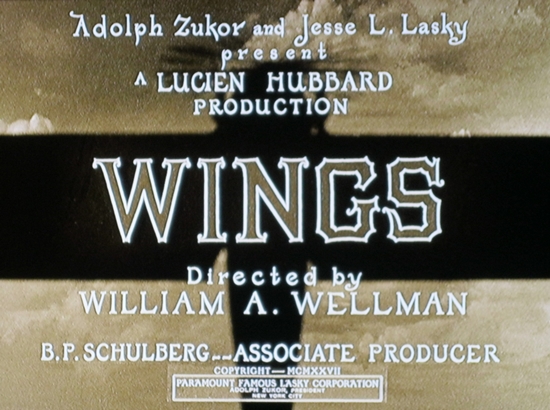 I would venture to guess that in the transfer to home video, no silent picture — perhaps no picture, period — has ever been as lovingly and carefully treated as Wings; Paramount Home Video can be as proud of the transfer as they are of the picture itself, for both are justified.
Leonard Maltin’s Movie Guide gives Wings two-and-a-half stars, saying: “One of the most famous silent films is, alas, not one of the best, despite rose-colored memories.” I say it’s Leonard who needs a memory check; Wings is a whopping piece of entertainment, and it set the template for Oscar-winning best pictures, with only rare (and usually regrettable) exceptions, from that day to this: well-crafted crowd-pleasers rather than groundbreaking works of art.
 Almost as important as that dupe negative, Paramount also had the original documentation for how the picture was to be tinted — both stock-tinting (amber, violet, sepia etc.) and the Handschiegel process (shown here), which added color to highlight flames, machine-gunfire and explosions; the documents specified exactly the shades to be used and the frames where every tint was to begin and end.
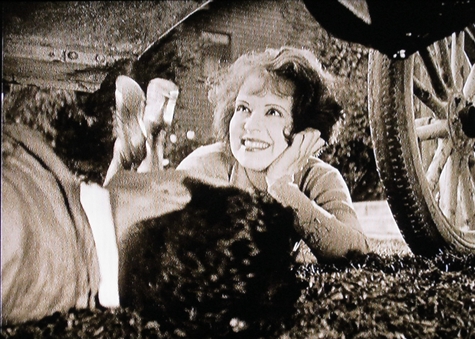 Last but absolutely not least, Wings has this young lady. Let me say this as plainly as I can: There was never a more charming and delightful movie star than Clara Bow. Plenty who were as delightful, certainly, but none more so. Ever. (If you don’t know Clara’s work, Mantrap [1926] and It [’27] are good places to start. For that matter, so is Wings.) She was the hottest star in Hollywood in 1927 (in every sense of the word), so naturally she’s top-billed in Wings, but it’s really a supporting role, almost a cameo; she plays the adoring, neglected girl next door who follows Buddy Rogers to France as a member of the Women’s Motor Corps. When Buddy’s leave in Paris is cancelled but he’s too drunk to respond, Clara goes to fetch him, only to find he’s too drunk even to recognize her, and she must dress as the flapper her fans have come to expect, all to lure him away from a French demimondaine with designs on him. (This scene also has Wellman’s most amazing non-combat shot, as the camera glides across table after table at the Folies Bergere, each with its own little drama going on: an angry woman tossing her drink in her lover’s face, a matron slipping cash to her gigolo, an adulterous couple nervously looking over their shoulders, even a pair of love-struck lesbians!)
Page, don't give up on Wings. I don't know exactly where you're located, but it does turn up on big screens from time to time; a pity TCM can't organize a one-night-only showing of the new restoration, like they did for Casablanca (and will again tomorrow, 4/26/12) — but then, it's a Paramount picture, so why would TCM care?
As for Napoleon…well, all I can say that hasn't already been said is that you'd be amazed how quickly those five-and-a-half hours fly by.
Jim,
I haven't seen Napoleon but from the sounds of it that's okay.
I'm quite envious that you can watch Wings on such a large screen. I do have a large flat screen but I don't have a great copy of Wings nor a projector setup.
I would love the chance to see it in the theater at least once.
Thanks for sharing!
Page
Jim, my 15-year-old daughter and I have taken a look at silent films on TCM in recent months. When I mentioned to her that you were writing about the silent films NAPOLEON and WINGS, she couldn't resist adding, "They're cops!" 🙂 But all kidding aside, she's been intrigued, so I can hardly wait for her to take a look at your fascinating post about these films and the discussion of the restored versions! I quite agree with your remark: "Frankly, I think this production/
artistic-quality-of-production dichotomy
might be worth bringing back.)" Amen to that! Great post, Jim, as always!
High praise indeed for two silent landmarks. Hyperbole on your part? Absolutely NOT! Today's entry makes many valid points: the value of a film's collective audience experience, the important of proper presentation to enhance enjoyment, the never-ending (but greatly appreciated and worthwhile) efforts of preservation, and the ability of art (in any form) to transcend time, tastes, and generations.
I bow to your Francophilia, Kim, and agree to disagree about the Corsican Upstart. No disagreement about Wings, though: a sight to see indeed, even in that "old version".
Jim, I've seen Napoleon, but never on the big screen and in the atmosphere(s) that you have. While I can't agree with your comments about Napoleon the man (years and years of study forbid it), I do agree that Gance did a stunning job with this. It is too bad that there is no complete version.
As for Wings, I haven't seen the new renovation, but if it's much better than the old version I saw it will be a delight. The fight scenes (both in the air and on the ground) are a sight to see.
I hope more people read this post!