
(NOTE: I feel terribly guilty about letting the Cinedrome lie fallow for so long. Between Christmas shopping and nine performances a week of A Christmas Carol at the Sacramento Theatre Co. I haven’t had the time I would like to devote to researching and writing my next post (on The Magnificent Ambersons). Soon, I promise! Until then, here’s an earlier post on one of my favorite movies, for those who may not have seen it when I put it up a year ago. — jl)
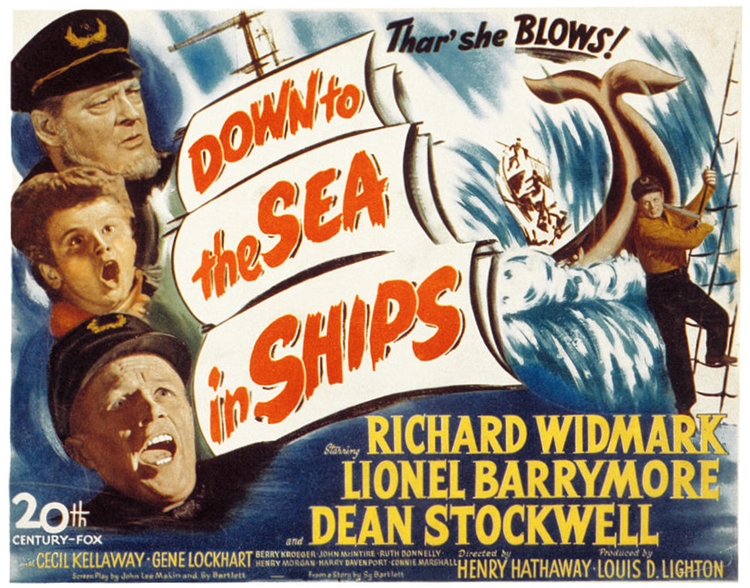 In 1949 Henry Hathaway made one of the best movies of his long career. In it, his three stars, Richard Widmark, Lionel Barrymore and Dean Stockwell (and for that matter, most of the supporting cast) each gave one of his own best performances. Down to the Sea in Ships is in fact one of the finest movies ever to come out of the Hollywood studio system, and almost nobody has ever heard of it.
I know I run the risk of overselling the product here, but I simply don’t understand why Down to the Sea in Ships isn’t one of the best-loved movies of all time. When the talk turns to the great seafaring stories of the screen — Treasure Island, Mutiny on the Bounty, Captains Courageous, Moby Dick et al. — it’s a mystery to me why Down to the Sea in Ships never comes up. If there are such things as flawless movies, and there surely are, Henry Hathaway’s Down to the Sea in Ships is one of them.
I say “Henry Hathaway’s” to distinguish this picture from the other Down to the Sea in Ships, from 1922. That one made a star out of Clara Bow, and curiously enough, it’s available on home video — no doubt because it’s in the public domain, while Hathaway’s picture is still under copyright and quarantined in the 20th Century Fox vault. (UPDATE 12/19/24: This situation has been rectified; see below.) In the 1960s and ’70s it was the other way around: Down to the Sea in Ships (1922) was gone and long forgotten, but if your local TV station had a decent film library and you were willing to stay up till two or three in the morning, you could count on seeing Down to the Sea in Ships (1949) two or three times a year.
Before we leave the subject of Clara Bow’s breakout vehicle for good, let’s get one point clear: Wikipedia says that the 1922 picture “was remade by Twentieth Century Fox in 1949,” but — well, that’s Wikipedia for you. (Whoever wrote the article didn’t even know that it’s “20th Century Fox,” not “Twentieth.”) In fact, there is no connection whatsoever between the two pictures — other than the fact that they both deal with whaling ships out of New Bedford, Mass., and they both take their title from Psalm 107:23 (“They that go down to the sea in ships, that do business in great waters…”). These aren’t two versions of the same story, they’re two different movies with the same title; henceforth, when I use the title, I’ll be talking about only one of them.
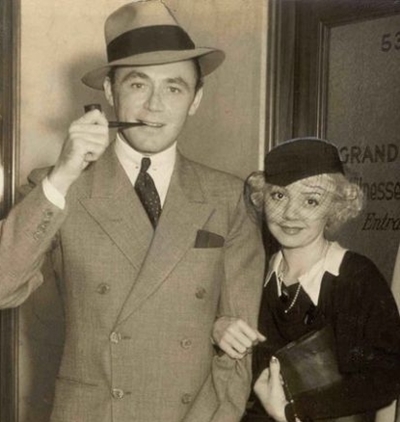 After the war, Zanuck reactivated the project and handed it over to producer Louis D. (“Buddy”) Lighton and director Hathaway. Both men were working for Fox now, but they had been paired before in the 1930s at Paramount: Lighton had produced the Shirley Temple vehicle Now and Forever, The Lives of a Bengal Lancer, and Peter Ibbetson, all of which Hathaway directed. The first draft of the script was by Sy Bartlett — that’s him at right with first wife Alice White — born Sacha Baraniev in Russia (now Ukraine) in 1900 but raised in America from the age of four. Originally a newspaper reporter, he became a screenwriter for various studios in the ’30s, but he was noted more for hobnobbing in Hollywood society, hosting Sunday barbecues, and the occasional gossip-column appearance. He served with the U.S. Army Air Corps during World War II, then returned to Hollywood and a job at Fox. At the time that he took his first cut at Down to the Sea in Ships, Bartlett’s most memorable work was still ahead of him: he later turned his wartime experience into the novel and screenplay Twelve O’Clock High (1949) for director Henry King and star Gregory Peck.
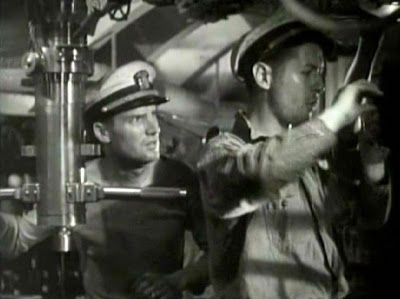 Music historian Jon Burlingame (in his notes for the movie’s soundtrack CD) says Bartlett’s script underwent a rewrite by John Lee Mahin — shown here (on the left) in a rare acting stint in Hell Below (1933) with Robert Montgomery. Like Bartlett a reporter-turned-screenwriter, Mahin already had a number of major credits on his resume, many of them — including Red Dust, Treasure Island (1934), Test Pilot, Captains Courageous and Dr. Jekyll and Mr. Hyde (1941) — for Hathaway’s mentor Victor Fleming.
Once the Pride of New Bedford is out to sea, Capt. Joy plays his trump card. He tells Lunceford that he sees “the hand of Providence” in Lunceford’s presence on board. Jed was allowed to ship out, he says, only on the condition that his studies be continued, and Capt. Joy is hereby assigning Lunceford, in addition to his regular duties as first mate, to be Jed’s tutor during his off-duty hours. In this way, the crafty old mariner intends to kill two birds with one stone: he’ll see to Jed’s education, and he’ll keep Lunceford too busy to undermine his authority.
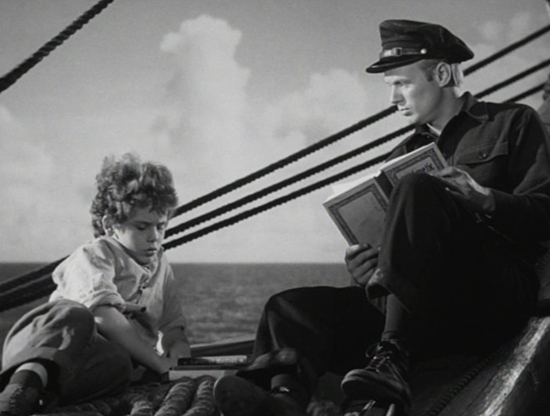 Lunceford has no choice but to accept the assignment, but he does so with ill grace. Resentful at what he regards as essentially a babysitting chore, he is impatient, sarcastic and dismissive. Resentful in turn, Jed is obstreperous and uncooperative. Lunceford decides Jed is just as ornery and pigheaded as his grandfather, and he give up the lessons as a waste of his time.
Stung, Jed applies himself and in time surprises Lunceford with answers to all the questions that had stumped him before. Lunceford suddenly approaches his duties as tutor in earnest, tailoring lessons more carefully to Jed’s quick and lively but unsophisticated intelligence. As the friendship grows between Jed and Lunceford, Capt. Joy begins — rightly or wrongly — to fear that his grandson’s respect and affection are drifting away from himself and attaching themselves to Lunceford; he responds to the unexpected competition by looking more carefully at Lunceford’s ideas, which he had formerly dismissed as not worth his attention. All this happens even as the Pride of New Bedford roams the waters of the South Atlantic, stalking and taking whales.
That’s about as much of the plot as I care to go into here; better that you should discover the rest for yourself. Down to the Sea in Ships isn’t available on home video, but it does surface (pun intended) from time to time on the Fox Movie Channel, and it’s worth seeking out to discover how the three-generation, three-way relationship of Capt. Joy, Jed and Dan Lunceford plays itself out against the background of a perilous voyage contending with the forces of nature and the leviathans of the deep. Each of the three discovers qualities of strength and character in the others that he either never suspected or did not properly value at first. Each brings out the best in the other two, and allows the other two to bring out the best in him. (UPDATE 12/19/24: The picture is now available on a DVD from 20th Century Fox Cinema Archives.)
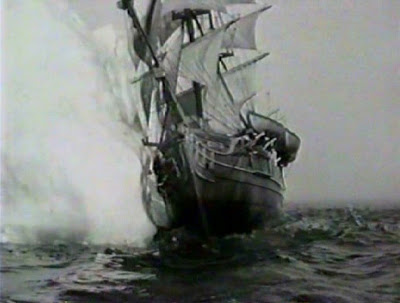 All this, mind you, while the movie does not skimp on action and high adventure. There are scenes of whale chases and boats lost at sea, suspenseful and beautifully shot (Joe MacDonald) and edited (Dorothy Spencer), with excellent special effects (Fred Sersen and Ray Kellogg). Capping it all is a climactic sequence in which the Pride of New Bedford runs aground on an iceberg in the fog near the horn of South America…
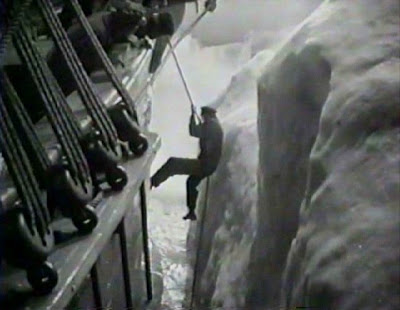 …with the crew desperately struggling to free themselves and repair the damage before the sea pounds their ship to splinters against the unforgiving ice. Not to mince words, it’s an absolutely brilliant action/suspense set piece. Amazingly enough, it was shot entirely in a soundstage tank on the Fox lot, but it’s spectacularly convincing and harrowing for all that.
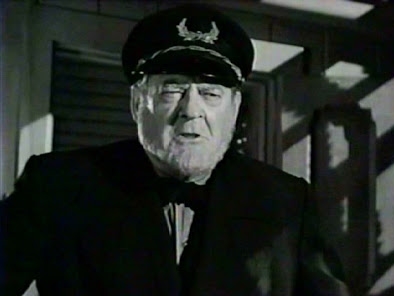 Down to the Sea in Ships was Lionel Barrymore’s last starring role, on loan from MGM. Once, when introducing Barrymore on a 1939 radio broadcast, Orson Welles referred to him as “the most beloved actor of our time.” It was probably an exaggeration, but not by much; Barrymore’s stock in trade was playing cantankerous old codgers with hearts of gold. Ironic, then, that the only role for which he’s widely remembered today is Old Man Potter in It’s a Wonderful Life, one of the most thoroughly heartless characters in the history of movies. In his own day Barrymore was more closely identified with wise old Dr. Gillespie in MGM’s Dr. Kildare series, and with his annual holiday performances as Ebenezer Scrooge on radio. In fact, Barrymore had been slated to play Scrooge in MGM’s A Christmas Carol (1938) until he broke his hip in an auto accident. That injury landed him in a wheelchair, then advancing arthritis kept him there for the rest of his career — until Down to the Sea in Ships.
Is this callousness or tough love? Po-tay-to, po-tah-to. Hathaway had a reputation for being tough on actors. His side of it was simply that he refused to mollycoddle them; he expected actors to report to the set ready to work. He also remembered the day they finished shooting Barrymore’s scenes:
We finish the picture, he walked off the set. No wheelchair. No crutches. And he came to me and said, “Mr. Hathaway, I want to tell you, you did more for me and for my life on this picture than ever happened to me before. From my father or my mother, or from anybody. I was just simply sitting there and waiting to die.”
Hathaway went on to say that they remained friends for the rest of Barrymore’s life. In any case, whatever the validity of Hathaway’s recollection, the evidence is there on screen: Barrymore responded — whether out of spite or chagrin — by giving one of his strongest performances in years. For once he’s not merely being wheeled around the set acting crusty (although in his more physically active shots he was often doubled by assistant director Richard Talmadge).
I don’t mean to minimize the genuine pain Barrymore surely suffered, but that wheelchair must have been a real convenience for a man who had never been all that crazy about being an actor to begin with. In youth, his real interests were in painting, writing, and composing music, but the pressure to enter the family trade (and the money to be made from it) kept him on stage, screen and radio for nearly sixty years. The role of Capt. Bering Joy was a recognizable “Lionel Barrymore type”, but it was also a complex and vigorous character betrayed by age and ill health, and Barrymore the self-described ham connected with it on a more profound level than almost any part he ever played. He deserves to be remembered for this performance as much as — indeed, more than — for the unalloyed wickedness of Henry Potter.
 Down to the Sea in Ships was Richard Widmark’s fifth movie, after his sensational debut as the giggling psycho killer Tommy Udo in Hathaway’s Kiss of Death (1947). In the intervening three pictures, Widmark played a woman-beating gang lord (The Street with No Name), a murderously jealous bar owner (Road House) and an underhanded western outlaw (Yellow Sky). The studio realized he was in danger of being typecast as a succession of nutjobs, sleazeballs and unsavories (because he played them so well), when what the studio really needed was another leading man. Casting him as Dan Lunceford was a conscious effort to help him segue into more sympathetic roles. It worked. Widmark went on to be one of Fox’s most stalwart leading men, playing good guys (Slattery’s Hurricane, Panic in the Streets), bad guys (No Way Out, O. Henry’s Full House) and guys in between (Pickup on South Street, Don’t Bother to Knock) — until, like many other stars, he went free-agent in the mid-1950s.
In Down to the Sea, Widmark is top-billed, although he doesn’t appear until half an hour in. His Dan Lunceford is the character who goes through the most self-surprising changes in the course of the picture. After all, Jed is an adolescent coming of age, and changes are to be expected, while Capt. Joy, though seemingly set in his ways and defiantly so, proves to be flexible, open to change, and willing to learn — when he thinks nobody is watching and he can do it without losing face.
Capt. Joy blusters, but it’s Dan Lunceford who is most nearly arrogant at the outset; part of the reason the captain scoffs at Lunceford’s education is that he senses Lunceford is more than a little puffed-up about it. For his part, Lunceford treats Capt. Joy with an exaggerated politeness that stops just short of insolent sarcasm. (Capt. Joy: “You may have noticed that most of my crew generally sign on again.” Lunceford [drily]: “Out of affection no doubt, sir.”) His sarcasm towards Jed’s lessons, on the other hand, is undisguised — at first. In time, he comes to realize he has misjudged them both, especially the captain. By the end he’s telling Jed that his grandfather is “more of a man than you or I could ever hope to be.” It’s an admission Lunceford could hardly have imagined making when the voyage began.
 And then there’s Dean Stockwell. Stockwell’s first screen role came in 1945, when he was eight years old, and he’s still working today — which means that his career has now lasted longer than Lionel Barrymore’s or Richard Widmark’s. (UPDATE 12/19/24: Dean Stockwell passed away on November 7, 2021, age 85.) When I screened my print of Down to the Sea in Ships for some friends, one of them said, “Dean Stockwell was a revelation!” She was familiar with Stockwell as an adult actor, and knew he had started as a child star, but had no inkling he was ever as good as he is here. (“He was marvelous,” remembered Hathaway, “just a great actor. Intense little guy.”) My friend was right: Dean Stockwell’s performance here is a revelation, easily (at the age of twelve) the best of his career — and for an actor whose résumé includes Anchors Aweigh, Gentleman’s Agreement, The Boy with Green Hair, The Secret Garden (’49), Kim, Compulsion, Long Day’s Journey into Night, Blue Velvet, and the TV series Quantum Leap, that’s saying something. Jed Joy is the fulcrum upon which the plot of Down to the Sea in Ships pivots, and in Stockwell’s performance we see him grow from an uncertain, sometimes petulant child into the makings of a fine, strong young man — he seems even to grow taller as the story progresses (and it’s all in his acting; the shooting schedule wasn’t that protracted).




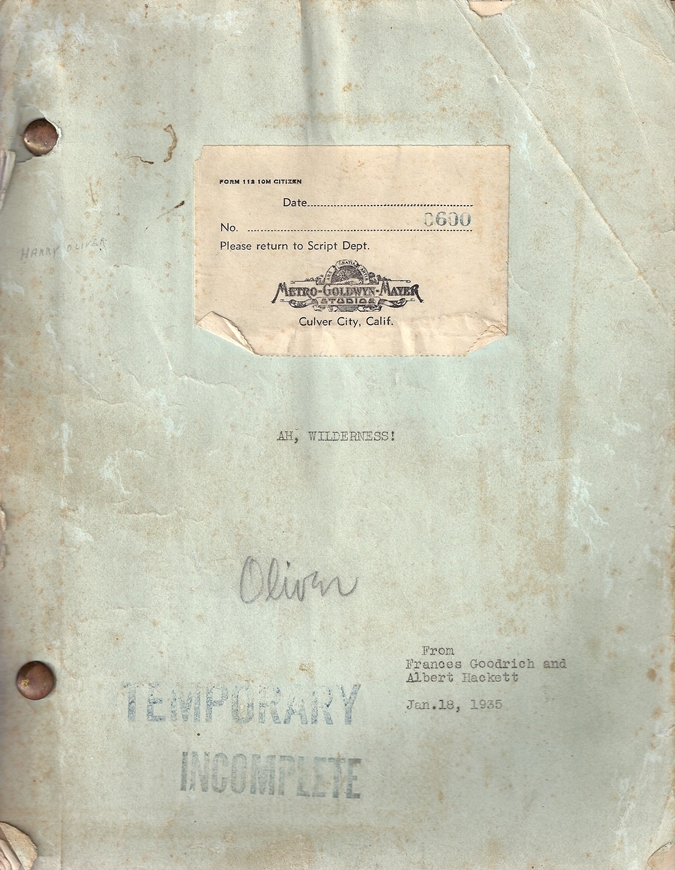 An interesting artifact has come into my hands on loan from an old friend. It’s an early draft of the screenplay for MGM’s 1935 movie of Eugene O’Neill’s Ah, Wilderness! by the husband-and-wife team of Frances Goodrich and Albert Hackett.
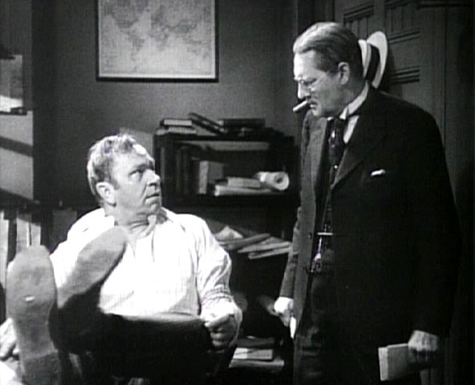 The first major difference is in the treatment of Wallace Beery’s role. Beery (left) gets top billing in the picture, playing Sid Davis, the brother of Spring Byington’s Essie Miller and the brother-in-law of Essie’s husband Nat (second-billed Lionel Barrymore, right). O’Neill’s play all takes place on one day — July 4, 1906 — but the Hacketts had expanded the time frame to open a week or two earlier (“late June”), before Sid enters the action (he comes back to the Miller household after being fired for drunkenness from his newspaper job in a neighboring town). So in this January 18 draft, Sid doesn’t show up until page 40 (of 93), on the morning of the Fourth. This would hardly do for a star of Beery’s standing at the time (I wouldn’t put it past him to have griped about it himself, loud and long), so a scene was added showing him going off with high hopes — for both his new job and his newfound sobriety — at the end of June, before slinking back to the Millers in time for the holiday. (“Ma! Pa! Uncle Sid’s come to spend the Fourth!” To which Sid mutters under his breath: “The Fourth, fifth, sixth, seventh, eighth, ad infinitum.”)
 As for the second major difference, it’s another scene that doesn’t appear in O’Neill’s play — a major one, just over 15 minutes long. I don’t know when it was inserted into the script, but God bless the Hacketts for writing it, and Clarence Brown for directing it so beautifully, because it’s one of the best and funniest scenes in the whole movie. Most of it takes place during the graduation ceremony at the high school in this small Connecticut city, where Nat and Essie Miller’s middle son Richard (Eric Linden) will be the valedictorian. Before Richard’s speech, however, we’re treated to a generous sampling of the commencement program: the school glee club singing “The Blue Danube”, an earnest young student reciting Mark Antony’s funeral oration from Julius Caesar; a more nervous youngster offering Poe’s “The Bells” (“…of the bells bells bells bells bells bells bells…”) and studiously counting every “bells” off on his fingers; a girl student’s how-I-spent-my-summer-vacation travelogue about her family’s visit to the Swiss Alps; and my favorite, this young lady (I wish I knew her name) struggling doggedly through a clarinet solo, darting irritated glances toward her piano accompanist at every real and imagined mistake.
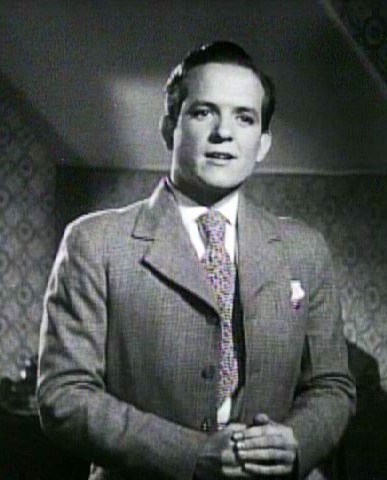 In their adaptation, the Hacketts emphasized the one slim thread of plot in O’Neill’s nostalgic reverie of a youth he never had: the emotional growing pains of the Millers’ middle son Richard, from his jejune flirtation with radical politics to his blossoming romance with neighbor girl Muriel McComber (Cecilia Parker) and the mean-spirited oppostion of her father. In so doing, the Hacketts handed 25-year-old Eric Linden the opportunity to give the performance of his career — and he delivered in style. Never mind that he gets no better than fourth billing; Ah, Wilderness! is Eric Linden’s picture from beginning to end. And never mind that he was a good decade too old for the role; his boyishness made him look not a day over 16, and his performance did the rest. Linden had a busy career in the 1930s — mostly in B-pictures for RKO, Warners and MGM — without ever really becoming a star; this was his only chance to carry an A-picture on his own. After this it was back to Bs at Metro and on loan to various studios and independent producers. But before he finally closed out his career in 1943 with Criminals Within (for lowly Producers Releasing Corporation, the skid row flophouse of Hollywood studios), he would give one more performance that I’m sure everyone who ever saw it will remember to their dying day:
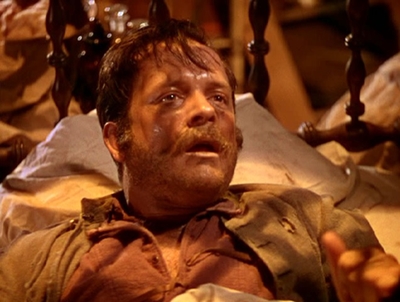 He was the Confederate soldier in Gone With the Wind who has just learned from Harry Davenport’s Dr. Meade that his leg will have to be amputated. He is on screen for less than three seconds, but his desperate cries (“Don’t cut! Don’t! — cut! Ple-e-e-e-ease!!”) have curdled the blood of millions of moviegoers for over 70 years. Oh yes, I’ll just bet you remember Eric Linden, all right.
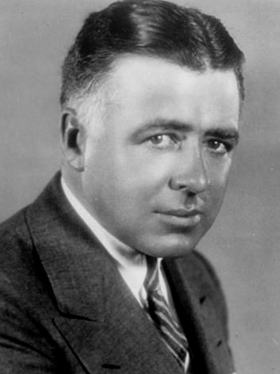 The Hacketts deftly tinkered with the letter of O’Neill’s play, but Ah, Wilderness! the movie remained stoutly faithful to its spirit, and for that, a good share of the credit should go to director Clarence Brown. Brown’s career and work deserve more attention than they’ve gotten, and maybe someday I’ll have more to say about him. For now, I’ll simply observe that in his 53 pictures between 1920 and 1952 he directed a striking number of performers to their best-ever performances: Eric Linden here, Elizabeth Taylor in National Velvet, Claude Jarman Jr. in The Yearling, Juano Hernandez in Intruder in the Dust, George Brent in The Rains Came, Marie Dressler in Emma, and so on. An equally striking number gave their near-best for him: Garbo and Basil Rathbone in Anna Karenina, Mickey Rooney and Frank Morgan in The Human Comedy, Charles Boyer in Conquest, Paul Douglas in Angels in the Outfield — well, you get the idea. I could do a whole post just on Brown’s contribution to Ah, Wilderness!, but my topic here is what the picture’s success led to for MGM and Hollywood — consequences beyond what anyone could have expected. Clarence Brown had a lot to do with that success; let’s just leave it at that.
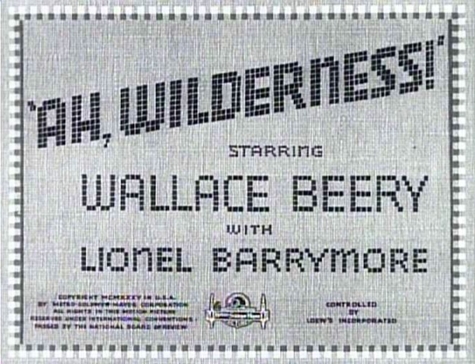 When the picture went into production in the fall of 1936, Aurania Rouverol’s Skidding had a new title, A Family Affair, and George B. Seitz was directing from a script by Kay Van Riper. It reunited a hefty chunk of the cast from Ah, Wilderness!: Lionel Barrymore, Spring Byington, Mickey Rooney, Charles Grapewin. Also back were Eric Linden and Cecilia Parker, romantically paired once again — only this time she was the one in the family and he was the neighboring sweetheart. The picture was shot on the same backlot “New England Street” that had been built for Ah, Wilderness!, and the new family “lived” in the same house. If you have any lingering doubt that this new picture was designed to evoke pleasant memories of the earlier one, here’s the title frame from Ah, Wilderness!…
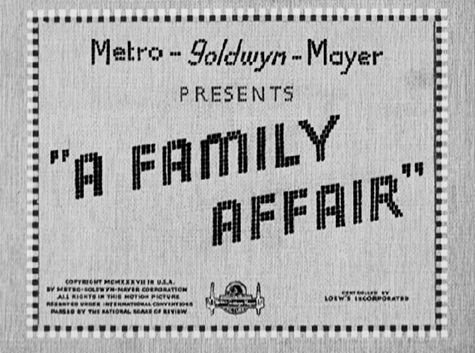 …and here’s the same frame from A Family Affair. The new picture took place in the “present day” (i.e., 1936) instead of a rose-colored turn of the century, but otherwise it followed the benevolent formula laid down by Eugene O’Neill in his change-of-pace comedy: the friendly, cozy big-small-town where everybody knows everybody else, the close-knit family bound by ties of affection and respect, the periodic heart-to-heart talks between father and son. The family of newspaper publisher Nat Miller in Ah, Wilderness! were the clear progenitors of Judge James K. Hardy and his clan — at least, by the time MGM had brought the Hardys to the screen. (In fact, ironically, Aurania Rouverol’s play had beaten O’Neill’s to Broadway by nearly five-and-a-half years; Skidding had a longer run, too.)
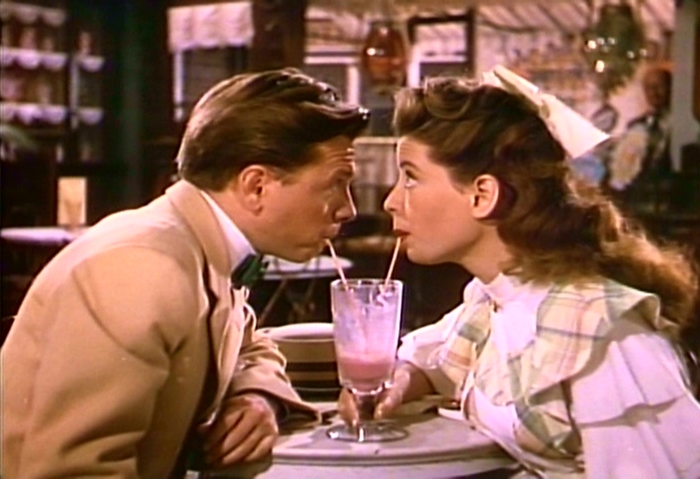 In 1946, the year of the last regular Andy Hardy picture (Love Laughs at Andy Hardy), there was a sort of closing of the circle on Ah, Wilderness! Producer Arthur Freed, still flush from his rousing success with Meet Me in St. Louis (which itself was a very close cousin to Ah, Wilderness!) conceived the idea of turning O’Neill’s play into a musical. So the Hardys moved out of their comfy white house and the Millers moved back in (and painted it yellow for Technicolor), and the result was Summer Holiday. This time Andy Hardy himself, Mickey Rooney (who had played Tommy, the youngest Miller boy, in Ah, Wilderness!), was promoted into the role of Richard Miller, and Richard and his Muriel (Gloria DeHaven) got the top billing (thanks to the Hacketts’ tweakings of O’Neill, here preserved and enhanced) that Eric Linden and Cecilia Parker had deserved but been denied in 1935.
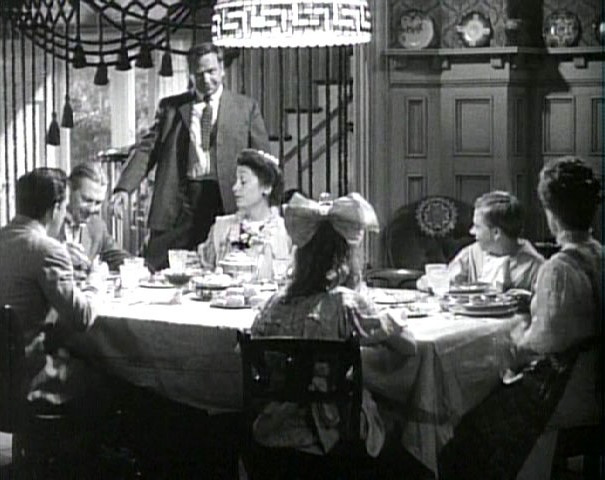 Even by 1948, the “reinventions” — of America and of Ah, Wilderness! — that Mickey Rooney talked about had begun to outstrip Andy Hardy, but Andy cast a long shadow for decades after the series itself ebbed. Sometimes the influence was direct and deliberate, as with the Archie comics that started in 1941 in blatant imitation of Andy Hardy and are still around today. Sometimes it was indirect but distinct, as in TV sitcoms from Father Knows Best and Leave It to Beaver, through The Partridge Family and The Brady Bunch, to Eight Is Enough and Modern Family. In them all, we can still discern the basic template with which L.B. Mayer “confected” small-town American life, in MGM’s conscious imitation of the way Eugene O’Neill had “confected” an imaginary youth for himself in New London, Conn. The shadow of Andy Hardy is really the shadow of Ah, Wilderness! (And let’s not forget Meet Me in St. Louis and the Technicolor musicals inspired by it, like Centennial Summer, State Fair, On Moonlight Bay, By the Light of the Silvery Moon, and yes, Summer Holiday, all with a clear kinship to O’Neill’s comedy.)