↓
 
  • Home
  • About the Author
  • Series
    • Carman Barnes: Five-Minute Movie Star
    • Crazy and Crazier
    • Films of Henry Hathaway
    • History of Cinerama: “Cinerama-Rama!”
    • Luck of the Irish: Darby O’Gill and the Little People
    • Marcel Delgado
    • Minority Opinion: The Magnificent Ambersons
    • Movie Souvenir Playing Cards
    • Shirley Temple Revisited: “Bright Eyes, 1928-2014”
    • The Bard of Burbank
    • The Fog of Lost London
    • The Museum That Never Was
    • William Wyler
  • Links and Resources
  • Jim’s Fiction
    • Glamour Boys
    • Items from the Scrapbook of Cosmo Brown
    • Sensible Christmas Wish, The
  • Contact

Jim Lane's Cinedrome

Classic Hollywood

Post navigation

← Older posts
Newer posts →

Shirley Temple Revisited, Part 5

Jim Lane's Cinedrome Posted on May 29, 2014 by Jim LaneAugust 30, 2016

The Little Colonel

(released March 21, 1935)

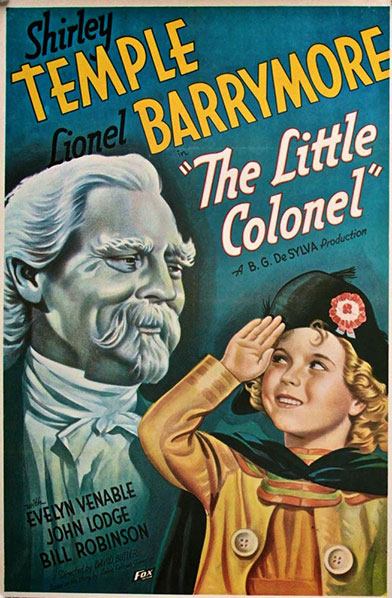
LC-poster02bWShirley’s first picture of 1935 was a period piece, her first costume drama as a star. The source material was a children’s book by Annie Fellows Johnston of McCutchanville, Indiana. Mrs. Johnston turned to writing at the age of 29 when her husband died in 1892, leaving her with three small stepchildren to raise on her own. The Little Colonel, published in 1895, was her third novel, and it proved so popular that she wrote a sequel a year until 1907. She wrote, in all, some four dozen books before she died in 1931 at age 68, but The Little Colonel was the only one that was ever filmed. It’s a pity Mrs. Johnston couldn’t have hung on for four more years and seen the apotheosis of her most famous creation.

Anyone who thinks that a movie is never as good as the book should try reading The Little Colonel. Mrs. Johnston’s ever-so-precious style hasn’t weathered the years well; I suspect it hadn’t by 1935, either. (It’s available online here if you want to check it out.) The story, as the saying goes, had “good bones”, and writer William Conselman fleshed them out rather better than Mrs. Johnston had. (Conselman also wrote Bright Eyes and would write for Shirley again.)

In Conselman’s script (unlike the original book), the story opens before the birth of its title character. A title tells us it’s “Kentucky in the ’70s”, and we meet old Colonel Lloyd (Lionel Barrymore), an unreconstructed Confederate for whom the War isn’t over. At a soiree at his plantation he offers a toast: “Gentlemen, I give you the South — and confusion to her enemies!” But it’s the Colonel who’s due for confusion; one of those “enemies”, a Northerner — named Sherman, no less — has won the heart of his beloved daughter Elizabeth (Evelyn Venable). The Colonel interrupts her and her intended (John Lodge) in the act of eloping, and he warns her: “Elizabeth, when that door closes, it’ll never open for you again.” Elizabeth leaves without another word, and she doesn’t close the door — she slams it.

Next scene, it’s six years later and the Shermans — Jack, Elizabeth and their daughter Lloyd (Shirley) — are at a military outpost on the edge of the western frontier. Lloyd has become the darling of the post, and she receives a commission as honorary colonel — an addition by Conselman that makes the girl a “little colonel” in fact, not just as the nickname the author gives her in the original story. The family has sold everything they own and left their Philadelphia home. Papa Jack is to continue west to make a new home for them; when he’s well-established and it’s safe, he’ll send for his wife and daughter. Until then, Elizabeth and the Little Colonel will return to Kentucky and live in a small cottage on the family property that was left to her by her mother.

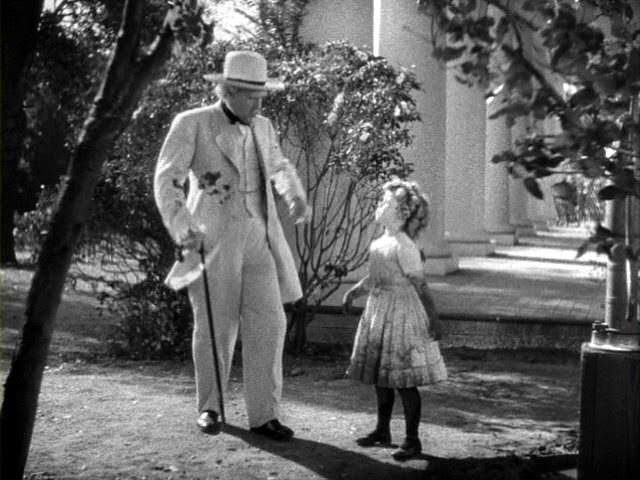
When the Old Colonel learns there are new tenants in the Cottage, he drops by to welcome them. But when the door is answered by his daughter Elizabeth, he storms off in a rage. “You’re a bad man to make my mother cry,” little Lloyd tells the old man’s portrait in the Cottage parlor. Later, when the two Colonels — Old and Little — finally meet, he doesn’t realize who the girl is, and he berates her for dirtying her dress making mudpies. Whoever your mother is, he tells her, she should teach you better. The Little Colonel stamps her foot — “Don’t you dare say anything about my mother!” — and hurls a fistful of mud at his white suit.

Later, when the old man learns who she is, he is mollified, even apologetic. He may have disowned his daughter and her husband, but he sees no reason not to associate with his granddaughter — especially since she reminds him so much of himself (and his outcast daughter, though he won’t admit it).

When Lloyd’s Papa Jack staggers home, sick with fever after having been swindled of the family’s savings by two hucksters (Sidney Blackmer, Alden Chase), Lloyd is sent to live with her grandfather to avoid catching what has laid her papa low. In time, just as we expect, the Little Colonel will effect a family reconciliation. But in the meantime she and her grandfather will just about drive each other to distraction, they’re both so willful, stubborn and short-tempered.
It’s easy to imagine that the Old Colonel’s consternation at the little girl’s spunk in standing up to him was a reflection of Lionel Barrymore’s own response to his little co-star; there’s a befuddled mix of exasperation and amusement that seems to come from both character and actor. Like the people they play, Barrymore and Shirley’s working relationship got off to a tetchy start: At their first rehearsal, when Barrymore stammered and groped for his lines, Shirley (who, being still too young to read, had memorized the whole script) prompted him. This sent the veteran actor storming off to his dressing room, where he sat sulking (and probably drinking) and threatening to walk off the picture.
Shirley describes in Child Star how both director David Butler and her own mother gently but firmly prodded her to make peace: you brought this on, they said, you have to make it right. And she did. She says she managed it by going to his dressing room, addressing him as “Uncle Lionel”, and asking for his autograph (“To my favorite little niece,” he wrote, “Your Uncle Lionel.”) It’s hard to believe it was a simple as that, for the seasoned old trouper to be coaxed out of his pout by the toddler who caused it, but that’s what Shirley says (oh to have been a fly on that wall!). Anyhow, Barrymore didn’t walk, and The Little Colonel crackles when he and Shirley are on screen together.

There’s another teaming in The Little Colonel that also makes it crackle. Playing the Old Colonel’s butler Walker was Bill “Bojangles” Robinson. Robinson began in vaudeville in 1900, and by 1934, when The Little Colonel was made, he was universally recognized (and for that matter, still is) as one of the greatest tapdancers who ever lived. Shirley was always proud that she and Robinson were the first interracial dance team in movie history. More than that, because of the age difference between six-year-old Shirley and the 56-year-old Robinson (and at the time, let’s face it, because of the difference in the color of their skin), they were one male-and-female team whose dances carried no hint of courtship or romance — nothing but the sheer joy of dancing together. (“The smile on my face wasn’t acting,” Shirley said in Child Star; “I was ecstatic.”) The teaming was Winfield Sheehan’s idea, and he hesitated only because he was unsure if Robinson could act; his three previous screen appearances had been dance-only. Robinson passed a screen test, and that was that. In all, he and Shirley would make five pictures together (I’ll get to the others in their time), and it all started here.

Their first dance together was the famous staircase dance. It was Robinson’s signature act, and he modified it to accomodate Shirley’s abilities; she couldn’t have come up to his level in the rehearsal time they had — but then, probably nobody could, no matter how long they rehearsed. Shirley remembered her “Uncle Billy” as “a superlative teacher, imperturbable and kind, but demanding…Every one of my taps had to ring crisp and clear in the best cadence. Otherwise I had to do it over.”

It’s been a while since I posted a YouTube clip of Shirley, and this is a good time to resume. Not the staircase dance, though. As good as it is, you don’t see as much of their body language, especially their faces beaming in the pleasure of each other’s company, as you do in this one, which comes later, with Walker and little Lloyd cavorting in the stables, to the accompaniment of “Oh! Susanna” on the harmonica:


It must be said that racial attitudes of the 1930s make The Little Colonel (and The Littlest Rebel, later in ’35) an awkward experience for some people today. It’s hard not to view these movies through the hindsight of how far African Americans have come (on screen and in real life) in the last 80 years. It’s worth remembering, though, the progress they had made by 1935 — what little there was, and only on screen at that — in the 40 years since The Little Colonel was written (or even the 20 years since The Birth of a Nation). We rightly cringe now when Colonel Lloyd calls to his granddaughter’s black playmates, “Come on, you pickaninnies!” But in Annie Fellows Johnston’s novel he uses an even uglier word — and for that matter, so does the Little Colonel herself. And to be fair to The Little Colonel (the movie), there’s a scene where Lloyd attends a black church’s baptism ceremony in a stream that runs through her grandfather’s property; the scene is presented unpatronizingly and without condescension. Also, the two most prominent black characters are played by Robinson as Walker and, as the Little Colonel’s cook and housekeeper “Mom Beck”, Hattie McDaniel (five years before she became the first African American to win an Academy Award). Both of them imbue their characters with a warmth and dignity that rises above the racism of the time.

Plus, of course and always, there’s the sheer pleasure of Shirley and Bojangles dancing.


Apropos of nothing, and apparently just because the powers that be at Fox felt like it, The Little Colonel ends — after Papa Jack has gotten well, his fortunes have been restored, the swindlers brought to justice, and Colonel Lloyd reconciled to his daughter and son-in-law — in Technicolor. The rationale is young Lloyd’s penchant for casting her stories in colors: “Tell me a blue story”; “This is a yellow story”. Evidently, she asks her grandfather for “a pink party” (the surviving version isn’t clear; something seems missing), and he replies, “Yes, just as pink as those flowers,” as a vase of black-and-white roses change to pink-and-green. I leave The Little Colonel with a shot from this party scene because it’s Shirley’s first appearance in the newly-perfected Technicolor process — and her last for several years.


To be continued…


Posted in Blog Entries, Shirley Temple

CMBA Blogathon: Come Next Spring (1956)

Jim Lane's Cinedrome Posted on May 23, 2014 by Jim LaneFebruary 16, 2023


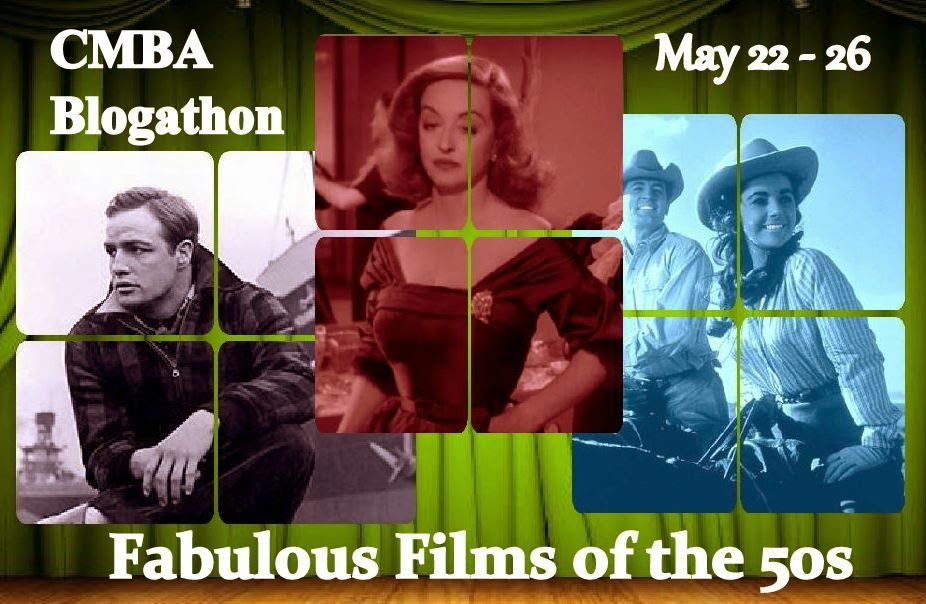
I interrupt my look back at Shirley Temple’s career to offer Cinedrome’s contribution to the Classic Movie Blog Association‘s blogathon Fabulous Films of the 1950s. Go here for a complete list of entries; you’ll find my colleagues holding forth on an impressive array of movies legendary and obscure, long-remembered and half-forgotten. 

The ’50s, like the ’40s before (subject of another CMBA blogathon here), were an embarrassment-of-riches period. The Hollywood studio system was dying, it’s true, but that wasn’t so clear at the time; in the second half of the decade especially, the studios seemed to be recovering from the sucker punch of television. There were plenty of terrific movies, three of which are illustrated on the banner here. For Cinedrome’s entry, I’ve decided to follow my customary practice and choose a lesser-known title — one that deserves to be remembered and rediscovered:


*                         *                         *


In the mid-1950s Republic Pictures was on its last legs as a movie-producing entity. Formed in 1935, it was the brainchild of Herbert J. Yates, founder and president of Consolidated Film Industries, a film processing lab based in New York. Yates saw his big chance when six of Hollywood’s Poverty Row studios — the largest (relatively speaking) being Monogram and Mascot — became deeply indebted to Consolidated for processing fees. Yates called all their debts, then offered an alternative: merge into one production facility, with Yates as head of the studio. The others went for it, and Republic Pictures was born. (In 1937, unable to get along with Yates, Monogram’s officers backed out of the deal and reorganized under their old corporate name, which morphed in 1947 into Allied Artists.)

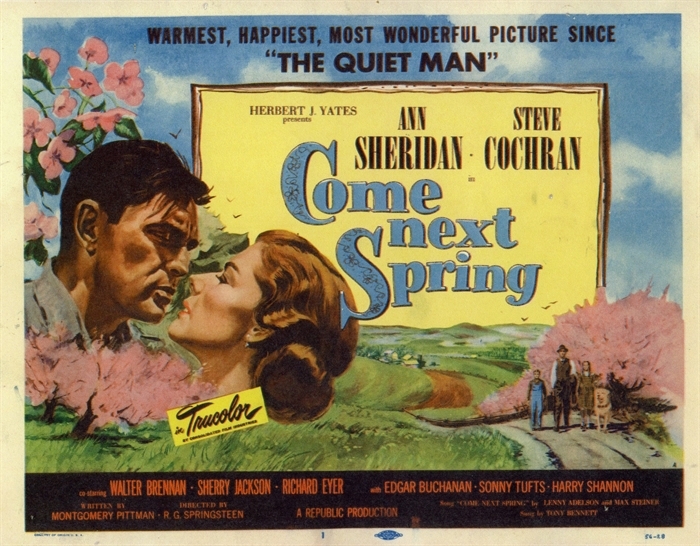
Strictly speaking, Republic was a notch or two above Poverty Row, but it was never a major operation. Its bread and butter was chapter serials and westerns, its biggest stars John Wayne, Gene Autry, Roy Rogers and Rex Allen (in just about that order). There was the occasional prestige picture (again, relatively speaking), like Sands of Iwo Jima and The Red Pony (both 1949), or, a few more notches up the scale, John Ford’s Rio Grande (’50) and The Quiet Man (’52), but for the most part it was cliffhangers, horse operas and hillbilly comedies for the small-town venues. In the summer of 1955, taking one last shot at prestige, Yates dispatched a unit headlined by Ann Sheridan and Steve Cochran up north to the California Gold Country town of Ione (pronounced “eye-own”) in the hills of Amador County 35 miles southeast of Sacramento. There they made what is surely (with the arguable exception of Orson Welles’s 1948 Macbeth) the best movie ever to come out of Republic Pictures that didn’t involve John Ford or John Wayne. (And no, I’m not forgetting Johnny Guitar.)


Come Next Spring was directed by R.G. (“Bud”) Springsteen. Springsteen was the epitome of the reliable but unexceptional studio workhorse. Actually, “plowhorse” would be more like it; his first directing credit came in 1945, and by the time of Come Next Spring ten years later he had already directed over 50 features — mostly Republic program westerns running about an hour, with a smattering of crime dramas and shoestring musical comedies. At the very least, Springsteen was a man who didn’t waste time, film or money — a triple virtue guaranteed to endear him to the penny-pinching Herbert Yates. It would also earn him a secure niche in television; by the time he retired in 1970 he had a hefty resume consisting of multiple episodes of Gunsmoke, Rawhide, Wanted: Dead or Alive, Wagon Train, Bonanza, Gentle Ben and others.
 
 
The secret ingredient of Come Next Spring was its writer, Montgomery Pittman (shown here in a small role on TV’s Cheyenne, in an episode he also wrote). Pittman was the kind of talent who might almost be described as “unjustly forgotten today” — except that the sorry truth is he died before even being noticed, succumbing to throat cancer at 42 in 1962. He was prolific, resourceful and original, and what he did accomplish in his brief 11-year career gives a frustrating hint of what might have been if even another ten or 15 years had been granted to him.
 
Born in Oklahoma in 1920, Pittman left home while still a teenager and, according to his own colorful account, found work with a traveling carnival as (no joke!) a snake-oil salesman. After military service during World War II he landed first in New York, then Los Angeles, with hopes of becoming an actor. Among the odd jobs he took during this time was housecleaning for fellow actor Steve Cochran, then under contract to Sam Goldwyn and beginning to make a name for himself; their friendship would bear fruit with Come Next Spring.
 
After a few minor movie roles (including one in Inside the Walls of Folsom Prison with his friend and sometimes employer Cochran), Pittman transitioned into writing and eventually, like other writers before him, into directing as a means of protecting his scripts. Along the way, in 1952, he met and married Maurita Gilbert Jackson, a widow whose ten-year-old daughter Sherry was already launched on a career as a child actress. Pittman’s relationship with his new stepdaughter would also bear fruit in Come Next Spring.
 
In the mid-to-late-’50s Pittman was a contract writer for Warner Bros. Television, where he contributed scripts to the studio’s westerns Cheyenne, Sugarfoot and Maverick, and the private-eye series 77 Sunset Strip (for the latter three he usually directed his scripts as well). 
 
In the early ’60s (and, in fact, just as his time among us was running out) Pittman wrote and directed three episodes for Rod Serling’s original The Twilight Zone on CBS. These jobs are worth mentioning here for several reasons. For one thing, Pittman was the only person during the entire five-year run of the show who both wrote and directed an episode, and he did it three times. For another, those three are among the very best episodes that weren’t written by The Twilight Zone‘s “Big Three” (Serling, Charles Beaumont and Richard Matheson). Finally, and most pertinent to the subject at hand, two of those three contain clear echoes of Come Next Spring: (1) “The Last Rites of Jeff Myrtlebank” — about a young man who springs to life out of the coffin at his own funeral, causing his backwoods neighbors to suspect he ain’t exactly human — takes place in the same time and region as Come Next Spring, and it even features several of the same actors (James Best, Edgar Buchanan, and Pittman’s stepdaughter Sherry Jackson); and (2) “The Grave”, in which bounty hunter Lee Marvin accepts a dare to visit the grave of the outlaw he’s been chasing, not only features James Best again, but it has a female character named Ione — an unmistakable hat-tip to the town where Come Next Spring was filmed.
 
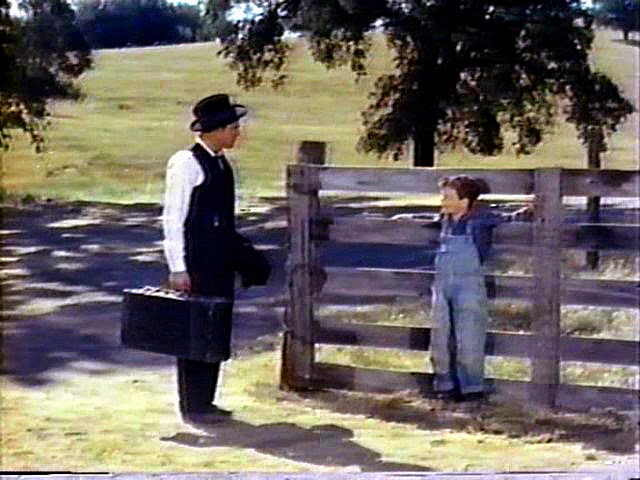
Come Next Spring takes place in 1927 in the hills of Arkansas. We first meet Matt Ballot (Steve Cochran) walking along a country road on a hot summer day. He strikes up a conversation with a little boy he meets (Richard Eyer), and offers to walk along with him a spell, since they both seem to be headed the same way. It turns out that they’re not only headed the same way, they’re headed to the same place. For the boy, Abraham, it’s the farm where he lives. For Matt it’s where he used to live, before he ran out on his wife Bess and daughter Annie nine years ago. Abraham is the son Matt never knew he had.
 
frame10x-cochran-sheridan
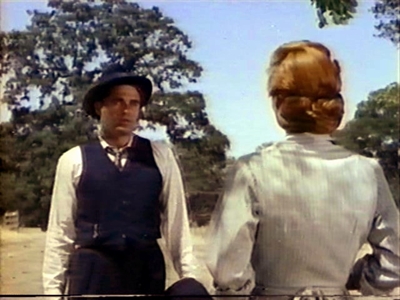
Bess (Ann Sheridan) is astonished to see Matt again after all these years, and she makes it plain that the surprise is not a pleasant one. “Why are you here, Matt?” she asks coldly.
 
Matt tells her he’s been all over the country, and found that whisky tastes pretty much the same everywhere. The last three years he’s been wondering what his wife and daughter were doing, “and I guess I just talked myself into” coming to find out. You never answered my letters, he says; didn’t you get them?
 
She may have gotten them, but clearly she didn’t read them. I never wanted to see you again, she says; I see no reason to change my mind now. Chastened, Matt is turning to leave when Bess suddenly relents. “I still think you done wrong in comin’ back,” she says, “but the damage is done now. Bein’ as you’re here, I reckon it’s only fair for you to see Annie. So you can stay to supper. If you stay sober.”
 
Matt assures her that he’s been sober for three years, then he asks about Annie. “Is she…Did she ever get over…?” “Nope,” says Bess, “still mute. Cain’t utter a sound.”
 
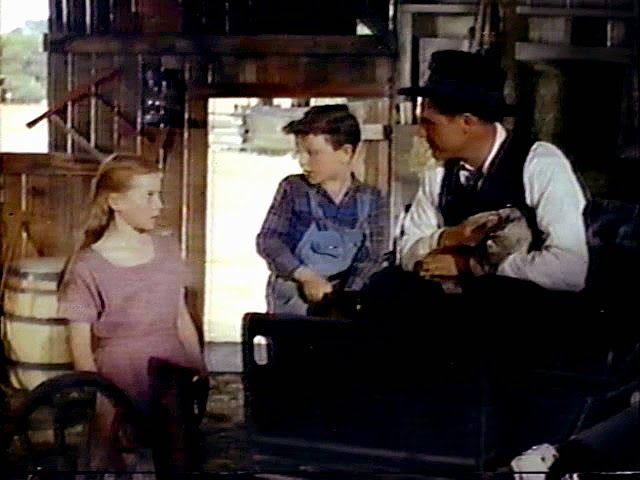
When Abraham returns from washing up, ready to do the milking, Bess hesitates barely a second before telling him who Matt is. “Gee,” says Abraham, “I didn’t even know I had a papa.” Later, when Annie (Sherry Jackson) comes home and warily eyes the stranger in their barn pulling a tick from the cat’s tail, Abraham shares the information, with the pride of a little brother who knows something his big sister doesn’t: “Annie, this here’s our papa!”
 
That night, Abraham surprises Bess by showing up for supper in his Sunday best: suit, bow tie. Later, as Matt prepares to leave, Bess unbends a little more. It’s a long walk in the dark, she says; Matt can spend the night in Abraham’s room. Even Annie, still shy of this stranger in the house, nods that it’s all right with her.
 
The next morning Abraham comes to breakfast having for the first time slept through the night without suffering from his “problem” — bedwetting. Even Annie is sorry to see Matt leave. So Bess softens an inch or two more. “I forgot how important a man is to children,” she says — and besides, she could use a hand around the farm. So she offers Matt the job. But that’s all he’ll be — a hired hand, at a dollar a day plus his keep, bunking with Abraham. “All right, Bess,” Matt says, “you hired yourself a hand.”
 
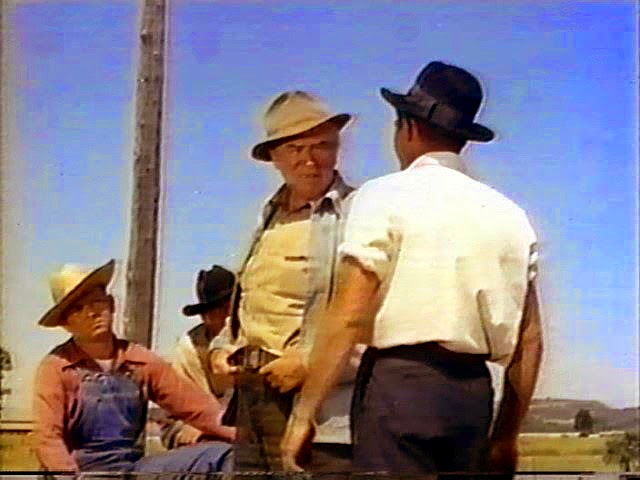
Matt’s return is greeted by others in the community with little enthusiasm; most of them will offer him no more than a frosty hello — and that only after he’s greeted them first, with their own “hello” signaling an end to the conversation. One of the few who greets him kindly is old Jeff Storys (Walter Brennan), a sharecropper on Bess’s farm who knows nothing of her and Matt’s history. Another, who does know but likes Matt anyway, is the Ballots’ friend and neighbor Mr. Canary (Edgar Buchanan), who urges Matt to have patience: “Look at it like you was one o’ them, Matt, put yourself in their place. What would you a-been thinkin’ the night Abraham was born?” Matt wonders if Canary feels the way they do. “I’ve always felt,” Canary tells him, “that you was a lot more of a man than they gave you credit for. If you’re still around here come next spring, you’ll prove I’m right.”
 
(This isn’t the first time the movie’s title pops up in the dialogue; the phrase seems part of the local idiom. At one point Abraham asks his mother, “How come people are always sayin’ ‘come next spring’ somethin’s gonna happen?” “Oh, it’s just a saying,” she tells him, “meaning ‘in the springtime’ or ‘not too far away’.” Abraham shrugs. “Seems to me it means it ain’t never gonna get done.”)
 
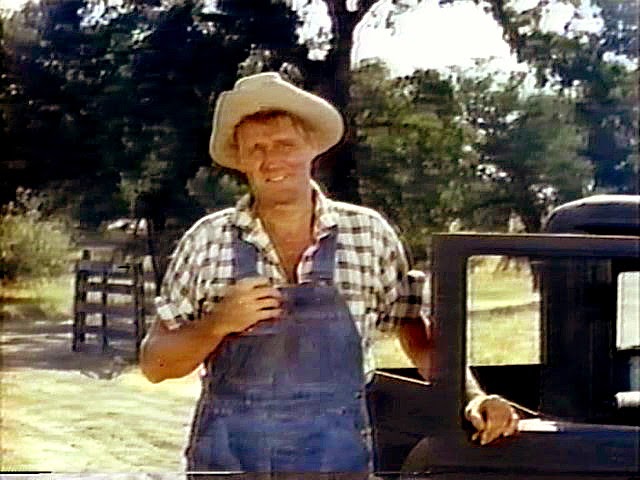
One who has particular and personal reasons for disgust at Matt’s return is Leroy Hightower (Sonny Tufts), Canary’s hired hand, who has been futilely trying to court Bess almost since the day Matt walked out on her. Leroy’s not a bad sort at heart, but there’s more than a little of the bully about him, and he talks to (and about) Matt with the snide sarcasm of a frustrated suitor. Leroy believes it’s only a matter of time before Matt falls off the wagon and becomes the same good-for-nothing drunk he was nine years ago — and Leroy’s not above doing his bit to make sure it happens.
 

Bowen Charles Tufts III is one of Hollywood’s sad cases. He was not without talent, but not talented enough to overcome some unfortunate life and career choices. Born of a prominent Boston family (his great-uncle founded Tufts University), he shunned the family banking business to study opera at Yale. Thanks to his good looks and a college football injury that made him 4-F during World War II, he found stardom in Hollywood when handsome leading men were relatively scarce. Alcohol was his undoing, and his off-screen behavior became notorious. He gave probably his best performance in Come Next Spring, and a few years later he reportedly sobered up in hopes of landing the role of Jim Bowie in John Wayne’s The Alamo. Whether that’s true or not, by that time his name was already a Hollywood punchline, and the idea was probably a non-starter. He died of pneumonia in 1970, age 58.

 
frame03d-cochran-jackson
How Matt Ballot, heeding Mr. Canary’s advice about patience, slowly wins his way back into the love of his family and the respect of his neighbors forms the spine of Come Next Spring. The movie’s emotional centerpiece comes almost exactly halfway through its 93 minutes, when Matt, prompted by a question from Abraham, and knowing the question will never go away, finally explains to Annie why she is unable to talk. “It wasn’t no Act of God like you always been told,” he says to her. “God give you a voice just like everybody else.” Bess tries to stop Matt — by this time even she doesn’t want to see him torn down in the children’s eyes — but Matt forges on. What happened, he tells Annie, was that one night, too drunk to drive and too belligerent to let Bess take the wheel, he drove their car off the road and wrecked it. Bess and Matt walked away unhurt, but the traumatic shock left Annie unable to speak — or to make any sound at all — from that day to this.
 
There are still crises to come for Matt, Bess and the children — a cyclone that devastates their farm, a long-simmering showdown with Leroy, a frightening disappearance by one of the kids — but how it all plays out is something best discovered by seeing the movie itself.

When she made Come Next Spring, Ann Sheridan was 40, several years past her glamour days as Warner Bros.’ “Oomph Girl” (a nickname she loathed). Even at the height of her career at Warners, her talent never got the respect it deserved — not surprising for a studio dominated by its male stars that already had Bette Davis and Olivia de Havilland. But she was an actress of considerable — even remarkable — depth and range. She demonstrated this to anyone who cared to notice during the fall of 1941, when she was shooting two pictures simultaneously: She worked mornings on the raucous farce The Man Who Came to Dinner (and was one of the funniest things in it), then after lunch she reported to the set of the brooding, dark melodrama Kings Row. All through World War II she was well-liked by co-workers, popular with audiences, and underrated by critics. That combination held all the way through her untimely death at 51 in 1967 (and the “underrated” part has stayed with her ever since).


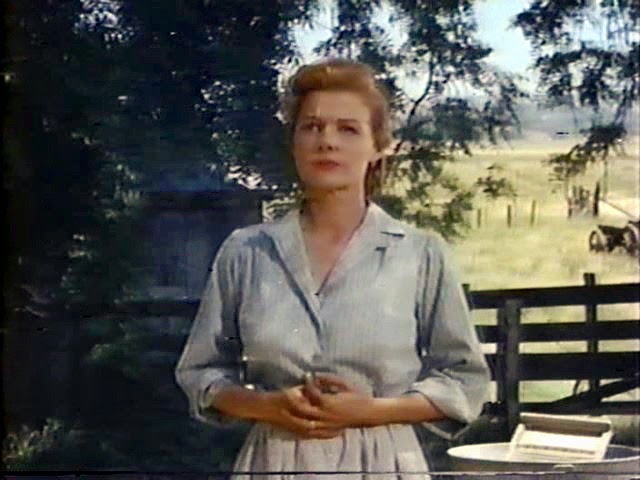
Sheridan’s Bess Ballot is a woman who has had self-sufficiency thrust upon her by the only man she’s ever loved, and the experience has made her stern almost to the point of harshness. When Matt’s wandering brings him back into her life, her defenses instantly fly up — because the sight of him, in spite of everything, still makes her weak in the knees. We can see it, even if she can’t, in the way she softens every time Matt is on the verge of leaving again: First she says he can stay for supper, then till morning, then till “come next spring” as a hired hand. This always-underrated actress was never better than she was as the resolute, wounded Bess.

Steve Cochran, unlike Sheridan, was never underrated — exactly. But ever since his sudden death from a lung infection at 48 in 1965, the question has haunted movie buffs: Why didn’t this guy ever become a bigger star? Part of it may have been his tabloid lifestyle of womanizing, carousing and boozing, flying in the face of his fragile health (he had a heart murmur that kept him out of the service during World War II). Or it may have been because he never managed to break the mold of gangsters, thugs and unsavories into which he had been typecast, certainly not the way other actors — Robert Mitchum and Dana Andrews, for instance — had been able to do. Still, he never really gave a bad performance even in the most ill-chosen of his 39 pictures; he was clearly an actor of substance (on stage he had played Orsino in Twelfth Night, Horatio in Hamlet, even Richard III). In Matt Ballot, Cochran gives us a good man who has been beaten down by an ill-spent life and the consequences of his own bad decisions, and who now hopes only to pull himself together before it’s too late. It was the role, and the performance, of Cochran’s life, and he knew it. When Monty Pittman brought him the script, Cochran bought it for his own company, Robert Alexander Productions (named for his real first and middle names), then sold it to Republic on the condition that he and Sherry Jackson play the roles that had been written for them. If Cochran had given this performance for any studio but Republic it might have made all the difference in the arc of his career. But the truth is that probably no other studio would have cast him as anything but a ne’er-do-well or a hood — Matt Ballot, if you will, unrepentant and unreformed. It may even be that no other studio would have touched Come Next Spring at all. That, sad to say, was just Steve Cochran’s luck.

 
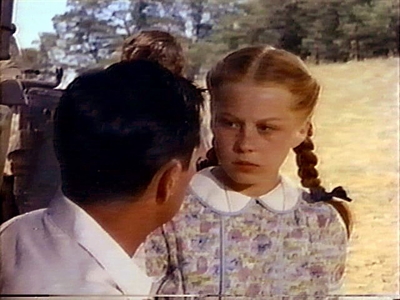
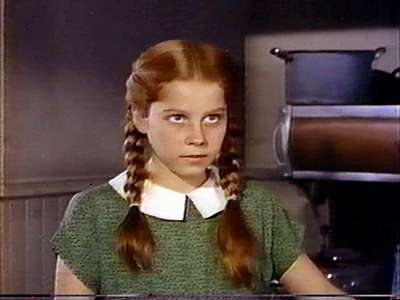
frame07b-jacksonAs if Ann Sheridan, and Steve Cochran, and Montgomery Pittman’s intelligent and perceptive script were not enough, there’s another excellent reason to see Come Next Spring, one that all by itself would be more than enough: the extraordinary performance of 13-year-old Sherry Jackson. If Pittman’s script was intended as a showcase for his friend Cochran, it seems to have been equally intended to give Pittman’s own stepdaughter the role of a lifetime. Even by the time Pittman married her mother in 1952, Sherry was already a veteran of more than 15 feature films. Mostly uncredited bits, but more substantial roles were ahead: one of the visionary Portuguese children in The Miracle of Our Lady of Fatima (’52), John Wayne’s daughter in Trouble Along the Way (’53). When shooting started on Come Next Spring, Sherry was coming off her second season as Danny Thomas’s oldest daughter on Make Room for Daddy.
 
As the shy and withdrawn Annie — “around the animals so much,” her mother says, “she’s beginning to act like one” — Sherry Jackson is thoughtful, watchful and wary. With her enormous — and enormously expressive — eyes, and with every tiny movement of the corners of her mouth, she makes Annie’s every fleeting thought as plain as if she spoke them out loud. And she does it without making a sound. Jane Wyman in Johnny Belinda won an Oscar (and rightly so) for doing not much more than Sherry Jackson does in Come Next Spring. It is, without question, one of the greatest child performances ever put on film.
 
Ann Sheridan, Steve Cochran, Sonny Tufts, Sherry Jackson. All of them were never better — maybe even never as good — as they were in Come Next Spring. Hmmm. Maybe this Bud Springsteen was a better director than he ever got credit for.
 

*                         *                         *


When it played host to the Come Next Spring company in 1955, Ione, Calif. was a small foothill community of perhaps 1,500 people. It’s grown somewhat in the 59 years since then, but not as much as you might think. The population now hovers around 4,200 (not counting the nearby Mule Creek State Prison, whose 3,000 inmates are technically “residents” of Ione). The town itself has changed even less than the population. Even allowing for its being dressed to resemble Arkansas 30 years earlier — with its fleet of Model A and Model T Fords, the vehicles of choice for small farmers in the 1920s — the Ione of Come Next Spring is still visible in the Ione of 2014. (NOTE: I am indebted to City Clerk Janice Traverso and her co-workers in the Ione City Hall, and to local resident Doug Hawkins, who played a small role in the picture at the age of 11, for their assistance in finding and photographing locations for Come Next Spring.)


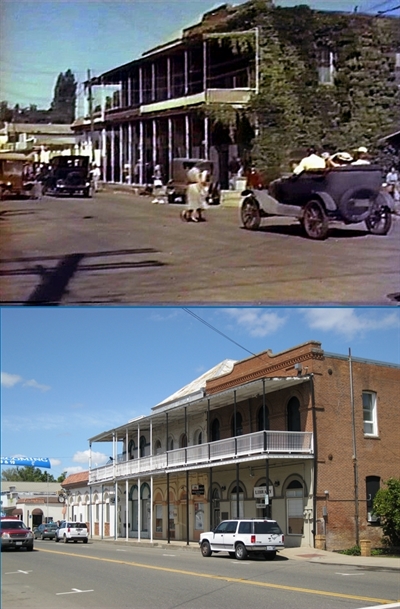
ione-then-now01a


This is Main Street of (the fictitious) Cushin, Arkansas as the Ballot family drives into town on Saturday to do their weekly shopping. That’s them on the right in their Model T — Matt driving, with Annie (holding her hat) and Bess in the back seat. That imposing-looking two-story building is actually the meeting hall of Ione Parlor 33 of the Native Sons of the Golden West…


…and it’s still there today, not much changed except for the removal of that out-of-control ivy on the eastern wall.


One block west and on the other side of Main Street, this building…


 …has had a facelift since 1955 — probably more than one, as a matter of fact — but it’s still recognizable. Pretty much.
 
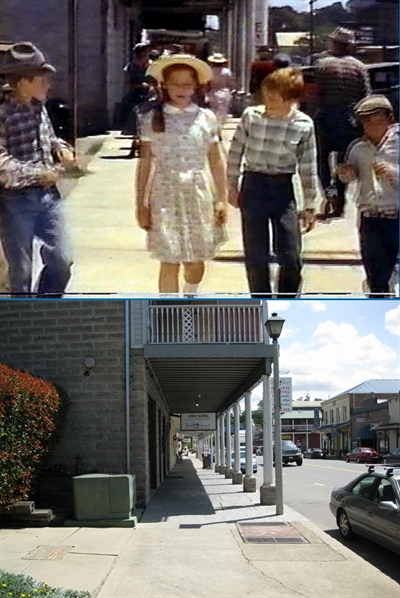
 ione-then-now03a


On the other hand, this stretch of sidewalk where a group of boys (including Doug Hawkins’s classmate Guy Campbell, a local boy who still lives in Ione) are taunting Annie as the town “dummy”…


…well, that’s hardly changed at all.


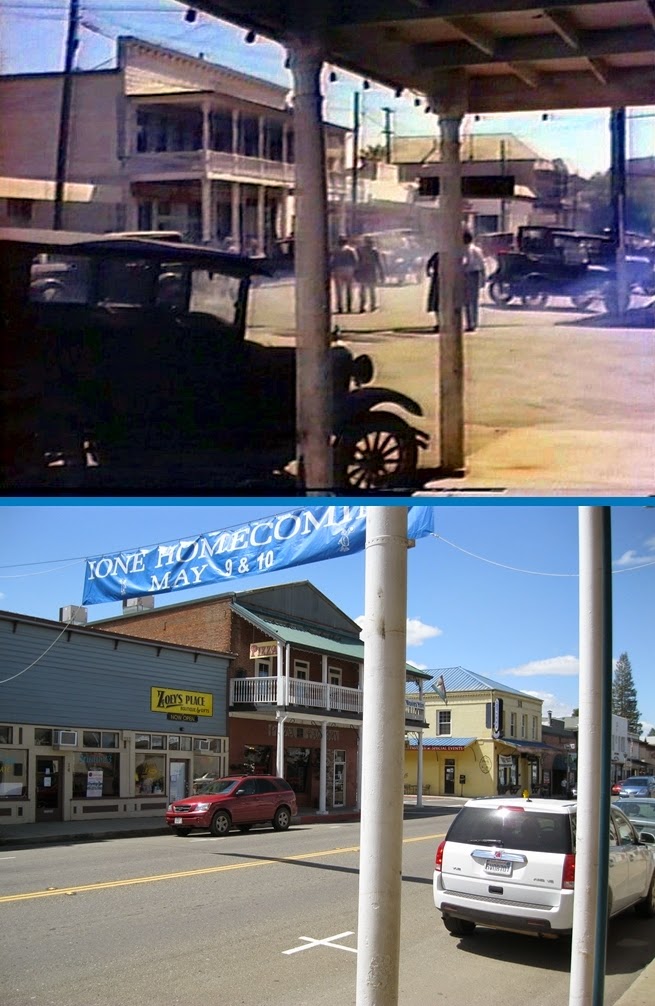
ione-then-now04a


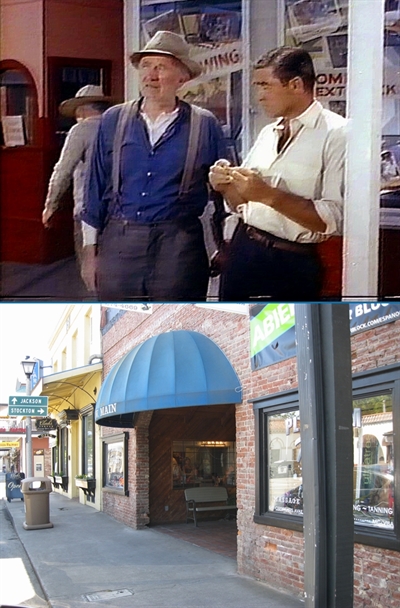
Here are Jeff Storys and Matt standing outside the town’s picture show chewing the fat (presumably the Ione Theatre’s display cases have been changed to reflect what might have been “now showing” and “coming next week” in 1927). Doug Hawkins remembers seeing Come Next Spring in this theater. That was no doubt a sneak preview for citizens of the host town; the picture’s world premiere was held at the Amador Theatre in nearby Jackson, the Amador County seat (and mighty big news that was in Jackson, believe you me). The Amador is gone now; where it stood is now the parking lot of the Jackson branch of El Dorado Savings…


…and the Ione Theatre is also gone, gutted by fire decades ago. The space is now a mini-mall housing a hair salon, a massage-and-tanning parlor, and other local businesses.
 
 ione-then-now05b


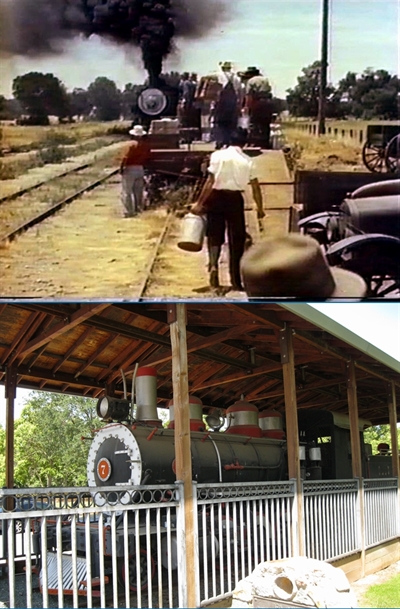
This locomotive is “Iron Ivan”. In 1955 it was the last steam engine operating on the Amador Central Railroad, a short (approx. 12 miles) line that operated entirely within the borders of Amador County. Ivan made this cameo appearance in a brief scene showing the area’s farmers arriving with their milk and eggs to ship them off to market. Iron Ivan was retired in 1956, not long after this scene was filmed…


…and rests now on permanent display in the Ione City Park.


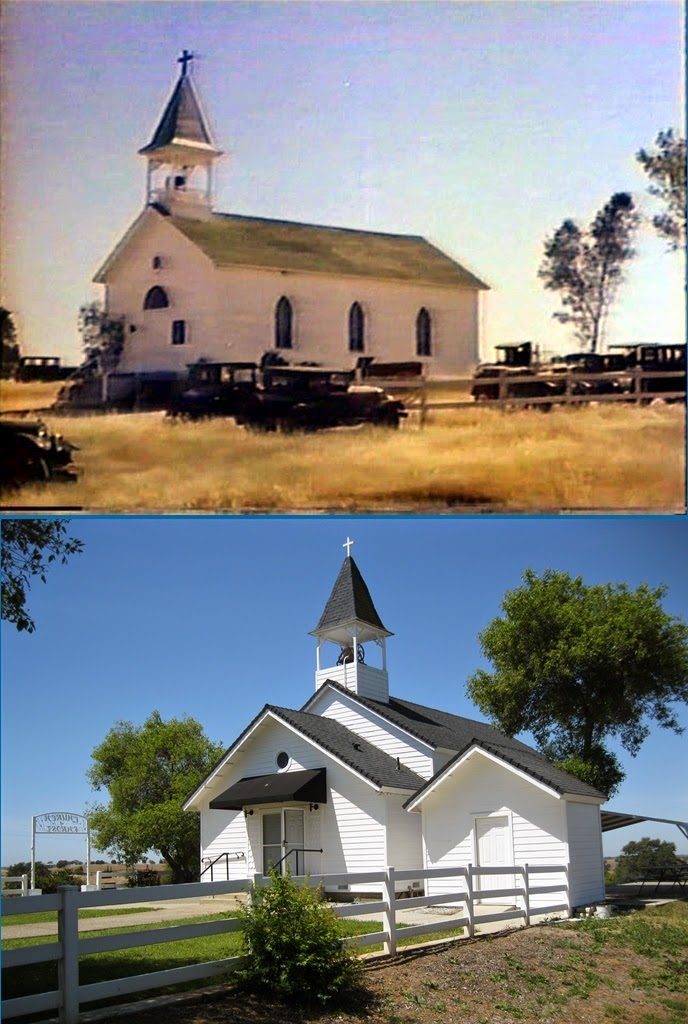
This on the right is the little country church where the Ballots and their neighbors worship. It is from these windows, during a Sunday morning sermon on the evils of drink, that the congregation first notices the approach of cyclone weather. And it’s here that Matt literally seizes the reins and stems a rising panic in the parking lot as worshipers dash madly out to their wagons and autos to try to save what they can of their homes.
 
In 1955 this church was in the tiny community of Camanche, about five miles south of Ione. Today, Camanche is at the bottom of Camanche Reservoir, created when an earthfill dam was completed across the Mokelumne River in 1963. (For you non-Californians out there, the river’s name is pronounced “McCullumy”.)


The church, however, was moved to higher ground, where it stands today overlooking the north shore of the reservoir — with the addition of a newer entry vestibule and storage shed.


As I mentioned before, the mainspring of Come Next Spring is Monty Pittman’s pitch-perfect script. It tells an unusual yet simple and straightforward story without a wasted word or a false note. Even its minor characters — for example, Harry Shannon as neighbor Tom Totter (that’s him a few pictures up giving Matt Ballot the cold shoulder at the railroad siding), Wade Ruby as the preacher Delbert Meaner, and Roscoe Ates as Shorty Wilkins, the local moonshiner — are sketched in sharp detail with a few deft strokes. Sometimes only a few lines are all it takes to tell us what we need to know about these people — and Pittman knew the right few lines. Then there are the sensitive performances, and the typically emotional musical score by the great Max Steiner (including a title song written with Lenny Adelson that was a popular hit for Tony Bennett, who sings it under the credits).
 
Come Next Spring has been going in and out of print for over 30 years, ever since the dawn of the home video age. As near as I’ve been able to determine, it’s currently out. But the good news is that it’s not unavailable. It can be had for streaming here at Amazon Instant Video — it’s even free if you subscribe to Amazon Prime. (UPDATE 7/29/22: Sorry, it’s no longer free to Prime subscribers, alas. But it’s well worth the $3.99 to rent or the $12.99 to buy.)
 
So here’s a challenge for my Cinedrome readers. As soon as you finish reading this post — or as soon as you have 93 spare minutes — click over to Amazon Instant Video (here’s the link again, just to double-dog-dare you) and treat yourself to Come Next Spring. Do yourself a favor. 
 
And one last thing. This is a promise: The very last shot of the picture, just before it fades to “The End”, is something you will remember as long as you live. Mark my words.
 
Posted in Blog Entries

Shirley Temple Revisited, Part 4

Jim Lane's Cinedrome Posted on April 26, 2014 by Jim LaneAugust 30, 2016

According to the IMDb, Now and Forever‘s U.S. release date was August 31, 1934. However, it wasn’t reviewed by the New York Times or Variety until October 13 and 16, respectively. Apparently, either Fox sent the picture off to down-market engagements two-and-a-half months before opening it in New York — or (more likely, I think) the IMDb has the date wrong.

Whatever the case, both Andre Sennwald in the Times and Abel Green (again) in Variety pegged Shirley as Now and Forever‘s saving grace. Sennwald:  

The little girl has lost none of her obvious delight in her work during her rise to fame. In “Now and Forever” she is, if possible, even more devastating in her unspoiled freshness of manner than she has been in the past…With Shirley’s assistance [the photoplay] becomes, despite its violent assaults upon the spectator’s credulity, a pleasant enough entertainment.

And Green:

“Now and Forever” is a remote title; it strains credulity; it can’t stand analysis; it has sundry other technical and plausibility shortcomings — but it has Shirley Temple and that virtually underwrites it for boxoffice…Shirley Temple in “Uncle Tom’s Cabin” would probably click just as well.

In these reviews, both written by seasoned showbiz observers, the subtext is unmistakeable: Shirley Temple saves the show; Gary Cooper and Carole Lombard do their best, but without Shirley they’d have gone down with the ship. And Shirley is still only six years old.

Next it was back home to Fox for…

Bright Eyes

(released December 20, 1934)

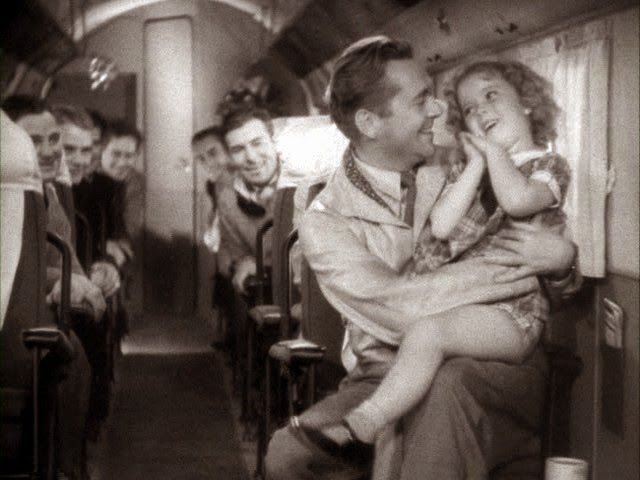
Shirley’s last picture of 1934 teamed her for the third time with James Dunn — not as her father this time, but as her godfather, an airplane pilot named “Loop” Merritt. William Conselman’s script (from a story by Edwin Burke and director David Butler) gave the two stars an unusual setting: the early years of commercial aviation, when airmail was an innovation and passenger flights were strictly for the well-to-do, who could fly coast-to-coast only in short hops of 200 miles or so, while the vast majority of the moviegoing audience could only dream of someday, maybe, going up in a plane. Much of the picture was shot on the grounds of Grand Central Air Terminal in Glendale, ten miles north of downtown Los Angeles, and it served as a publicity gold mine for American Airlines and Douglas Aircraft, both of which cooperated generously with the production.
 
Shirley plays Shirley Blake, whose father, Loop’s best friend since childhood, died in a plane crash some years before the story opens. Shirley spends much of her time with Loop and his aviator pals, and is something of a mascot around the airport, while her widowed mother works as a maid to a family in nearby Flintridge (then, as now under its incorporated name of La Canada Flintridge, an affluent suburb of L.A.). 
 
The airport is a lot more fun than home; Shirley loves her mother and the other servants, but the family they all work for is a trio of world-class pills. Mr. and Mrs. “Smythe” (real name Smith, but that’s not good enough for them) are a couple of selfish, snooty social-climbing snobs. As the story opens on Christmas Eve, Mrs. Smythe (Dorothy Christy) is reprimanding Shirley’s mother Mary (Lois Wilson) for taking so many personal phone calls and visits from her aviator friends. As Mary slinks contritely back to the kitchen, the effete Mr. Smythe (Theodor von Eltz) smirks, “I told you when you engaged her that it wouldn’t work out.” “Well,” she sighs, “she was so pathetic about wanting a nice home for her little girl that I let my sympathy get the better of my judgment.” Then, showing the true depth of her sympathy, she adds, “I’ll let her go right after the holidays.”
 

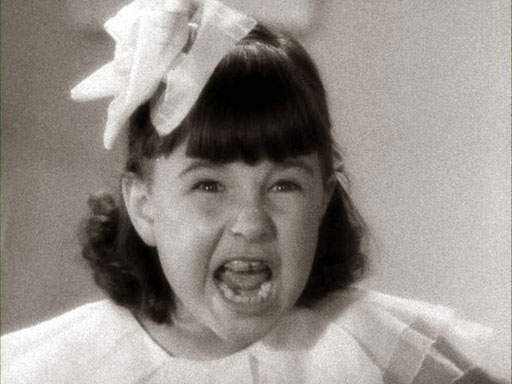
BE-frame01a-WithersWAs bad as the Smythes are, they’re not the worst of it. That would be their daughter Joy (Jane Withers), a screaming little monster in a perpetual state of tantrum, and the most misnamed child in the history of human life on Earth.

In real life, eight-year-old Jane was nothing like the character she played. Bright Eyes was her big break after a handful of uncredited bits since 1932. Fox quickly signed her to a seven-year contract and she went on to become a star in her own right, though inevitably in Shirley’s shadow, especially since they worked for the same studio. The two girls never worked together again — which is a pity, because Jane was the perfect foil for her younger co-star, and in Bright Eyes she comes as close as anybody ever did to stealing a show from Shirley Temple. Playing an obnoxious, spoiled-rotten brat, Jane was genuinely funny — no small achievement when you consider how many child actors over the years have tried to be funny, only to come off looking like obnoxious, spoiled-rotten brats.

Jane continued acting into her early 20s, even after 20th Century Fox dropped her in 1942, then she retired from the screen in favor of marriage to a rich Texas oil man. That foundered after eight years, and Jane made a comeback as a character actress in George Stevens’s Giant in 1956. Thereafter, she stayed busy in movies and on TV, and she became familiar to millions of baby boomers as Josephine the Plumber in a series of commercials for Comet Cleanser in the 1960s and ’70s. As of this writing Jane Withers is still with us, and hopefully in good health and spirits. Continued long life to her.

But back to Bright Eyes. Rounding out the household is Uncle Ned Smith (Charles Sellon), a crotchety old invalid who drives his wheelchair around the house like an assault vehicle, barking and grumbling sourly at everybody. Underneath the crust, however, he’s an old softie, especially toward Shirley; it’s just that he has no patience with his nephew and niece-in-law’s hifalutin airs (the original family name is good enough for him), and he can’t stand the holy terror Joy. He knows the Smythes don’t like him any more than he likes them, that they only fawn over him in hopes of a big payoff when he finally kicks the bucket, and he enjoys lording it over them for just that reason.
 
Finally there’s Mrs. Smythe’s cousin Judith Allen (Adele Martin), visiting from back east for the holidays. By a remarkable coincidence, Judith is the former society debutante whose family pressured her into jilting Loop Merritt years earlier. It’s clear she still thinks the world of Loop, but just as clear that he feels once-bitten-twice-shy; the best she can get from him when they meet is an icy politeness.
 
So that’s the situation going into Christmas Day, when Mary Blake, hurrying through her duties and rushing off to join a Christmas party at the air field with Shirley, Loop and the boys, is struck and killed by an automobile. Uncle Ned orders the Smythes to take the orphaned Shirley in, but they’re not happy about it. Neither is Loop, and as Shirley’s godfather he wants to bring her to live with him, even though the life of a seat-of-the-pants aviator is marginal at best. Uncle Ned thinks he knows what’s best, and takes steps to adopt Shirley. This prompts Loop to take on a dangerous flight in deadly foul weather to earn the money to hire a lawyer to fight Uncle Ned’s expensive legal team. Meanwhile, Shirley, knowing full well how unwelcome she is in the Smythe house, stows away on Loop’s plane. The stage is set for a nasty custody battle — that is, if Shirley and Loop can manage to survive the flight.
 
Bright Eyes was the first movie created from the ground up specifically to showcase Shirley Temple, and it has many of the elements that would become standard in Shirley’s pictures: Shirley the orphan, the legions of grown-ups charmed by her, the cranky old coot for her to win over (although in this case she’s won him over before the movie begins), etc. And not incidentally, it has the Shirley Temple song, “On the Good Ship Lollipop” by Richard Whiting and Sidney Clare. I’m not posting a YouTube clip here because, frankly, I don’t think I need to — is there anybody over the age of 18 who doesn’t know this scene? It’s interesting to note, though, that the song isn’t about a seagoing vessel — it’s about an airplane. As Shirley sings in the verse: 
 
I’ve thrown away my toys
Even my drum and trains
I want to make some noise
With real live aeroplanes
Someday I’m going to fly
I’ll be a pilot too
And when I do
How would you
Like to be my crew
 
On the goo-oo-ood ship Lollipop…
 
Bright Eyes was Shirley’s last teaming with James Dunn, who had pretty much been her steady escort to the top of the heap at Fox. Dunn himself, however, was on the way down, thanks in large part to his increasing dependency on alcohol. He didn’t make the cut when Fox merged with 20th Century in 1935, and he drifted off to other studios: first Warners, then Universal, then a long sojourn on Poverty Row, almost unemployable. He made a comeback of sorts — ironically, at 20th Century Fox — in 1945, winning an Oscar as the charming, alcoholic father in A Tree Grows in Brooklyn (a virtually autobiographical role). He never really made it back to the top, or out of the bottle, but his Irish charm never entirely deserted him, and he worked steadily until his death at 65 after stomach surgery in 1967.
 

*                    *                    *


In a nutshell — and not counting five shorts and bit roles under her old contract to Jack Hays, or the two walk-ons in Change of Heart and Now I’ll Tell — Shirley Temple’s output for 1934 consisted of a breakthrough debut in Stand Up and Cheer!, a confirming star turn in Little Miss Marker, a placeholding appearance in Baby Take a Bow, credit for the save in Now and Forever, and a tailor-made vehicle in Bright Eyes. A great year for any rising star, and unprecedented for one who turned six midway through it.

In Child Star Shirley remembers that when Oscar nominations for 1934 were announced, “a vicious cat fight had erupted. My name was on the nomination list and odds-makers had me an almost certainty to win.” She goes on to assert that a storm of protest arose over the Academy’s failure to nominate either Myrna Loy for The Thin Man or Bette Davis for Of Human Bondage, and that as a result her own nomination was rescinded and voting rules changed to allow for write-ins. I’ve been unable to find this confirmed anywhere else, and I suspect Shirley’s memory was playing her false. She doesn’t say which picture she believed she had been nominated for (if they’d had supporting awards in ’34, she might have been a cinch to win for Little Miss Marker, but those categories were still two years in the future). Shirley is right, however, about the write-ins and the protest — though the storm was more on behalf of Davis than Loy (in the end, the award went to Claudette Colbert for It Happened One Night; Davis, even with the write-ins, came in third).

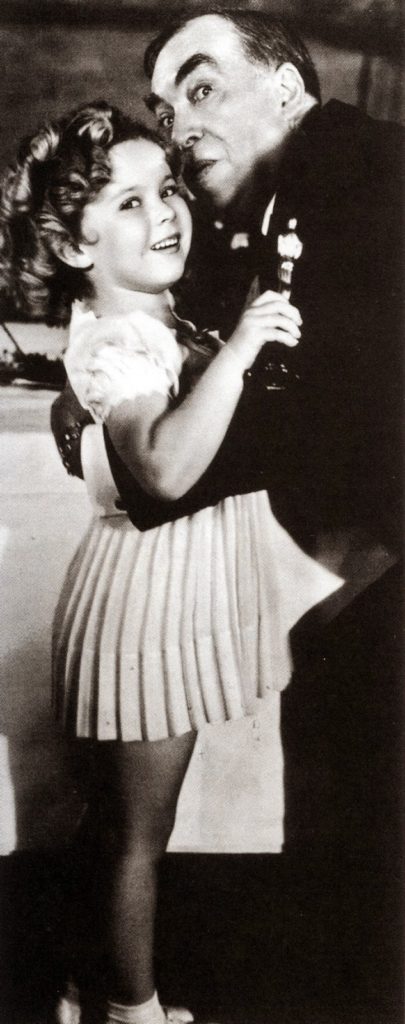
Be that as it may, there was no ignoring Shirley’s meteoric rise to the top tier of box-office stars, and the Academy Board of Governors conferred a new award, a miniature statuette “in grateful recognition of her outstanding contribution to screen entertainment during the year”. The emcee at that year’s awards was the prolific Kentucky humorist, author and columnist Irvin S. Cobb (shown here with Shirley), one of those writers whose fame more or less died when he did in 1944. Most of his 60-plus books and 300 short stories are out of print now, and he is probably best remembered for what he said that night. First: “There was one great towering figure in the cinema game, one artiste among artistes, one giant among the troupers, whose monumental, stupendous and elephantine work deserved special mention…Is Shirley Temple in the house?” Then, after Shirley joined him at the podium: “Listen, y’all ain’t old enough to know what this is all about. But honey, I want to tell you that when Santa Claus wrapped y’all up in a package and dropped you down Creation’s chimney, he brought the loveliest Christmas present that was ever given to the world.”

In Child Star, even 50-plus years on, Shirley’s disappointment still sounds tender to the touch (“If mine was really a commendable job done, why not a big Oscar like everyone else’s?”), but I think she overlooks the specialness of her special award (the only one given that year). The miniature Oscar that was created just for her would remain the standard recognition for outstanding juvenile performers for the next 26 years, and would be given 11 more times. The last went to Hayley Mills for Pollyanna in 1960; after that, beginning with nine-year-old Mary Badham for To Kill a Mockingbird in 1962, the kids would have to take their chances with the grownups (and some — Patty Duke, Tatum O’Neal, Anna Paquin — would even win). Of those dozen miniature-Oscar winners — who include Mickey Rooney, Deanna Durbin, Judy Garland, Margaret O’Brien and others — the little girl who inspired the creation of it was the youngest to receive it. In fact, she remains to this day the youngest person ever to win anything from the Academy of Motion Picture Arts and Sciences. I doubt if that record will ever be broken. 

Shirley Temple’s career hit its stride with Bright Eyes. Nineteen-thirty-four had been a banner year, and the banner would continue to wave in ’35. I’ll get to that next time.
 

To be continued…
  

Posted in Blog Entries, Shirley Temple

The Duke of Hollywood

Jim Lane's Cinedrome Posted on April 19, 2014 by Jim LaneFebruary 24, 2021

Scott Eyman has been crafting definitive Hollywood biographies for over 20 years now, and each one seems to come hotter on the heels of the one before. His Lion of Hollywood: The Life and Legend of Louis B. Mayer and Empire of Dreams: The Epic Life of Cecil B. DeMille appeared only five years apart (2005 and 2010 respectively); a lesser writer — someone like, well, me for instance — might have spent 12 or 15 years on either one of them and never managed to convey the sense that yes, this must be what the man was like, as well as Scott did both times. And as if that weren’t impressive enough, in between those two he collaborated with Robert Wagner on his 2008 autobiography Pieces of My Heart.

(Full disclosure: Scott Eyman is a friend of mine. I first met him about 15 years ago and could hardly believe I was shaking the hand that wrote The Speed of Sound [1997] — the indispensible book on the talkie revolution. Scott is some years younger than I am, but I hope to be just like him when I grow up.)

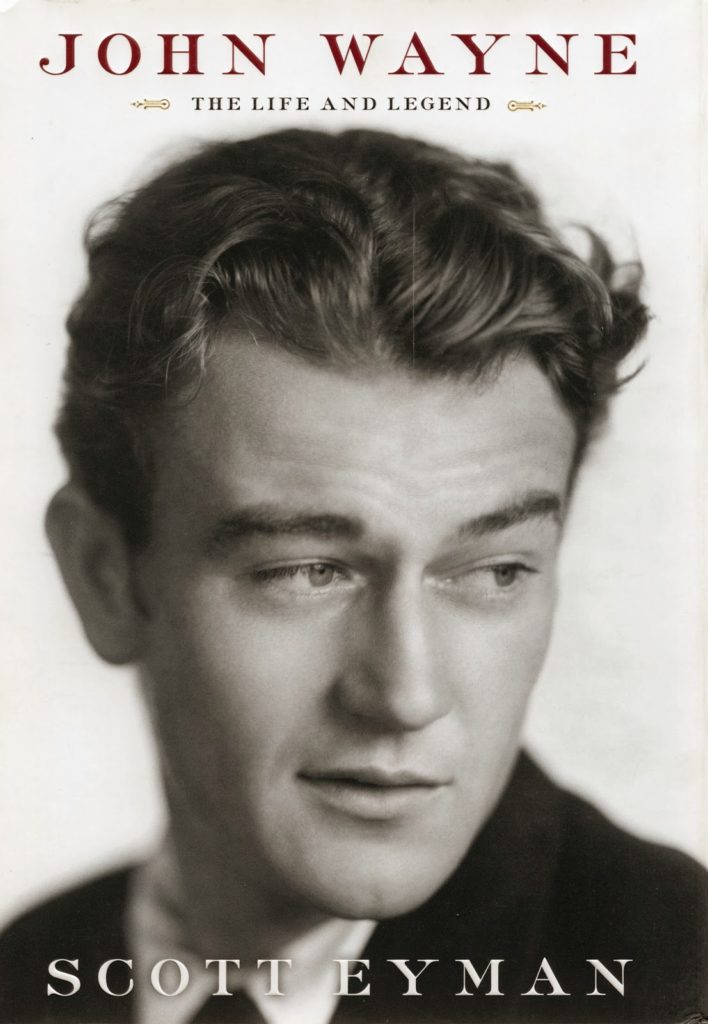
Scott’s latest book is John Wayne: The Life and Legend — and yes, this must be what the man was like. This is very much a companion volume to Scott’s 1999 bio Print the Legend: The Life and Times of John Ford, and it could hardly be otherwise: the two names were linked in life and art as few others have been. Both books end with the final image from The Searchers: Wayne as Ethan Edwards, framed in the cabin door and walking away from the family reunion into a barren landscape.

There are no bombshell revelations in John Wayne, yet the book is full of surprises — beginning with the cover, which pictures a younger, slimmer, smoother Wayne than we’re used to. (I carried the book into a Hallmark card store one day and set it on the counter while I paid for my purchase. The clerk, looking at it upside down, thought it was a picture of James Dean.)

Other surprises: The idea that Wayne stumbled into acting by accident was a myth propagated by Wayne himself. In fact, he was movie-struck from childhood, stage-struck as early as high school, and began lobbying for on-screen parts from the day he first walk onto the Fox lot as a laborer. And his feelings for his parents — the feckless father whom he adored for his kindness, the stern mother (who detested him to her dying day) whom he resented even as he paid tribute to “her strength of character, her strong sense of right and wrong, and her temper — all of which he inherited.”

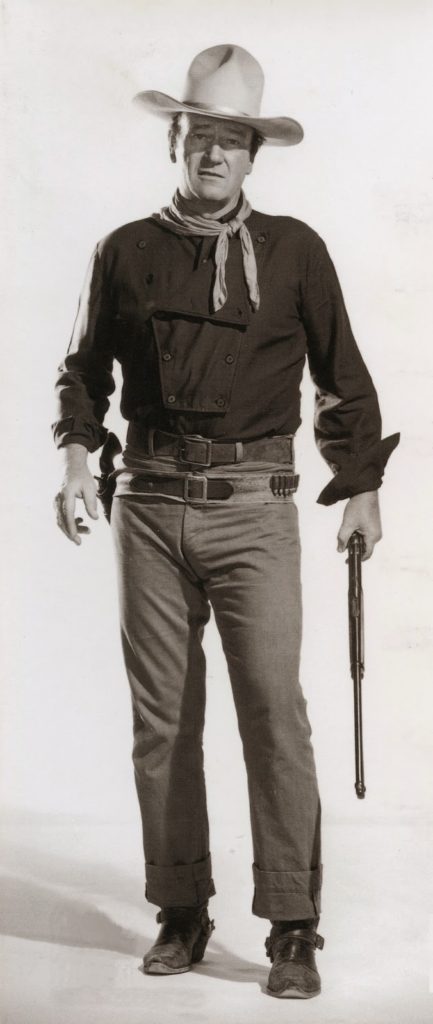
Perhaps the biggest surprise for me was how separately the man viewed himself from “John Wayne”. “In Wayne’s own mind,” Scott writes, “He was Duke Morrison. John Wayne was to him what the Tramp was to Charlie Chaplin — a character that overlapped his own personality, but not to the point of subsuming it.” The Duke never legally changed his name; his death certificate identified him as “Marion Morrison (John Wayne)”. 
 
Two quotes from the Duke, which Scott uses as epigraphs, illustrate this separation. From 1957: “The guy you see on the screen isn’t really me. I’m Duke Morrison, and I never was and never will be a film personality like John Wayne. I know him well. I’m one of his closest students. I have to be. I make a living out of him.” And again, much later: “I’ve played the kind of man I’d like to have been.” These two wistful quotes put me in mind of the famous remark by Cary Grant (who always thought of himself as Archie Leach): “Everybody wants to be Cary Grant. Even I want to be Cary Grant.”
 
Scott gives us a picture of Wayne the underrated actor (how anyone could watch Wayne’s performances in Stagecoach, They Were Expendable, The Searchers, True Grit, Island in the Sky, She Wore a Yellow Ribbon and The Quiet Man and still say he was “always the same” strikes me as a study in obtuseness, and I suspect Scott would feel the same way). The biography doesn’t shrink from an honest appraisal of the conservative politics that made Wayne such a hated lightning rod in the last third of his life, or the fact that he could be impatient, demanding, gregarious and charming — sometimes by turns, sometimes all at once. We also see the history buff who knew the American Civil War backward and forward, the collector who could discuss Asian or Native American art, and the “demon chess player” who could psych out an opponent as much as out-maneuver him on the board. 
 
Last but never least, John Wayne: The Life and Legend shows us the man who loved everything about making movies, who was first on the set in the morning and the last to leave at night. And who loved to talk about movies, his own and other people’s. At one point, Scott quotes reporter Billy Wilkerson of the Hollywood Reporter, who sat in on a conversation between Wayne and director William Wellman in 1954, when the two were putting the finishing touches on The High and the Mighty: “They had praise for every name brought into the gab and, above all, praise for the business that made it possible for unknowns to become great personages in such a short span. They had logical excuses for some failures — theirs and others — with never a knock, never derision, always enthusiasm.”
 

That, I think, is the John Wayne I would like to have met. And thanks to Scott Eyman, I feel like I have.

Posted in Blog Entries

Shirley Temple Revisited, Part 3

Jim Lane's Cinedrome Posted on April 15, 2014 by Jim LaneAugust 30, 2016

At this point in our story it’s still the spring of 1934. Before renting Shirley Temple out to Paramount to become a star, Fox frittered her away in one more pointless bit in Now I’ll Tell. Actually, the picture’s full title on screen was “Now I’ll Tell” by Mrs. Arnold Rothstein, and as that suggests, it purported to be the inside dope on the high-flying life and mysterious death of Mrs. Rothstein’s deceased husband, the gangster/gambler who fixed the 1919 World Series, was shot in November 1928 (apparently for welshing on a poker debt), and died two days later refusing to name his killer. Names were changed to protect the guilty, so Spencer Tracy starred as “Murray Golden”, with Helen Twelvetrees as his saintly, noble wife (Mrs. Rothstein wrote the story, remember!), and with Rothstein’s many mistresses combined into one person and played by 18-year-old Alice Faye.

Shirley’s role was an inch or two better than in Change of Heart: 42 seconds on screen and a whopping five lines of dialogue (to wit: “And we saw a cow there, too!”, “Does a black cow make black milk?”, “Good night”, and “Good night, Daddy” — twice). Publicity poses like this one may have led Shirley to misremember her role as that of Tracy’s daughter; in fact, she played the daughter of Tommy Doran (Henry O’Neill), a boyhood chum of Golden’s who grows up to be a police detective — on the other side of the law from his old pal. A decent enough gangland melodrama, Now I’ll Tell hit screens one week after Little Miss Marker, and could only have underscored Fox’s cluelessness.

(A side note: While Fox quickly learned to value Shirley, they never did know what they had in Spencer Tracy. They put him in 18 pictures in five years, usually as mugs and lummoxes, with the occasional loan-out here and there. Gradually he built a reputation as one of the best actors in town, but Fox kept wasting him on parts you could practically train a gorilla to play. Eventually they let him slip through their fingers into a contract with MGM in 1935. Within two years at Metro, Spence had snagged his first Oscar nomination; in the following two years he got his second and third, winning both times.) 

After Now I’ll Tell, however, Shirley’s days of Poverty Row shorts, four-line bits and uncredited walk-ons were finally behind her. For her next picture, she got top billing at last from her home studio, and just to remind audiences where they’d seen this kid before, Fox changed the title to…


Baby Take a Bow

(released June 30, 1934)
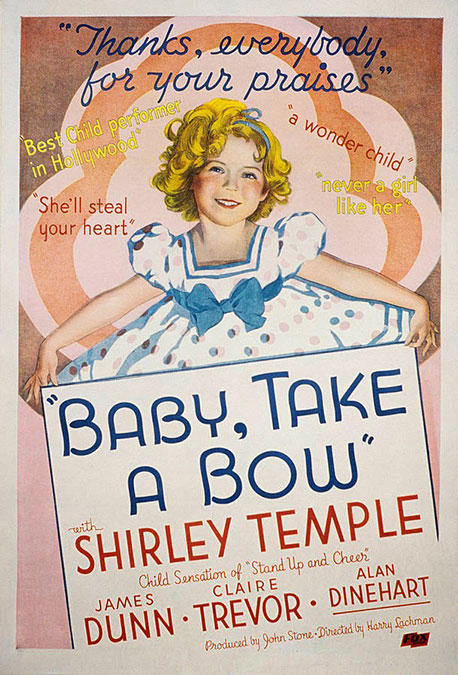
BTAB-poster02WFirst, an explanation of a trivial point, just so you don’t suspect sloppy copy editing here at Cinedrome. The title of Jay Gorney and Lew Brown’s song “Baby, Take a Bow” has a comma, and the comma appears in this and some other posters, ads and lobby cards for the movie. But it’s not on the picture’s main title card as it appears on screen. Therefore, I’ll be using the comma when referring to the song, but not using it when I’m referring to the movie. Got it?
 
Anyhow, “Baby, Take a Bow” isn’t in Baby Take a Bow — except as a line of dialogue spoken by James Dunn (once again playing Shirley’s father); but more of that later.
 
There’s an intriguing mystery about the source material for Baby Take a Bow that’s worth going into before we get to Shirley’s version of it. It was originally a play by James P. Judge titled Square Crooks that ran on Broadway for 150 performances in 1926. That was a pretty decent run in those days, especially for a one-set play with a cast of nine, so Square Crooks probably turned a profit for its investors. In any case, it was bought by Fox and filmed as a silent in 1928.

Robert Armstrong and John Mack Brown played two ex-cons trying to go straight who fall under suspicion when a crony from their criminal days steals a pearl necklace from their wealthy employer. The thief tries to get the two to fence the pearls but they refuse. Complications arise when the thief, sensing the cops hot on his trail, stashes the necklace with Armstrong’s unsuspecting little girl, who thinks it’s a birthday present. What follows is a comic round of button-button-who’s-got-the-button as the thief tries to retrieve the pearls; the heroes try to return them to their boss; an implacable insurance detective seeks to get the goods on the heroes, whom he suspects of the theft; and the little girl thinks it’s all a game of hide-and-seek.

The mystery I mentioned arises from a reading of Variety’s review of Square Crooks. The reviewer “Mori” praised it lightly as a “moderately interesting” B programmer (it ran only 60 minutes), but added, “Only chance with a story of this kind was to build a central character. But here five different people and a juvenile player divide interest, with the baby drawing first honors.” Mori didn’t identify the “baby”, and neither does the picture’s IMDb listing or the listing for the original play on the Internet Broadway Database (where the credits are admittedly incomplete). So unless a print of Square Crooks survives in the Fox vault (which, for a silent that came out during the hectic talkie revolution, is highly doubtful), the name of the little girl who Mori thought stole the show is probably lost forever to history.
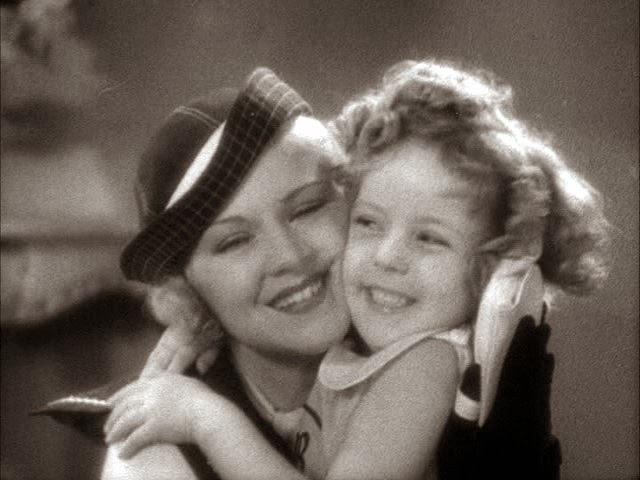
 

Be that as it may, we certainly know who played the kid in the sound remake. Shirley is shown here with Claire Trevor, who plays her mother and James Dunn’s wife. Trevor is younger and softer in Baby Take a Bow than we remember her from her better-known performances — Stagecoach; Key Largo; The High and the Mighty; Murder, My Sweet — she could almost pass for Ginger Rogers here.

Baby Take a Bow opens as Eddie Ellison (Dunn) is released from Sing Sing, promising to go straight. His girl Kay (Trevor) meets him at the gate, with continuing tickets for them to Niagra Falls for a justice of the peace wedding and honeymoon. At the same time we meet insurance investigator Welch (Alan Dinehart in an interesting performance), a tinhorn Javert who bluffly pals around with the men of various police forces — and tries in vain to make time with Kay. Everybody, especially Kay, makes it clear that they don’t like him, but Welch remains oblivious, blithely carrying on as if he’s one of the guys. Six years later, when Eddie and Kay have built a happy home with their daughter Shirley (star and character share the given name), it will be Welch who tries to hound Eddie and his pal Larry (Ray Walker) back into prison.
 
Unlike Little Miss Marker over at Paramount, Baby Take a Bow gives ample evidence of having been thrown together in haste. It begins as melodrama, then segues into farce as Dunn, Walker, Trevor, Shirley and Ralf Harolde as the thief chase the pearl necklace up, down, back and forth in the Ellisons’ apartment house. Then for the last reel it shifts back to melodrama as Harolde finally nabs the pearls and kidnaps Shirley to use as a shield in making good his escape. All ends happily, with the thief in custody, the pearls returned, and the heroes exonerated. Even the meddling Welch gets his just deserts.
 
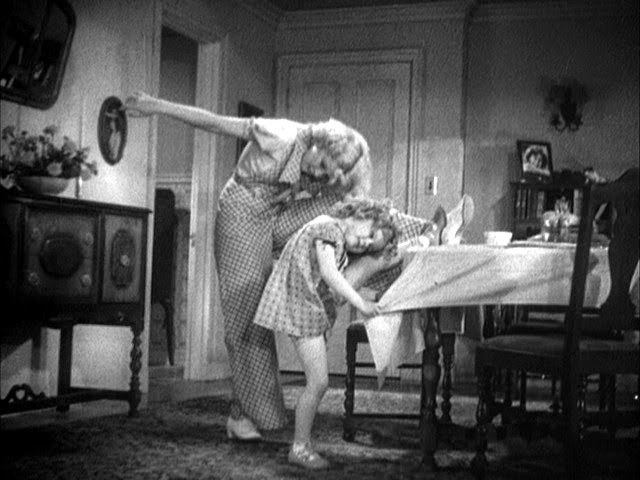
Director Harry Lachman was evidently too hurried — or too clumsy — to negotiate these shifts in tone; the comedy scenes fall particularly flat. The picture’s chief pleasure, predictably, is Shirley herself. But there are other small ones along the way, such as this, a tossed-off scene in which Kay and Shirley go through some dining-room calisthenics while listening to an exercise progam on the radio. Mother and daughter (and the actresses playing them) are clearly having fun, and it’s contagious.
 
 
Also among those pleasures is another song and dance number for Shirley and James Dunn — the one touch of music in the picture. The song is “On Account-a I Love You” by Bud Green and Sam H. Stept, performed by father and daughter at a rooftop birthday party for Shirley in which she shows off the new ballet dress Mommy and Daddy have given her. Again, the haste of the production is evident in the under-rehearsed hoofing (dance director Sammy Lee apparently didn’t even have the few days he was allotted for “Baby, Take a Bow” in Stand Up and Cheer!). Still, the number is a highlight and worth sharing. At the end of the song, you’ll see Dunn turn to Shirley and say, “C’mon, baby, take a bow,” thus justifying the picture’s title (again, the YouTube clip is colorized, and again I ask your indulgence):


Variety’s reviewer “Kauf” pegged Baby Take a Bow exactly: “Without Shirley Temple this might have been a pretty obvious and silly melodrama, but it has Shirley Temple so it can go down on the books as a neat and sure b.o. (box office) hit, especially for the family trade.” (It’s a pity Mori couldn’t have reviewed it; it would be interesting to have him compare it to Square Crooks — assuming he even remembered a six-year-old silent B picture as late as 1934.) Meanwhile, back east at the New York Times, the anonymous reviewer sounded the first notes of praise mixed with highbrow condescension that would increase in some quarters in coming years (and would lead eventually to a successful libel suit against novelist Graham Greene and the British magazine Night and Day):

Little Shirley Temple continues in her new film at the Roxy to be the nation’s best-liked babykins. A miracle of spontaneity, Shirley successfully conceals the illusion of sideline coaching which, in the ordinary child genius, produces homicidal impulses in those old fussbudgets who lack the proper admiration for cute kiddies.

Then, in the next sentence, the reviewer gave credit where it was due: “In ‘Baby, Take a Bow,’ she tucks the picture under her little arm and toddles off with it.” (And by the way, it’s worth noting that “nation’s best-liked babykins” line. This, mind you, on the strength of only Stand Up and Cheer! and — especially — Little Miss Marker.)

Before embarking on her next picture at Fox, Shirley was shuttled back to Paramount for another loan-out:

Now and Forever

(released August 31, 1934)
Now-&-Forever-LC02W


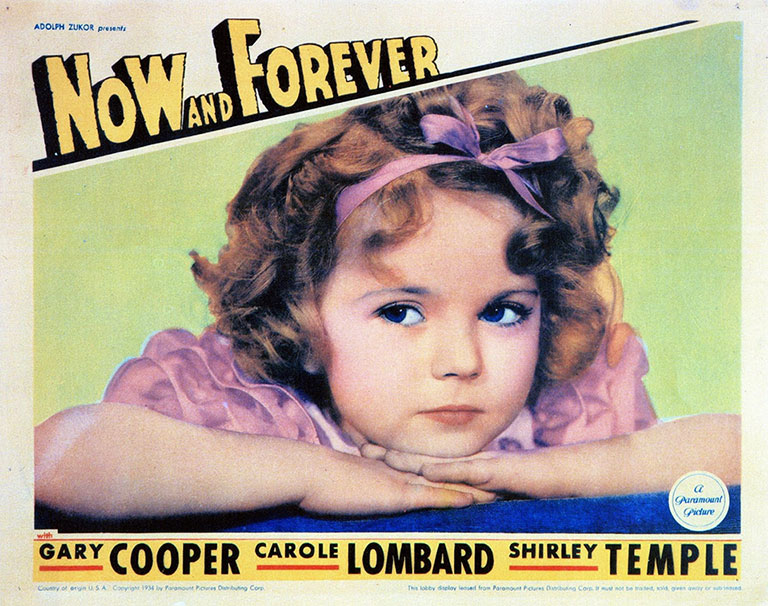
Shirley’s billing on Now and Forever was again above the title, but third this time. Still, when you’re billed third after Gary Cooper and Carole Lombard, you’ve really got no kick coming. (On screen she gets an “and”: “And SHIRLEY TEMPLE”.) Even more significantly, the music under the opening titles is an instrumental rendition of “Laugh, You Son of a Gun” — reminding audiences of Little Miss Marker the way Baby Take a Bow had reminded them of Stand Up and Cheer! 
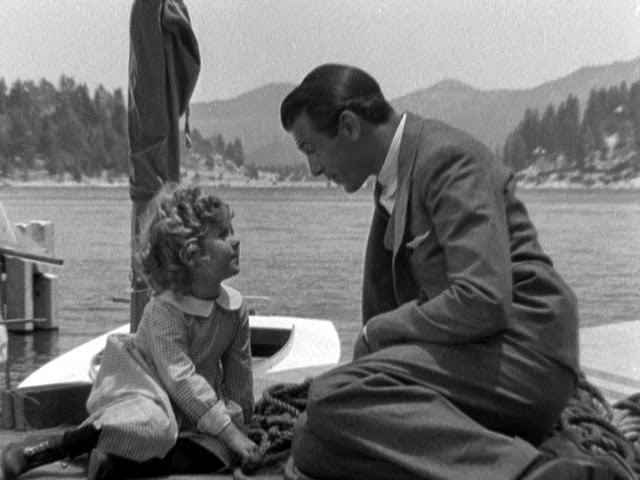


Now and Forever also reunited Shirley with director Henry Hathaway, who had presided over her near-death experience with a pony on To the Last Man. In this picture, Gary Cooper plays Jerry Day, a globe-trotting confidence man, with Carole Lombard as Toni, his accomplice and companion. In the credits she’s identified as “Toni Day”, but the script makes it pretty clear that they’re not married; in the first scene he tells her, “I told you I was married,” not, “was married before.” Anyhow, Jerry was married, but when his wife died, he left his infant daughter with her wealthy, disapproving family; he figures the child must be five or six now. When he and Toni find themselves out of cash, he proposes to go to his stuffed-shirt brother-in-law and sell his parental rights for $75,000. But one brief visit with little Penny (Shirley), who naturally doesn’t know him, changes his mind. He reveals himself to her and takes her with him while his brother-in-law fumes and blusters.
 
First stop, New York, where Jerry runs a scam on a Mr. Felix Evans (Sir Guy Standing) for $5,000 in a phony mining deal. Then it’s bon voyage for Europe to meet Toni in Paris. Their ship is barely out of port before they meet Mr. Evans strolling the deck. Jerry manages to stammer out that he was suddenly called away to Europe, and Evans gives him a smooth, knowing smirk. “Quite a coincidence, Mr. Day. Because the same thing happened to me.” And Evans calmly wishes him a good day.
 
Jerry and Penny join Toni in Paris, where, after a little jealous tension, Toni and Penny bond with one another. Toni has an uneasy conscience over bringing Penny into the lifestyle she and Jerry have adopted, and in his way, so does he. He tries to settle down into an honest job in Paris, but his and Toni’s rich tastes are his undoing. Then the sinister Mr. Evans reenters his life. Evans has his eye on the jewels of Mrs. J.H.P. Crane (Charlotte Granville), a dowager widow who has taken a shine to Penny, and he wants Jerry to help him lay hands on them.
 
That’s really as far as we need to go with Now and Forever because…well, frankly, despite the nostalgic value of Cooper, Lombard and Temple in the same picture, it’s a bit of a dud. The script by Vincent Lawrence and Sylvia Thalberg (sister of Irving) is as bland and pointless as the title, and this sort of ersatz Ernst Lubitsch was never director Hathaway’s strong suit. Shirley sings one song, “The World Owes Me a Living” from the then-current Disney Silly Symphony The Grasshopper and the Ants, which serves as Jerry’s unofficial theme song (he’s whistling it when he first meets Penny). But even that’s a cheat; Hathaway cuts away for a long scene of Jerry stealing an emerald necklace and stashing it in his daughter’s teddy bear, with Penny’s voice barely audible in a distant room of the old lady’s mansion. Now and Forever is really only memorable for two things. One is Shirley’s recollection of the fun of working with Carole Lombard (“If she really employed bawdy humor and truck-driver expletives, it was never within my hearing. Wherever she went she seemed to wear a halo of crystalline happiness.”).
 
The other thing is a scene in which Penny learns that her father is a jewel thief and has lied to her about it. On the set that day, just before the cameras rolled, some blabbermouth inadvertently spilled the beans about Dorothy Dell’s gruesome death. The tears we see in that scene aren’t Penny’s disillusionment with her father; they’re Shirley’s genuine grief at the loss of her friend from Little Miss Marker.
 
After this second excursion to Paramount, Shirley returned to Fox for her next job, the first real “Shirley Temple picture” — in the sense that it was tailor-made just for her — with the song that, as she put it, would stick to her “like lifelong glue”. Except for a famous near-miss several years later (which I’ll get to in good time), there would be no more talk about loaning her out.
 
To be continued…
 

Posted in Blog Entries, Shirley Temple

Post navigation

← Older posts
Newer posts →
index sitemap advanced
search engine by freefind

Recent Posts

  • Twinkle, Twinkle, Little “Star” (Republished)

  • Sixty-Six Years’ Worth of Oscars

  • A Visit with Jody Baxter, Chick Mallison, Trooper Jeff Yorke et al.

  • Ave Atque Vale, Jody Baxter

Articles A – Z

You will find 222 posts in the category  on this blog.


Jump to , 4, A, B, C, D, E, F, G, H, I, J, L, M, N, O, P, R, S, T, U, W, Y

4

  • 40th Anniversary Tour: Jesus Christ Superstar

A

  • “A Genial Hack,” Part 1
  • “A Genial Hack,” Part 2: The Trail of the Lonesome Pine
  • “A Genial Hack,” Part 3: Peter Ibbetson
  • A “Christmas Wish” Returns
  • A Cinedrome “Christmas Tradition” Returns
  • A Cinedrome Pop Quiz
  • A Hitch in the Get-Along: State Secret
  • A Holiday Treat (I Hope!) for Cinedrome Readers
  • A Jigsaw Mystery
  • A Mystery Photo
  • A Time-Travel Studio Tour
  • A Treasure Trove of MGM Shorts, Part 1
  • A Treasure Trove of MGM Shorts, Part 2
  • A Visit with Jody Baxter, Chick Mallison, Trooper Jeff Yorke et al.
  • A Weekend With David O. Selznick
  • A-a-a-and We’re Back…!
  • Addio, Cinevent 42!
  • After a Brief Intermission…
  • America’s Canadian Sweetheart, 1921-2013
  • Andrew Sarris, 1928-2012
  • Auditioning for Immortality
  • Ave Atque Vale, Fairy Princess!
  • Ave Atque Vale, Jody Baxter

B

  • Bright Eyes, 1928-2014
  • Browsing the Cinevent Library, Part 1
  • Browsing the Cinevent Library, Part 2

C

  • C.B. Gets His Due
  • Camera Beauty
  • Cary-ing On
  • Catching Some Rays
  • Catting Around
  • CHAPTER I
  • CHAPTER II
  • Cinedrome Does Its Part
  • Cinedrome Wins 2012 CMBA Award
  • Cinedrome’s Annual Holiday Treat Returns
  • Cinerama-Rama!
  • Cinevent 2016 (Continued)
  • Cinevent 2016, Concluded
  • Cinevent 2016, Part 3
  • Cinevent 2016, Part 4
  • Cinevent 2017 – No. 49 and Counting, Part 1
  • Cinevent 2017 – No. 49 and Counting, Part 4
  • Cinevent 2017 — No. 49 and Counting, Part 2
  • Cinevent 2017 — No. 49 and Counting, Part 3
  • Cinevent 42
  • Cinevent 45
  • Cinevent 50 – Day 1
  • Cinevent 50 – Day 2
  • Cinevent 50 – Day 3 (Part 2)
  • Cinevent 50 – Prelude
  • Cinevent 50 — Day 3 (Part 1)
  • Cinevent 50 — Day 4
  • Cinevent 51 – Day 1, Part 1
  • Cinevent 51 – Prelude
  • Cinevent 51 — Day 1, Part 2
  • Cinevent 51 — Day 2
  • Cinevent 51 — Day 3
  • Cinevent 51 — Day 4
  • Cinevent Turns 50
  • Cinevent, Day 2
  • Cinevent, Day 3
  • Cinevent, Day 4
  • CMBA Blogathon: Come Next Spring (1956)
  • CMBA Blogathon: Kitty (1945)
  • Crazy and Crazier, Part 1
  • Crazy and Crazier, Part 2
  • Crazy and Crazier, Part 3
  • Crazy and Crazier, Part 4

D

  • “Don’t Stay Away Too Long…”

E

  • Elizabeth Taylor, 1932-2011

F

  • Films of Henry Hathaway: Brigham Young (1940)
  • Films of Henry Hathaway: Down to the Sea in Ships
  • Films of Henry Hathaway: Down to the Sea in Ships
  • Films of Henry Hathaway: Fourteen Hours (1951)
  • Films of Henry Hathaway: Prince Valiant
  • Films of Henry Hathaway: The Shepherd of the Hills
  • First Comes the Phone Call
  • Five-Minute Movie Star: Carman Barnes in Hollywood — Epilogue
  • Five-Minute Movie Star: Carman Barnes in Hollywood, Part 1
  • Five-Minute Movie Star: Carman Barnes in Hollywood, Part 2
  • Five-Minute Movie Star: Carman Barnes in Hollywood, Part 3
  • Flo Chart

G

  • “Glamour Boys” Begins…
  • “Glamour Boys” Continues…
  • Grand Opening!

H

  • “Here’s a Job for You, Marcel,” Part 1
  • “Here’s a Job for You, Marcel,” Part 2
  • “Here’s a Job for You, Marcel,” Part 3
  • Harlow in Hollywood

I

  • “Is Virginia Rappe Still Alive?”
  • Items from the Scrapbook of Cosmo Brown
  • Items from the Scrapbook of Cosmo Brown

J

  • Jigsaw Mystery — Solved?

L

  • Liebster Blog Award
  • Lost & Found: Alias Nick Beal
  • Lost & Found: Night Has a Thousand Eyes
  • Lost and Found: Miss Tatlock’s Millions (1948)
  • Luck of the Irish: Darby O’Gill and the Little People, Part 1
  • Luck of the Irish: Darby O’Gill and the Little People, Part 2
  • Luck of the Irish: Darby O’Gill and the Little People, Part 3
  • Luck of the Irish: Darby O’Gill and the Little People, Part 4

M

  • “MOVIE” Souvenir Playing Cards
  • Merry Christmas from Cinedrome!
  • MERRY CHRISTMAS from Cinedrome!
  • Mickey and Judy — Together at Last
  • Minority Opinion: The Magnificent Ambersons, Part 1
  • Minority Opinion: The Magnificent Ambersons, Part 2
  • Minority Opinion: The Magnificent Ambersons, Part 3
  • Minority Opinion: The Magnificent Ambersons, Part 4
  • Minority Opinion: The Magnificent Ambersons, Part 5
  • Minority Opinion: The Magnificent Ambersons, Part 6
  • Movie Playing Cards: 3 of Hearts – Geraldine Farrar
  • Movie Playing Cards: 5 of Spades – George Walsh
  • Movie Playing Cards: 9 of Diamonds – Mary Miles Minter
  • Moving Right Along…
  • Mr. Stewart Goes to War

N

  • Nuts and Bolts of the Rollercoaster

O

  • Our Mr. Webb

P

  • Picture Show 02 — Day 1
  • Picture Show 02 — Day 2
  • Picture Show 02 — Day 3
  • Picture Show 02 — Day 4
  • Picture Show 02, Day 00 — Prelude at the Wex
  • Picture Show 2022 – Day 2
  • Picture Show 2022 — Day 1
  • Picture Show 2022 — Day 3
  • Picture Show 2022 — Day 4
  • Picture Show 2022 — Prelude
  • Picture Show No. 3 — Day 1, Part 1
  • Picture Show No. 3 — Prelude
  • Picture Show No. 3 — Tying Off a Loose End
  • Please Stay Tuned

R

  • R.I.P. Ray Harryhausen, 1920-2013
  • Remembering the Night
  • Remembering the Night
  • Return of “Movie” Souvenir Playing Cards
  • Returning to Lost London
  • Returning to Lost London (Reprinted)
  • Rex the First
  • Rhapsody in Green and Orange – EPILOGUE
  • Rhapsody in Green and Orange, Part 1
  • Rhapsody in Green and Orange, Part 2
  • RIP Dean Stockwell, 1936-2021

S

  • Say, What Ever Happened to Carman Barnes?
  • Shirley Temple Revisited, Part 1
  • Shirley Temple Revisited, Part 10
  • Shirley Temple Revisited, Part 11
  • Shirley Temple Revisited, Part 12
  • Shirley Temple Revisited, Part 13
  • Shirley Temple Revisited, Part 14
  • Shirley Temple Revisited, Part 2
  • Shirley Temple Revisited, Part 3
  • Shirley Temple Revisited, Part 4
  • Shirley Temple Revisited, Part 5
  • Shirley Temple Revisited, Part 6
  • Shirley Temple Revisited, Part 7
  • Shirley Temple Revisited, Part 8
  • Shirley Temple Revisited, Part 9
  • Silent Weekends
  • Silents in Kansas 2011, Part 2
  • Sixty-Six Years’ Worth of Oscars
  • Songs in the Light, Part 1
  • Songs in the Light, Part 2
  • Songs in the Light, Part 3
  • Speak (Again) of the Devil
  • Speak of the Devil…

T

  • “The Best of Us,” Part 1
  • “The Best of Us,” Part 2
  • “The Best of Us”, Part 1
  • “The Best of Us”, Part 2
  • Ted Sierka’s Brush with Greatness
  • The 11-Oscar Mistake
  • The Annotated “Lydia the Tattooed Lady”
  • The Bard of Burbank, Part 1
  • The Bard of Burbank, Part 2
  • The Could-Have-Been-Greater Moment
  • The Duke of Hollywood
  • The Fog of Lost London, Part 1
  • The Fog of Lost London, Part 1
  • The Fog of Lost London, Part 2
  • The Fog of Lost London, Part 2
  • The Fog of Lost London, Part 3
  • The Fog of Lost London, Part 3
  • The Fog of Lost London, Part 4
  • The Fog of Lost London, Part 4
  • The Kansas Silent Film Festival 2011
  • The Last Cinevent, the First Picture Show — Day 1
  • The Last Cinevent, the First Picture Show — Day 2
  • The Last Cinevent, the First Picture Show — Day 3
  • The Last Cinevent, the First Picture Show — Day 4
  • The Man Who Saved Cinerama
  • The Mark of Kane
  • The Museum That Never Was, Part 1
  • The Museum That Never Was, Part 2
  • The Return of the King
  • The Rubaiyat of Eugene O’Neill
  • The Sensible Christmas Wish
  • The Shout Heard Round the World
  • The Stainless Steel Maiden, 1916-2020
  • The Stamm
  • Tony Curtis 1925-2010
  • Tragedy in Nevada, January 1942
  • Twinkle, Twinkle, Little ‘Star’
  • Twinkle, Twinkle, Little “Star” (Republished)

U

  • Ups and Downs of the Rollercoaster, Part 1
  • Ups and Downs of the Rollercoaster, Part 2
  • Ups and Downs of the Rollercoaster, Part 3
  • Ups and Downs of the Rollercoaster, Part 4
  • Ups and Downs of the Rollercoaster, Part 5
  • Ups and Downs of the Rollercoaster, Part 6

W

  • “Who Is the Tall Dark Stranger There…”
  • Wings, Again
  • Wyler and “Goldwynitis”
  • Wyler and “Goldwynitis” (reprinted)
  • Wyler Catches Fire: Hell’s Heroes
  • Wyler Catches Fire: Hell’s Heroes
  • Wyler’s Legacy
  • Wyler’s Legacy (reprinted)

Y

  • Yuletide 2018

Copyright Notice

All textual content Copyright © date of posting by Jim Lane. All rights reserved. Unauthorized use and/or duplication of this material without express written permission from this blog’s author is strictly prohibited. Excerpts and links may be used, provided that full and clear credit is given to Jim Lane and Jim Lane’s Cinedrome with appropriate and specific direction to the original content.

↑