↓
 
  • Home
  • About the Author
  • Series
    • Carman Barnes: Five-Minute Movie Star
    • Crazy and Crazier
    • Films of Henry Hathaway
    • History of Cinerama: “Cinerama-Rama!”
    • Luck of the Irish: Darby O’Gill and the Little People
    • Marcel Delgado
    • Minority Opinion: The Magnificent Ambersons
    • Movie Souvenir Playing Cards
    • Shirley Temple Revisited: “Bright Eyes, 1928-2014”
    • The Bard of Burbank
    • The Fog of Lost London
    • The Museum That Never Was
    • William Wyler
  • Links and Resources
  • Jim’s Fiction
    • Glamour Boys
    • Items from the Scrapbook of Cosmo Brown
    • Sensible Christmas Wish, The
  • Contact

Jim Lane's Cinedrome

Classic Hollywood

Post navigation

← Older posts
Newer posts →

Grand Opening!

Jim Lane's Cinedrome Posted on September 11, 2016 by Jim LaneSeptember 11, 2016

Welcome to the New! Improved! Cinedrome! As you can see, there’s a new look and a lot of new features. I’ll go over some of them with you now.

First, in the right column:

  • Recent Posts and Articles A – Z  You’ll find here first a list of the ten most recent posts, followed by a list of all Cinedrome posts, arranged alphabetically by the title of the post (and here’s a hint in case you haven’t noticed: Posts that begin with the articles “A” and “The” are listed in the A’s and T’s, respectively). You may find that you’d like to revisit a post on this or that movie or personality but can’t recall the title; in that case, you can use…
  • Search  If you’ve spent much time at all on line, I’m sure you have a pretty good idea of how this feature works. This replaces the old Cinedrome Index: NAMES and Cinedrome Index: TITLES, which were beginning to get pretty cumbersome.


And up top:

  • About the Author  A few brief words about Yours Truly.
  • Series  As longtime readers of Cinedrome no doubt know, I’ve often found occasion to post at length on a given subject. Under this heading you’ll find a number of these series (and the number will no doubt grow in the future), including my 14-part retrospective on the career of Shirley Temple; my award-winning history of the making and editing of Orson Welles’s The Magnificent Ambersons; my histories of Cinerama and the screen versions of George and Ira Gershwin’s Girl Crazy; and my ongoing retrospective on the career of director Henry Hathaway (which I will soon be adding to with a post on one of Hathaway’s best pictures of the 1950s, one that is lamentably unavailable on video in the U.S.). Clicking on one of these series titles will take you to all of the series parts on a single page for your convenience. The series page does not include any comments that readers may have left; to read those, simply click on the title of any part and you’ll be taken to just that post, comments and all.
  • Jim’s Fiction  It’s true; I write fiction too. At present the only entry under this heading is my 2010 post “Items from the Scrapbook of Cosmo Brown” (yes, the cat’s out of the bag: I made that all up), but I’ll be adding to it from time to time. Some things will be movie-related, some won’t.


In addition to these, there’s my Links and Resources page, imported from before, and a Contact page for info on how to get in touch with me; it’s always a pleasure to hear from any and all of you.

I’m grateful to my good friend Jean Black at My Big Fat Sites for bringing all this to fruition. I hope you like the new Cinedrome; feel free to look around, make yourself comfortable, and come back often.

Coming up next – Clara Talks!

Posted in Blog Entries

Cinevent 2016, Concluded

Jim Lane's Cinedrome Posted on June 23, 2016 by Jim LaneAugust 1, 2016

Sunday, the last day of Cinevent 2016, got off to a vivacious start with a double feature showcasing that most utterly, charmingly, irresistibly delightful of movie stars, Clara Bow. Only the persistent prejudice against silent movies keeps Clara Bow from her rightful place among the movies’ greatest stars — in the minds of the general public, that is; true movie buffs know her worth. Greta Garbo and Marilyn Monroe, at the height of their careers, were never as popular or as sexy as Clara. But Greta and Marilyn are enshrined in the Temple of Screen Immortals, even to people who know them only by name, while the name of Clara Bow is something out of a quaint, distant, forgotten prehistory, like Nell Gwyn or Minnie Maddern Fiske.

This is unfair. To see Clara Bow at her best — in Mantrap (1926), or in It or Wings (both ’27) — is to see someone who is still as animated and as immediately alluring as she was the day she reported to the set. Everybody who ever worked with Clara spoke of her ever after with a wistful smile. More to the point, the camera loved her as it has loved few other women who ever stood in front of one.

She’s been the victim, perhaps, of the legend that her atrocious Brooklyn accent doomed her when sound came in. Not so. While it’s true that the microphone terrified her at first, she rolled with the punch and gamely soldiered on. In her 11-year career she appeared in 56 features, and 11 of them were talkies. There was nothing wrong with her voice, any more than there was with Jean Harlow’s (the two women’s careers overlapped by a few years). Clara’s sound pictures did reasonably well at the box office, though it’s true, not as well as her silents. But that’s not because Clara was talking now. The simple truth is that her day was passing, while Jean Harlow’s was coming on.

I’ll save any further thoughts for another day. For now, let’s turn to Clara’s Sunday double bill in Columbus.

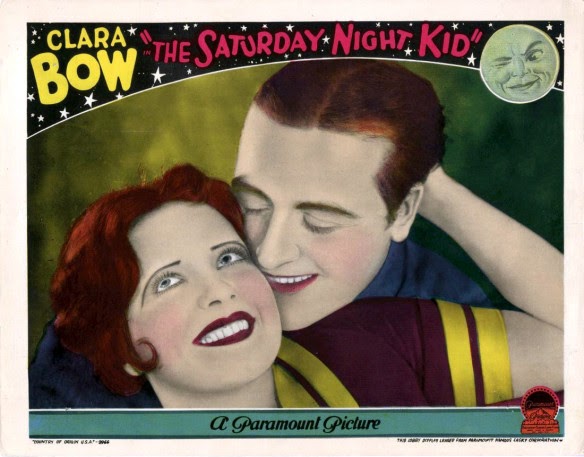
Saturday Night Kid LC02First came The Saturday Night Kid (1929), based on Love ‘Em and Leave ‘Em, a 1926 play by George Abbott and John V.A. Weaver. The play was filmed silent (also in ’26) under its original title (and screened at Cinevent in 2010), with Evelyn Brent and Louise Brooks playing Mame and Janie Walsh, two sisters who work together at a big department store. Mame is the older, more responsible one, forever mother-henning her hedonistic, troublemaking kid sister Janie. For this talkie remake, Clara played the slightly renamed Mayme and Jean Arthur was Janie (though she was in fact five years older than Clara). Janie is a hell-raiser and borderline sociopath, playing the ponies with the store empoyees’ charity fund, losing it, then blaming Mayme for the embezzlement — and even trying to steal Mayme’s boyfriend (James Hall). Clara wasn’t looking her best (she was, just this once, a trifle overweight and a bit frowzy), but the picture was a hit in 1929 and it still plays well; when Mayme finally got fed up and slapped Janie clear across their bedroom, applause rippled through the Cinevent audience.

Next, Kid Boots (1926) was one of those oddities, a silent movie based (albeit loosely) on a Broadway musical comedy produced by Florenz Ziegfeld. Ziegfeld’s star Eddie Cantor made his screen debut here, playing a man hired to flirt with a rich man’s gold-digging wife and give the husband grounds for divorce. At a mountain resort, Eddie hits it off with the swimming instructor — but their romance proceeds awkwardly because every time she sees him he’s wooing somebody else. Since Eddie couldn’t resort to song-and-dance, he was teamed with Clara (as the swimming instructor) for box-office insurance. It was a felicitous pairing. The two got along famously; Eddie helped Clara with her comic timing and she helped him learn how to act for the camera, and their rapport and mutual affection still come through on the screen.

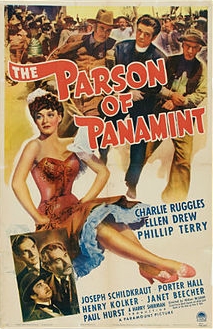
Parson of Panamint poster02aAfter lunch there was a new wrinkle this year. They called it the Audience Choice Picture: Earlier in the year, on the Cinevent Web site, those of us planning to attend were polled as to which of four titles we’d like to see screened in this slot. I can’t remember what the four choices were, nor which one I voted for, but we wound up with The Parson of Panamint (1941), from a story by Peter B. Kyne. Like Kyne’s perennially popular The Three Godfathers, the story was a parable. Charlie Ruggles (in a change-of-pace straight dramatic role) plays the mayor of the rough-and-tumble mining town of Panamint, California. The mayor goes to the big city of San Francisco to hire a preacher for his town’s new church, and that’s where he finds the Rev. Philip Pharo (Phillip Terry) — not in a church, but taking the mayor’s part in a saloon fight. The Rev. Mr. Pharo accepts the job and rides back with the mayor to his new congregation.
 
At first things go well between the parson and the townspeople. But as it becomes clear to them that he takes the Christian doctrine of “love thy neighbor” quite seriously, his innate goodness begins to make people uncomfortable — plus, his concern for the welfare of the town’s gold miners incurs the enmity of the self-styled leaders of the community, who set about stirring up public outrage against him. The script by Adrian Scott and Harold Shumate, and Kyne’s original story, bore obvious parallels to the life of Jesus (although — spoiler alert! — in the movie things work out rather better for the Parson of Panamint than they did for the Carpenter of Nazareth). The picture garnered good reviews but poor box office; today it’s an unusual little jewel of a movie, marred only by a too-bland performance by Phillip Terry as the parson. But Terry was more than compensated for by others in the cast, especially Ruggles and Ellen Drew as a local saloon girl (the movie’s equivalent of Mary Magdalene).
 
The Parson of Panamint was the final highlight of this year’s Cinevent, but the weekend didn’t exactly end with a whimper. The last two features were The Tomboy (1924), a rural romance starring the now-forgotten silent comedienne Dorothy Devore (just the kind of scheduling Cinevent excels at, spotlighting former stars for whom there’s no market on video but who deserve to be remembered); and King of Alcatraz (1938) a marvelously tight little Paramount B (running a lightning 68 min.) starring Lloyd Nolan and Robert Preston as frenemy wireless operators on a tramp steamer matching wits with an escaped crime kingpin (J. Carrol Naish) who hijacks their ship in mid-Pacific.
 
And so it was at 5:48 p.m. on Sunday, June 5, 2016, that the 48th Annual Cinevent Classic Movie Convention came to a close. I’ve posted on it in some detail, as I have in the past, because movie buffs everywhere should know about it and be encouraged to take it in. I haven’t even touched on the dealers’ rooms this year, though I once again acquired my share of books, videos, and memorabilia (some of which will no doubt find its way here from time to time).
 
As film festivals go, Cinevent is hard to beat. Financially, it’s just about the bargain of the century: a pass for the entire weekend goes for less than you’d pay for a single screening at some classic film festivals. But it’s more than that. Cinevent is a get-together of friends; historian and bestselling biographer Scott Eyman calls it “the most relaxed, friendly, unpretentious, accessible and enjoyable of the Cinephile Conventions.” I hope to see you all there one of these years. Be sure to say hello.
 

Afterword

 
There are changes afoot here at Cinedrome. That’s why this series on Cinevent 2016 has taken longer than I would have liked: I’ve been working two blogs, in a way, putting together these posts on the one hand, while working on the other hand with my friend Jean at My Big Fat Sites to develop a new and (I hope) improved Cinedrome. This will be the last of my posts here on Blogspot, though I’ll update this afterword with my new Web address when it’s ready to be seen.
 
And oh yes, all previous posts will still be available (maybe, if plans work out, even more so) at Cinedrome’s new location.
 
Posted in Blog Entries

Cinevent 2016, Part 4

Jim Lane's Cinedrome Posted on June 17, 2016 by Jim LaneAugust 1, 2016

Day 3

Another regular — and eagerly anticipated — feature of Cinevent is the Saturday morning cartoon program, compiled and curated by animation maven Stewart McKissick. This year the bill included a specimen from each of the major cartoon studios of the 1930s through ’50s — Disney, Warner Bros., MGM, Fleischer, UPA, etc. The clear highlight of the morning was MGM’s Magical Maestro (1952) by the great Tex Avery, in which a spurned vaudeville magician wreaks vengeance by disrupting an operatic recital by “the Great Poochini” (as the poster shows, the cartoon is populated by dogs). It’s a wild and zany ride that anticipates (may even have inspired) Chuck Jones’s Duck Amuck over at Warners the following year, and it’s better seen than described.

Fortunately, that can be arranged. Click here to see the cartoon complete from beginning to end — including a few fleeting (and fairly harmless) seconds of non-p.c. ethnic humor. It’s only six-and-a-half minutes, and worth the side trip. I’ll wait till you get back. (NOTE: The cartoon is on a Romanian-language Web site and is preceded by a commercial for one product or another. Look for a white “X” in the top right corner of the frame or the word “Inchide” [“skip”] in the bottom right; click on either of those and it’ll go directly to the cartoon.)

The cartoon program was followed by Houdini (1953), a purported biopic starring a youthful Tony Curtis and then-wife Janet Leigh as the legendary escapologist and his wife Bess. A big hit in 1953, the picture was a mainstay of Saturday afternoon kiddie matinees when I was going to them — I remember seeing it three or four times — and I’ve always had a soft spot for it. There was, of course, a magician and escape artist (born Erik Weisz) who billed himself as Harry Houdini, and his wife Wilhelmina Beatrice was known as Bess; aside from that, the movie is arrant fiction from first frame to last — but it’s as entertaining as it is made-up. Seeing it in Columbus this year — especially right after a whole slew of cartoons — made me feel seven years old again.

The afternoon was devoted to two silent programs: Douglas Fairbanks in His Picture in the Papers (1916), followed by a selection of rarely seen comedy shorts, also from 1916, consisting of The Mystery of the Leaping Fish, starring Doug Fairbanks again as a detective named (get this) Coke Ennyday (a spoof on the name of Craig Kennedy, a character created by Arthur B. Reeve in 1910 and popular in magazine fiction until Reeve’s death in 1936); An Angelic Attitude, directed by and starring Tom Mix, already seven years into his movie career and poised on the brink of superstardom; and A Scoundrel’s Toll, a Mack Sennett short starring Raymond Griffith. (Griffith would be a mid-level comedy star throughout the 1920s, but his badly damaged vocal cords would relegate him to behind-the-camera work writing and producing, and quite successfully, once talkies came in.)
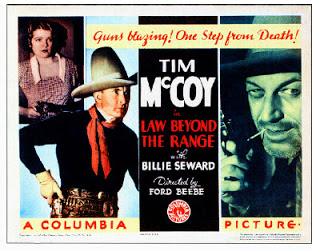
 
x-defaultThis was followed by Tim McCoy in Law Beyond the Range (1935), an unpretentious and quite entertaining B western from Columbia. Tim McCoy was one of those interesting characters who sort of backed into movies because making movies was fun and he himself was fairly comfortable in front of  camera. Born in Saginaw, Michigan, in 1891, he became fascinated with the Wild West as a student in college; he dropped out and resettled in Wyoming, where he became a ranch hand and expert horseman. After serving in World War I (he rose to the rank of colonel and later, in his movie career, was sometimes billed as Col. Tim McCoy), he was appointed adjutant general of the Wyoming National Guard. In that capacity he worked diplomatically and well with Wyoming’s native Arapaho and Shoshone tribes, and in 1922, when Paramount came to Wyoming to film their epic The Covered Wagon, McCoy served as liaison between the company and several hundred Indian extras. That gave him the bug. He resigned his commission and cried “Westward ho!” once again, settling in Hollywood, where he worked steadily through the 1940s, then tapered off into retirement, making his last appearance in Requiem for a Gunfighter in 1965.
 
In Law Beyond the Range McCoy played a Texas Ranger who leaves the force to take over an old friend and mentor’s crusading newspaper in a neighboring town. Arriving in town shortly after his editor friend’s death, he carries on the paper’s crusade against the crime boss who is running the town (Guy Usher). In the end he brings down the bad guy, but not because the pen is mightier than the sword; in fact it takes a blazing shootout that fills the local saloon with a dense cloud of gunsmoke, a rip-roaring climax that Col. Tim’s 1935 fans had no doubt been waiting for all along. At the final fadeout he has not only cleaned up the town but cleared an old friend (Robert Allen) of a bogus murder charge and won the heart of the late editor’s daughter (Billie Seward).
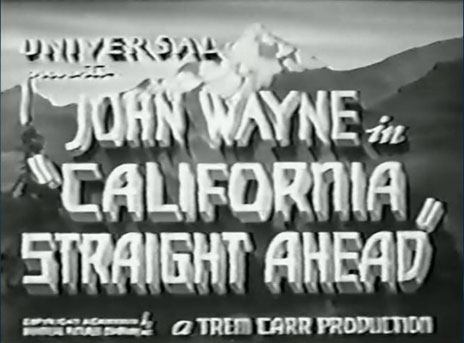
 
California-Straight-Ahead-WAfter dinner came of two of the highlights of the whole weekend — both, as it happened, from Universal. First was California Straight Ahead (1937). I here reproduce the title card from the movie’s credits, rather than a poster or lobby card, to make a point: It’s 1937, two years before Stagecoach, and John Wayne is billed above the title. And not in a B western from Monogram or Republic, but in one of six pictures he made at Universal (none of them westerns) before returning to the saddle at Republic. It’s still a B picture, of course; it would take John Ford to promote the Duke out of B’s once and for all. But California Straight Ahead has a better-than-B professional gloss to it; with Universal’s backlot and production infrastructure a few dollars could go a lot farther than they could on some location ranch up in the San Fernando Valley.
 
Wayne plays a partner in a struggling Chicago trucking firm, trying to make a go of his little two-truck operation against sometimes unscrupulous opposition from other truckers and railroads (he faces some unsporting competition for the affections of the fetching Louise Latimer too). The story climaxes in a cross-country race between Wayne’s convoy of big-rigs and an express train, both seeking to deliver a shipment of airplane parts to the Port of Los Angeles to be loaded on a ship and dispatched across the Pacific before a general strike closes the port. With a smart script by W. Scott Darling and lickety-split direction by Arthur Lubin, the picture makes for an enjoyable 67 minutes.


In his introduction to the screening, Wayne biographer Scott Eyman told us that Wayne regarded his six-picture foray at Universal as a mistake; it had failed to take him out of the “juvenile ghetto” of Saturday afternoon B westerns, and when it was over he found himself back at Square One in Republic horse operas — without his former momentum and unsure when, or if ever, he could work his way out of them. (He couldn’t know, of course, that his big break was just around the corner.) I quote Scott at length on California Straight Ahead and the Duke’s five other Universal B’s: “This is a good movie; they are all good, solid movies. They’re better, frankly, I think, than the Republic westerns he’d been making, because the technicians are a little bit better, the scripts are a little bit better, and the production schedules a little bit longer, and you can get more of where he’s not just riding and roping and slugging people. He actually gets a chance to do a little acting in these movies. And as you’ll see, he’s getting better and better. By 1937, and finishing up this series of pictures, he’s ready. He’s ready for John Ford, he’s ready for the Big Time.”
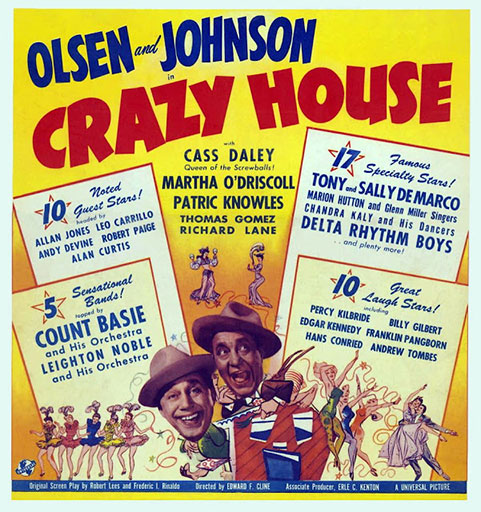
Crazy-House-poster01WAnd then came the deluge, again courtesy of Universal Pictures. The title of this onslaught was Crazy House, and the leading inmates of the loony bin were two slap-happy vaudevillians named Ole Olsen and Chic Johnson. How do you describe these two to someone who’s never seen them? In my last post I called them the Monty Python of the 1940s, but the truth is, Olsen and Johnson made Monty Python look like a Sunday afternoon game of whist between Oscar Wilde and James MacNeill Whistler.
 
John Sigvard “Ole” Olsen and Harold Ogden “Chic” Johnson first teamed up in 1914 as members of a more or less straight musical vaudeville quartet. Their personalities and wacky senses of humor clicked, and they eventually morphed into a madcap improvisational comedy act, with neither of them playing the customary straight man. Eventually they wound up on radio in “The Padded Cell of the Air”, a segment of NBC’s Fleischmann’s Yeast Hour, hosted by crooner Rudy Vallee. The rather stodgy Vallee evidently left Olsen and Johnson pretty much to their own devices, and the team’s wild act was free-wheeling and utterly unpredictable. They reached their apotheosis in 1938 with the Broadway musical comedy revue Hellzapoppin, whose title remains a byword for insanely corny, anything-for-a-laugh comedy. It was a show where nobody ever knew what was going to happen next. And I don’t mean just the audience — I mean the stagehands, the orchestra and the other performers. Hellzapoppin ran for over three years — 1,404 performances, and it was never the same experience twice.
 
In 1941 Universal induced Olsen and Johnson to put the show on film (as Hellzapoppin’, adding the apostrophe). It might have seemed like a fool’s errand, and Universal hedged their bets by forcing the insertion of a conventional romantic subplot, but the movie clicked. It was screened at last year’s Cinevent and stole the whole weekend, as hilarious as ever.
 
And so it was this year with Crazy House, Olsen and Johnson’s follow-up movie two years later. It begins with Olsen and Johnson staging their own triumphant return parade down Hollywood Boulevard, with the cry preceding them: “Olsen and Johnson are coming!”, while everyone from studio bigwigs to hairdressers and carpenters flies into a panic. (On one soundstage Basil Rathbone tells Nigel Bruce of the dire devastation in store for them all when the two comics arrive. “How do you know all that?” Bruce asks. “I’m Sherlock Holmes,” snaps Rathbone. “I know everything.”) The boys show up to find the Universal lot deserted and barricaded against them. Unfazed, they resolve to produce their next movie themselves.
 
Let’s leave it at that, shall we? Crazy House goes on in that vein for a lightning 80 minutes, throwing jokes so fast you miss every third one because you’re still laughing at the first two. Olsen and Johnson’s governing principle was that a joke not good enough to use once might be bad enough to use five times, and it still works; O&J’s influence can be seen not only in Monty Python but elsewhere, including Laugh-In in the 1960s and Jim Henson’s original Muppet Show 20 years after that.
 
After the boisterous delirium of Crazy House anything would have been an anticlimax, so 1927’s silent The Fighting Eagle started off at a disadvantage. Still, it was an engaging, slightly tongue-in-cheek swashbuckler with Rod La Rocque (such a perfectly Hollywood name, and yet it was his own) swaggering grandly as a braggart popinjay French soldier engaging in swordplay, intrigue and romance (with countess Phyllis Haver, the movies’ original Roxie Hart in Chicago) in the days of the Emperor Napoleon.
 
And finally, another midnight snack: The Monkey’s Paw, a low-budget 1948 British thriller with a good but uniformly unfamiliar cast, adapted from the classic short story by W.W. Jacobs. If you haven’t read the story, you should; give yourself a sleepless night or two. It concerns the eponymous, mummified simian extremity, a talisman with the power to grant three wishes. But this monkey’s paw is no rabbit’s foot; it’s the ultimate illustration of be-careful-what-you-wish-for: In a touch not in the original story but added for the movie, one woman wishes to be free of her boring, alcoholic husband; her freedom is granted to her when he shoots her dead.
 
Jacobs’s story is a vivid one, but short, and the
script by Barbara Toy and director Norman
Lee fills it out without diluting its sinister
spirit — as that flashback scene with the bored
wife makes clear. And so it was, at 2:00 that
Sunday morning, after the monkey’s paw had
wrought its dark magic on the hapless
Trelawne family (played by Milton Rosmer,
Megs Jenkins and Eric Micklewood), that
those hardy night owls among us were
finally trundled off to our rooms, our lights,
and the comforting drone of an all-night
television…
 
To be concluded…
 
Posted in Blog Entries

Cinevent 2016, Part 3

Jim Lane's Cinedrome Posted on June 14, 2016 by Jim LaneJuly 28, 2016

Day 2 (cont.)

ChaseWA regular feature at every Cinevent is a program of Charley Chase shorts. If you don’t recognize the name, it’s worth the effort to familiarize yourself. Unlike some other greats of silent comedy (Chaplin, Keaton, Lloyd, Laurel and Hardy), Chase never graduated from shorts to features (though he turned in a delightful supporting performance in Laurel and Hardy’s Sons of the Desert in 1933). Still, his output was prodigious; Cinevent could present a program of five of his shorts (assuming they all survived, which unfortunately they don’t) and go 50 years without repeating one. Cinevent regulars and others familiar with him may skip the next two paragraphs.
Charles Joseph Parrott was born in Baltimore in 1893. He began performing in vaudeville as a teenager and started in movies at 19. After stints with Al Christie and Mack Sennett, he joined Hal Roach as a director in 1920 and by 1922 rose to be general manager of the studio. It was Parrott who brought Oliver Hardy to the Hal Roach “Lot of Fun”; he also recruited Robert McGowan to oversee Roach’s Our Gang comedies, which McGowan did for 14 years.
 
But Parrott found admin work unrewarding, and by 1924 he returned to performing. Rechristened Charley Chase (a wordplay on the title of a popular World War I-era song, “Chase Me Charlie”), he developed his own comic persona as a lanky, dapper, bedeviled everyman, and was a mainstay of Hal Roach shorts for over ten years, silent and sound, though always a third banana behind Our Gang and Laurel and Hardy. When Roach cut him loose in 1935 (the reasons are a little vague; Roach may simply have been retrenching), he wound up at Columbia starring in his own series of shorts and directing others for the Three Stooges (including one of their best, Violent is the Word for Curly). By this time health problems, exacerbated by alcoholism, were dogging him, and when his beloved younger brother James (who had his own substance-abuse problems) died in 1939, Charley’s drinking soared out of control until a heart attack killed him in June 1940 at age 46.
 
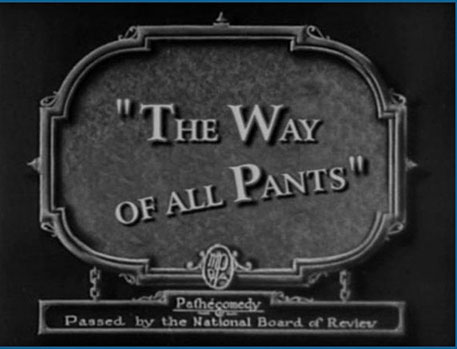
PantsWThat’s the quick-and-dirty version of Chase’s career, and some day I may post on him in more detail. For now, suffice it to say that Cinevent is doing its share to keep Chase’s name alive (as Richard Roberts aptly put it, he’s not so much neglected as taken for granted) with these regular annual tributes. This year the Cinevent audience got a real scoop: in addition to the shorts Powder and Smoke, Stolen Goods, Too Many Mammas (all 1924), and Looking for Sally (’25), the Chase program included The Way of All Pants (‘27), complete for the first time in a couple of generations. A truncated version of Pants has survived in the Robert Youngson compilation The Further Perils of Laurel and Hardy (’67), but the complete two-reeler was long believed lost. A British release print was recently discovered, with some damage due to age and decomposition; it was digitally restored, then transferred back to 16mm film for screening in Columbus. The whole thing was touch-and-go right down to the wire: the print wasn’t completed until just a few weeks beforehand; it wasn’t even mentioned in the program book because they weren’t sure it would be ready in time to be “re-premiered” at Cinevent.
 
Anyhow, The Way of All Pants (U.K. title The Way of All Dress, since “pants” was considered vulgar in Britain at the time) was an ingenious delight, ringing endless changes on men (beginning with Charley) losing their trousers at a high-tone dinner party. A canine performer identified as Buddy the Dog all but stole the show. (NOTE: Lacking program notes, I’ve had to rely on my memory. Richard M. Roberts, if you’re reading this and I’ve got any details amiss, feel free to set me straight.)
 
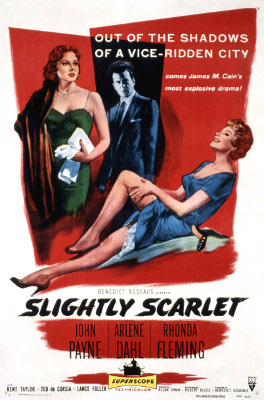
The evening highlight of Day 2 was Slightly Scarlet, a 1956 Technicolor film noir (if that’s not a contradition in terms) about two sisters, one nice (Rhonda Fleming) and one naughty (Arlene Dahl), with John Payne as the political muscle man to a corrupt city boss (Ted de Corsia) serving as the rope in a tug-of-war of female sibling rivalry. It was based on a novel by James M. Cain (better known for Double Indemnity, Mildred Pierce and The Postman Always Rings Twice) entitled Love’s Lovely Counterfeit; if nothing else, the movie at least improved on Cain’s title. Directed by the venerable Allan Dwan, it was a suitably fast-paced melodrama of sex and politics set amid the now-retro decor of 1950s moderne-ity, and it demonstrated conclusively that whatever you might think, Rhonda Fleming and Arlene Dahl are not, in fact, the same person (both ladies, God bless ’em, are still with us at this writing, 92 and 90 respectively; continued long life to them both). Cinevent’s print had deliciously lurid Technicolor but was presented in the standard 4:3 aspect ratio and not screened in “Superscope”. Whatever that is.
 
After that, another silent, White Tiger (1923), with Wallace Beery as a jewel thief who teams up with two confederates, Priscilla Dean (top-billed) and Raymond Griffith — concealing from them both the fact that not only are they brother and sister separated in infancy, but Beery himself betrayed their father and brought about his death. It was directed and co-written by Tod (London After Midnight) Browning, who could always be counted on to come up with a real whopper.
 
 
Day 2 closed out with a midnight snack: An episode of the short-lived (1961-62) TV series Bus Stop, which was unrelated to the William Inge play or the Marilyn Monroe movie, but essentially a dramatic anthology series with a few continuing characters playing peripheral roles in each episode. This one was “I Kiss Your Shadow”, from a story by Robert (Psycho, “Yours Truly, Jack the Ripper”) Bloch, about a man (George Grizzard) haunted — in every sense — by the death of his neurotic, possessive wife (Joanne Linville) in a car crash. It was (spoiler alert!) a creepy, atmospheric variation on Poe’s “The Tell-Tale Heart”, just the thing to send you back to your hotel room to sleep with the lights on and the flat-screen TV blaring all the rest of the night.
 
Next up: Day 3, Saturday, featuring a supremely anarchic turn by Olsen and Johnson, the two-man Monty Python of the 1940s, and an exhilarating horseless turn by the pre-Stagecoach John Wayne…
 

To be continued…


Posted in Blog Entries

Cinevent 2016 (Continued)

Jim Lane's Cinedrome Posted on June 11, 2016 by Jim LaneJuly 28, 2016

Day 2

The second day of Cinevent began with a departure from custom and a real curiosity: Die Reise nach Tilsit (The Trip to Tilsit), a 1939 German film. That’s the departure; Cinevent has heretofore screened almost exclusively (if not entirely so) English-language movies. The curiosity is that The Trip to Tilsit is based on the same Hermann Sudermann story that inspired F.W. Murnau’s Sunrise (1927): a cheating husband plots to murder his wife and make it look like an accident, but changes his mind when the couple visit the big city and rekindle their love for each other. The compare-and-contrast lends The Trip to Tilsit a fascination it doesn’t have all by itself; it’s well-crafted and well-acted, especially by Kristina Soderbaum (wife of director Veit Harlan) as the wronged wife. But Sunrise is one of the supremely transcendent visual poems of movie history, a movie that, once seen, is never forgotten; The Trip to Tilsit, well-made as it is, is just a mundane Teutonic soap opera. Historian and Cinevent regular Richard M. Roberts dismissed it as “the Nazi Sunrise“, and that just about nails it. (Director Harlan was an ardent Nazi who joined the party in 1933 and prospered during the ’30s turning out propaganda for Josef Goebbels, culminating in the viciously anti-Semitic Jew Suss in 1940.)

One more point of interest about The Trip to Tilsit. Playing the philandering husband (and also good) was a Dutch actor named Hein van der Niet, billed as Frits von Dongen. Unlike his director, van der Niet fled the Nazis at the outbreak of World War II and wound up in Hollywood working as a freelance actor under the name Philip Dorn. He was Hal Wallis’s first choice to play Victor Laszlo in Casablanca — personally, I say it’s a pity he didn’t — but he had already signed for Random Harvest at MGM and the scheduling wouldn’t work. No telling how Dorn’s career might have gone if he had done Casablanca instead of Paul Henreid, but as it was he still managed to rack up a pretty good career — Ziegfeld Girl, Tarzan’s Secret Treasure, Calling Dr. Gillespie, Passage to Marseilles and The Fighting Kentuckian, among others (he was especially fine as Irene Dunne’s husband in I Remember Mama) — before ill-health forced his retirement in 1955. He died in Los Angeles 20 years later, age 73.

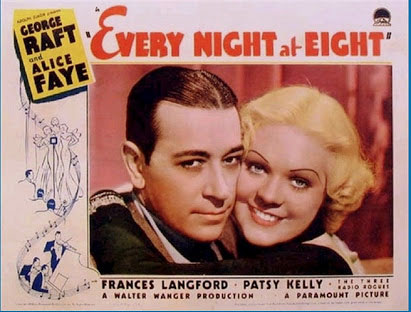
 Every-Night-at-eightAfter “the Nazi Sunrise” it was back to Hollywood and the English language for Every Night at Eight (1935), a well-above-average musical from Paramount. George Raft and Alice Faye (on loan from 20th Century Fox) were top-billed, but the prime role went to radio singer Frances Langford, in her feature debut. Alice and Frances played two of three pals (the third was Patsy Kelly) seeking and finding radio stardom with bandleader Raft. Raoul Walsh, better known for movies like High Sierra, They Died With Their Boots On and White Heat, directed at a lively pace, and there was a bunch of first-rate songs, two of which are still with us: “I Feel a Song Comin’ On” and “I’m in the Mood for Love”.
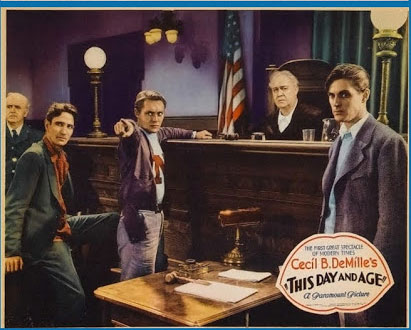


This-Day-and-Age…And then came Cecil B. DeMille’s This Day and Age (1933). Talk about a curiosity! Richard Cromwell plays the leader of a group of high school students who get appointed to ceremonial positions in city government — judge, chief of police, district attorney, etc. — as a way to give them an on-the-job view of how the grownups run things. When a friend of theirs is murdered by a local gangster (Charles Bickford) who gets off scot-free thanks to an oily high-priced attorney, the kids take over the government for real, kidnapping the gangster and torturing a confession out of him (“We haven’t got time for rules of evidence!”), after which the adults see the error of their ways. The trauma of the Great Depression spawned more than one movie like this — check out a little oddity called Gabriel Over the White House (’33) sometime — movies where audiences could vent their frustrtion with “the System” by vicariously experiencing things they’d never get away with (or seriously contemplate) in real life.


I’m going to cut this post short in the interest of getting it up. But stay tuned; we’re not even halfway through the weekend, and there’s more where this came from.
 

To be continued…

 
Posted in Blog Entries

Post navigation

← Older posts
Newer posts →
index sitemap advanced
search engine by freefind

Recent Posts

  • Twinkle, Twinkle, Little “Star” (Republished)

  • Sixty-Six Years’ Worth of Oscars

  • A Visit with Jody Baxter, Chick Mallison, Trooper Jeff Yorke et al.

  • Ave Atque Vale, Jody Baxter

Articles A – Z

You will find 222 posts in the category  on this blog.


Jump to , 4, A, B, C, D, E, F, G, H, I, J, L, M, N, O, P, R, S, T, U, W, Y

4

  • 40th Anniversary Tour: Jesus Christ Superstar

A

  • “A Genial Hack,” Part 1
  • “A Genial Hack,” Part 2: The Trail of the Lonesome Pine
  • “A Genial Hack,” Part 3: Peter Ibbetson
  • A “Christmas Wish” Returns
  • A Cinedrome “Christmas Tradition” Returns
  • A Cinedrome Pop Quiz
  • A Hitch in the Get-Along: State Secret
  • A Holiday Treat (I Hope!) for Cinedrome Readers
  • A Jigsaw Mystery
  • A Mystery Photo
  • A Time-Travel Studio Tour
  • A Treasure Trove of MGM Shorts, Part 1
  • A Treasure Trove of MGM Shorts, Part 2
  • A Visit with Jody Baxter, Chick Mallison, Trooper Jeff Yorke et al.
  • A Weekend With David O. Selznick
  • A-a-a-and We’re Back…!
  • Addio, Cinevent 42!
  • After a Brief Intermission…
  • America’s Canadian Sweetheart, 1921-2013
  • Andrew Sarris, 1928-2012
  • Auditioning for Immortality
  • Ave Atque Vale, Fairy Princess!
  • Ave Atque Vale, Jody Baxter

B

  • Bright Eyes, 1928-2014
  • Browsing the Cinevent Library, Part 1
  • Browsing the Cinevent Library, Part 2

C

  • C.B. Gets His Due
  • Camera Beauty
  • Cary-ing On
  • Catching Some Rays
  • Catting Around
  • CHAPTER I
  • CHAPTER II
  • Cinedrome Does Its Part
  • Cinedrome Wins 2012 CMBA Award
  • Cinedrome’s Annual Holiday Treat Returns
  • Cinerama-Rama!
  • Cinevent 2016 (Continued)
  • Cinevent 2016, Concluded
  • Cinevent 2016, Part 3
  • Cinevent 2016, Part 4
  • Cinevent 2017 – No. 49 and Counting, Part 1
  • Cinevent 2017 – No. 49 and Counting, Part 4
  • Cinevent 2017 — No. 49 and Counting, Part 2
  • Cinevent 2017 — No. 49 and Counting, Part 3
  • Cinevent 42
  • Cinevent 45
  • Cinevent 50 – Day 1
  • Cinevent 50 – Day 2
  • Cinevent 50 – Day 3 (Part 2)
  • Cinevent 50 – Prelude
  • Cinevent 50 — Day 3 (Part 1)
  • Cinevent 50 — Day 4
  • Cinevent 51 – Day 1, Part 1
  • Cinevent 51 – Prelude
  • Cinevent 51 — Day 1, Part 2
  • Cinevent 51 — Day 2
  • Cinevent 51 — Day 3
  • Cinevent 51 — Day 4
  • Cinevent Turns 50
  • Cinevent, Day 2
  • Cinevent, Day 3
  • Cinevent, Day 4
  • CMBA Blogathon: Come Next Spring (1956)
  • CMBA Blogathon: Kitty (1945)
  • Crazy and Crazier, Part 1
  • Crazy and Crazier, Part 2
  • Crazy and Crazier, Part 3
  • Crazy and Crazier, Part 4

D

  • “Don’t Stay Away Too Long…”

E

  • Elizabeth Taylor, 1932-2011

F

  • Films of Henry Hathaway: Brigham Young (1940)
  • Films of Henry Hathaway: Down to the Sea in Ships
  • Films of Henry Hathaway: Down to the Sea in Ships
  • Films of Henry Hathaway: Fourteen Hours (1951)
  • Films of Henry Hathaway: Prince Valiant
  • Films of Henry Hathaway: The Shepherd of the Hills
  • First Comes the Phone Call
  • Five-Minute Movie Star: Carman Barnes in Hollywood — Epilogue
  • Five-Minute Movie Star: Carman Barnes in Hollywood, Part 1
  • Five-Minute Movie Star: Carman Barnes in Hollywood, Part 2
  • Five-Minute Movie Star: Carman Barnes in Hollywood, Part 3
  • Flo Chart

G

  • “Glamour Boys” Begins…
  • “Glamour Boys” Continues…
  • Grand Opening!

H

  • “Here’s a Job for You, Marcel,” Part 1
  • “Here’s a Job for You, Marcel,” Part 2
  • “Here’s a Job for You, Marcel,” Part 3
  • Harlow in Hollywood

I

  • “Is Virginia Rappe Still Alive?”
  • Items from the Scrapbook of Cosmo Brown
  • Items from the Scrapbook of Cosmo Brown

J

  • Jigsaw Mystery — Solved?

L

  • Liebster Blog Award
  • Lost & Found: Alias Nick Beal
  • Lost & Found: Night Has a Thousand Eyes
  • Lost and Found: Miss Tatlock’s Millions (1948)
  • Luck of the Irish: Darby O’Gill and the Little People, Part 1
  • Luck of the Irish: Darby O’Gill and the Little People, Part 2
  • Luck of the Irish: Darby O’Gill and the Little People, Part 3
  • Luck of the Irish: Darby O’Gill and the Little People, Part 4

M

  • “MOVIE” Souvenir Playing Cards
  • Merry Christmas from Cinedrome!
  • MERRY CHRISTMAS from Cinedrome!
  • Mickey and Judy — Together at Last
  • Minority Opinion: The Magnificent Ambersons, Part 1
  • Minority Opinion: The Magnificent Ambersons, Part 2
  • Minority Opinion: The Magnificent Ambersons, Part 3
  • Minority Opinion: The Magnificent Ambersons, Part 4
  • Minority Opinion: The Magnificent Ambersons, Part 5
  • Minority Opinion: The Magnificent Ambersons, Part 6
  • Movie Playing Cards: 3 of Hearts – Geraldine Farrar
  • Movie Playing Cards: 5 of Spades – George Walsh
  • Movie Playing Cards: 9 of Diamonds – Mary Miles Minter
  • Moving Right Along…
  • Mr. Stewart Goes to War

N

  • Nuts and Bolts of the Rollercoaster

O

  • Our Mr. Webb

P

  • Picture Show 02 — Day 1
  • Picture Show 02 — Day 2
  • Picture Show 02 — Day 3
  • Picture Show 02 — Day 4
  • Picture Show 02, Day 00 — Prelude at the Wex
  • Picture Show 2022 – Day 2
  • Picture Show 2022 — Day 1
  • Picture Show 2022 — Day 3
  • Picture Show 2022 — Day 4
  • Picture Show 2022 — Prelude
  • Picture Show No. 3 — Day 1, Part 1
  • Picture Show No. 3 — Prelude
  • Picture Show No. 3 — Tying Off a Loose End
  • Please Stay Tuned

R

  • R.I.P. Ray Harryhausen, 1920-2013
  • Remembering the Night
  • Remembering the Night
  • Return of “Movie” Souvenir Playing Cards
  • Returning to Lost London
  • Returning to Lost London (Reprinted)
  • Rex the First
  • Rhapsody in Green and Orange – EPILOGUE
  • Rhapsody in Green and Orange, Part 1
  • Rhapsody in Green and Orange, Part 2
  • RIP Dean Stockwell, 1936-2021

S

  • Say, What Ever Happened to Carman Barnes?
  • Shirley Temple Revisited, Part 1
  • Shirley Temple Revisited, Part 10
  • Shirley Temple Revisited, Part 11
  • Shirley Temple Revisited, Part 12
  • Shirley Temple Revisited, Part 13
  • Shirley Temple Revisited, Part 14
  • Shirley Temple Revisited, Part 2
  • Shirley Temple Revisited, Part 3
  • Shirley Temple Revisited, Part 4
  • Shirley Temple Revisited, Part 5
  • Shirley Temple Revisited, Part 6
  • Shirley Temple Revisited, Part 7
  • Shirley Temple Revisited, Part 8
  • Shirley Temple Revisited, Part 9
  • Silent Weekends
  • Silents in Kansas 2011, Part 2
  • Sixty-Six Years’ Worth of Oscars
  • Songs in the Light, Part 1
  • Songs in the Light, Part 2
  • Songs in the Light, Part 3
  • Speak (Again) of the Devil
  • Speak of the Devil…

T

  • “The Best of Us,” Part 1
  • “The Best of Us,” Part 2
  • “The Best of Us”, Part 1
  • “The Best of Us”, Part 2
  • Ted Sierka’s Brush with Greatness
  • The 11-Oscar Mistake
  • The Annotated “Lydia the Tattooed Lady”
  • The Bard of Burbank, Part 1
  • The Bard of Burbank, Part 2
  • The Could-Have-Been-Greater Moment
  • The Duke of Hollywood
  • The Fog of Lost London, Part 1
  • The Fog of Lost London, Part 1
  • The Fog of Lost London, Part 2
  • The Fog of Lost London, Part 2
  • The Fog of Lost London, Part 3
  • The Fog of Lost London, Part 3
  • The Fog of Lost London, Part 4
  • The Fog of Lost London, Part 4
  • The Kansas Silent Film Festival 2011
  • The Last Cinevent, the First Picture Show — Day 1
  • The Last Cinevent, the First Picture Show — Day 2
  • The Last Cinevent, the First Picture Show — Day 3
  • The Last Cinevent, the First Picture Show — Day 4
  • The Man Who Saved Cinerama
  • The Mark of Kane
  • The Museum That Never Was, Part 1
  • The Museum That Never Was, Part 2
  • The Return of the King
  • The Rubaiyat of Eugene O’Neill
  • The Sensible Christmas Wish
  • The Shout Heard Round the World
  • The Stainless Steel Maiden, 1916-2020
  • The Stamm
  • Tony Curtis 1925-2010
  • Tragedy in Nevada, January 1942
  • Twinkle, Twinkle, Little ‘Star’
  • Twinkle, Twinkle, Little “Star” (Republished)

U

  • Ups and Downs of the Rollercoaster, Part 1
  • Ups and Downs of the Rollercoaster, Part 2
  • Ups and Downs of the Rollercoaster, Part 3
  • Ups and Downs of the Rollercoaster, Part 4
  • Ups and Downs of the Rollercoaster, Part 5
  • Ups and Downs of the Rollercoaster, Part 6

W

  • “Who Is the Tall Dark Stranger There…”
  • Wings, Again
  • Wyler and “Goldwynitis”
  • Wyler and “Goldwynitis” (reprinted)
  • Wyler Catches Fire: Hell’s Heroes
  • Wyler Catches Fire: Hell’s Heroes
  • Wyler’s Legacy
  • Wyler’s Legacy (reprinted)

Y

  • Yuletide 2018

Copyright Notice

All textual content Copyright © date of posting by Jim Lane. All rights reserved. Unauthorized use and/or duplication of this material without express written permission from this blog’s author is strictly prohibited. Excerpts and links may be used, provided that full and clear credit is given to Jim Lane and Jim Lane’s Cinedrome with appropriate and specific direction to the original content.

↑