
Lost and Found: Miss Tatlock’s Millions (1948)
 I interrupt my consideration of The Magnificent Ambersons for this entry in the Classic Movie Blog Association’s Comedy Classics Blogathon. For other posts in the blogathon, click on the link; you’ll find my colleagues at CMBA holding forth on comedies from City Lights to Pillow Talk, from Ball of Fire to The Producers, and on stars from Jean Harlow to Gene Tierney. There are a lot of famous names and revered titles on the agenda; trust me to pick one you never heard of.
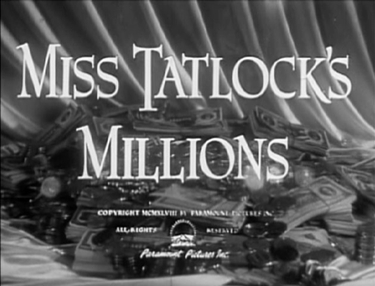
 Miss Tatlock’s Millions (1948) is another one of those pre-1950 Paramounts now owned by Universal that I used to see regularly in late-night TV syndication, like Night Has a Thousand Eyes and Alias Nick Beal. That’s where I discovered it in the late 1960s — our local CBS affiliate dipped freely into the Paramount package, and after local news signed off at 11:30 p.m. it was movies every weeknight until the wee hours. Tatlock was one of the titles I used to search for every week in the Late Late Show listings as soon as we got the TV Guide home from the supermarket.
If (as it’s sometimes said) Charade and Witness for the Prosecution are the best Hitchcock movies Hitchcock never made, then Miss Tatlock’s Millions is one of the best Preston Sturges movies Preston Sturges never made. Of course Sturges (like Hitchcock) remains peerless, and I wouldn’t necessarily rank Miss Tatlock’s Millions up there with The Lady Eve or Sullivan’s Travels. But The Great McGinty? Christmas in July? Definitely. (And for that matter, miles ahead of The Sin of Harold Diddlebock or The Beautiful Blonde from Bashful Bend.)
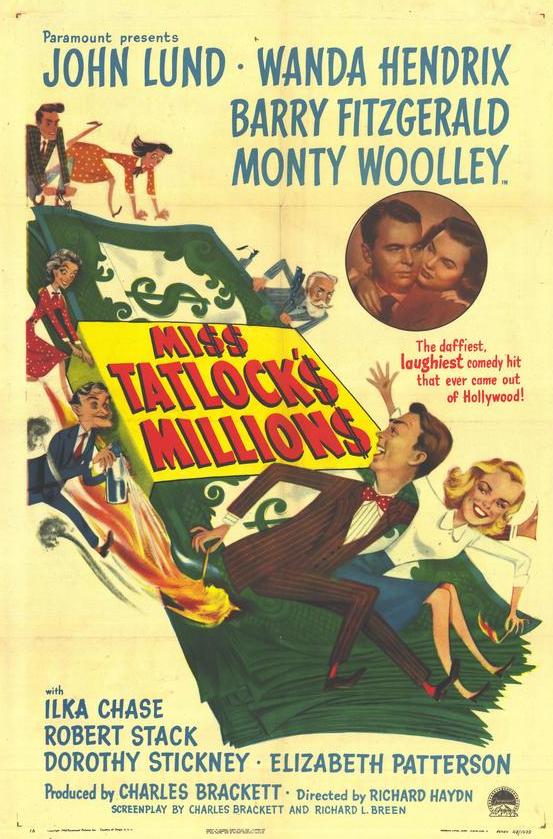
For starters, just take a gander at — feast your eyes upon — the roster of names on this poster. That’s what I call a pretty deep bench. I’ll get to all of them in time, but let’s begin with the fine print way down there at the bottom.
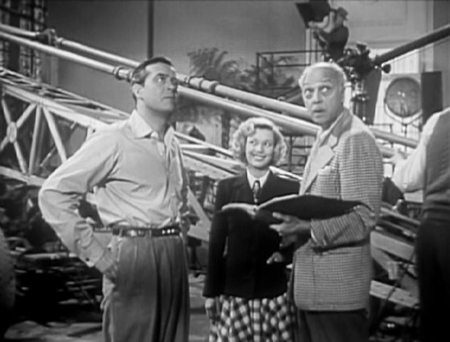 Miss Tatlock’s Millions begins, like Sullivan’s Travels, with a midnight brawl between two men, this time in a seedy room rather than on a speeding train. Also like Sullivan’s Travels, the opener turns out to be a movie-within-the-movie tease. Not on the screen, but on the set: One of the two men crashes through a window, rolls across an overhang, falls on his back in the street below, and a voice shouts, “Okay, cut!” The director is Paramount ace Mitchell Leisen (“I had hoped he’d hit his head on the chimney coming down, but I guess that’s the best we can get.”), and the man who took the tumble is stuntman Tim Burke (John Lund), doubling for star Ray Milland. Leisen and Milland here make in-joke cameos, a favor to Brackett in return for ones he’s done them: scripts for Leisen (Midnight, Hold Back the Dawn, To Each His Own), roles — and an Oscar — for Milland (The Major and the Minor; Arise, My Love; The Uninvited; The Lost Weekend). (And say, check out that nameless script girl standing between them; eager to make an impression, or what?)
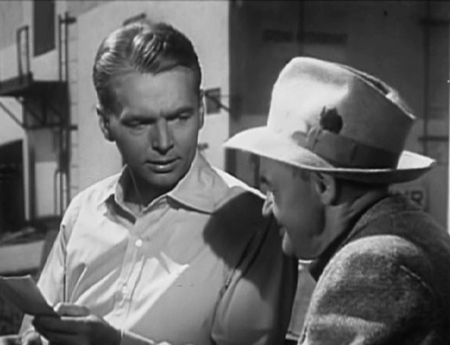 As he leaves the set, Burke is approached by Denno Noonan (Barry Fitzgerald), who found him through a picture file at Central Casting. Noonan is the social secretary (i.e., “keeper”) for one Schuyler Tatlock, the eccentric (i.e., “barking mad”) scion of the wealthy Santa Barbara Tatlocks, shipped off by his concerned (i.e., “embarrassed”) family to the safe distance of the Hawaiian Islands. That is, he was Schuyler’s keeper — until two years ago, when Schuyler, indulging his weakness for matches, burned himself to death while Noonan was in the village indulging his own weakness for Irish whisky. Noonan never told the family, just stayed there enjoying the sunshine, tropical breezes, and $500-a-month allowance checks. But now Schuyler’s grandparents have both died, and Noonan must produce him for the reading of the will; he wants to hire Burke to impersonate Schuyler, “a thousand dollars in 48 hours and no physical discomfort whatsoever.” Noonan insists the family won’t know the difference — “They haven’t seen him in ten years and they didn’t look at him then.” Looking at a snapshot, Burke admits there is a strong resemblance. Of course, he’ll have to darken his blonde hair, adopt the glasses Schuyler always wore…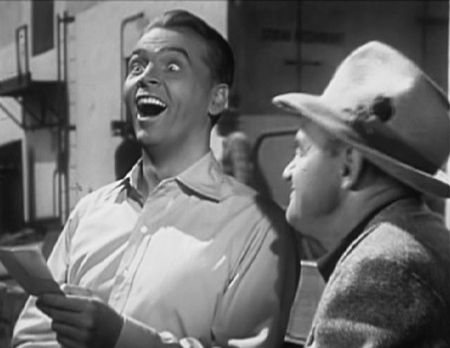

Burke is still dubious, but as Noonan wisely points out, it beats falling off buildings for 150 bucks a pop, so before long they’re motoring up the Pacific Coast Highway toward Santa Barbara. That’s where Burke gets his first glimpse of the Tatlock estate. “Just a sweet little family cottage,” Noonan explains, “with 22 bathrooms.” “How come they didn’t buy the Pacific Ocean too?” asks Burke. “They would’ve,” Noonan says, “only they couldn’t landscape the other side.”
In that sweet little cottage up there, the heirs of Grandfather and Grandmother Tatlock have started to gather. Already there is Schuyler’s younger sister Nancy (Wanda Hendrix), who lived with her grandparents, joined by her uncles Gifford (Dan Tobin) and Miles (Monty Woolley) and Miles’s wife Emily (Dorothy Stickney). Emily is sweetly engrossed in her embroidery, but the two brothers are already licking their chops. Miles calculates that after all the assorted taxes and fees, their parents’ estate will come to “only” about $6 million. “As a practicing communist, you should be pleased.” “Gifford’s not a communist, Miles dear,” Emily says; “he just likes to see his name on letterheads.” “Oh, I admit you’re not one by conviction,” says Miles. “You just haven’t the guts to face being a rich man.” Nancy is appalled at their naked greed and goes for a walk in the vast garden (with its $900-a-month watering bill).
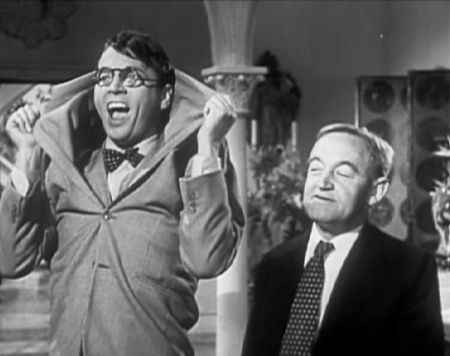
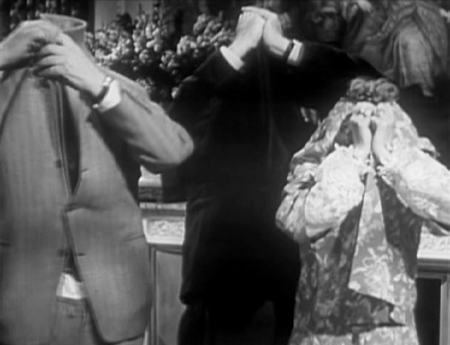 …so Miles, Gifford and Emily have no choice but to follow suit — only to have “Schuyler” change the game and guffaw at their silly poses.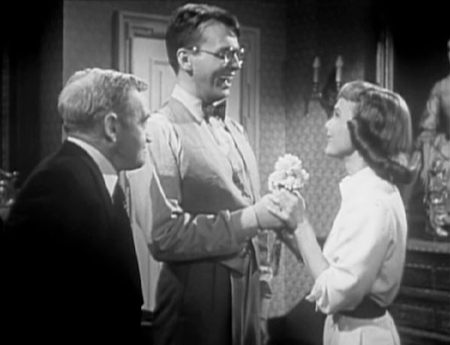
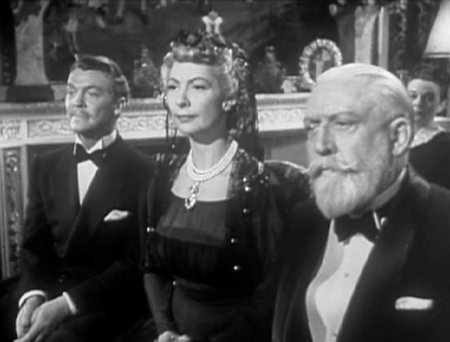 The last relative to arrive is imperious Cassie Van Alen (Ilka Chase), Nicky’s mother and Miles and Gifford’s sister. But when the will is finally opened and read, there are a couple of surprises in store for the acquisitive branches of the Tatlock-Van Alen clan. Grandfather Tatlock, after a few small bequests to the servants, left his entire estate to “my beloved wife Annette Tatlock, for distribution to our heirs” — never suspecting that she would outlive him by only an hour. And what nobody suspected until now is that Grandmother Annette left a hand-written holographic will leaving “everything I possess” to her unfortunate grandson Schuyler — and as things turned out, everything she possessed at her death consisted of the entire Tatlock estate, lock, stock and barrel. Schuyler gets absolutely everything.
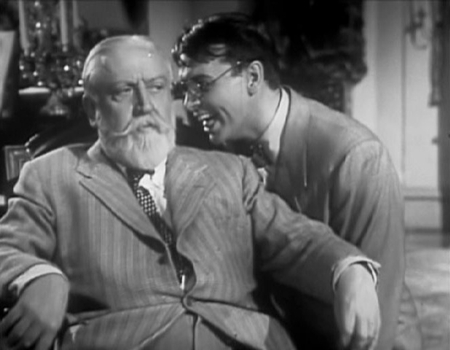
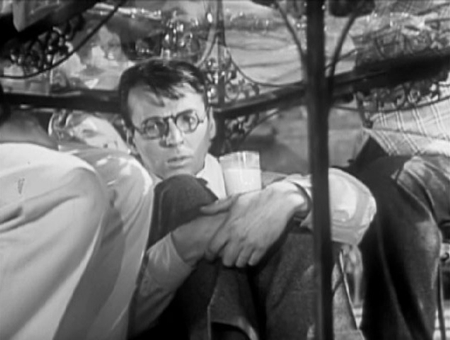 The next morning at breakfast, Miles, Cassie and Gifford fawn over their new favorite nephew, then ignore him as he climbs under the patio table, complacently sure that their conversation will go over his head — literally and figuratively. From his perch at their feet, Burke hears the three siblings cut a deal: Miles and Gifford will have themselves made Schuyler’s trustees, and will then settle a generous allowance — “Say, $100,000 a year for life” — on Nancy, which Cassie will gain control of by marrying Nancy off to Nicky.
 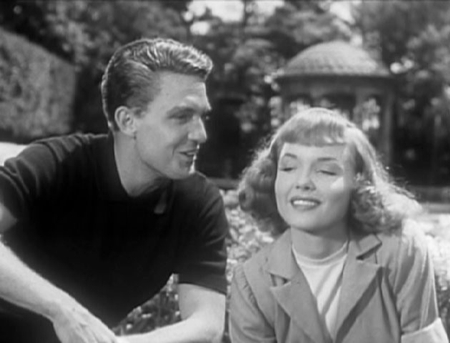 Once Cassie has explained the facts of life to Nicky, he turns on the oily charm to Nancy, nurturing the crush she has had on him since childhood. “It just hit me all of a sudden,” he preens, “I haven’t been giving you a break. Did a miracle happen overnight? You’ve stepped right up into my class. I could show you around with a lot of pleasure.”
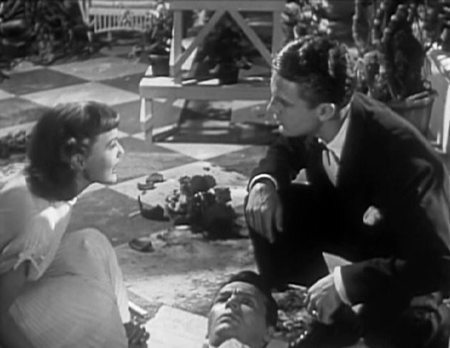 That night after dinner, Nicky turns up the heat over candlelight and cocktails in the greenhouse. Meanwhile, Burke prowls protectively (and jealously) in the trees overhead, keeping an eye on the snake Nicky’s progress. Suddenly he slips and falls through the glass roof, landing flat on his back at Nicky and Nancy’s feet, in a real-life reprise of the stunt that opens the picture. This time, however, he’s injured and momentarily stunned. Before his head can clear, he speaks to Nancy, forgetting to keep up the babbling Schuyler act. Nancy is thrilled, convinced that the shock has knocked Schuyler into his right mind, and that she has “a real brother” at last.
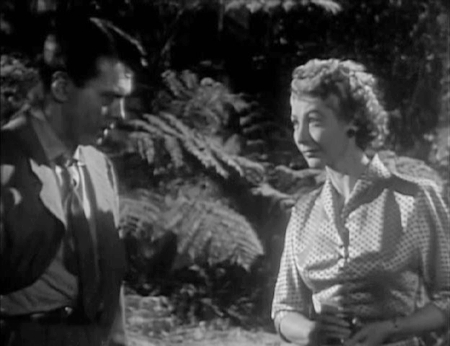 Things quickly get complicated, especially for Burke, who has fallen in love with Nancy. For Nancy too, who can’t imagine why all at once her lifelong crush on Nicky pales beside her affection for her “brother”. (Here the script plays with sexual taboo in much the way Brackett and Wilder did in The Major and the Minor: In the earlier picture, Ray Milland was disturbed by his feelings for the “child” Ginger Rogers, and the movie got away with it because we knew she was really an adult. In the same way, we know here that “Schuyler” isn’t really her brother — but Nancy doesn’t.)
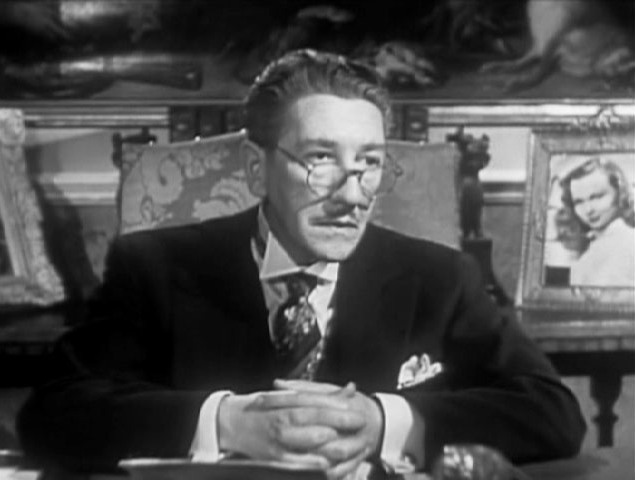 Miss Tatlock’s Millions was directed by veteran character actor Richard Haydn, who also appears (under the name “Richard Rancyd”) as the family attorney who breaks the good news to “Schuyler” and the bad news to Miles, Cassie and Gifford. As Lawyer Fergel (accent on the second syllable, please), Haydn uses the patented hyper-nasal, super-enunciated voice for which he was famous, the same voice he used as the Caterpillar in Walt Disney’s Alice in Wonderland (“Ah-whooo…aaaarrrrrre…Ah-yooo?”). Haydn could be just as memorable without the voice, most noticeably as “Uncle” Max Detweiler in The Sound of Music in 1965. (I’ve heard many people bemoan the fact that Christopher Plummer was passed over for an Oscar nomination in that picture, and I agree with them. But even more unjust, I think, was the failure to nominate Haydn as best supporting actor. It should have been the capstone of his career.) For Tatlock — the first of only three pictures he directed — Haydn adopted a style and pace less headlong and frenetic than Preston Sturges at his best, but still sprightly, giving his sterling cast plenty of room to stretch out and enjoy themselves. (Brackett and Breen’s sparkling dialogue even gave Monty Woolley one of his signature lines, often quoted by people with no idea of where it came from: “California, the only state in the Union where you can go to sleep under a rosebush in full bloom — and freeze to death.”)
 Haydn could take considerable pride in the performance he got from John Lund. Lund’s career never quite fulfilled its early promise; he seems to have spent much of it — certainly at Paramount — being palmed off as a taller version of Alan Ladd, and playing the parts Ladd didn’t want. Certainly, he shows here a flair for semi-slapstick comedy that was seldom given rein, and never exploited as fully as Brackett, Breen and Haydn do here. Miss Tatlock’s Millions is — not to mince words — a riot, and it’s largely thanks to John Lund.
Welcome, Anon! You may be on to something with the idea that "the film mak[ing] light of the mentally challenged" may be keeping Miss Tatlock's Millions in the Universal vault. And you're right, it certainly doesn't; if anything, it makes light of people who do make light of such people. Thanks for stopping by, and for commenting.
Hello
Just found your blog while looking for any signs of fresh showings of Miss Tatlock's Millions. I watched this movies many times as a kid in the 60's on Channel 5 out of NYC. Loved the movie and years later bought a very poor quality DVD. I have over the years sent TCM several requests to please show this film. When the movie "The Ringer" come out some years ago USA Today even mentioned Miss Tatlock's Millions in their review of the Johnny Knoxville comedy! I thought maybe then TCM might show it but alas that was not to be. I have wondered if the fact that some might think that the film makes light of the mentally challenged may be the reason TCM has never shown Miss Tatlock's Millions. It doesn't and I sure wish this very funny movie was easier to be viewed!
Thanks for stopping by, Anon! The frame-caps on this post are from a DVD I bought from a concern known as Hollywood's Attic; alas, they're out of business now. The quality isn't the best, but it's better than other videos of Miss Tatlock that I've picked up over the years (one VHS tape was simply awful). As the frame-caps suggest, it's passable enough, and I'm grateful to have it, considering the range of inferior bootlegs out there.
By all means, stay a while here at Cinedrome, and look around! I hope you like what you see.
I first saw Miss Tatlock's Millions many — too many — years ago on TV when I was first starting to watch movies.
Recently I acquired a DVD thru Amazon, it's OK — I'm not complaining — but it is rather poor quality, like it was originally filmed from a TV showing (in fact, periodically a "Channel 9" logo pops up). The story holds up well after all these years and it was fun to watch again.
This tribute page is awesome, so thanks for that. I don't know how you came up with those photos. I'll have to look around your website for other gems. Thanks again.
Thanks for dropping by, soaplover! I share your frustration at Tatlock's scant showing on video. I too have bought one or two of those multi-generational VHS dupes and cringed at the poor quality. Finally I found the reasonably decent DVD copy from which the images in this post were captured. But a glance at the customer reviews on Amazon shows that few buyers found it as satisfactory as I did; maybe I was just lucky. Now (two years after my post) even that is no longer available, and the source, Hollywood's Attic in Burbank, CA, has gone out of business.
As for why Miss Tatlock's Millions remains "lost", I suspect (and hope) it's more likely buried in the Universal vault rather than destroyed and gone forever. With no powerhouse names to hang a DVD release on, Universal probably figures it's just not worth the time and money. Universal took the trouble with some of their old Paramounts — W.C. Fields, the Marx Brothers, Preston Sturges for the stars he worked with (Henry Fonda, Barbara Stanwyck, Joel McCrea, Betty Hutton, etc.), and so on. But John Lund? Wanda Hendrix? Not so much. There's always hope, but in the meantime we can take comfort from knowing that at least the picture's not genuinely lost.
Miss Tatlock's Millions is one of my all-time favorite comedies–probably the funniest of them all. I've loved it since it first came out.
John Lund is absolutely superb in this, hilarious, and his comedic timing is perfection. From beginning to end he is terrific. And what a cast–Woolley is his acerbic best, Ilka Chase dryly sarcastic ('Nicky has to act fast–his charm wears off after a couple hours'..she says about her son).
Richard Haydn's annoyingly slow reader-of-the-will is his usual joy, and we can't overlook Barry Fitzgerald–another comic joy.
I've bought this in tape and DVD and never received a decent copy of it. It always looks like a VHS tape copied over and over, kinda watery. At least I can watch it and try to re-live the fun of it, but a good DVD would be wonderful and this is a film all film lovers really need to see.
I've heard various reason why it is one of the lost films–that the studio buried it in the archives, that the original burned in a studio fire, that no one thought it important enough to keep decent copies. Whatever the excuse it is high time for all good movie lovers to bombard TCM!