↓
 
  • Home
  • About the Author
  • Series
    • Carman Barnes: Five-Minute Movie Star
    • Crazy and Crazier
    • Films of Henry Hathaway
    • History of Cinerama: “Cinerama-Rama!”
    • Luck of the Irish: Darby O’Gill and the Little People
    • Marcel Delgado
    • Minority Opinion: The Magnificent Ambersons
    • Movie Souvenir Playing Cards
    • Shirley Temple Revisited: “Bright Eyes, 1928-2014”
    • The Bard of Burbank
    • The Fog of Lost London
    • The Museum That Never Was
    • William Wyler
  • Links and Resources
  • Jim’s Fiction
    • Glamour Boys
    • Items from the Scrapbook of Cosmo Brown
    • Sensible Christmas Wish, The
  • Contact

Jim Lane's Cinedrome

Classic Hollywood

Category Archives: Blog Entries

Post navigation

Newer posts →

First Comes the Phone Call

Jim Lane's Cinedrome Posted on May 14, 2010 by Jim LaneApril 28, 2022

Back in 1970, in the reckless ardor of youth, I took it into my head to write a book about the making of the original King Kong. One Sunday night in January, I even went so far as to call Los Angeles and San Diego information to see if they had a listing for Merian C. Cooper. I was hardly surprised that they didn’t; someone like Mr. Cooper would surely have an unlisted number.

But I was surprised when I tried the name Marcel Delgado; information had a number for that name in Los Angeles. When I called, a soft, lightly accented, cultured-sounding voice answered.

“May I speak to Mr. Marcel Delgado?”

“Speaking.”

“Marcel Delgado, the retired special effects artist in Hollywood?”

“Yes.”

So there it was. I was talking to the man who built the models for the great Willis O’Brien, for the silent The Lost World and King Kong. (I didn’t think “the original King Kong” then, because this was 1970 and there were as yet no remakes to confuse the issue.) Hoping I didn’t sound as excited as I felt, I introduced myself, told him I was planning to write a book on the making of King Kong, and asked if he could tell me how to get in touch with Merian C. Cooper.

“Oh no, I haven’t seen Mr. Cooper for many years. I think he’s living down in Coronado these days.”

We didn’t talk much longer — it was, after all, fairly late on a Sunday night — but before I hung up I asked if I could feel free to get in touch with him again. “Yes, of course,” he said, “I’ll be happy to hear from you.”

I had also gotten his address from information, so I wrote him the next week and he answered very promptly (there’s his letter on the right), inviting me down to see him and asking only that I let him know when I was coming. I mentioned it to my college chum Bob Irvin: ” … and he said I could come down and visit him.” “Well, Jim,” said Bob, “Let’s go.”

And we did. The following August, with our classes safely on hold for the summer, Bob, our friend Carol Cullens and I drove down to Southern California for the weekend, where we stayed with relatives of Bob’s. Mr. Delgado greeted us at his home at 1761 North Van Ness Avenue (don’t bother looking it up; the house — the whole block — is gone, subsumed into a TV studio at the corner of Van Ness and Sunset).

I didn’t take this picture, but it is from the same time period as our visit to his home, and this is exactly how I remember him looking that day. In fact, he may well be wearing the same shirt in this picture that he wore as he sat chatting with us in his living room that sultry August afternoon.

As a matter of fact, I didn’t take any pictures, because, ill-prepared upstart that I was, I hadn’t thought to bring along a camera. But I did think to bring along a tape recorder, and I recorded our conversation over the next two hours as he reminisced about his career in special effects; not all of the jobs he talked about are listed on his entry at the IMDB.

A few months ago I finally got around to having that old 6-inch reel-to-reel tape transferred to CD, and I’m in the process of transcribing our interview for posting here — soon, I trust.

Mr. Delgado had some keepsakes that he shared with us. Two old-style black-page photo albums filled with behind-the-scenes pictures. Or rather, copies of them; he had once lent the albums to someone who had copied all the pictures, then pasted the copies in the albums and mailed them back to him, keeping the originals. Mr. Delgado never got them back, and he never lent the albums out again.

I’d never seen any of these snapshots before, but many of them have been published online since (maybe even courtesy of the scumbag thief who stole them from Mr. Delgado in the first place), and here are a couple:


Delgado (on scaffold at left) and others working on the full-size bust of Kong…


… and …


Delgado and his brother Victor (left) building the armature for Kong’s full-size hand.
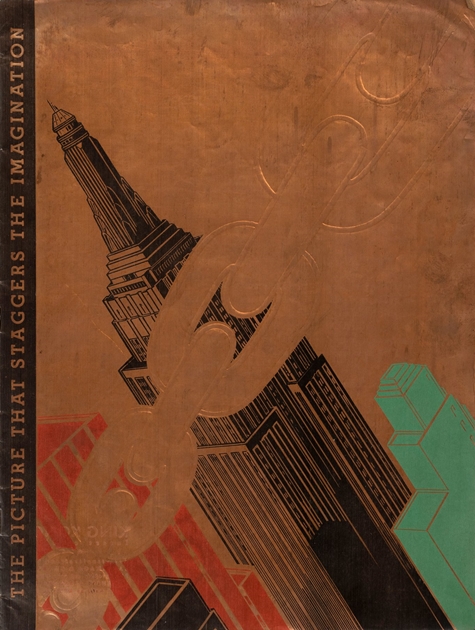


He also had the Holy Grail of movie souvenir programs, the only copy of it I’ve ever seen. Here, just to give you the idea, is a picture of the replica that was included in the deluxe collector’s DVD of Kong that came out in 2005, at the same time as Peter Jackson’s remake.

The real thing was 8½ x 11, and you couldn’t buy it at the theater. In fact, you couldn’t buy it at all; it was published as a supplement to The Hollywood Reporter on Monday, March 6, 1933, heralding the coming of Kong to Grauman’s Chinese Theatre on March 16. The front and back covers were paper-thin sheets of copper. (One of these programs was offered on eBay a few years ago. I bid it up to — well, I won’t say exactly how high, in case I ever get another chance at one; I wouldn’t want the seller to know how much I was willing to pay. Anyhow, I didn’t get it. And I wasn’t the second-highest bidder, either.) (UPDATE 4/27/22: Since then, in June 2021 in fact, another such program has been sold on Hake’s Auctions. I bid on that one too, and again I lost out — the final price was over $4,500 — but this time I didn’t exactly come away empty handed. I was able to download one of the images on the auction, and I’ve substituted that for the one I originally published on this post, of the replica in the 2005 Collector’s Edition DVD. So this is no longer a reproduction of a replica, it’s the real McCoy. Other images can be found — as of this writing, anyhow — at the link.)

I never did write that book about King Kong. I was foolish to think I ever could; I had neither the time, the resources, nor the experience for such a project in those days. By the time I might have been able to tackle it, it had already been done. Twice: in The Making of King Kong by Orville Goldner and George E. Turner (1975, revised and expanded and edited 2018 by Michael H. Price); and (even better) The Girl in the Hairy Paw, edited by Ronald Gottesman and Harry Geduld. (UPDATE 4/27/22: And now there’s a third: King Kong: The History of a Movie Icon from Fay Wray to Peter Jackson by Ray Morton.)

Now it’s back to plugging away on that transcript, so I can give you Marcel Delgado in his own words, opening his home, his memories and his scrapbooks to this callow young intruder from Sacramento.

Posted in Blog Entries, Marcel Delgado

Songs in the Light, Part 3

Jim Lane's Cinedrome Posted on May 11, 2010 by Jim LaneSeptember 1, 2016

In American entertainment, the 1900s were the Vaudeville Century. This is a theme I expect to return to and explore as opportunity arises. For now, suffice it to say this: we live even now among the last ripples of the entertainment tsunami that was vaudeville (what is American Idol but a hi-tech riff on Amateur Night down at the local Orpheum?). For decades after it supposedly “died” under the one-two punch of radio and talking pictures, vaudeville’s influence persisted as its practitioners abandoned the shriveling two-a-day circuits and went where the money was: Broadway, Hollywood, radio, television.

Those early musicals Richard Barrios deals with in A Song in the Dark, and the Vitaphone shorts that preceded them, were the ground on which vaudeville and talking pictures first met, and I think that’s the main reason I find them so fascinating. Here was vaudeville, in the full vigor of what seemed the prime of life, little suspecting that before another decade was out it would go the way of traveling medicine shows. And here are talking pictures, flexing their muscles and, haltingly, finding their legs.

One of the biggest names in vaudeville belonged to the Duncan Sisters, Rosetta and Vivian (or “Hymie” and “Jake,” as they were affectionately known). Beginning with an act mixing straight ballads and comic songs, they got off to a rocky start in 1917, when Variety called them “not ripe as yet for the big time.” They ripened fast, perfecting their act on the circuit until in time they were getting $7,500 a week plus 50 percent of the box office over $25,000 — megastar earnings in an age when 90 percent of American families were earning less than $5,000 a year.

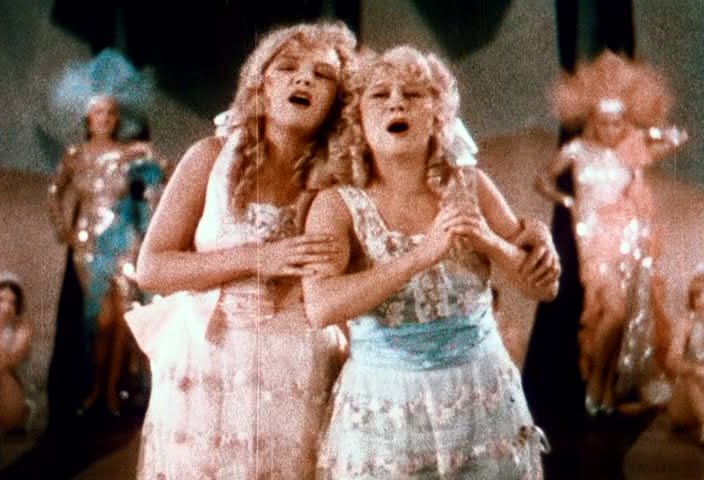
As luck would have it, the Duncan Sisters’ one and only talkie, It’s a Great Life (1929), has survived intact, Technicolor inserts and all. As a movie it’s yet another variation on The Broadway Melody and a bit of a challenge to one’s patience, but as a record of Hymie and Jake in harness it’s priceless. They play sisters named Hogan; Alexander Gray plays the pianist who breaks them up (at least until the final happy fadeout). Midway through the movie, there’s a 12-minute scene that duplicates the sisters’ vaudeville act exactly. Later, in a Technicolor dream sequence, the “girls” (Rosetta was 35, Vivian 32) harmonize to “I’m Sailing on a Sunbeam.” The two scenes give, as Barrios says, “a worthy glimpse of what vaudeville and stars like the Duncans meant to the American public.”

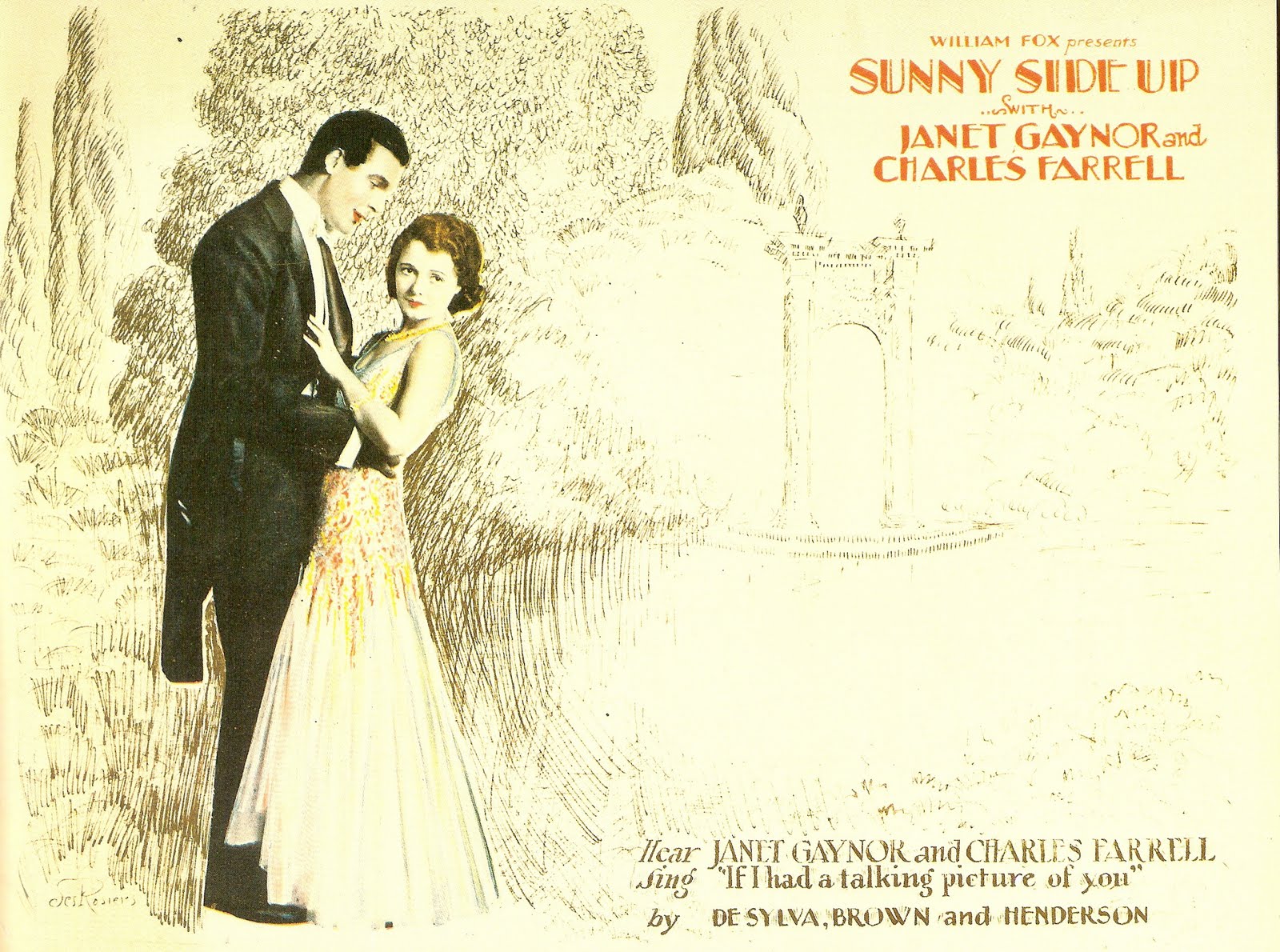
Also in 1929, Fox Studios hired the reigning kings of Broadway, DeSylva, Brown and Henderson (I’ve always wondered how three guys wrote songs together; anyhow, it certainly worked for them), to write screenplay, music and lyrics for an original musical designed to usher Fox’s top stars, Janet Gaynor and Charles Farrell, into talkies. The result was Sunny Side Up, and I caught up with this one at Cinevent in Columbus, Ohio in 2005. In a manner that would crop up again and again in movie musicals, the two stars did their best, with a gameness that compensated somewhat for their lack of musical finesse: Gaynor could barely carry a tune, but she had sweet appeal aplenty and made you want to believe she was really socking it over (she gets the perennial title tune); Farrell had a decent light tenor voice, but a lugubrious whining way with “If I Had a Talking Picture of You” that all but drains the song of its charm. The real musical chops were in the secondary couple, Frank Richardson and Marjorie White (vaudevillians both), who cavort joyously through “You Got Me Pickin’ Petals Off o’ Daisies,” a comic love song in the vein of “Button Up Your Overcoat.”

(Later, they get a reprise of the title number that shows Janet Gaynor how it’s done.) White was a particular joy on film, a peppy four-foot-ten scene-stealer whom Fox kept busy in their early musicals. She later went to Columbia, where she was top-billed in Woman Haters, the Three Stooges’ first short in their long career at the studio. Sadly, White’s career was cut short in 1935 when she was killed in a Santa Monica auto accident; she was 31.

It wasn’t all vaudeville in those early talkies, of course. The careers of silent stars Bessie Love and Bebe Daniels were beginning to flag in the late ’20s, and both made huge comebacks in (respectively) The Broadway Melody and Rio Rita (Love even snagged an Oscar nomination). Rio Rita survives in a slightly edited reissue version; it’s a bit of a relic, with Daniels’s performance probably the best thing about it.

Neither woman’s stardom lasted long into the 1930s. Daniels is best remembered today as the leading lady whose broken ankle gives Ruby Keeler her big chance in 42nd Street. Love, after a popular (and still creditable) run in light musicals of the day, kept plugging away in smaller roles for decades; her last was in The Hunger (1983) with David Bowie and Catherine Deneuve.

MGM famously shoved Joan Crawford into a few musicals, in which the salient feature is her feverish determination to make good, clomping through her dance routines with panting zest; eventually she and Metro (and, later, Warner Bros.) channeled her manic drive in more fruitful directions.

These ruminations on early musicals, prompted by a happy rereading of A Song in the Dark, have run on longer than I expected. I think I’ll wind up with an illustration of the unexpected, if sometimes modest, pleasures to be found in those half-forgotten songfests. This one is from Love in the Rough (1930), a musical version of the Vincent Lawrence play Spring Fever that — like the play and movie of Follow Thru — exploited the vogue for golf in the wake of Bobby Jones’s phenomenal career. Robert Montgomery (who proved a pretty good song-and-dance man) plays a shipping clerk whose prowess at golf earns him an entree to his boss’s country club, where the upper crust snobs take him for one of their own. He and heiress Dorothy Jordan fall in love at first sight, and she sings “I’m Doing That Thing,” one of the sprightly songs by Jimmy McHugh and Dorothy Fields. Jordan is a delight; even her slight speech impediment is endearing.

Jordan’s movie career was cut short more happily than Marjorie White’s. She was cast opposite Fred Astaire in Flying Down to Rio, but dropped out to marry producer-director Merian C. Cooper, leaving Ginger Rogers to take over for her. Jordan came out of retirement years later to play John Wayne’s doomed sister-in-law in The Searchers. But here are both she and the Hollywood musical in the bloom of youth (with a special dance insert from Earl “Snake Hips” Tucker). Enjoy:

Posted in Blog Entries

Songs in the Light, Part 2

Jim Lane's Cinedrome Posted on May 8, 2010 by Jim LaneSeptember 2, 2016

Last time, when I talked about early-sound musicals being a “precious record of an industry in turmoil,” I didn’t mention the heartbreaking truth: the record is all too incomplete. We may have a more thorough sampling of the doodles of Leonardo Da Vinci than we do of movies made during the 1920s, and reading a roster of lost films can be like listening to the mournful tolling of a funeral bell: gone … gone … gone. Before talking about some of the movies mentioned in A Song in the Dark, I want to give a rueful nod to all the movie musicals made between 1927 and 1934 that neither I nor anyone else will ever be able to see.

Just for starters, there are My Man (1928) and Honky Tonk (1929), which might have given us a record of (respectively) Fanny Brice and Sophie Tucker in their primes. And The Rogue Song, starring the great Metropolitan Opera baritone Lawrence Tibbett. Tibbett, whom Barrios calls “simply one of the best voices ever captured on a soundtrack” (the Vitaphone discs for the movie survive), was nominated for an Oscar for Rogue Song, but we’ll probably never know why.

Let one particular movie stand in for all the ones we’ve lost. In his book The Hollywood Musical, Ethan Mordden awarded the title of “Most Tantalizing Lost Film” to:

What’s tantalizing is that it isn’t completely lost. Just enough has surfaced to show us why it was a blockbuster hit, raking in a then-stratospheric $4,000,000 at the box office and, like Broadway Melody, spawning a succession of follow-ups — not exactly sequels or remakes, but simply repetitions of that magic title: just as MGM gave us Broadway Melodys in 1936, ’38 and ’40, so Warner Bros. trotted out some Gold Diggers in 1933, ’35, ’37 and in Paris.


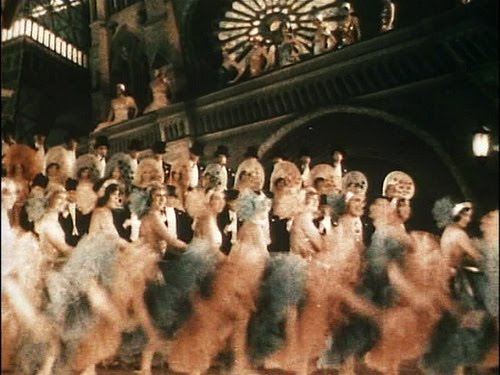
As for the remnants of Gold Diggers of Broadway. We have guitar-strumming troubadour Nick Lucas introducing one of the movie’s two big hit songs, “Tiptoe Through the Tulips” (the other hit, “Painting the Clouds with Sunshine,”  survives only on the Vitaphone disc), and a few scattered seconds here and there. Best and most tantalizing of all, we have all but the last 60 seconds of the finale, a spectacular production number that seems to have recruited every dancer in California, including some acrobatic dancers — one girl, then two boys — whom I wish I could single out by name. Whoever you were, kids, and wherever you are, well done.

The two-strip Technicolor looks a little faded — apparently, Technicolor dyes didn’t yet have the rock-solid permanence they would attain later on, after Herbert Kalmus perfected the process — but the look of the number is still impressive.

Let me rephrase that. It looks impressive now; in 1929 it must have looked astounding.

These frames are from the preservation print. The original nitrate footage (safely squirreled away, I hope, in a climate-controlled vault) may look better; it appears that modern technology is incapable of duplicating the look of what little two-strip Technicolor survives (in 1970 I saw the only existing nitrate Tech print of 1933’s Mystery of the Wax Museum; no video version has come close to duplicating the delicacy of those colors).

Technicolor’s original contracts with the studios stipulated that the color negative elements would remain the sole property of Technicolor Inc., although positive prints might remain in studio hands. Then, somewhere along the line (Barrios says it was in the early 1950s), Technicolor decided that all those old reels were simply relics of an early, imperfect product — and a fire hazard to boot — so they systematically set about destroying them. I even heard once that they simply chartered a boat, chugged out past the three-mile limit, and dumped millions of feet of film history into the Pacific Ocean. I don’t know if that’s true, but the rumor alone is an emblem of the state of film preservation circa 1953. Thanks for nothing, Technicolor; your dog-in-the-manger attitude assured that any examples we have of two-strip Technicolor — like the first feature, Toll of the Sea (1922), Douglas Fairbanks’s The Black Pirate (1926) and Eddie Cantor’s Whoopee! (1930) — have survived by pure, blind accident. 

One musical on which I understand the negative has in fact survived is Follow Thru (1930), from the DeSylva-Brown-Henderson Broadway hit that included “Button Up Your Overcoat” and “I Want to Be Bad.” Considering that two-strip Tech’s forte was in the green-to-orange-to-red range, what could be more natural than a musical set on a golf course? And the UCLA Film and Television Archive’s restoration print looks and sounds great — much better than it does in this YouTube clip of Zelma O’Neal and a troupe of angel/devils singing and dancing “I Want to Be Bad,” but it’ll give you a flavor of the fun to be had.

If you live in the vicinity of Palo Alto, Calif. and would like to see how this scene (and the rest of Follow Thru) really looks, that UCLA print will be playing at the Stanford Theatre in downtown P.A. at the end of this month (May 26-28). It’s a real crowd-pleaser and the Stanford brings it back periodically. On the bill with it will be Wake Up and Live with Alice Faye and Jack Haley; they’re both worth the trip.

Others of these early Tech musicals survive in black and white, thanks to their sale to television in the late ’40s and early ’50s; b&w prints were struck off for broadcast and are now all that survives of them. I call these movies “half-lost,” but in fact it may be more than half. Case in point: On with the Show! (’29), an early backstage-clone of Metro’s Broadway Melody, and Warner Bros.’ first all-talking Technicolor musical. Harried producer Sam Hardy tries to hold his show together long enough to limp into New York for (hopefully) success on Broadway; along the way he contends with impatient creditors, bickering stars (Arthur Lake and Joe E. Brown), a temperamental leading lady (Betty Compson) and her sleazeball Lothario boyfriend (Wheeler Oakman) — and on top of all that, somebody robs the box office. The movie has its pleasures, including a persuasive backstage atmosphere, an engaging score, nifty comic dancing by Brown, and the great Ethel Waters (playing herself) introducing “Am I Blue?” and “Birmingham Bertha.” Liabilities too, chief among them shaky sound recording that renders much of the choral singing unintelligible, and befuddled little Sally O’Neil as the hat-check girl who becomes a star when the leading lady walks out. (Poor O’Neil had a winsome kewpie-doll face that made her a natural for silents, but a glass-scratching Noo Joizey twang that doomed her in talkies, starting here.)


How bad would those liabilities look today if we could see On with the Show! (a big $2.4-million hit) the way audiences did in 1929? No telling, but here’s a clue: on the left is a frame from a 30-second snippet of nitrate Technicolor footage that surfaced in 2005; beneath it is the same moment from the surviving b&w version, as it looked when broadcast on Turner Classic Movies in July 2009.

The color frame, remember, is nitrate stock, so there’s none of the color loss you’ll see in those frames from Gold Diggers or the Zelma O’Neal clip from Follow Thru. A glance from one frame to the other gives an inkling of what posterity lost when Technicolor decided its early work wasn’t worth bothering with. Of course, the glass is half full, too: if Warner Bros. hadn’t decided it was worth copying in b&w and selling to TV, we wouldn’t have On with the Show! at all.

I see I’m running a little long here, so I’ll close with another YouTube clip. I mentioned the “sublime pleasure” of Jeanette MacDonald singing “Beyond the Blue Horizon” in Monte Carlo. Well, here it is. Jeanette plays a runaway bride leaving her boring blueblooded twit of a fiance at the altar; she boards the train for Monaco convinced there must be something better than what she’s running away from. The clip is a ten-minute excerpt from Monte Carlo, but the money scene is the first 2 min. 36 sec. Between the driving locomotive rhythm and the soaring melody, there’s simply no getting this song out of your head. (UPDATE 9/1/16: Alas, that clip has gone dead now. Too bad, you don’t know what you’re missing; you’ll just have to track down Monte Carlo to find out. Meanwhile, if it surfaces again on YouTube I’ll include it here.)

Still more to say about these early musicals; I hope you’ll come back for Part 3.

Posted in Blog Entries

Songs in the Light, Part 1

Jim Lane's Cinedrome Posted on May 6, 2010 by Jim LaneSeptember 1, 2016

Richard Barrios’s A Song in the Dark: The Birth of the Musical Film has been one of the indispensible movie books ever since it came out in 1995. Now there’s a second edition and, no surprise, it’s just as indispensible as the first. Maybe more.

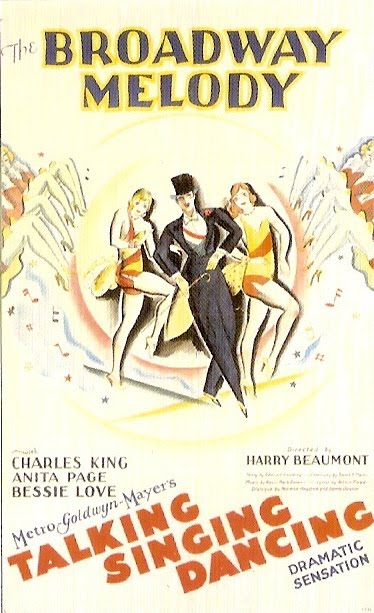
Barrios’s thesis was a bold one in ’95. Those early musicals, he said, weren’t simply the clumsy relics that time and advancing technique had made so embarrassing to look at today. (This may be the worst film ever to win a Best Picture Oscar sneered the L.A. Times, belittling The Broadway Melody several generations after the fact.) On the contrary, Barrios contended — and he proved his point beyond arguing — that they’re the precious record of an industry in turmoil, groping and struggling to invent a genre that had simply never existed before — and which in time would be viewed as the jewel in the crown of Golden Age Hollywood. And doing it all, moreover, not behind locked doors in secret trial-and-error experiments, but “in nearly full view of a vast, enthusiastic, and finally exasperated mass audience.” What is worth remembering about those early talkie-singie-dancies isn’t how primitive, naive and maladroit they look to us now, but how they electrified audiences at the time, and how much they still seem to get right — even if serendipity deserves the credit as often as deliberate intent.


Barrios says musicals were inevitable once sound came in, because they were the only thing silent movies couldn’t do. No doubt he’s exactly right; even Shakespeare, Oscar Wilde and La Boheme had been successfully filmed in the silent era; who’s to say that couldn’t have continued indefinitely? But say — what if it was the other way around? What if it was musicals that made sound inevitable? Seems to me that’s at least as valid a point as vice versa. Barrios doesn’t come right out and say so, and he may not have meant to imply it, but it occurred to me that maybe the popularity of musicals — at least for those crucial first two-or-three years, before they became a drug on the market and had to be resuscitated by Busby Berkeley at Warner Bros. and Fred Astaire and Ginger Rogers at RKO — maybe that very popularity, at this delicate point when studios were teetering, trying to decide if sound was permanent or a passing fad, is the reason sound came in to stay. Surely it couldn’t have been because of Lights of New York (“Take him…for…a ride!“).

So did sound usher in musicals, or did musicals usher in sound? Chicken, egg. I don’t know; I guess you could argue either side of that one. The point is, I didn’t even think to frame the question before A Song in the Dark came along. That’s what makes it one of the indispensible books: it was a paradigm-shifter in 1995, and it still is. Once you’ve read it, you simply can’t look at those 1927-34 musicals the same way again. I’m grateful to Barrios for giving me a firm context for The Broadway Melody and saving me from making a public comment that’s as … well, let’s say “as lacking in nuance” … as the one quoted above from the L.A. Times.

Reading the second edition of ASITD, I get the distinct impression that it’s a substantially different book from the first one. (Alas, I lent out my first edition in 2004 and never got it back, so I can’t readily compare them side by side.) It’s an odd feeling, revisiting a book I remembered as just about perfect, and finding it distinctly different — yet, still, just about perfect.

Whatever changes Barrios has made in his text, one thing’s definitely different this time around: I’ve been able to see a lot more of the movies he writes about. Back in ’95, I had (at least) vols. 1-3 of George Feltenstein’s Dawn of Sound laserdisc collections, so I could check out Broadway Melody, Hollywood Revue of 1929, Sally (with Queen of Broadway Marilyn Miller), and King Vidor’s pioneering all-black Hallelujah!; I could even confirm that Golden Dawn is every inch the ghastly cringe-making fiasco Barrios said it was (and that’ll be enought of that, thank you!). And in the clips and excerpts, I saw enough of delightful Dorothy McNulty galvanizing the gang into “The Varsity Drag” in 1930’s Good News to make me wish they’d release the whole movie — or what survives of it — on its own (are you listening, Warner Archive?).

Otherwise, pickings could be pretty slim. Take the case of Rouben Mamoulian’s masterpiece Love Me Tonight. “Let it be stated plainly:” Barrios said, then and now, “Love Me Tonight is a wonderful film, one of the two or three greatest musicals ever made.” Hooray and amen! No joke and no exaggeration. But if you

wanted to see it in 1995, you’d better have a collector friend who owned a print, or a connection at one of the big film archives. Fortunately for me, I had the former, so I knew whereof Barrios spoke. By 2001, I had managed to get my hands on a decent 16mm reduction print of my own. Then, two years later, Kino Video made my print obsolete by (finally!) issuing a sparkling new DVD transfer. It was worth the wait, but for a movie as delightful, as flawless, and as historically important as Love Me Tonight, it’s a pity we had to wait at all.

In 1997, Universal, owners of the pre-1948 Paramount library, issued The Lubitsch Touch, a laserdisc box set that included, for appetites whetted by Barrios’s first edition, several of director Ernst Lubitsch’s seminal early-sound musicals, long out of circulation: The Love Parade, Monte Carlo, One Hour with You, The Smiling Lieutenant. As good as it is to read Barrios on Jeanette MacDonald singing “Beyond the Blue Horizon” in Monte Carlo, there’s no substitute for the sublime pleasure of the real thing. Ideally, we should have both; we can now, but we couldn’t in 1995.

What with Turner Classic Movies, Netflix, the Warner Archive and the Universal Vault, I’ve been able to season my reading of Barrios’s second edition by seeing movies I could only have dreamed of fifteen years ago: Chasing Rainbows, It’s a Great Life, Flying High, Love in the Rough, So This Is College, Sunny, So Long Letty, Rio Rita (1929), Lord Byron of Broadway, On with the Show!, Sweet Kitty Bellairs. Even The Great Gabbo is waiting impatiently at the top of my Netflix queue. (Frankly, I’m rather dreading that one — overtly obnoxious, Barrios says — but hey, if I can take Golden Dawn I can take anything.) In fact, the seasoning goes both ways: reading about the movies enhances the experience of seeing them, while seeing them deepens my admiration for how well Barrios writes about them.

In Part 2, I’ll talk about some of these movies.

Posted in Blog Entries

Post navigation

Newer posts →
index sitemap advanced
search engine by freefind

Recent Posts

  • Twinkle, Twinkle, Little “Star” (Republished)

  • Sixty-Six Years’ Worth of Oscars

  • A Visit with Jody Baxter, Chick Mallison, Trooper Jeff Yorke et al.

  • Ave Atque Vale, Jody Baxter

Articles A – Z

You will find 222 posts in the category  on this blog.


Jump to , 4, A, B, C, D, E, F, G, H, I, J, L, M, N, O, P, R, S, T, U, W, Y

4

  • 40th Anniversary Tour: Jesus Christ Superstar

A

  • “A Genial Hack,” Part 1
  • “A Genial Hack,” Part 2: The Trail of the Lonesome Pine
  • “A Genial Hack,” Part 3: Peter Ibbetson
  • A “Christmas Wish” Returns
  • A Cinedrome “Christmas Tradition” Returns
  • A Cinedrome Pop Quiz
  • A Hitch in the Get-Along: State Secret
  • A Holiday Treat (I Hope!) for Cinedrome Readers
  • A Jigsaw Mystery
  • A Mystery Photo
  • A Time-Travel Studio Tour
  • A Treasure Trove of MGM Shorts, Part 1
  • A Treasure Trove of MGM Shorts, Part 2
  • A Visit with Jody Baxter, Chick Mallison, Trooper Jeff Yorke et al.
  • A Weekend With David O. Selznick
  • A-a-a-and We’re Back…!
  • Addio, Cinevent 42!
  • After a Brief Intermission…
  • America’s Canadian Sweetheart, 1921-2013
  • Andrew Sarris, 1928-2012
  • Auditioning for Immortality
  • Ave Atque Vale, Fairy Princess!
  • Ave Atque Vale, Jody Baxter

B

  • Bright Eyes, 1928-2014
  • Browsing the Cinevent Library, Part 1
  • Browsing the Cinevent Library, Part 2

C

  • C.B. Gets His Due
  • Camera Beauty
  • Cary-ing On
  • Catching Some Rays
  • Catting Around
  • CHAPTER I
  • CHAPTER II
  • Cinedrome Does Its Part
  • Cinedrome Wins 2012 CMBA Award
  • Cinedrome’s Annual Holiday Treat Returns
  • Cinerama-Rama!
  • Cinevent 2016 (Continued)
  • Cinevent 2016, Concluded
  • Cinevent 2016, Part 3
  • Cinevent 2016, Part 4
  • Cinevent 2017 – No. 49 and Counting, Part 1
  • Cinevent 2017 – No. 49 and Counting, Part 4
  • Cinevent 2017 — No. 49 and Counting, Part 2
  • Cinevent 2017 — No. 49 and Counting, Part 3
  • Cinevent 42
  • Cinevent 45
  • Cinevent 50 – Day 1
  • Cinevent 50 – Day 2
  • Cinevent 50 – Day 3 (Part 2)
  • Cinevent 50 – Prelude
  • Cinevent 50 — Day 3 (Part 1)
  • Cinevent 50 — Day 4
  • Cinevent 51 – Day 1, Part 1
  • Cinevent 51 – Prelude
  • Cinevent 51 — Day 1, Part 2
  • Cinevent 51 — Day 2
  • Cinevent 51 — Day 3
  • Cinevent 51 — Day 4
  • Cinevent Turns 50
  • Cinevent, Day 2
  • Cinevent, Day 3
  • Cinevent, Day 4
  • CMBA Blogathon: Come Next Spring (1956)
  • CMBA Blogathon: Kitty (1945)
  • Crazy and Crazier, Part 1
  • Crazy and Crazier, Part 2
  • Crazy and Crazier, Part 3
  • Crazy and Crazier, Part 4

D

  • “Don’t Stay Away Too Long…”

E

  • Elizabeth Taylor, 1932-2011

F

  • Films of Henry Hathaway: Brigham Young (1940)
  • Films of Henry Hathaway: Down to the Sea in Ships
  • Films of Henry Hathaway: Down to the Sea in Ships
  • Films of Henry Hathaway: Fourteen Hours (1951)
  • Films of Henry Hathaway: Prince Valiant
  • Films of Henry Hathaway: The Shepherd of the Hills
  • First Comes the Phone Call
  • Five-Minute Movie Star: Carman Barnes in Hollywood — Epilogue
  • Five-Minute Movie Star: Carman Barnes in Hollywood, Part 1
  • Five-Minute Movie Star: Carman Barnes in Hollywood, Part 2
  • Five-Minute Movie Star: Carman Barnes in Hollywood, Part 3
  • Flo Chart

G

  • “Glamour Boys” Begins…
  • “Glamour Boys” Continues…
  • Grand Opening!

H

  • “Here’s a Job for You, Marcel,” Part 1
  • “Here’s a Job for You, Marcel,” Part 2
  • “Here’s a Job for You, Marcel,” Part 3
  • Harlow in Hollywood

I

  • “Is Virginia Rappe Still Alive?”
  • Items from the Scrapbook of Cosmo Brown
  • Items from the Scrapbook of Cosmo Brown

J

  • Jigsaw Mystery — Solved?

L

  • Liebster Blog Award
  • Lost & Found: Alias Nick Beal
  • Lost & Found: Night Has a Thousand Eyes
  • Lost and Found: Miss Tatlock’s Millions (1948)
  • Luck of the Irish: Darby O’Gill and the Little People, Part 1
  • Luck of the Irish: Darby O’Gill and the Little People, Part 2
  • Luck of the Irish: Darby O’Gill and the Little People, Part 3
  • Luck of the Irish: Darby O’Gill and the Little People, Part 4

M

  • “MOVIE” Souvenir Playing Cards
  • Merry Christmas from Cinedrome!
  • MERRY CHRISTMAS from Cinedrome!
  • Mickey and Judy — Together at Last
  • Minority Opinion: The Magnificent Ambersons, Part 1
  • Minority Opinion: The Magnificent Ambersons, Part 2
  • Minority Opinion: The Magnificent Ambersons, Part 3
  • Minority Opinion: The Magnificent Ambersons, Part 4
  • Minority Opinion: The Magnificent Ambersons, Part 5
  • Minority Opinion: The Magnificent Ambersons, Part 6
  • Movie Playing Cards: 3 of Hearts – Geraldine Farrar
  • Movie Playing Cards: 5 of Spades – George Walsh
  • Movie Playing Cards: 9 of Diamonds – Mary Miles Minter
  • Moving Right Along…
  • Mr. Stewart Goes to War

N

  • Nuts and Bolts of the Rollercoaster

O

  • Our Mr. Webb

P

  • Picture Show 02 — Day 1
  • Picture Show 02 — Day 2
  • Picture Show 02 — Day 3
  • Picture Show 02 — Day 4
  • Picture Show 02, Day 00 — Prelude at the Wex
  • Picture Show 2022 – Day 2
  • Picture Show 2022 — Day 1
  • Picture Show 2022 — Day 3
  • Picture Show 2022 — Day 4
  • Picture Show 2022 — Prelude
  • Picture Show No. 3 — Day 1, Part 1
  • Picture Show No. 3 — Prelude
  • Picture Show No. 3 — Tying Off a Loose End
  • Please Stay Tuned

R

  • R.I.P. Ray Harryhausen, 1920-2013
  • Remembering the Night
  • Remembering the Night
  • Return of “Movie” Souvenir Playing Cards
  • Returning to Lost London
  • Returning to Lost London (Reprinted)
  • Rex the First
  • Rhapsody in Green and Orange – EPILOGUE
  • Rhapsody in Green and Orange, Part 1
  • Rhapsody in Green and Orange, Part 2
  • RIP Dean Stockwell, 1936-2021

S

  • Say, What Ever Happened to Carman Barnes?
  • Shirley Temple Revisited, Part 1
  • Shirley Temple Revisited, Part 10
  • Shirley Temple Revisited, Part 11
  • Shirley Temple Revisited, Part 12
  • Shirley Temple Revisited, Part 13
  • Shirley Temple Revisited, Part 14
  • Shirley Temple Revisited, Part 2
  • Shirley Temple Revisited, Part 3
  • Shirley Temple Revisited, Part 4
  • Shirley Temple Revisited, Part 5
  • Shirley Temple Revisited, Part 6
  • Shirley Temple Revisited, Part 7
  • Shirley Temple Revisited, Part 8
  • Shirley Temple Revisited, Part 9
  • Silent Weekends
  • Silents in Kansas 2011, Part 2
  • Sixty-Six Years’ Worth of Oscars
  • Songs in the Light, Part 1
  • Songs in the Light, Part 2
  • Songs in the Light, Part 3
  • Speak (Again) of the Devil
  • Speak of the Devil…

T

  • “The Best of Us,” Part 1
  • “The Best of Us,” Part 2
  • “The Best of Us”, Part 1
  • “The Best of Us”, Part 2
  • Ted Sierka’s Brush with Greatness
  • The 11-Oscar Mistake
  • The Annotated “Lydia the Tattooed Lady”
  • The Bard of Burbank, Part 1
  • The Bard of Burbank, Part 2
  • The Could-Have-Been-Greater Moment
  • The Duke of Hollywood
  • The Fog of Lost London, Part 1
  • The Fog of Lost London, Part 1
  • The Fog of Lost London, Part 2
  • The Fog of Lost London, Part 2
  • The Fog of Lost London, Part 3
  • The Fog of Lost London, Part 3
  • The Fog of Lost London, Part 4
  • The Fog of Lost London, Part 4
  • The Kansas Silent Film Festival 2011
  • The Last Cinevent, the First Picture Show — Day 1
  • The Last Cinevent, the First Picture Show — Day 2
  • The Last Cinevent, the First Picture Show — Day 3
  • The Last Cinevent, the First Picture Show — Day 4
  • The Man Who Saved Cinerama
  • The Mark of Kane
  • The Museum That Never Was, Part 1
  • The Museum That Never Was, Part 2
  • The Return of the King
  • The Rubaiyat of Eugene O’Neill
  • The Sensible Christmas Wish
  • The Shout Heard Round the World
  • The Stainless Steel Maiden, 1916-2020
  • The Stamm
  • Tony Curtis 1925-2010
  • Tragedy in Nevada, January 1942
  • Twinkle, Twinkle, Little ‘Star’
  • Twinkle, Twinkle, Little “Star” (Republished)

U

  • Ups and Downs of the Rollercoaster, Part 1
  • Ups and Downs of the Rollercoaster, Part 2
  • Ups and Downs of the Rollercoaster, Part 3
  • Ups and Downs of the Rollercoaster, Part 4
  • Ups and Downs of the Rollercoaster, Part 5
  • Ups and Downs of the Rollercoaster, Part 6

W

  • “Who Is the Tall Dark Stranger There…”
  • Wings, Again
  • Wyler and “Goldwynitis”
  • Wyler and “Goldwynitis” (reprinted)
  • Wyler Catches Fire: Hell’s Heroes
  • Wyler Catches Fire: Hell’s Heroes
  • Wyler’s Legacy
  • Wyler’s Legacy (reprinted)

Y

  • Yuletide 2018

Copyright Notice

All textual content Copyright © date of posting by Jim Lane. All rights reserved. Unauthorized use and/or duplication of this material without express written permission from this blog’s author is strictly prohibited. Excerpts and links may be used, provided that full and clear credit is given to Jim Lane and Jim Lane’s Cinedrome with appropriate and specific direction to the original content.

↑